Forbes Blockchain 50 2022 — from forbes.com; edited by Michael del Castillo and Matt Schifrin; reported by Maria Abreu, Nina Bambysheva, Justin Birnbaum, Lauren Debter, Michael del Castillo, Steven Ehrlich, Chris Helman, Katie Jennings, Jeff Kauflin, Javier Paz, Jon Ponciano, Marie Schulte-Bockum
Cryptocurrencies hog the spotlight, but blockchain’s biggest innovations are below the surface, saving billions each year for the world’s largest companies.

Excerpt:

You’ve come a long way, blockchain! Since our inaugural roundup of the Blockchain 50, published in 2019, the billion-dollar companies (minimum, by sales or market value) on our annual list have moved beyond test projects and now rely on “distributed ledger” technology to do serious work. A lot of the action is in the back office, verifying insurance claims or facilitating real estate deals. It has also become vital to supply chains, whether checking the provenance of conflict minerals like cobalt or tracking auto parts for Renault. Nearly half of the Blockchain 50 are based outside the United States; 14% are Chinese. New this year: venture capital firms, which as a group invested more than $32 billion in the sector in 2021.


A whole new world: Education meets the metaverse — from brookings.edu by Kathy Hirsh-Pasek, Jennifer M. Zosh, Helen Shwe Hadani, Roberta Michnick Golinkoff, Kevin Clark, Chip Donohue, and Ellen Wartella

Excerpt:

The metaverse is upon us. Soon it will be as omnipresent as TikTok, Instagram, and Facebook (now Meta). As technology advances to bring us new immersive and imaginary worlds, how we educate children and prepare teachers must also advance to meet these new opportunities. When education lags the digital leaps, the technology rather than educators defines what counts as educational opportunity. This is largely what happened with the introduction of “educational” apps designed to be used on smartphones and tablets meant for adults. Today, as the metaverse infrastructure is still under construction, researchers, educators, policymakers, and digital designers have a chance to lead the way rather than get caught in the undertow. To leverage the potential of the metaverse as a 3D, global, interconnected, immersive, and real-time online space, we need new ways to connect the physical world with augmented and virtual reality (VR) experiences.

In the end, we challenge those creating educational products for the metaverse to partner with educators and scientists to ensure that children experience real human social interaction as they navigate virtual spaces, children’s agency is supported as they explore these spaces, and there is a real eye to diversity in the representation and access to what is created.  

Also relevant/see:

The metaverse can provide a whole new opportunity for education. Here’s what to consider — from fastcompany.com by Stephen Fromkin
The cofounder of Talespin looks at an existing immersive learning program that delivers results and says our next priority should be getting it into the hands of as many learners as possible through the metaverse.


As bomb threats keep targeting HBCUs, 64 higher ed groups tell Congress to act — from highereddive.com by Laura Spitalniak

Excerpt (emphasis DSC):

More than a dozen HBCUs have been forced to clear campuses and cancel in-person classes following bomb threats this year. Fisk University, in Tennessee, issued a shelter-in-place order Monday after receiving a series of threats. The same day, Howard University, in Washington, D.C., received a bomb threat for the fourth time since the beginning of January and told students and employees to stay indoors.

All-clear notices have since been issued for both Fisk U and Howard U.

‘You’re Not Safe as a Black Person’: New Round of Bomb Threats Rattles HBCUs — from chronicle.com by Oyin Adedoyin

Excerpt:

The recent string of bomb threats across a handful of historically Black colleges and universities has sparked fear within higher education’s Black community. “This is probably one of the clearest examples of hate crimes based on race,” said Paulette Granberry Russell, the president of the National Association of Diversity Officers in Higher Education.

From DSC:
Some of the institutions I saw mentioned were:

  • Bowie State University, Howard University, Albany State University, Bethune-Cookman University, Southern University and A&M College, and Delaware State University

Can you imagine if this happened at Harvard, Yale, Northwestern, Stanford, and/or similar institutions? You and I both know that if students there kept having to put up with bomb threats and having their in-person classes canceled, there would be hell to pay! There would be a lot more heat in the kitchen. A lot more noise. A lot more overall societal concern. 

For me, the bottom line is that this situation is horribly wrong. It’s downright evil. I hope it gets resolved soon, though I have to say that I’m not as hopeful as I’d like to be in this 21st century of ours here in the United States…where I continue to be amazed at our lack of unity, respect, compassion, and caring for other people. The amount of racism and hate crimes in our country is just horribly wrong.

On somewhat related notes, see:

Where HBCU grads are thriving — from linkedin.com by McKenna Moore

Excerpt:

Promotion rates for graduates of historically Black colleges and universities (HBCUs) rose 4.94% in 2021 from the previous year, according to insights from LinkedIn’s data on over 600,000 HBCU alumni. The industries that outperform others in promoting HBCU grads include energy and mining, software and IT services, hardware and networking, finance and manufacturing. And the specific job functions that lead to the best chance of promotion for these alumni are program and project management, marketing, human resources, business development and accounting.

Black talent on the fast track: these 10 paths stand out for HBCU graduates — from linkedin.com by George Anders

Excerpt:

All told, more than 600,000 graduates of HBCUs such as Spelman have profiles on LinkedIn. That makes it possible for LinkedIn’s Economic Graph team to analyze the career paths that these alumni have chosen – and to extract insights about promotion rates by job types, gender and in comparison to non-HBCU graduates.

The overall picture that emerges from this data includes a wide list of career paths where HBCU alumni are thriving, as well as signs that overall gaps between HBCU graduates’ promotion rates and non-HBCU trends haven’t yet closed.

Giving to Community Colleges and HBCUs Soared Last Year — from philanthropy.com by Dan Parks

Addendum on 2/19/22:


Holograms? Check! Now what? — from blog.webex.com by Elizabeth Bieniek

Excerpt (emphasis DSC):

Two years ago, I wrote about the Future of Meetings in 2030 and hinted at an effort my team was building to make this a reality. Now, we have publicly unveiled Webex Hologram and brought the reality of a real-time, end-to-end holographic meeting solution to life.

With Webex Hologram, you can feel co-located with a colleague who is thousands of miles away. You can share real objects in incredible multi-dimensional detail and collaborate on 3D content to show perspective, share, and approve design changes in real-time, all from the comfort of your home workspace.

As the hype dies down, the focus on entirely virtual experiences in fanciful environments will abate and a resurgence in focus on augmented experiences—interjecting virtual content into the physical world around you for an enhanced experience that blends the best of physical and virtual—will emerge.

The ability to have curated information at one’s fingertips, still holds an incredible value prop that has yet to be realized. Applying AI to predict, find, and present this type of augmented information in both 2D and 3D formats will become incredibly useful. 

From DSC:
As I think of some of the categories that this posting about establishing a new kind of co-presence relates to, there are many relevant ones:

  • 21st century
  • 24x7x365
  • 3D
  • Audio/Visual (A/V)
  • Artificial Intelligence (AI)
  • Cloud-based
  • Collaboration/web-based collaboration
  • Intelligent tutoring
  • Law schools, legal, government
  • Learning, learning agents, learning ecosystems, Learning from the Living [Class] Room, learning spaces/hubs/pods
  • Libraries/librarians
  • K-12, higher education, corporate training
  • Metaverse
  • Online learning
  • Telelegal, telemedicine
  • Videoconferencing
  • Virtual courts, virtual tutoring, virtual field trips
  • Web3
 

5 Tips for Online Tutoring Based on New Research — from techlearning.com by Erik Ofgang
Matthew Kraft, a professor at Brown University, shares some best practices for implementing online tutoring programs based on his recent research.

Excerpt:

While in-person high-dosage tutoring has been shown to improve student learning in multiple studies, the extent that this translates to online tutoring is not as well researched. However, a recent pilot study of online tutoring in which college students volunteered as tutors and were paired with middle school students in Illinois found consistently positive effects of online tutoring on student achievement, though these effects were smaller than had been seen for in-person tutoring.


Exploring Virtual Reality [VR] learning experiences in the classroom — from blog.neolms.com by Rachelle Dene Poth

Excerpt:

With the start of a new year, it is always a great time to explore new ideas or try some new methods that may be a bit different from what we have traditionally done. I always think it is a great opportunity to stretch ourselves professionally, especially after a break or during the spring months.

Finding ways to boost student engagement is important, and what I have found is that by using tools like Augmented Reality (AR) and Virtual Reality (VR), we can immerse students in unique and personalized learning experiences. The use of augmented and virtual reality has increased in K-12 and Higher Ed, especially during the past two years, as educators have sought new ways to facilitate learning and give students the chance to connect more with the content. The use of these technologies is increasing in the workplace, as well.

With all of these technologies, we now have endless opportunities to take learning beyond what has been a confined classroom “space” and access the entire world with the right devices.


AI Foundation Models for the Rest of Us — from future.a16z.com by Elliot Turner

Excerpt:

While 2012’s state-of-the-art systems could be trained on a $700 video game card, today’s state-of-the-art systems – often referred to as foundation models – likely require tens of millions of dollars in computation to train.

The emergence of these massive-scale, high-cost foundation models brings opportunities, risks, and limitations for startups and others that want to innovate in artificial intelligence and machine learning.


Ecclesiastes 11:1-2 and 6 Invest in Many Ventures; as written by King Solomon

11 Ship your grain across the sea;
    after many days you may receive a return.
Invest in seven ventures, yes, in eight;
    you do not know what disaster may come upon the land.

Sow your seed in the morning,
    and at evening let your hands not be idle,
for you do not know which will succeed,
    whether this or that,
    or whether both will do equally well.


From DSC:
Perhaps Solomon should get more credit as one of the first wise investment advisors. If he lived today, he would likely support diversification and support the concepts behind using index funds! 


RTO [Return To Office] – Will That Drive Partners (yes, partners) to Parachute Into Virtual Firms? — from lawandmore.typepad.com

There are options. One is joining a virtual firm. Another is launching one. To that startup, they can take both fellow partners as well as associates.


From DSC:
Along the lines of change within the legal realm, also see:

Those differences can be broadly grouped into three main areas: dumping the billable hour; more use and better use of technology when possible; and operating with far lower overheads.


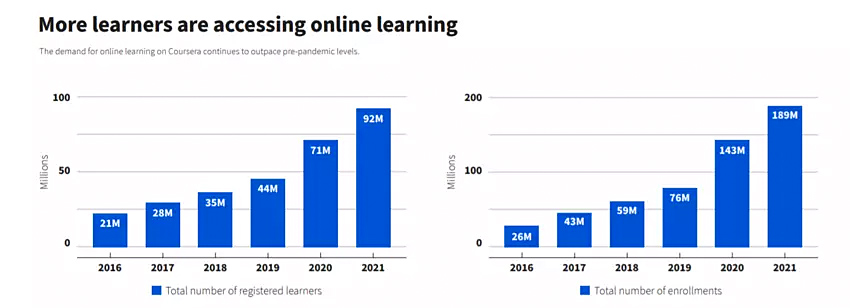
These 3 charts show the global growth in online learning — from weforum.org by Johnny Wood; with thanks to Ray Schroeder out on LinkedIn

Example chart:

Also relevant/see:

The company has launched 13 new degrees with colleges since 2021, bringing the total number of bachelor’s, master’s and postgraduate degrees up to 38, according to Maggioncalda.

2U saw $152.4 million from its degree segment in 2021’s fourth quarter, about 11 times the revenue Coursera brought in from its degree business over the same period. 


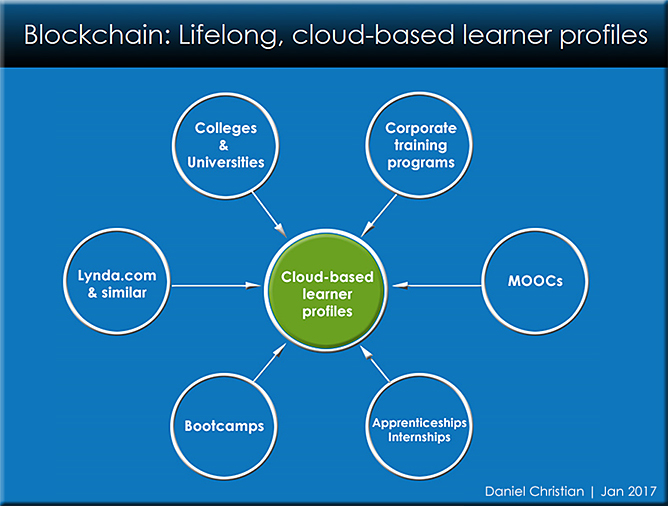
Technology We Need: Documenting the complete Learner Record — from gettingsmart.com by Nate McClennen and Rebecca Midles

Key Points

  • Most innovative schools and a number of states have built Graduate Profiles/Learner Profiles and a handful have created K12 competency progressions that articulate pathways towards meeting the profile.
  • These learning organizations are using a learning management system (LMS) that does not accommodate comprehensive Learner Records, does not capture or report transparent growth to learners or their families and does not capture out-of-course learning experiences.
  • We issue a challenge to those building and creating solutions.

From DSC:
The above posting reminds me of the following graphic:


The DOJ’s $3.6B Bitcoin Seizure Shows How Hard It Is to Launder Crypto — from wired.com by Andy Greenberg
A couple allegedly used a “laundry list” of technical measures to cover their tracks. They didn’t work.

Excerpt:

“What was amazing about this case is the laundry list of obfuscation techniques [Lichtenstein and Morgan allegedly] used,” says Ari Redbord, the head of legal and government affairs for TRM Labs, a cryptocurrency tracing and forensics firm. Redbord points to the couple’s alleged use of “chain-hopping”— transferring funds from one cryptocurrency to another to make them more difficult to follow—including exchanging bitcoins for “privacy coins” like monero and dash, both designed to foil blockchain analysis. Court documents say the couple also allegedly moved their money through the Alphabay dark web market—the biggest of its kind at the time—in an attempt to stymie detectives.

From DSC:
Easy to follow/understand, isn’t it!?! Not.


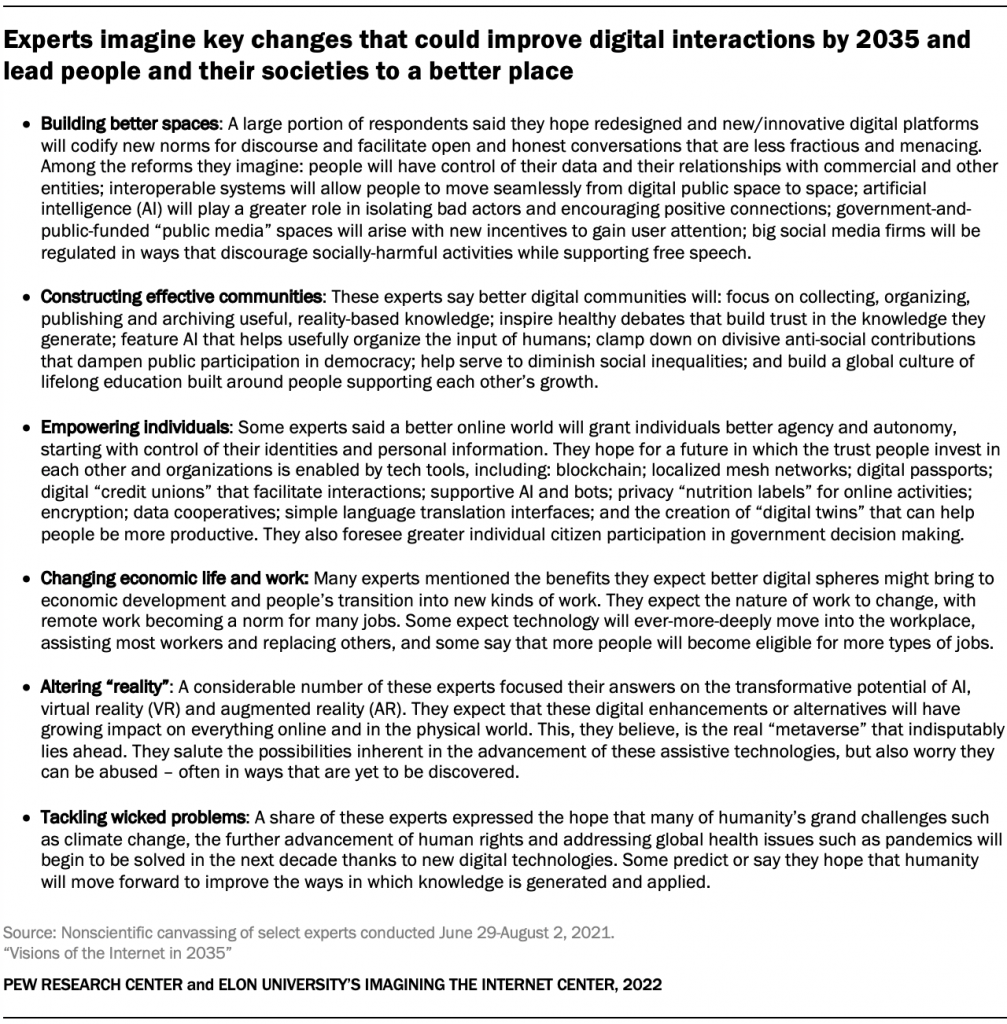
Visions of the Internet in 2035 — from pewresearch.org

Excerpt:

This report is the second of two analyzing the insights of hundreds of technology experts who responded in the summer of 2021 to a canvassing of their predictions about the evolution of online public spaces and their role in democracy in the coming years. In response to the primary research question, many said they expect that these forums will be significantly improved by 2035 if reformers, big technology firms, governments and activists tackle the problems created by misinformation, disinformation and toxic discourse. At the same time, they expressed ongoing concerns about the destructive forces in culture and technology that could continue to plague online life and disrupt beneficial change in the coming years.

Visions of the Internet in 2035


As seen/accessible from this page.

A brief insert from DSC:
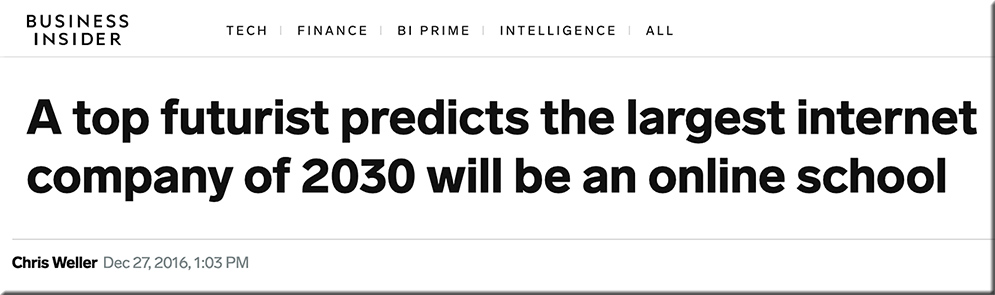
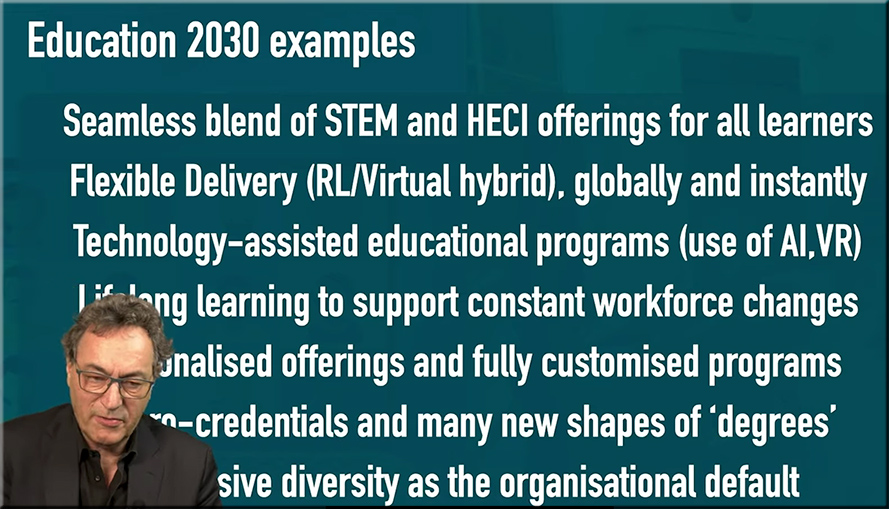
Another futurist Thomas Frey has some thoughts along this same line.

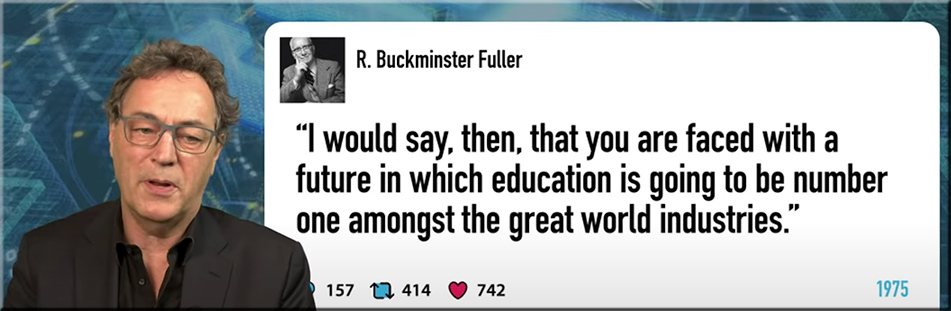
A top futurist predicts the largest internet company of 2030 will be an online school

#Canada #education #future #trends #careerdevelopment #change #paceofchange #automation #robotics #education #AI #learnhowtolearn #unlearn #learningecosystems #lifelonglearning #endofroutine #experientiallearning


Machines are for answers. Humans are for questions. 


Also relevant/see:


Tech skill gaps are decimating the global workforce and could put workers—and companies—in crisis — from fortune.com by Colin Lodewick

Excerpt:

The pandemic laid bare the value of digital skills when it forced people around the world to shift their lives even more online. Understanding and using technology is no longer a “nice-to-have” but essential for anyone looking for a job. Still, is the workforce ready for this change?

Salesforce released its Global Digital Skills Index* on Thursday, which offers insights into how the global workforce feels about the future of work in a world that continues to prioritize tech savviness and a digital-first mindset.

The report found 76% of respondents said they do not feel prepared for that future.

*An excerpt from that skills index:
Across 19 surveyed countries, workers scored 33 out of a possible 100 points on the Digital Skills Readiness Index across areas such as preparedness, access to learning resources, skill level, and participation in training. Workers in the United States fared slightly better at 36 out of 100 points.

 
© 2025 | Daniel Christian