Is Artificial Intelligence Undermining The Legal System? — from lawyer-monthly.com
Globally recognised artificial intelligence expert Dr Lance Eliot explains how AI is undermining the legal system.

Excerpt:

Well, imagine if I told you that the text messages, the emails, and the video clips were all crafted via the use of AI-based deepfake technologies. None of that seeming “evidence” of wrongdoing or at least inappropriate actions of the prosecutor are real. They certainly look to be real. The texts use the same style of text messaging that the prosecutor normally uses. The emails have the same written style as other emails by the prosecutor.

And, the most damning of the materials, those video clips of the prosecutor, are clearly the face of the prosecutor, and the words spoken are of the same voice as the prosecutor. You might have been willing to assume that the texts and the emails could be faked, but the video seems to be the last straw on the camel’s back. This is the prosecutor caught on video saying things that are utterly untoward in this context. All of that could readily be prepared via the use of today’s AI-based deepfake high-tech.

So, be on the watch for getting AI-based deepfake materials produced about you.

 

The Metaverse Will Radically Change Content Creation Forever — from forbes.com by Falon Fatemi

Excerpt:

Although the metaverse promises to touch nearly every person in our society, there’s one demographic that will almost certainly see disproportionately strong disruption: creators. The metaverse has the potential to fundamentally disrupt the content creation process.

The metaverse is slated to help creators make more interactive and immersive content, thanks in large part to advances in VR and AR. The stakes will be raised as creators will be expected to build more immersive and interactive content than ever before.

Also related/see:

The Amazing Possibilities Of Healthcare In The Metaverse — from forbes.com by Bernard Marr

Excerpts:

What’s generally agreed on, however, is that it’s effectively the next version of the internet – one that will take advantage of artificial intelligence (AI), augmented reality (AR), virtual reality (VR), and ever-increasing connectivity (for example, 5G networks) to create online environments that are more immersive, experiential and interactive than what we have today.

Metaverse involves the convergence of three major technological trends, which all have the potential to impact healthcare individually. Together, though, they could create entirely new channels for delivering care that have the potential to lower costs and vastly improve patient outcomes. These are telepresence (allowing people to be together virtually, even while we’re apart physically), digital twinning, and blockchain (and its ability to let us create a distributed internet).

From DSC:
That last paragraph could likely apply to our future learning ecosystems as well. Lower costs. A greater sense of presence. Getting paid for one’s teaching…then going to learn something new and paying someone else for that new training/education.


AI Could Power the Next Generation of Smart Glasses — from lifewire.com by Mayank Sharma. I’d like to thank Mayank for letting me contribute some thoughts to this article.
Making the bigger picture clearer

Key Takeaways

  • Biel Glasses has created a pair of smart glasses to enhance the mobility of users with low vision.
  • Experts believe smart glasses will soon outpace VR headsets in terms of adoption and use.
  • This new generation of smart glasses will infuse AI together with AR to give users a new and better perspective.


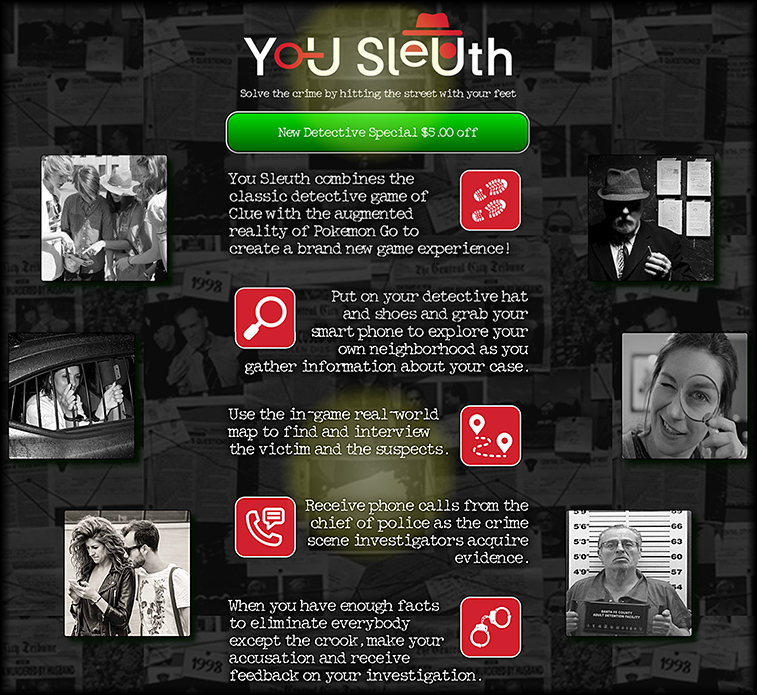
You Sleuth = The game of Clue + Augmented Reality (AR)

You Sleuth is a family-friendly outdoor game that requires a moderate amount of walking. You can play by yourself or with a group of friends or family. If you are looking for something new that will stimulate your mind while sneaking in a little exercise and fresh air then register today. Read the rest of the FAQ for more details about how You Sleuth works.


From DSC:
What might this look/work like for learning-related applications? Also, if you are studying to be an actor or actress, might there be some new opportunities for you here!? If you are a writer, might there be some new sorts of collaborations opening up here? As the next version of the internet is developed, what new affordances/opportunities might exist in this area?


MUHC uses artificial intelligence to train neurosurgery students — from montreal.ctvnews.ca by Rob Lurie

Excerpt:

“I think above all it just provides an opportunity for junior learners to get some hands-on exposure,” said medical student Ali Fazlollahi.

“Basically, it was inspired by the idea of how do we prevent error in the operating room,” said Neurosurgeon Dr. Rolando De Maestro. Maestro says virtual reality has been a game-changer when it comes to teaching.


From DSC:
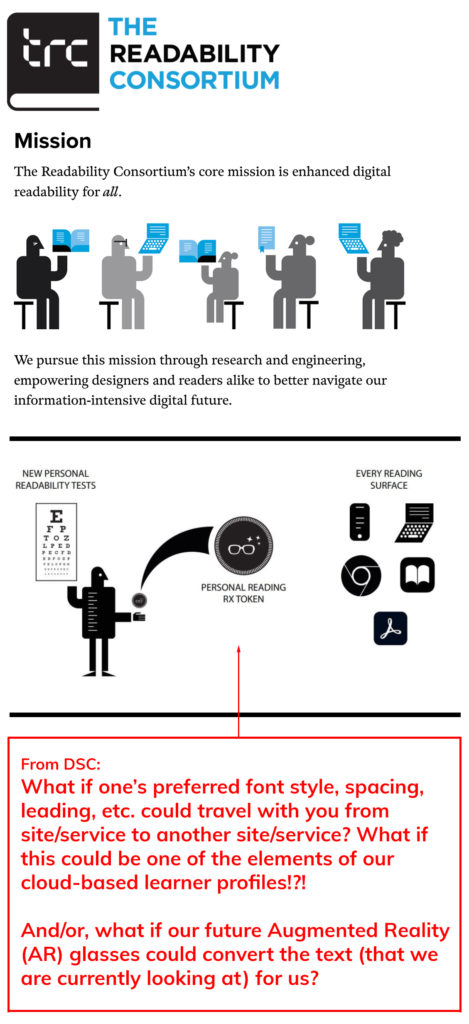
After checking out the following two links, I created the graphic below:

  1. Readability initiative > Better reading for all. — from Adobe.com
    We’re working with educators, nonprofits, and technologists to help people of all ages and abilities read better by personalizing the reading experience on digital devices.
  2. The Readability Consortium > About page


What if one's preferred font style, spacing, leading, etc. could travel with you from site to site? Or perhaps future AR glasses will be able to convert the text that we are looking at for us


Also related/see:


Why the World’s First Virtual Reality High School Changes Everything — from steve-grubbs.medium.com by Steve Grubs

Excerpts:

The recipe required key ingredients to happen. In addition to an accredited school to manage students, admissions and the for-credit learning, it also needed a platform. That’s where EngageVR comes in. There are other platforms that will ultimately host schools, perhaps AltSpace, Horizon or others, but the first is on Engage.

The bottom line is this: creators, coders, educators, entrepreneurs, investors, corporations, parents and students all played a role in finally bringing the first global virtual reality high school to life. It won’t be the last school to open in the metaverse, but to all those involved in this inaugural launch — the Neil Armstrongs of your age — a special tip of the hat today for having the vision and the willingness to launch a better and more equitable era of education.

Also see:

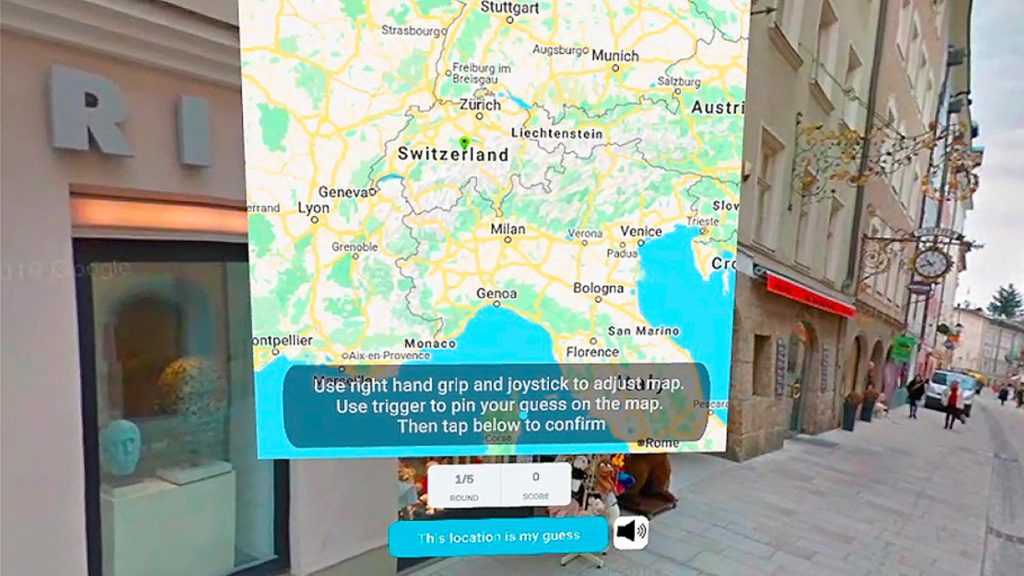
This is a snapshot from the Geo Guesser VR game


The doctor is in—the video call — from mckinsey.com

Excerpt:

More patients than ever were willing to try virtual health services after COVID-19 emerged. Last year, the use of telehealth care was 38 times higher than prepandemic levels, as appointments such as follow-ups could easily be delivered remotely. A recent McKinsey survey shows that up to $265 billion in Medicare spending could shift to patients’ homes by 2025, with greater physician participation in the transition from telehealth to at-home care.

From facility to home: How healthcare could shift by 2025 — from mckinsey.com by Oleg Bestsennyy, Michelle Chmielewski, Anne Koffel, and Amit Shah

Also see the other charts via their daily chart feature:

A daily chart from McKinsey Dot Com that helps explain a changing world—during the pandemic and beyond.


Using Telehealth to Expand Student Access to Care — from techlearning.com by Erik Ofgang
Renee Kotsopoulo, director of health services for the Garland ISD in Texas, helped bring telehealth to her students and believes technology can help keep kids healthy and in school.

Can Teletherapy Companies Ease the Campus Mental-Health Crisis? — from chronicle.com by Kate Hidalgo Bellows

From DSC:
Telehealth has been booming during the pandemic. I think telelegal will ride on the coattails of telehealth.


Companies are making serious money with AI — from sloanreview.mit.edu by Thomas Davenport and Randy Bean

Excerpt:

Just a few years later, things are beginning to change. In the 2022 survey of senior data and technology executives by NewVantage Partners (where Randy Bean is CEO and cofounder, and Tom Davenport is a fellow), 92% of large companies reported that they are achieving returns on their data and AI investments. That’s up markedly from 48% in 2017. The same percentage (92%) said that they are increasing investments in data and AI, equaling last year’s percentage.


Innovation & Tech Today Names the Top 50 Most Innovative Products of 2021 — from innotechtoday.com by Corey Noles

Excerpt:

The Top 50 Most Innovative Products is I&TT’s most popular feature every year. The feature includes a collection of business innovations, new products, and connected services, along with gadgets from industries such as healthcare, smart home, outdoor and adventure, STEM, gaming, and entertainment.


Robots help kids tell stories—with a little help from stuffed animals — from colorado.edu by Daniel Strain

Excerpt:

Through a series of recent studies, Hubbard and her colleagues at CU Boulder have put the technology to the test, revealing the promise and limitations of storytelling technology.

Educational robotics to top $4 billion by 2028 — from thejournal.com by David Nagel
The need for robotics in education will help drive double-digit annual growth worldwide through 2028.

Excerpt:

According to a new forecast from market research firm Emergen Research, the market for educational robotics technologies, including software and professional development, will grow at a compound annual rate of 17.9%, reaching $4.02 billion in global expenditures in 2028.


Metaverse vs. employment law: The reality of the virtual workplace — from arstechnica.com by Kate Beoiley
It is unclear how employee protections apply in the universal digital realm.

Excerpt:

When it comes to employment laws, however, it is unclear what rules of engagement apply in a universal digital realm. What counts as harassment in the metaverse? Can an avatar be discriminated against, or worse? Will national legislation protect employees or does working in the metaverse require a new rule book altogether?

Lack of legal framework
But the metaverse takes hybrid working a step further and brings with it a host of thorny employment law issues. These range from practical challenges, such as how employees are paid, to more philosophical ones, like whether avatars have a legal identity. “The legal conundrums are about as diverse as the possibilities of the metaverse itself,” says Jonathan Newman, managing associate at law firm Simmons & Simmons.


Six Unaddressed Legal Concerns For The Metaverse — from forbes.com by Nitin Kumar; with thanks to Ori Inbar on Twitter for this resource

The metaverse is an extremely exciting space with many opportunities. It is also a shift that breaks down conventional legal thinking and frameworks built for the old economy, creating new legal, regulatory and technical issues that need resolution.
 

‘Human-in-the-loop’ solutions will comprise 30% of new legal tech automation by 2025: Gartner — from thelawyermag.com/au/ by Lucy Saddleton

Excerpt:

“There’s little question that growth in legal work is outstripping growth in legal headcount, and on the surface, this can make advanced automation solutions appear very attractive to legal leaders,” said Zack Hutto, director, advisory in the Gartner Legal & Compliance practice. “The question is whether the legal department has the capabilities required to customize and configure advanced machine learning systems, which will be needed to enable them to handle the unique scenarios and frequent exceptions that come about in this type of work.”


Legal work is outstripping growth in legal headcount


© 2025 | Daniel Christian