Radar Trends to Watch: June 2022 — from oreilly.com

Excerpt:

The explosion of large models continues. Several developments are especially noteworthy. DeepMind’s Gato model is unique in that it’s a single model that’s trained for over 600 different tasks; whether or not it’s a step towards general intelligence (the ensuing debate may be more important than the model itself), it’s an impressive achievement. Google Brain’s Imagen creates photorealistic images that are impressive, even after you’ve seen what DALL-E 2 can do. And Allen AI’s Macaw (surely an allusion to Emily Bender and Timnit Gebru’s Stochastic Parrots paper) is open source, one tenth the size of GPT-3, and claims to be more accurate. Facebook/Meta is also releasing an open source large language model, including the model’s training log, which records in detail the work required to train it.


Into the metaverse: What does it hold for the future of L&D? — from chieflearningofficer.com by Calvin Coffee

Excerpt:

Instead of putting learners in front of 2D videos where they’re answering questions or just clicking boxes, the metaverse allows learners to experience what a job is actually like before accepting and will enable leaders to see if employees are ready for the next level of work. In the same way flight simulators can prepare pilots for many aspects of operating and flying an aircraft, through technologies like VR the metaverse can prepare employees for almost anything at work.

“This technology can impact every stage of the HR journey for an employee,” Belch says. “We all know the interviewing process is flawed and riddled with bias. Let’s have someone do the job and show us whether or not they can do the job.” And if they mess up in VR, they’re not going to take down the whole factory. From hiring and beyond, there is an abundance of potential spaces that the metaverse can capitalize on and improve.

Research in medical training has found that information retention rates can reach 80 percent after a full year of training through immersive simulated experiences compared to just 20 percent for traditional training. “People are picking it up and are much more comfortable performing their tasks after going through the simulation,” Jordan says. “It’s incredibly powerful.”

Also from chieflearningofficer.com:


How to ensure we benefit society with the most impactful technology being developed today — from deepmind.com by Lila Ibrahim

In 2000, I took a sabbatical from my job at Intel to visit the orphanage in Lebanon where my father was raised. For two months, I worked to install 20 PCs in the orphanage’s first computer lab, and to train the students and teachers to use them. The trip started out as a way to honour my dad. But being in a place with such limited technical infrastructure also gave me a new perspective on my own work. I realised that without real effort by the technology community, many of the products I was building at Intel would be inaccessible to millions of people. I became acutely aware of how that gap in access was exacerbating inequality; even as computers solved problems and accelerated progress in some parts of the world, others were being left further behind. 

After that first trip to Lebanon, I started reevaluating my career priorities. I had always wanted to be part of building groundbreaking technology. But when I returned to the US, my focus narrowed in on helping build technology that could make a positive and lasting impact on society. That led me to a variety of roles at the intersection of education and technology, including co-founding Team4Tech, a non-profit that works to improve access to technology for students in developing countries. 


Also relevant/see:

Microsoft AI news: Making AI easier, simpler, more responsible — from venturebeat.com by Sharon Goldman

But one common theme bubbles over consistently: For AI to become more useful for business applications, it needs to be easier, simpler, more explainable, more accessible and, most of all, responsible


The original article by @andylocal in the @nytimes when we first filed our challenge:

They Need Legal Advice on Debts. Should It Have to Come From Lawyers? — from nytimes.com
A nonprofit has filed a lawsuit in New York, hoping to clear the way for volunteers to help people defend themselves against debt collection suits.

Thalia Juarez for The New York Times.

Excerpt:

The Rev. John Udo-Okon, a Pentecostal minister in the Bronx, has a lot of congregants who are sued by debt collectors and don’t know what to do.

Like most of the millions of Americans sued over consumer debt each year, Pastor Udo-Okon’s congregants typically cannot retain a lawyer. When they fail to respond to the suit, they lose the case by default.


Also relevant/see:

Law Firms Branch Out Beyond Lawyers in Bid to Beat Out Rival Advisers — from wsj.com
Facing competitive pressure from consulting firms and others, old law firms try to pick up new tricks

“Clients increasingly were coming to us with a problem that they needed to solve and they really didn’t much care how we solved it,” Mr. Portnoy said. “Very often they were looking for something that was beyond the traditional tool kit.”


What technology trends will—and should—lead business agendas in 2022? — from mckinsey.com

Excerpt:

Metaverse. Web3. Crypto. 5G.

These are just a few of the technologies grabbing headlines at the start of 2022. But what technology trends truly sit atop business agendas this year? Which might be under executives’ radars but should be surfaced? And what should business leaders keep in mind as they consider these trends?

We asked some members of the McKinsey Technology Council, a group of global experts convened to assess, track, and debate real emerging trends in business and technology, for their perspectives on these questions. Specifically, we asked the following:

  • What technology trend do you predict will headline business agendas for the remainder of 2022 and why?
  • What technology trend do you think is under businesses’ radars but merits more of executives’ attention?
  • What’s one piece of advice you would give to business leaders as they consider incorporating new technologies into their business?

Also relevant/see:

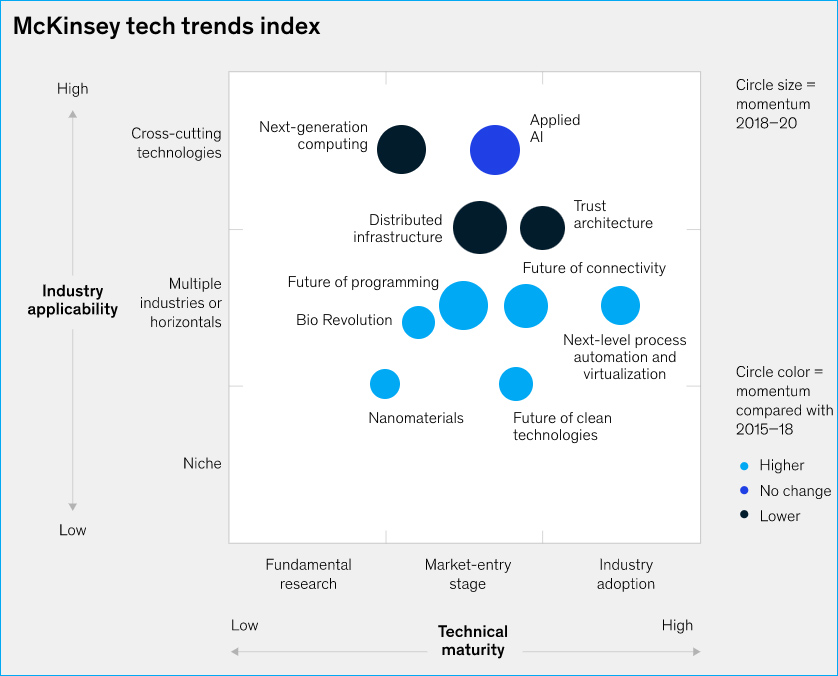
The top trends in tech — from mckinsey.com
Which technologies have the most momentum in an accelerating world? We identified the trends that matter most.

McKinsey tech trends index

Marketing in the metaverse: An opportunity for innovation and experimentation — from mckinsey.com
Although widespread adoption of the metaverse may take some time, leading brands are already rewriting the rules of marketing.

Marketers would be remiss if they didn’t start exploring what the metaverse can offer. Now is the right time to adopt a test-and-learn mindset, to be open to experiments, and to move on quickly from failure and capitalize on success.

From DSC:
And not just marketers. How about teachers, professors, trainers, and instructional designers?

#Metaverse #learningfromthelivingclassroom #learningecosystems #learning #training #education #K12 #highereducation #vocations #careers #corporatetraining #learninganddevelopment


Google accelerates audiobook production exponentially — from provideocoalition.com by Allan Tépper

Excerpt:

In March 2022, I published Google’s Aloud auto-dubs your English video in Castilian or Portuguese, free. Now, Google is doing a similar quantum leap for audiobook production. In fact, I already converted and published one of my own books as an audiobook successfully using Google’s semi-automatic voices. Ahead, I’ll explain how Google’s process can convert the manuscript into a presentable audiobook in a few hours instead of over a month of work, using one of Google’s automated voices which are available for different languages and regions.


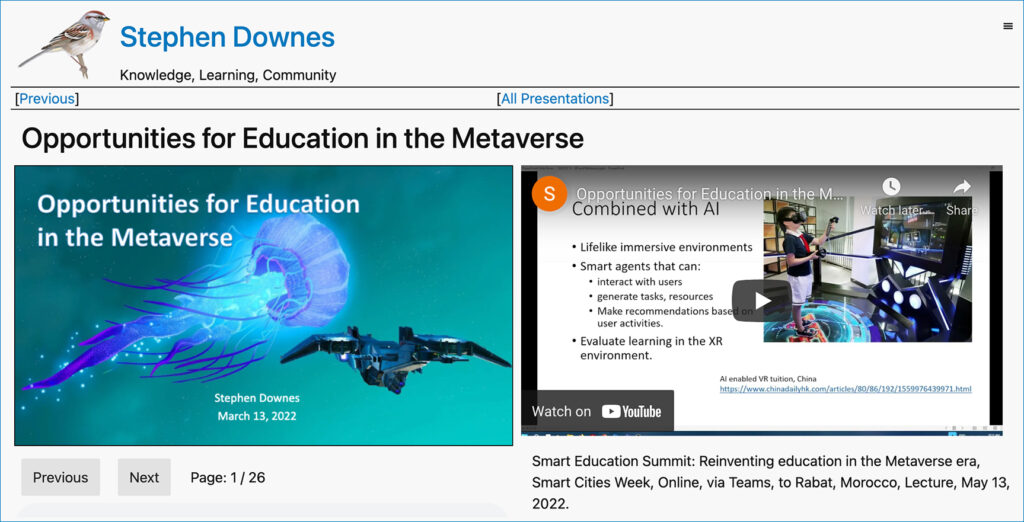
Opportunities for Education in the Metaverse -- from downes.ca by Stephen Downes

Opportunities for Education in the Metaverse — from downes.ca by Stephen Downes

Excerpt:

This short presentation introduces major elements of the metaverse, outlines some applications for education, discusses how it may be combined with other technologies for advanced applications, and outlines some issues and concerns.

Also relevant/see:

What Should Higher Ed in the Metaverse Look like? – from linkedin.com by Joe Schaefer

Excerpt:

The Metaverse is coming whether we like it or not, and it is time for educators to think critically about how it can benefit students. As higher education continues to evolve, I believe every learning product and platform working with or within the Metaverse should, at least, have these functionalities:


Addendum on 5/23/22:


Google Maps to add “immersive view” — from futuretimeline.net
Google Maps, the world’s most-downloaded travel app, will soon become more immersive and intuitive thanks to a major upgrade.


Excerpts:

A new “immersive view” will generate far more detailed graphics than are available currently. This will provide sweeping views of cities in full 3D, complete with simulated cars, real-time weather, realistic day/night cycles, shadow effects, water reflections, and even animations like birds flying through the sky.

The company also announced an update for Live View. First launched in 2019, this provides augmented reality (AR) walking routes in the form of arrows, directions, and distance markers.

These improvements are possible thanks to advances in computer vision and AI that allow billions of aerial, street view, and other images to combine and create a rich, seamless, digital model of the world.


Addendums on 5/23/22:

Google Wants To Deliver World-Scale AR Using Google Maps — from vrscout.com by Bobby Carlton

Somewhat relevant/see:

Earth // Around The World From The Air 4K from Kien Lam on Vimeo.


Entrepreneur Education Platform GeniusU Raises $1.5M Seed Funding at $250M Valuation — from edtechreview.in ed by Stephen Soulunii

Excerpt (emphasis DSC):

Genius Group has recently announced that its EdTech arm, GeniusU Ltd, has raised $1.5 million in a seed round to support the development of its Genius Metaversity virtual learning plans.

With the fresh funding, GeniusU plans to extend its courses and programs to interactive learning environments in the metaverse, with students and faculty connecting and learning in global classrooms and virtual 3D environments. It also plans to integrate each student’s AI-based virtual assistant ‘Genie’ into the metaverse as 3D virtual assistants that accompany each student on their personalized journey and integrate its GEMs (Genius Education Merits) student credits into the metaverse. GEMs are earned by students as they learn and can be spent on products and services within GeniusU and counting towards their certifications.


From DSC:
I love the parts about seeing instant language translations — including sign language! Very cool indeed!
(With thanks to Ori Inbar out on Twitter for this resource.)

Realtime American Sign Language translation via potential set of AR glasses from Google

Also see:


AI research is a dumpster fire and Google’s holding the matches — from thenextweb.com by Tristan Greene
Scientific endeavor is no match for corporate greed

Excerpts:

The world of AI research is in shambles. From the academics prioritizing easy-to-monetize schemes over breaking novel ground, to the Silicon Valley elite using the threat of job loss to encourage corporate-friendly hypotheses, the system is a broken mess.

And Google deserves a lion’s share of the blame.

Google, more than any other company, bears responsibility for the modern AI paradigm. That means we need to give big G full marks for bringing natural language processing and image recognition to the masses.

It also means we can credit Google with creating the researcher-eat-researcher environment that has some college students and their big-tech-partnered professors treating research papers as little more than bait for venture capitalists and corporate headhunters.

But the system’s set up to encourage the monetization of algorithms first, and to further the field second. In order for this to change, big tech and academia both need to commit to wholesale reform in how research is presented and reviewed.

Also relevant/see:

Every month Essentials publish an Industry Trend Report on AI in general and the following related topics:

  • AI Research
  • AI Applied Use Cases
  • AI Ethics
  • AI Robotics
  • AI Marketing
  • AI Cybersecurity
  • AI Healthcare

It’s never too early to get your AI ethics right — from protocol.com by Veronica Irwin
The Ethical AI Governance Group wants to give startups a framework for avoiding scandals and blunders while deploying new technology.

Excerpt:

To solve this problem, a group of consultants, venture capitalists and executives in AI created the Ethical AI Governance Group last September. In March, it went public, and published a survey-style “continuum” for investors to use in advising the startups in their portfolio.

The continuum conveys clear guidance for startups at various growth stages, recommending that startups have people in charge of AI governance and data privacy strategy, for example. EAIGG leadership argues that using the continuum will protect VC portfolios from value-destroying scandals.


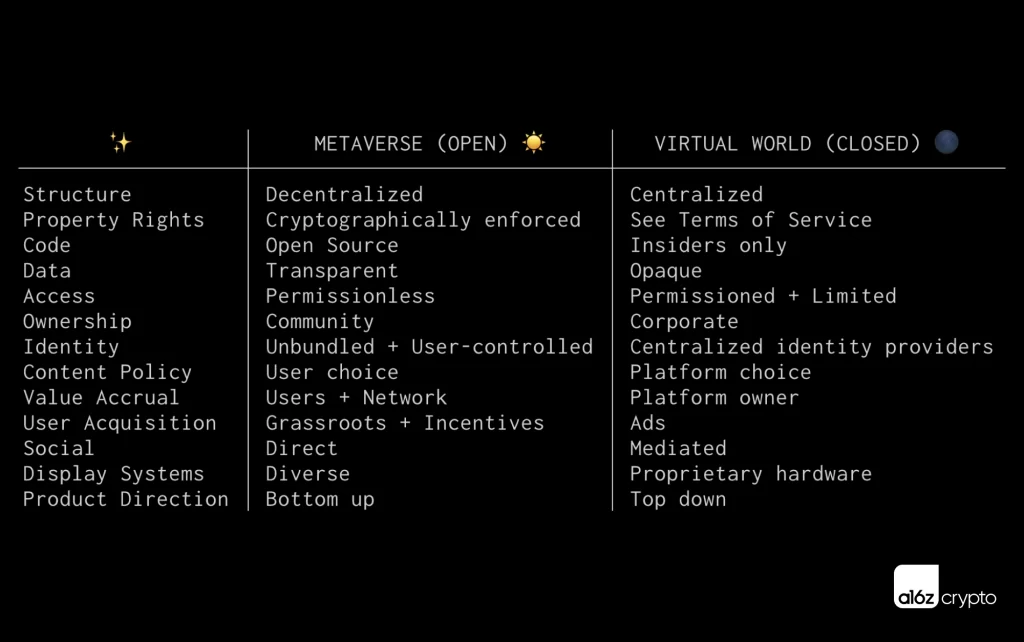
7 Essential Ingredients of a Metaverse — from future.a16z.com by Liz Harkavy, Eddy Lazzarin, Arianna Simpson

Excerpt:

There has been a lot of buzz about “the metaverse” since its coinage in the ‘90s, but especially during the pandemic (given the surge in online activity), and even more so after Facebook changed its name to Meta.

Is this just a bit of opaque marketing-speak? What is a metaverse exactly? How does one define the term, and where does one draw a line between a metaverse and, say, just another virtual world? These are common questions that people ask about the metaverse, so we thought we’d outline how we see it and how the metaverse intersects with web3.

Also relevant/see:

 
© 2025 | Daniel Christian