MicrosoftHololensDevelopmentKit-March2016


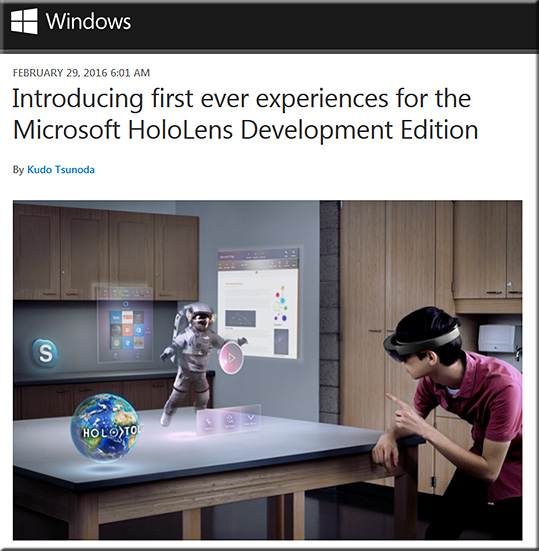
Introducing first ever experiences for the Microsoft HoloLens Development Edition — from blogs.windows.com by Kudo Tsunoda

Excerpt:

I am super excited about today’s announcement that the Microsoft HoloLens Development Edition is available for pre-order. We set out on a mission to deliver the world’s first untethered holographic computer and it is amazing to finally be at this point in time where developers will be receiving the very first versions so they can start building their own holographic experiences.

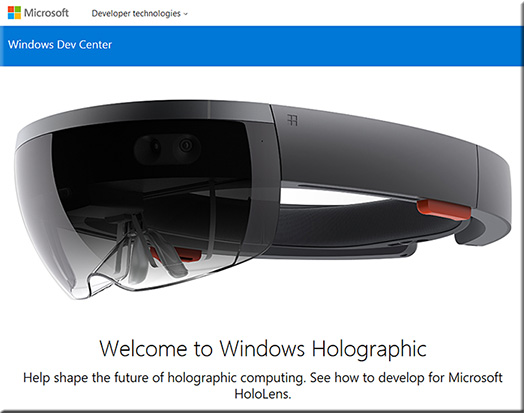
With HoloLens, we are committed to providing the development community with the best experience possible. In order to help get developers started creating experiences for HoloLens, we’ve provided a number of great resources. First of all, there is a complete set of documentation provided to developers both by the people who have created the platform and by the people who have been building holographic experiences. We want to share all of our holographic knowledge with developers so they can start bringing their holographic dreams to reality as easily as possible. We have also provided a host of tutorial videos to help people along. All of the documentation and videos can be found at dev.windows.com/holographic.


MicrosoftHololensDevelopmentKit2-March2016


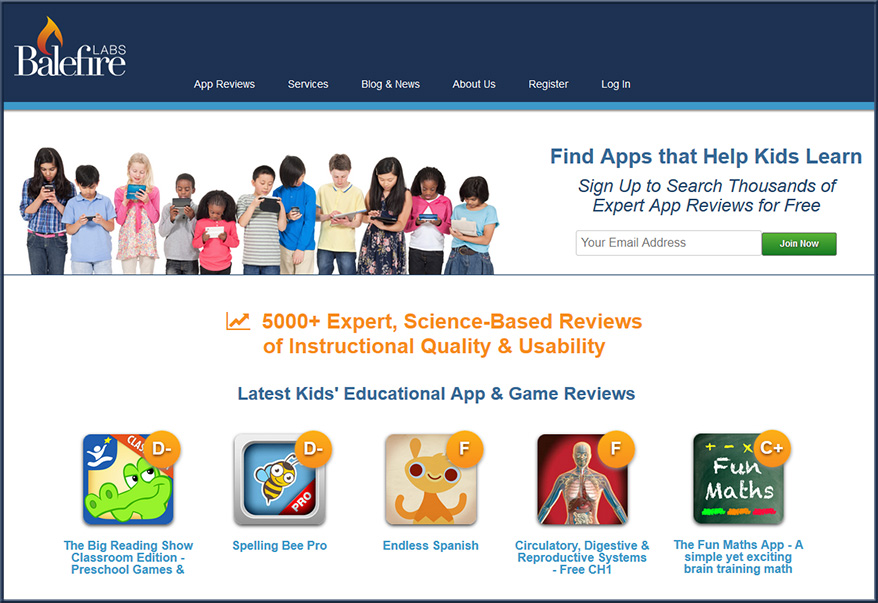
balefirelabs.com — with thanks to Rene Grimes for this resource.

Per Rene:

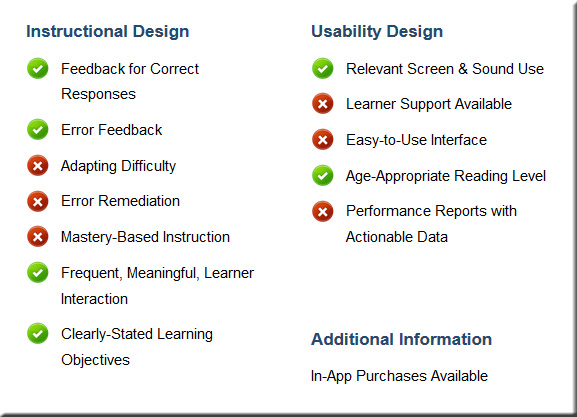
I’d like to recommend you check out Balefire Labs, an app review service, because they have very solid objective metrics for determining the learning elements within content apps. We know not all edtech is actually educational (talking specifically about instructional apps). Content apps have their place, to be sure; but I have decided to only use adaptive, mastery based apps because these individualize instruction. Not all apps that use the word “adaptive” mean they adapt to learners levels of mastery. Check out their metrics and see what you think. http://www.balefirelabs.com


Balefirelabs-March2016


Balefirelabs2-March2016


For example, see:

  • New Top-Rated Kids’ Learning Apps & Games of March 2016
    Every month we look for the best of the best learning apps and games for kids and every month we find some new and very cool apps to recommend. Here are this month’s top eight apps and games we found for your kids…all of these top rated apps earned a letter grade of A or B, according to our research-based review criteria, putting them in the top 12% of the more than 5,000 apps we’ve reviewed. Enjoy!


IBM brings more data science to college — from clomedia.com by Bravetta Hassell
For some companies, combating skills gap means starting early — like, college early.

Excerpt:

To help close the growing skill gap in analytics, IBM has announced it’s expanding its data science education efforts.

According to IT research and advisory company Gartner, the number of citizen data scientists is on track to grow five times faster than the number of highly skilled data scientists through 2017, and the need for talent who can make data-driven insights and decisions will increase as well. Through IBM’s new Watson Analytics Academic Program, students at select universities around the world will gain access to tools and resources that will help them build data-analytic skills.


Also see the IBM Watson Analytics Academic Program page for a list of relevant resources, including:


Virtual classrooms: A vision of the future of teacher training — from edtechmagazine.com by D. Frank Smith
A classroom simulator platform operating out of UCF is breaking new ground for how teachers hone their craft.

Excerpt:

Stepping in front of a classroom of skeptical students can be nerve-wracking for first-time teachers, but a new teaching platform at the University of Central Florida gives educators-in-training the option of conquering their classroom jitters in a virtual environment.

Educators must navigate social, pedagogical and professional hurdles all at once. And TeachLive is the first of its kind — a classroom simulator that can emulate these challenges and scale its difficulty to the specific needs of the teacher.

TeachLive places a teacher-in-training in a virtual classroom populated by computer-generated students. A Skype conference call and a Microsoft Kinect motion sensor power the high-tech pantomiming behind the platform. It’s currently being used at more than 80 campuses across the U.S. to train some of the next generation of educators, and it appears to be working.


Also see:


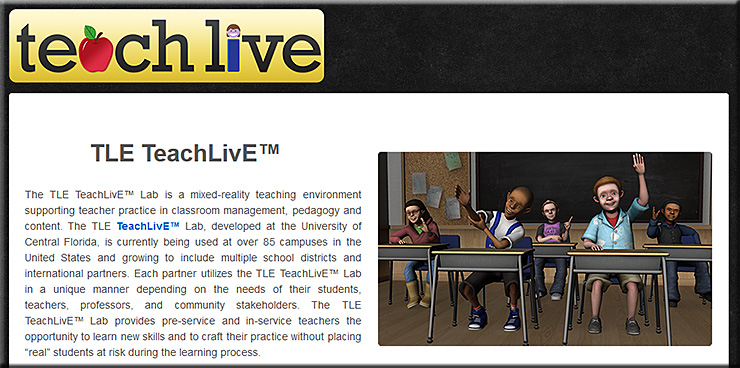
teachlive-march2016

teachlive.org

Excerpt:

TLE TeachLivE™ is a mixed-reality classroom with simulated students that provides teachers the opportunity to develop their pedagogical practice in a safe environment that doesn’t place real students at risk.  This lab is currently the only one in the country using a mixed reality environment to prepare or retrain pre-service and in-service teachers. The use of TLE TeachLivE™ Lab has also been instrumental in developing transition skills for students with significant disabilities, providing immediate feedback through bug-in-ear technology to pre-service teachers, developing discrete trial skills in pre-service and in-service teachers, and preparing teachers in the use of STEM-related instructional strategies.


Mobile World Congress 2016: Event Highlights

Excerpts:

  • Over 100,000 attendees came to Mobile World Congress 2016: nearly 101,000, in fact. Attendees from 204 countries and territories were present, and was covered by more than 3,600 members of the international press and media.
  • More than 2,200 companies participated
  • Everything from virtual reality, new handsets and ingenious app ideas, to 3D printing, privacy protection and backend solutions were on display.
  • 5G & NFV, mobile apps, retail & digital commerce, mobile media, IoT and security
  • 374 speakers from consumer brands, mobile organisations, mobile operators and industries touched by the mobile market — including advertising, banking, health, NGOs, entertainment and education.


Also see their blog.


© 2025 | Daniel Christian