Education was once the No. 1 major for college students. Now it’s an afterthought. — from cbsnews.com by Aimee Picchi & Sanvi Bangalore; via GSV

Today, education is an afterthought for many college students, who are more likely to study business, engineering, and even the visual and performing arts, according to data from the National Center for Educational Statistics. Even as the population of college students has increased by 150% since 1970, the number of bachelor’s degrees in education has plummeted by almost 50% — a steeper drop than that for English, literature and foreign language majors.


On a somewhat-related note, also see:

‘We’re going to have to be a little more nimble’: How school districts are responding to AI — from by Javeria Salman
School districts are training teachers on generative AI and encouraging them to experiment with the tools for lesson planning and remedial help

Roschelle said he wants to see school leaders and educators experiment in ways that don’t carry big risks for students, such as changing a few lesson plans. “I personally would advise school districts not to rush into buying a particular product, but really treat this year as a chance to educate yourself,” he said.

It’s a sentiment echoed by Richard Culatta, CEO of ISTE, which recently published a guide on AI in collaboration with AASA, the School Superintendents Association. What schools need to do, he said, is provide teachers with a better understanding of what AI is and share examples of how to use it.


‘Future lawyers need to be versatile and willing to innovate’ — from legalcheek.com

Lawyers’ jobs will be different and new roles have and will continue to emerge, such as the legal technologist. I believe further momentum will come with the growth of future lawyers.

I would like to see AI support the people via perhaps a chatbot that can offer reliable and accurate guidance to support individuals and services to help mitigate the pain relating to basic but fundamental legal matters to fill this void. Issues such as homelessness, debt, asylum, slavery etc. would be examples of such areas to prioritise.

To Future-Proof Their Firms, Attorneys Must Embrace AI — from forbes.com by Daniel Farrar

Law firms that want to use AI-powered legal tech should first adopt the mindset that AI is there to supplement their attorneys’ roles, not replace those roles. They must come to view AI-driven legal tech as a means to complete their jobs more efficiently and better address their clients’ needs.

Generative AI and the future of the legal profession: LexisNexis UK report canvases in-house and law firm views  — from legaltechnology.com by Caroline Hill

LexisNexis Legal & Professional (on 13 July) released a new report entitled “Generative AI and the future of the legal profession”, which highlights the at times surprising expectations of in-house counsel and law firms when it comes to generative AI adoption.

Forty nine percent of in-house counsel expect their law firms to be using generative AI in the next 12 months, including 11% who say they expect firms to be already using the technology. Only 8% didn’t want AI used on their work. In contrast, 24% of firms believe their clients would not want them to use AI.

The survey, conducted among 1,175 UK legal professionals from May to June 2023, finds 87% of legal professionals are aware of generative AI tools and of that group, 95% agree these tools will have an impact on the practice of law (38% said it will have a significant impact,11% said it will be transformative and 46% thought it would have “some impact”).

5 Considerations Before Starting With New Legal Tech  — from jdsupra.com

Suddenly the most urgent in-house legal conversations centered on which new technology to install next. And while I’m glad to see more legal departments shift their mindsets, I still preach caution. Budgets are tight, change is difficult and selecting the right tool at the wrong moment can prove counterproductive.

So before starting the search for innovative or new legal tech, it’s always best to assess your readiness with a few quick criteria.


Some scripture for us

Psalms 86:11
Teach me your way, LORD, that I may rely on your faithfulness; give me an undivided heart, that I may fear (respect/hold in awe) your name.

Amos 5:24
But let justice roll on like a river, righteousness like a never-failing stream!

Psalms 86:5
You, Lord, are forgiving and good, abounding in love to all who call to you.

Proverbs 17:17
A friend loves at all times, and a brother is born for a time of adversity.


National ChatGPT Survey: Teachers Accepting AI Into Classrooms & Workflow — Even More Than Students — from the74million.org by Greg Toppo
42% of students use ChatGPT, up from 33% in a prior survey. Their teachers are way ahead of them, with now 63% saying they’ve used the tool on the job

Teachers … and parents … believe it’s legit
Teachers who use ChatGPT overwhelmingly give it good reviews. Fully 84% say it has positively impacted their classes, with about 6 in 10 (61%) predicting it will have “legitimate educational uses that we cannot ignore.”

New Book Aims to Reshape the Future of Learning (With Your Help) — from samchaltain.substack.com by Sam Chaltain

  • What circumstances would be required for the existing educational model to be deemed obsolete?
  • What stands in the way of those circumstances coming to pass?
  • And if you were to craft a tool that actually helped people create those circumstances, what would you want that sort of resource to be, say, and do?

Last week, in Istanbul, a select group of educators, architects, students and entrepreneurs met to wrestle with those questions, as part of a yearlong collaborative design project.

What small changes could have the biggest impact and help spark the larger revolution we seek?

Will the future even have occupations — and if so, what are they most likely to be? 

What is most essential to know and embody in the next 25 years?

The Great Unbundling — from educationnext.org by Joseph Olchefske and Steven Adamowski
Is the parents’ rights movement opening a new frontier in school choice?

The mindsets of parents are changing—rapidly—as they make decisions about the schooling of their children. Over the past few years, a convergence of two megatrends—pandemic desperation and parental-rights politics—has driven many families to reconsider the traditional school model and find ways of “unbundling” their children’s schooling into discrete elements that are controlled by the parent rather than the school.

While parent-led unbundling is not a new phenomenon, the current movement has expanded so quickly that it’s been dubbed “the Great Unbundling” of K–12 schooling.

The Great Unbundling is now influencing the education marketplace, as a broad set of nonschool vendors have responded to this unprecedented demand by pitching their education services directly to families: “microschools,” online courses, private tutoring, learning pods, and outdoor learning experiences.

Yes, AI could profoundly disrupt education. But maybe that’s not a bad thing — from theguardian.com by Rose Luckin; with thanks to Will Richardson and Homa Tavangar for this resource
Humans need to excel at things AI can’t do – and that means more creativity and critical thinking and less memorisation

Staying ahead of AI will mean radically rethinking what education is for, and what success means. Human intelligence is far more impressive than any AI system we see today. We possess a rich and diverse intelligence, much of which is unrecognised by our current education system.

How we can teach children so they survive AI – and cope with whatever comes next — from theguardian.com by George Monbiot
It’s not enough to build learning around a single societal shift. Students should be trained to handle a rapidly changing world

I don’t claim to have definitive answers. But I believe certain principles would help. One is that rigidity is lethal. Any aspect of an education system that locks pupils in to fixed patterns of thought and action will enhance their vulnerability to rapid and massive change. For instance, there could be no worse preparation for life than England’s Standard Assessment Tests, which dominate year 6 teaching. If the testimony of other parents I know is representative, SATs are a crushing experience for the majority of pupils, snuffing out enthusiasm, forcing them down a narrow, fenced track and demanding rigidity just as their minds are seeking to blossom and expand.

Education, to the greatest extent possible, should be joyful and delightful, not only because joy and delight are essential to our wellbeing, but also because we are more likely to withstand major change if we see acquiring new knowledge and skills as a fascinating challenge, not a louring threat.

BRINGING AI TO SCHOOL: TIPS FOR SCHOOL LEADERS— a mini ebook from ISTE

Artificial Intelligence is having a major impact on education. Whether you are excited or
concerned about AI, as a school leader you have a responsibility to ensure AI is approached
thoughtfully and appropriately in your school community and informs your vision for teaching and learning. This guide will help you quickly gain the background you need as a learning leader in an AI infused world.

Schools that have been successful in bringing AI into their schools in purposeful ways have some common strategies. The following five strategies are critical for a successful AI culture in your school.

The Potential Impact of AI Technology on Education. — from medium.com by Happiness Uduak

In this article, we’ll explore the potential impact of AI on education, and then take a look at how it could shape the human view of learning for good.

Teaching Through Asking Rather Than Telling — from edutopia by Jay Schauer
High school teachers can promote active learning by strategically replacing some direct instruction with questions that produce thoughtful conversations.

Does much of your teaching resemble the lectures you and 20 or 50 or 400 of your closest college friends received from a “sage on the stage”? Are you frustrated that most of your students won’t remember much from the fascinating information you just delivered to them for 15 or 30 or 55 minutes? If so, maybe it’s time to implement more ARTT—Ask, Rather Than Tell—into your teaching.

I started doing a lot of asking in order to help students make connections, establish common baseline understandings, and identify knowledge gaps or areas of misunderstanding, rather than telling them information. My lectures then evolved into more meaningful conversations.

Best Free Virtual Labs — from techlearning.com by Diana Restifo
These best virtual lab sites and apps are all free, highly engaging, and informative—and most don’t require registration

Many schools don’t have robust in-person laboratory facilities, instead relying primarily on dry textbooks to teach difficult STEM topics. But even schools with quality labs can benefit from these innovative and flexible online simulations.

The following top virtual lab sites and apps are all free, highly engaging, and informative—and most don’t require registration. Since most browsers no longer support Java or Flash, sites built exclusively with those outdated technologies have been excluded.

Gov. Gretchen Whitmer launching new education-focused state department — from detroitnews.com by Craig Mauger and Chad Livengood

Whitmer’s office said Wednesday the new Michigan Department of Lifelong Education, Achievement and Potential, or MiLEAP, will feature offices governing early childhood education, higher education and “education partnerships.”

“Establishing MiLEAP ensures all available resources, data and dollars are aligned around a single vision — supporting an education system focused on lifelong learning that can support the economy of the future and helping anyone make it in Michigan,” according to a “talking points” document obtained by The Detroit News on Wednesday morning.

How to Get Kids to Read for Fun — from nataliewexler.substack.com by Natalie Wexler
An overemphasis on analytical skills can make reading a joyless task.

Schools have been giving students isolated bits of text rather than letting them sink their teeth into engaging novels, and they’ve prioritized teaching analytical reading skills over allowing kids to immerse themselves in a good story.

Celebrating Student Interests to Create a Positive High School Culture — from edutopia.org by Nicole Rossi-Mumpower
Events that center students’ picks in art, music, and food can create powerful opportunities for them to increase their sense of belonging.

Modeled after the First Friday events that take place in many cities and towns (when community members gather to experience local culture), First Fridays at school offer students a chance to listen to music, view art, and sample cuisine.?The tradition has become a cornerstone of our school community and is replicable across school sites.

THE IMPORTANCE OF A MEANINGFUL SCHOOL CULTURE
Creating a positive school climate and culture is essential for student success. When students feel like they are an important part of the community, they’re more likely to be engaged in their learning and have a positive attitude toward school.


Teaching Assistants that Actually Assist Instructors with Teaching — from opencontent.org by David Wiley

“…what if generative AI could provide every instructor with a genuine teaching assistant – a teaching assistant that actually assisted instructors with their teaching?”

Assignment Makeovers in the AI Age: Reading Response Edition — from derekbruff.org by Derek Bruff

For my cryptography course, Mollick’s first option would probably mean throwing out all my existing reading questions. My intent with these reading questions was noble, that is, to guide students to the big questions and debates in the field, but those are exactly the kinds of questions for which AI can write decent answers. Maybe the AI tools would fare worse in a more advanced course with very specialized readings, but in my intro to cryptography course, they can handle my existing reading questions with ease.

What about option two? I think one version of this would be to do away with the reading response assignment altogether.

4 Steps to Help You Plan for ChatGPT in Your Classroom — from chronicle.com by Flower Darby
Why you should understand how to teach with AI tools — even if you have no plans to actually use them.


Some items re: AI in other areas:

15 Generative AI Tools A billion+ people will be collectively using very soon. I use most of them every day — from stefanbauschard.substack.com by Stefan Bauschard
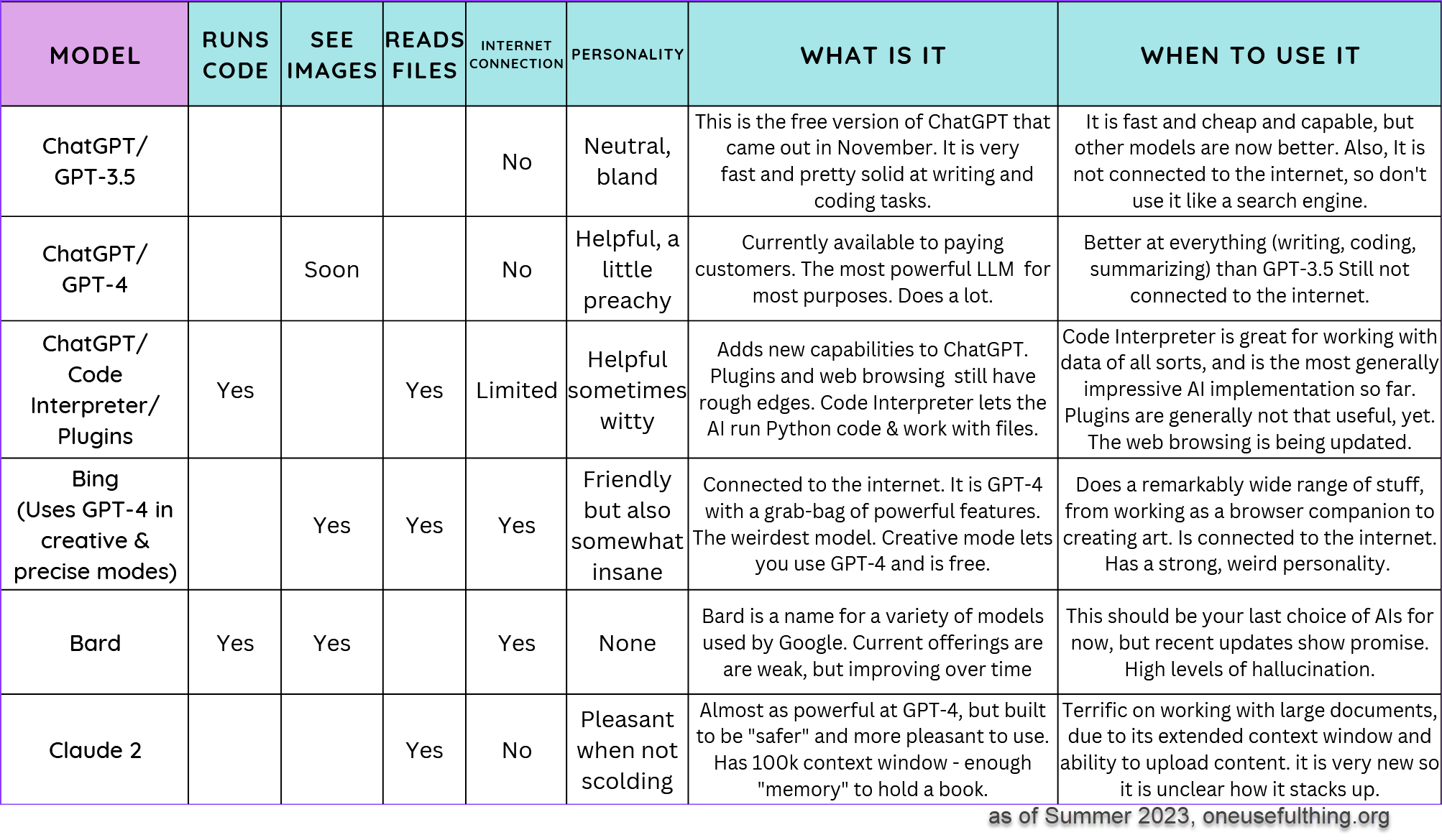
ChatGPT, Bing, Office Suite, Google Docs, Claude, Perplexity.ai, Plug-Ins, MidJourney, Pi, Runway, Bard, Bing, Synthesia, D-ID

The Future of AI in Video: a look forward — from provideocoalition.com by Iain Anderson

Actors say Hollywood studios want their AI replicas — for free, forever — from theverge.com by Andrew Webster; resource from Tom Barrett

Along these lines of Hollywood and AI, see this Tweet:

Claude 2: ChatGPT rival launches chatbot that can summarise a novel –from theguardian.com by Dan Milmo; resource from Tom Barrett
Anthropic releases chatbot able to process large blocks of text and make judgments on what it is producing

Generative AI imagines new protein structures — from news.mit.edu by Rachel Gordon; resource from Sunday Signal
MIT researchers develop “FrameDiff,” a computational tool that uses generative AI to craft new protein structures, with the aim of accelerating drug development and improving gene therapy.

Google’s medical AI chatbot is already being tested in hospitals — from theverge.com by Wes Davis; resource via GSV

Ready to Sing Elvis Karaoke … as Elvis? The Weird Rise of AI Music — from rollingstone.com by Brian Hiatt; resource from Misha da Vinci
From voice-cloning wars to looming copyright disputes to a potential flood of nonhuman music on streaming, AI is already a musical battleground


Proverbs 17:9
Whoever would foster love covers over an offense, but whoever repeats the matter separates close friends.

Proverbs 17:3

The crucible for silver and the furnace for gold, but the LORD tests the heart.

Philippians 2:9-11

9 Therefore God exalted him to the highest place
and gave him the name that is above every name,
10 that at the name of Jesus every knee should bow,
in heaven and on earth and under the earth,
11 and every tongue acknowledge that Jesus Christ is Lord,
to the glory of God the Father.

Psalm 18:30

As for God, his way is perfect: The Lord’s word is flawless; he shields all who take refuge in him.

Proverbs 17:7
Eloquent lips are unsuited to a godless fool— how much worse lying lips to a ruler!


The Evolution of Public Libraries — from designinglibraries.org.uk by Ayub Khan
Designing Libraries Director, Ayub Khan, looks at the evolution of public libraries – and the implications for library design

Reinvention
Public libraries have always adapted and reinvented themselves to the changing needs and preferences of their users – and they continue to do so. Books and reading remain central to what libraries do but – it’s a bit of a cliché to say so – they are not just about books nowadays. They are social places at the centre of their communities.

Having worked on the initial design concepts for the new Library of Birmingham, earlier in my career, I know books were only part of the plans. When I started out as a librarian around 75% of library spaces were for books and 25% for other activities and events. Now it’s the other way round.


From DSC:
I thought this was a really good idea from Dan Pontefact: “Why Experienced Employees Should Write Letters to New Team Members”

Excerpt:

Regardless of their age, an individual who is fresh to the team is given between five and ten pieces of advice from a more seasoned employee in the form of an email or letter. These tidbits of knowledge are what these seasoned professionals wish they had known when they first joined.

This is more than just a welcome; it’s a guide, a primer, offering an insider’s view of the organization and fostering a sense of camaraderie from the very beginning.


Actors say Hollywood studios want their AI replicas — for free, forever — from theverge.com by Andrew Webster
The reveal came as SAG-AFTRA actors confirmed they were going on strike.

When asked about the proposal during the press conference, Crabtree-Ireland said that “This ‘groundbreaking’ AI proposal that they gave us yesterday, they proposed that our background performers should be able to be scanned, get one day’s pay, and their companies should own that scan, their image, their likeness and should be able to use it for the rest of eternity on any project they want, with no consent and no compensation. So if you think that’s a groundbreaking proposal, I suggest you think again.”


The Future of Law: Embracing AI in the Legal Profession — from ethicalailawinstitute.com by Trent Kubasiak

Excerpt:

Improving Access to Justice:
One significant advantage of AI in the legal profession is its potential to improve access to justice. The high costs associated with legal services have traditionally created barriers for individuals with limited financial means. However, AI-powered solutions can help bridge this gap by providing affordable and accessible legal information and guidance. Virtual legal assistants and chatbots can assist individuals with legal queries, empowering them to navigate legal processes more effectively and make informed decisions. By leveraging AI, the legal profession can become more inclusive and ensure that legal services are available to a broader segment of society.


Also relevant/see:

Law Unlimited: Welcome to the re-envisioned legal profession — from jordanfurlong.substack.com by Jordan Furlong
Will Generative AI destroy law firms? Only if lawyers are too fixed in their ways to see the possibilities that lie beyond who we’ve always been and what we’ve always done.

Excerpt:

The immediate impact of Gen AI on legal services will be to introduce unprecedented efficiency to the production of countless legal documents and processes. For most of the last century, lawyers have personally performed this work, spending and billing hours or parts of hours to accomplish each task. Law firms have used this production method to provide on-the-job training for inexperienced lawyers and have leveraged those hours to generate profits for their partners. But LLMs can now do the same work in seconds, as effectively as lawyers can today and much better in the near future. This is, among other things, a very serious problem for law firms’ business models and talent development practices, not to mention a real challenge to lawyer education and training and potentially a revolution in access to justice.


So, you want to become an instructional designer? — from drlukehobson.com by Luke Hobson

Excerpt:

The most significant problem I’ve seen for aspiring instructional designers is that they don’t have a solid plan in place with how to make acquiring a new job a reality. What does this involve? A monumental portion of instructional design is knowing about how learning works. Yes, there are other components about instructional design like technology, project management, relationship management, research, but at the end of the day, you need to know how people learn to design meaningful learning experiences. So, think of your instructional design journey as a learning experience. How would you reverse engineer this process to help you obtain your goal? Let’s start by asking a few questions:


Commentary from Rick Seltzer re: “Public confidence in higher ed plunges — again” — from chronicle.com

Excerpt:

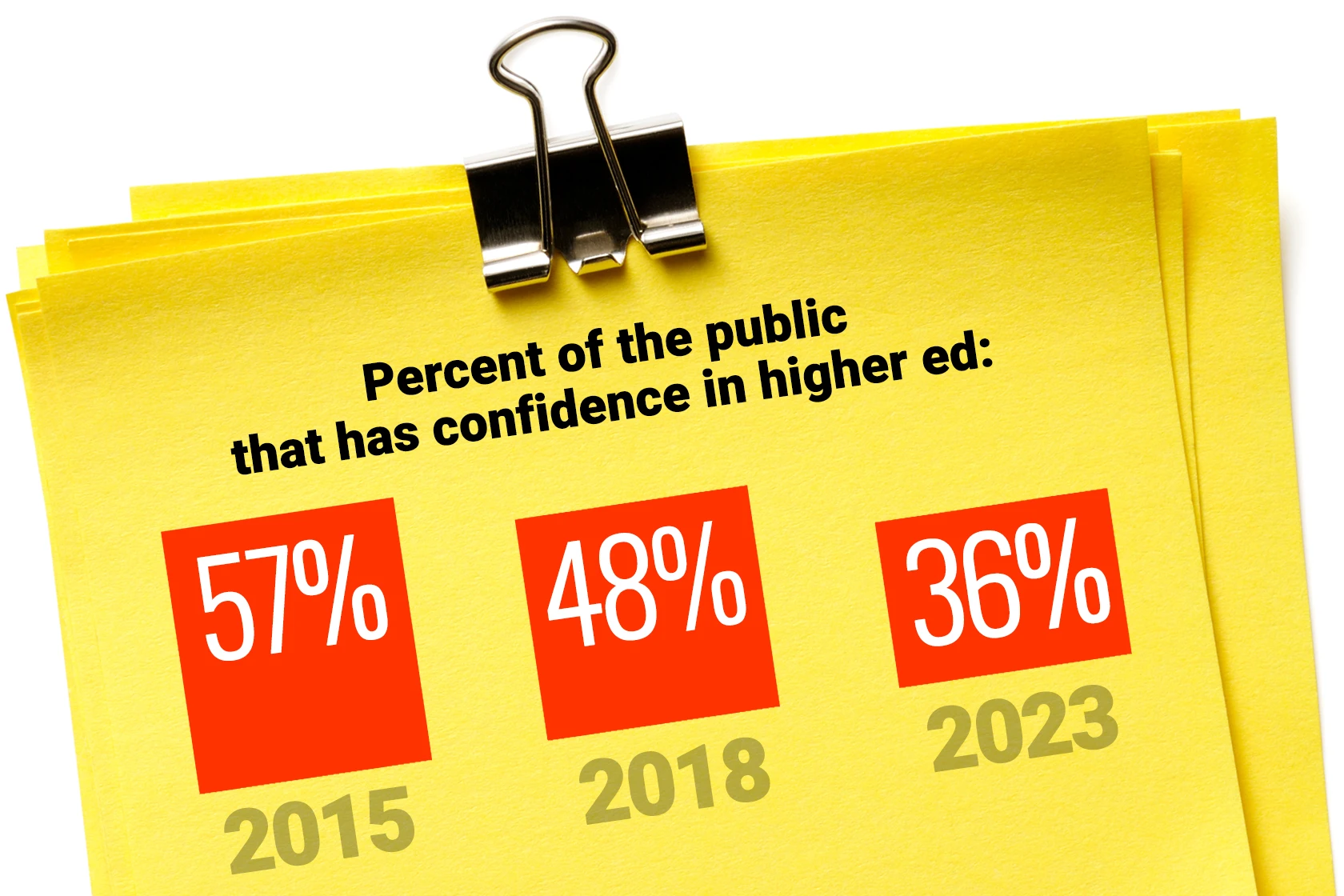
Only 36 percent of Americans say they have a great deal or quite a lot of confidence in higher education, according to a survey Gallup conducted in June. That’s down from 48 percent who said the same in 2018 and 57 percent in 2015.

It’s also broadly consistent with a March Wall Street Journal-NORC survey that found just 42 percent of respondents thought college was worth the cost because it improves career prospects.

Confidence waned among all major groups. Sharpest declines were among Republicans, those without a college degree, women, and the oldest respondents.

Rick links to Zachary’s article:

Public Trust in Higher Ed Has Plummeted. Yes, Again. — from chronicle.com by Zachary Schermele
Americans’ confidence in higher ed is continuing to shrivel — a troubling sign that could foreshadow further erosion of colleges’ enrollment, funding, and stature in the coming years.
.


Also relevant/see:


Animation Tips for eLearning — from learningguild.com by Bill Brandon

Excerpt:

Why use animation in eLearning? Many people may think of animation in terms of entertainment value alone. Animation is far more valuable for its ability to engage learners, explain or illustrate ideas, and improve recall of complex relationships, such as cause and effect.

Look up these specific animation types for use in your projects:

  1. Whiteboard animation: Not necessary to be able to draw the characters. Multiple brands.
  2. Stop-motion animation
  3. Animation programs for beginners
  4. Free animation software

Also relevant/see:

Be an eLearning Storyteller With Style and Confidence — from learningguild.com by Bill Brandon

Excerpt:

Humans are good storytellers, and humans respond well to stories. We know this from our own experience. Not only that, people remember stories for a long time, far longer than we remember a lot of teaching. Do you recall stories that someone in your family told you? Why don’t we remember lessons from school as long or as vividly? Stories are powerful if we know how to use them. In this article I will introduce you to a way to use stories to achieve outcomes.

Any time you are designing a course, a learning experience, or just pitching an idea to your boss or an L&D stakeholder, it’s a story. Even if it does not seem like one, a successful production—whether it is an animated presentation, a virtual supporting example or other content—is based on some fundamental storytelling tactics. It doesn’t have to begin “Once Upon A Time,” it just needs to be constructed the right way for your purpose – To make it a memory.


PROOF POINTS: Plenty of Black college students want to be teachers, but something keeps derailing them — from hechingerreport.org by Jill Barshay
Study inside Michigan’s teacher preparation programs sheds light on some of the reasons for the scarcity of Black teachers in America

There are many reasons for the paucity of Black teachers. But a June 2023 analysis of college students in Michigan highlights a particularly leaky part of the teacher pipeline: teacher preparation programs inside colleges and universities.

 
© 2025 | Daniel Christian