Q&A from Vendors – Learning Systems Edition — from elearninfo247.com by Craig Weiss

Excerpt:

It is kind of weird. So many sites that list Q&A’s – mine included, look at it from the reader’s standpoint – what I refer to as consumers, even though they may have an audience consisting of PEs (Private Equity), outside their industry (C-Level and similar), vendors in the specific industry (e-learning) and sub-segments OR just a variety of folks who are not on the consumer side of the house, instead on the vendor or investment side.

And yet, I receive a lot of inquiries from vendors, including PE and investment firms. They all have questions. They all seek answers. I will hold back from the investment and PE side; let’s take a peek at the vendor side.


22 Classroom-Focused Resources on AI from Teachers Everywhere

22 Classroom-Focused Resources on AI from Teachers Everywhere — from coolcatteacher.com by Vicki Davis; via GSV

***


Back to School Survey: 44% of Teens “Likely” to Use AI To Do Their Schoolwork for Them This School Year — from prnewswire.com by Junior Achievement
Research by Junior Achievement Shows 60% of Teens Consider the Use of AI to Do Their Schoolwork for Them as “Cheating”

Excerpt:

COLORADO SPRINGS, Colo.July 26, 2023 /PRNewswire/ — A new survey of teens conducted for Junior Achievement by the research firm Big Village shows that nearly half of teens (44%) are “likely” to use AI to do their schoolwork instead of doing it themselves this coming school year. However, most teens (60%) consider using AI in this way as “cheating.” The survey of 1,006 13- to 17-year-olds was conducted by Big Village from July 6 through 11, 2023.

From DSC:
In a competitive society as we have in the U.S. and when many of our K-12 learning ecosystems are designed to create game players, we shouldn’t be surprised to see a significant amount of our students using AI to “win”/game the system.

As it becomes appropriate for each student, offering more choice and control should help to allow more students to pursue what they want to learn about. They won’t be as interested in gaming the system if they truly want to learn about something.


Psalms 89:11

The heavens are yours, and yours also the earth; you founded the world and all that is in it.

Proverbs 18:13

To answer before listening— that is folly and shame.

Romans 10:9-11

If you declare with your mouth, “Jesus is Lord,” and believe in your heart that God raised him from the dead, you will be saved. For it is with your heart that you believe and are justified, and it is with your mouth that you profess your faith and are saved. As Scripture says, “Anyone who believes in him will never be put to shame.”

Psalm 112:5

Good will come to those who are generous and lend freely, who conduct their affairs with justice.

Psalm 119:93

I will never forget your precepts, for by them you have preserved my life.


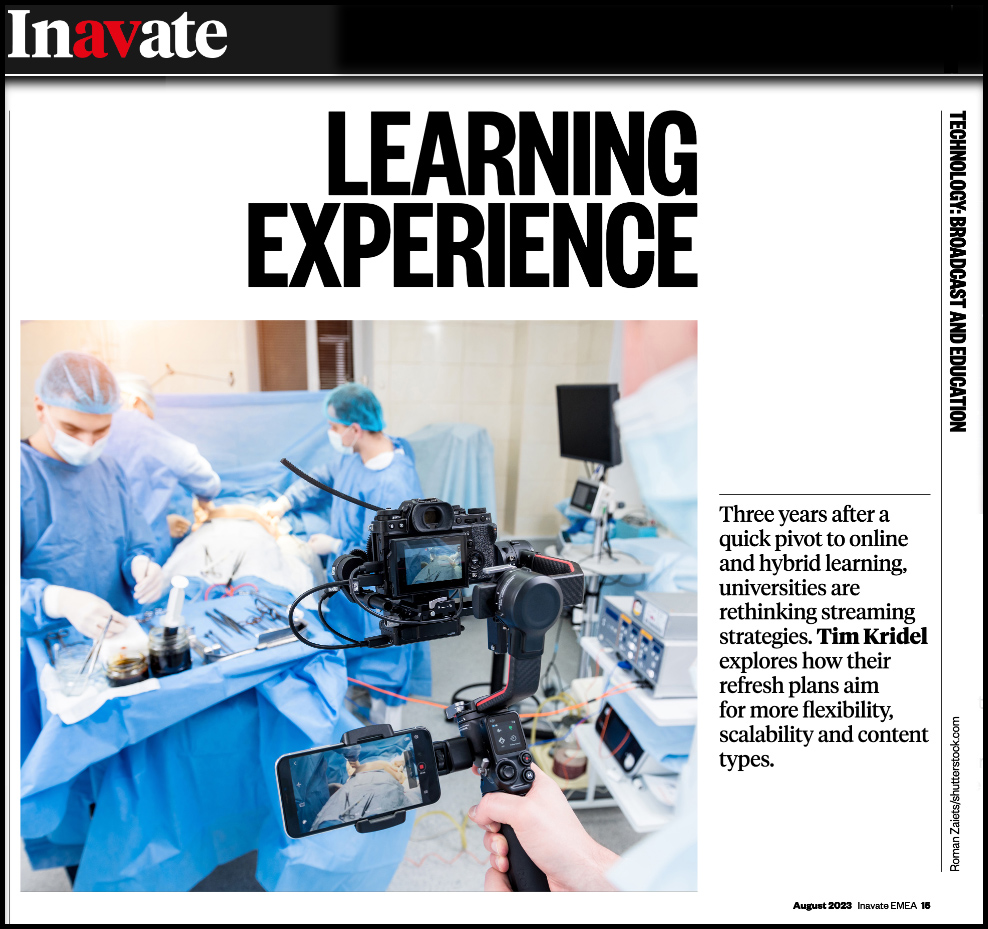
Camera fixed on a surgery being used to provide remote learning and feeds

Learning Experience — from inavateemea.com by Tim Kridel

“Some of the stuff we’re doing is creating templates and workflows that capture multiple feeds: not just the teacher, [but also] the white board, an overhead camera,” Risby says.

“The student can then go in and pick what they look at, so it’s more interactive. You might be watching it the first time to listen to the lecturer, but you might watch the second time to concentrate on the experiment. It makes the stream more valuable.”


10 Charts That Capture How the World Is Changing (July 2023) — from digitalnative.substack.com by Rex Woodbury
From Higher Education to AI Art, Therapy to Venture Capital Funding

The charts this week again cover a broad range of themes—

  1. Confidence in Higher Education
  2. Confidence in Institutions
  3. AI Mania
  4. Is Art Created by AI Still Art?
  5. A Venture Capital Reset
  6. The Highs and Lows of Threads
  7. More Americans Are Living Alone
  8. Therapy Goes Mainstream
  9. Secondhand Explosion
  10. A Climate Reckoning
 

Related topics from DSC:

  • Getting someone’s attention
  • Having the information sink in and mean something to someone
  • Inspiration
  • Goal setting
  • Motivation
  • Metacognition?
  • Getting psyched to try something new out!

From DSC: Engaged students do not just absorb content, they try to make meaning of what they study. Engaged learners ***care about*** the subject, ***feel motivated or excited*** to learn, and take ownership of their learning.


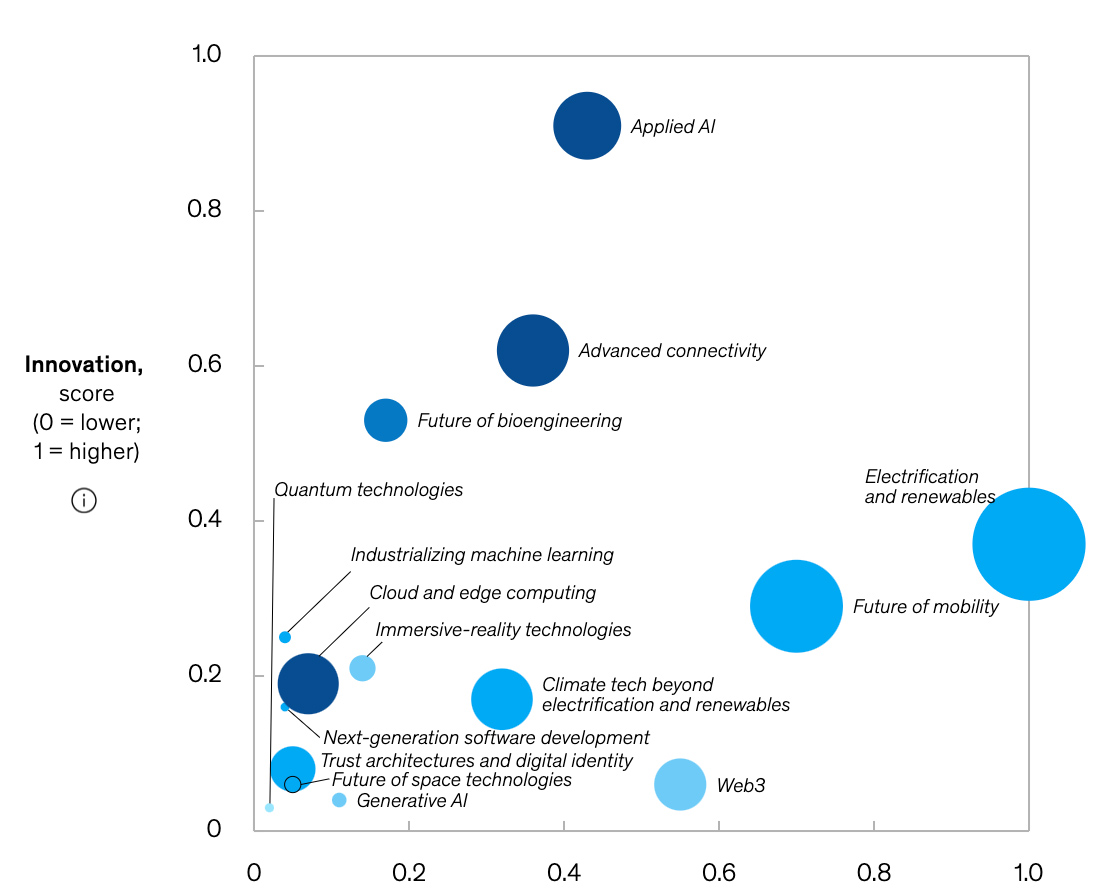
McKinsey Technology Trends Outlook 2023 — from mckinsey.com

Excerpt:

Which technology trends have the most momentum in an accelerating world? We ranked the top cross-industry trends that matter most for companies and executives.

McKinsey Technology Trends Outlook 2023


Start Lifelong Learning Now! Tips for Students & Inspiring Examples — from custom-writing.org; with thanks to Julia Reed for this resource

Excerpts:

  • Develop a growth mindset
  • Set effective learning goals
  • Work on your time management
  • Develop self-motivation
  • Reflect on your progress
  • Make learning a habit
  • …and several more items

From DSC:
I would add a few more:

  • Have fun!
  • Select something that you want to learn about and enjoy the experience!
  • In the process, take some time to enjoy the gifts of others as well as the gifts that you’ve been given.
  • Use what you’ve learned to help/serve others.
 

Mystery Abounds in Lee Madgwick’s Uncanny Paintings of Derelict Buildings — from thisiscolossal.com Grace Ebert and Lee Madgwick

The Veil -- by Lee Madgwick


Also for another creative/fun item, see:

Photos of Everyday Activities Reveal the Humor of Perspective and Serendipitous Alignments — from thisiscolossal.com by Grace Ebert and Anthimos Ntagkas


Partnership with American Journalism Project to support local news — from openai.com; via The Rundown AI
A new $5+ million partnership aims to explore ways the development of artificial intelligence (AI) can support a thriving, innovative local news field, and ensure local news organizations shape the future of this emerging technology.


SEC’s Gensler Warns AI Risks Financial Stability — from bloomberg.com by Lydia Beyoud; via The Brainyacts
SEC on lookout for fraud, conflicts of interest, chair says | Gensler cautions companies touting AI in corporate docs


Per a recent Brainyacts posting:

The recent petition from Kenyan workers who engage in content moderation for OpenAI’s ChatGPT, via the intermediary company Sama, has opened a new discussion in the global legal market. This dialogue surrounds the concept of “harmful and dangerous technology work” and its implications for laws and regulations within the expansive field of AI development and deployment.

The petition, asking for investigations into the working conditions and operations of big tech companies outsourcing services in Kenya, is notable not just for its immediate context but also for the broader legal issues it raises. Central among these is the notion of “harmful and dangerous technology work,” a term that encapsulates the uniquely modern form of labor involved in developing and ensuring the safety of AI systems.

The most junior data labelers, or agents, earned a basic salary of 21,000 Kenyan shillings ($170) per month, with monthly bonuses and commissions for meeting performance targets that could elevate their hourly rate to just $1.44 – a far cry from the $12.50 hourly rate that OpenAI paid Sama for their work. This discrepancy raises crucial questions about the fair distribution of economic benefits in the AI value chain.


How ChatGPT Code Interpreter (And Four Other AI Initiatives) Might Revolutionize Education — from edtechinsiders.substack.com by Phuong Do, Alex Sarlin, and Sarah Morin
And more on Meta’s Llama, education LLMs, the Supreme Court affirmative action ruling, and Byju’s continued unraveling

Let’s put it all together for emphasis. With Code Interpreter by ChatGPT, you can:

  1. Upload any file
  2. Tell ChatGPT what you want to do with it
  3. Receive your instructions translated into Python
  4. Execute the code
  5. Transform the output back into readable language (or visuals, charts, graphs, tables, etc.)
  6. Provide the results (and the underlying Python code)


AI Tools and Links — from Wally Boston

It’s become so difficult to track AI tools as they are revealed. I’ve decided to create a running list of tools as I find out about them.  The list is in alphabetical order even though there are classification systems that I’ve seen others use. Although it’s not good in blogging land to update posts, I’ll change the date every time that I update this list. Please feel free to respond to me with your comments about any of these as well as AI tools that you use that I do not have on the list. I’ll post your comments next to a tool when appropriate. Thanks.


Meet Claude — A helpful new AI assistant — from wondertools.substack.com by Jeremy Caplan
How to make the most of ChatGPT’s new alternative

Claude has surprising capabilities, including a couple you won’t find in the free version of ChatGPT.

Since this new AI bot launched on July 11, I’ve found Claude useful for summarizing long transcripts, clarifying complex writings, and generating lists of ideas and questions. It also helps me put unstructured notes into orderly tables. For some things, I prefer Claude to ChatGPT. Read on for Claude’s strengths and limitations, and ideas for using it creatively.

Claude’s free version allows you to attach documents for analysis. ChatGPT’s doesn’t.


The Next Frontier For Large Language Models Is Biology — from forbes.com by Rob Toews

Large language models like GPT-4 have taken the world by storm thanks to their astonishing command of natural language. Yet the most significant long-term opportunity for LLMs will entail an entirely different type of language: the language of biology.

In the near term, the most compelling opportunity to apply large language models in the life sciences is to design novel proteins.


Seven AI companies agree to safeguards in the US — from bbc.com by Shiona McCallum; via Tom Barrett

Seven leading companies in artificial intelligence have committed to managing risks posed by the tech, the White House has said.

This will include testing the security of AI, and making the results of those tests public.

Representatives from Amazon, Anthropic, Google, Inflection, Meta, Microsoft, and OpenAI joined US President Joe Biden to make the announcement.


New York Times sues AI — theneurondaily.com


In Hollywood, writers and actors/actresses are on strike due to AI-related items.


From DSC:
And while some are asking about other industries’/individuals’ data, Bryan Alexander asks this about academics:

While I’m here, also see Bryan’s posting –> How colleges and university are responding to AI now


AI’s Coming Constitutional Convention — from thebrainyacts.beehiiv.com

For centuries, constitutional conventions have been pivotal moments in history for codifying the rights and responsibilities that shape civilized societies. As artificial intelligence rapidly grows more powerful, the AI community faces a similar historic inflection point. The time has come to draft a “Constitutional Convention for AI” – to proactively encode principles that will steer these transformative technologies toward justice, empowerment, and human flourishing.

AI promises immense benefits, from curing diseases to unlocking clean energy. But uncontrolled, it poses existential dangers that could undermine human autonomy and dignity. Lawyers understand well that mere regulations or oversight are no match for a determined bad actor. Fundamental principles must be woven into the very fabric of the system.


The invisible cost of resisting AI in higher education — from blogs.lse.ac.uk by Dr. Philippa Hardman

Excerpt (emphasis DSC):

The implications of this development are perhaps more significant than we realise. There has been much discussion in recent months about the risks associated with the rise of generative AI for higher education, with most of the discussion centring around the challenge that ChatGPT poses to academic integrity.

However, much less work has been done on exploring the negative – even existential – consequences that might stem from not embracing AI in higher education. Are these new principles enough to reverse the risk of irrelevance?

What if we reimagine “learning” in higher education as something more than the recall and restructuring of existing information? What if instead of lectures, essays and exams we shifted to a model of problem sets, projects and portfolios?

I am often asked what this could look like in practice. If we turn to tried and tested instructional strategies which optimise for learner motivation and mastery, it would look something like this…

Also relevant/see:

Do or Die? — from drphilippahardman.substack.com by Dr. Philippa Hardman
The invisible cost of resisting AI in higher education

Excerpt:

  • Embracing AI in the higher education sector prepares students for the increasingly technology-driven job market and promotes more active, participatory learning experiences which we know lead to better outcomes for both students and employers.
  • With the rising popularity of alternative education routes such as bootcamps and apprenticeships, it’s crucial for traditional higher education to engage positively with AI in order to maintain its competitiveness and relevance.

For example, a teacher crafting a lesson plan no longer has to repeat that they’re teaching 3rd grade science. A developer preferring efficient code in a language that’s not Python – they can say it once, and it’s understood. Grocery shopping for a big family becomes easier, with the model accounting for 6 servings in the grocery list.


This is the worst AI will ever be, so focused are educators on the present they can’t see the future — from donaldclarkplanb.blogspot.com by Donald Clark

Teaching technology
There is also the misconception around the word ‘generative’, the assumption that all it does is create blocks of predictable text. Wrong. May of its best uses in learning are its ability to summarise, outline, provide guidance, support and many other pedagogic features that can be built into the software. This works and will mean tutors, teachers, teaching support, not taking support, coaches and many other services will emerge that aid both teaching and learning. They are being developed in their hundreds as we speak.

This simple fact, that this is the first technology to ‘learn’ and learn fast, on scale, continuously, across a range of media and tasks, it what makes it extraordinary.


On holding back the strange AI tide — from oneusefulthing.org by Ethan Mollick
There is no way to stop the disruption. We need to channel it instead

And empowering workers is not going to be possible with a top-down solution alone. Instead, consider:

  • Radical incentives to ensure that workers are willing to share what they learn. If they are worried about being punished, they won’t share. If they are worried they won’t be rewarded, they won’t share. If they are worried that the AI tools that they develop might replace them, or their coworkers, they won’t share. Corporate leaders need to figure out a way to reassure and reward workers, something they are not used to doing.
  • Empowering user-to-user innovation. Build prompt libraries that help workers develop and share prompts with other people inside the organization. Open up tools broadly to workers to use (while still setting policies around proprietary information), and see what they come up with. Create slack time for workers to develop, and discuss, AI approaches.
  • Don’t rely on outside providers or your existing R&D groups to tell you the answer. We are in the very early days of a new technology. Nobody really knows anything about the best ways to use AI, and they certainly don’t know the best ways to use it in your company. Only by diving in, responsibly, can you hope to figure out the best use cases.

Teaching: Preparing yourself for AI in the classroom — from chronicle.com by Beth McMurtrie

Auburn’s modules cover the following questions:

  • What do I need to know about AI?
  • What are the ethical considerations in a higher-ed context?
  • How will AI tools affect the courses I teach?
  • How are students using AI tools, and how can I partner with my students?
  • How do I need to rethink exams, papers, and projects I assign?
  • How do I redesign my courses in the wake of AI disruption?
  • What other AI tools or capabilities are coming, and how can I design for them?
  • What conversations need to happen in my department or discipline, and what is my role?

Transforming Higher Education: AI as an Assistive Technology for Inclusive Learning — from fenews.co.uk by Gain Hoole

In recent years, I have witnessed the transformative power of technology in higher education. One particular innovation that has captured my attention is Artificial Intelligence (AI). AI holds tremendous potential as an assistive technology for students with reasonable adjustments in further education (FE) and higher education (HE).

In this comprehensive blog post, I will delve into the multifaceted aspects of AI as an assistive technology, exploring its benefits, considerations, challenges, and the future it holds for transforming higher education.

The integration of AI as an assistive technology can create an inclusive educational environment where all students, regardless of disabilities or specific learning needs, have equal access to educational resources. Real-time transcription services, text-to-speech capabilities, and personalized learning experiences empower students like me to engage with course content in various formats and at our own pace (Fenews, 2023). This not only removes barriers but also fosters a more inclusive and diverse academic community.


5 Ways to Ease Students Off the Lecture and Into Active Learning — from chronicle.com by Jermey T. Murphy
Lecturing endures in college classrooms in part because students prefer that style of teaching. How can we shift that preference?

What can we do? Here are five considerations I’ll be following this coming fall in response to that nagging “less discussion, more instruction” evaluation.

  • Lecture … sparingly. 
  • Routinely ask how the course is going.
  • Be transparent.
  • …and more

A three-part series re: courseware out at The Chronicle of Higher Education:

  1. Millions of Students a Year Are Required to Buy Courseware. Often, It Replaces the Professor. — from chronicle.com by Taylor Swaak
    .
  2. Courseware Can Be Integral to a Course. Why, Then, Are Students Footing the Bill for It? — from chronicle.com by Taylor Swaak
    The Homework Tax | For students already struggling to afford college, courseware can add to the burden
    Their argument is multifold: For one, they say, products like these — which often deliver key elements of a course that an instructor would typically be responsible for, like homework, assessments, and grading — should not be the student’s burden. At least one student advocate said colleges, rather, should cover or subsidize the cost, as they do with software like learning-management systems, if they’re allowing faculty free rein to adopt the products.

    And the fact that students’ access to these products expires — sometimes after just a semester — rubs salt in the wound, and risks further disadvantaging students.
    .
  3. Bots Are Grabbing Students’ Personal Data When They Complete Assignments — from chronicle.com by Taylor Swaak
    When students use courseware, how much personal data is it collecting?

Institutions aren’t “letting the wolf into the henhouse”; instead, “we’re letting the hens out into a forest of wolves,” said Billy Meinke, an open educational resources technologist with the Outreach College at the University of Hawaii-Manoa who’s done research on publisher misuse of student data.
.


Here are five reading challenges to learn about learning this summer — from retrievalpractice.org by Pooja K. Agarwal, Ph.D.

Excerpt (emphasis DSC):

Here are five summer reading challenges to learn about the science of learning.

Important: make sure you remember what you learn! Engage yourself in retrieval practice and retrieve two things after each book, practice guide, and research article you read. Share your two things with our communities on Twitter and Facebook, make a list of what you’ve learned to boost your long-term learning,…


Assignment Makeovers in the AI Age: Essay Edition — from derekbruff.org Derek Bruff

Last week, I explored some ways an instructor might want to (or need to) redesign a reading response assignment for the fall, given the many AI text generation tools now available to students. This week, I want to continue that thread with another assignment makeover. Reading response assignments were just the warm up; now we’re tackling the essay assignment.


Here are ways professional education leaders can prepare students for the rise of AI — from highereddive.com by A. Benjamin Spencer
Institutions must adapt their curricula to incorporate artificial intelligence-related topics, the dean of William & Mary Law School argues.

First, they need to understand that the technological side of AI can no longer be simply left to the information technology experts. Regardless of the professional domain, understanding what AI is, how it works, how the underlying code and algorithms are designed, and what assumptions lie behind the computer code are important components to being able to use and consume the products of AI tools appropriately. 


It’s time for a Legal Moonshot — from jordanfurlong.substack.com by Jordan Furlong
All the challenges facing the legal sector today are systemic and entrenched. To solve them, we have to make a radical commitment to accomplish what we once believed impossible.

Here are three Legal Moonshots that the legal profession could take the lead on.

  1. Establish universal access to justice.
    Someday, this will be reality. Everyone will know their basic legal rights and can easily exercise them. Legal remedies will be free or extremely low-cost. Courts will be integrated into communities with simple entry and guided assistance, delivering clear and swift justice. AI-driven online services will render business agreements and settle everyday disputes. Everyone will have a last will and testament. Nobody will have to represent themselves. Justice will be real. That is all possible, and lawyers can lead the way there. It’s our Holy Grail. Let’s make it actually happen.
  2. Eliminate violence against women.  
  3. Root out public and private corruption.

The Tech Stack Law Firms and Legal Professionals Need to Succeed (Adriana Linares – LawTech Partners) — from tlpodcast.com with Adriana Linares

Adriana explains the differences between case management software, document management platforms, and practice management software. She also touches on the importance of document assembly software and how to maximize the use of data captured during the various stages of a legal matter. She closes out the discussion explaining why many in legal are missing out when they don’t use CRMs–Client and Customer Relationship Management platforms.


How To Use AI in Your Firm (with examples!) — a 1.5 hour webinar recording from clio.com; via The Brainyacts
You know your firm could benefit from AI—now, see how.

In this webinar recording you’ll learn about:

  • Practical use cases for AI in law firms—from legal research to practice area-specific prompts.
  • Popular AI tools and how to choose ones that work with your firm’s budget and goals.
  • The limitations, risks, and ethical considerations of AI for legal professionals.

Virtual Law Firms: Reinventing The Legal Profession With Technology — from forbes.com by Mohaimina Haque

Given these intrinsic advantages, it should come as no surprise that virtual law firms are on the rise. The shutdown and disruptions caused by Covid have provided a further impetus to this trend. For example, it would take an attorney the whole day to drive to the courthouse, park, wait for the judge to call their case, argue the matter, then drive back to the office. Now the same matter can be handled through Zoom and court filings can be filed online. However, after these measures were instituted, I’ve seen how the opposition to such virtual measures has eroded as the real savings in time and money to all parties concerned have become very clear.


Legal Soft Revolutionizes Legal Training with AI-Powered Platform — from globenewswire.com

LOS ANGELES, July 21, 2023 (GLOBE NEWSWIRE) — Legal Soft, a pioneering company in legal technology, is leveraging the power of artificial intelligence (AI) to revolutionize the development of training materials for law firms. Committed to advancing legal education and professional development, Legal Soft’s innovative AI-driven platform is transforming the training landscape for legal professionals.


AI Legal Case Analysis: The Next Frontier in Legal Technology — from dtgreviews.com

AI legal case analysis refers to the use of AI algorithms to analyze legal cases, identify patterns, predict outcomes, and provide insights that can aid in legal decision-making. This technology has the potential to revolutionize the way lawyers approach case strategy, conduct legal research, and even interact with clients.

One of the most significant benefits of AI legal case analysis is its ability to process vast amounts of data quickly and accurately. Traditional legal research is a time-consuming process that involves sifting through hundreds, if not thousands, of cases to find relevant precedents. AI can automate this process, analyzing thousands of cases in a fraction of the time it would take a human. This not only saves time but also increases the accuracy of the research reducing the risk of human error.

Moreover, AI can identify patterns and trends in case law that might be overlooked human researchers. For instance, AI can analyze the decisions of a particular judge or court to determine how they typically rule on certain issues. This information can be invaluable in formulating a case strategy or predicting the outcome of a case.

From DSC:
I’m not sure how I feel about this yet…but I have to admit that I’m very tentative and a bit suspect at this point.


How Professionals Are Using AI in eLearning — from teamedforlearning.com

The boom in artificial intelligence is touching nearly every industry, and eLearning is no exception. From content creation to instructional design, industry professionals and organizations are finding innovative ways to apply AI in elearning. Whether creating training modules for corporate employees or crafting educational programs, professionals are making AI part of their standard toolkit.

At Teamed, we have the privilege of working and speaking with people from all over the elearning industry including instructional designers, content developers, and organizations considering how to apply it for productivity and the benefit of learners. AI and machine learning come up frequently in these conversations. Here’s what we’ve learned and observed about AI in elearning from experts in our industry.

On a somewhat related note, also see:

The hottest new job is “head of AI” and nobody knows what they do — from www-vox-com.cdn.ampproject.org by Rani Molla
America’s biggest companies are hiring AI leadership as fast as they can.


© 2025 | Daniel Christian