


What does the future of education LOOK like? — from stefanbauschard.substack.com by Stefen Bauschard
Diverse students receive instruction from robots in an online classroom that mimics the current structure of education.
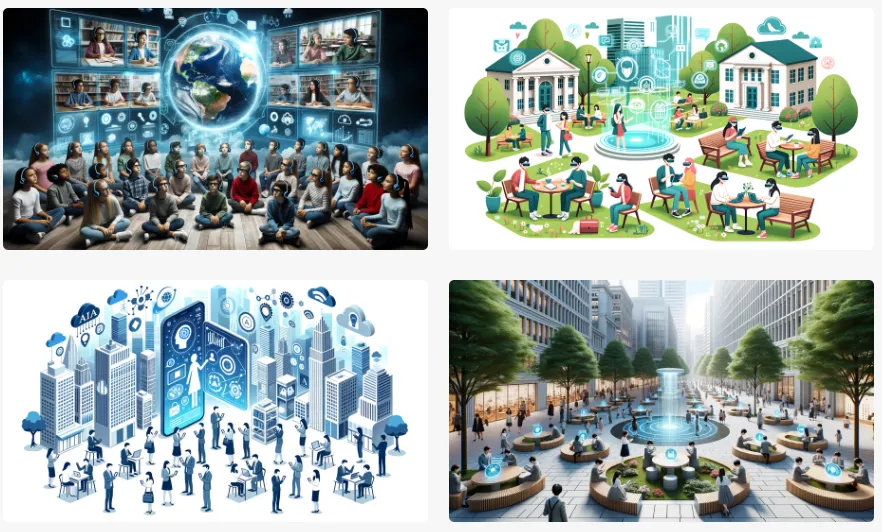
What does the future of education LOOK like? — from stefanbauschard.substack.com by Stefen Bauschard
Diverse students receive instruction from robots in an online classroom that mimics the current structure of education.
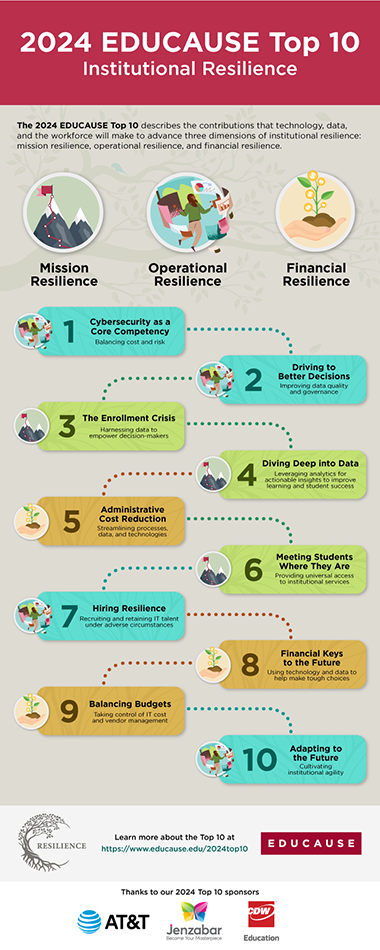
2024 EDUCAUSE Top 10: Institutional Resilience — from educause.edu
.
Advice From More than A Decade of Career Pathway Innovation — from gettingsmart.com by Hilary Sontag and Kerri McDermid
Excerpt:
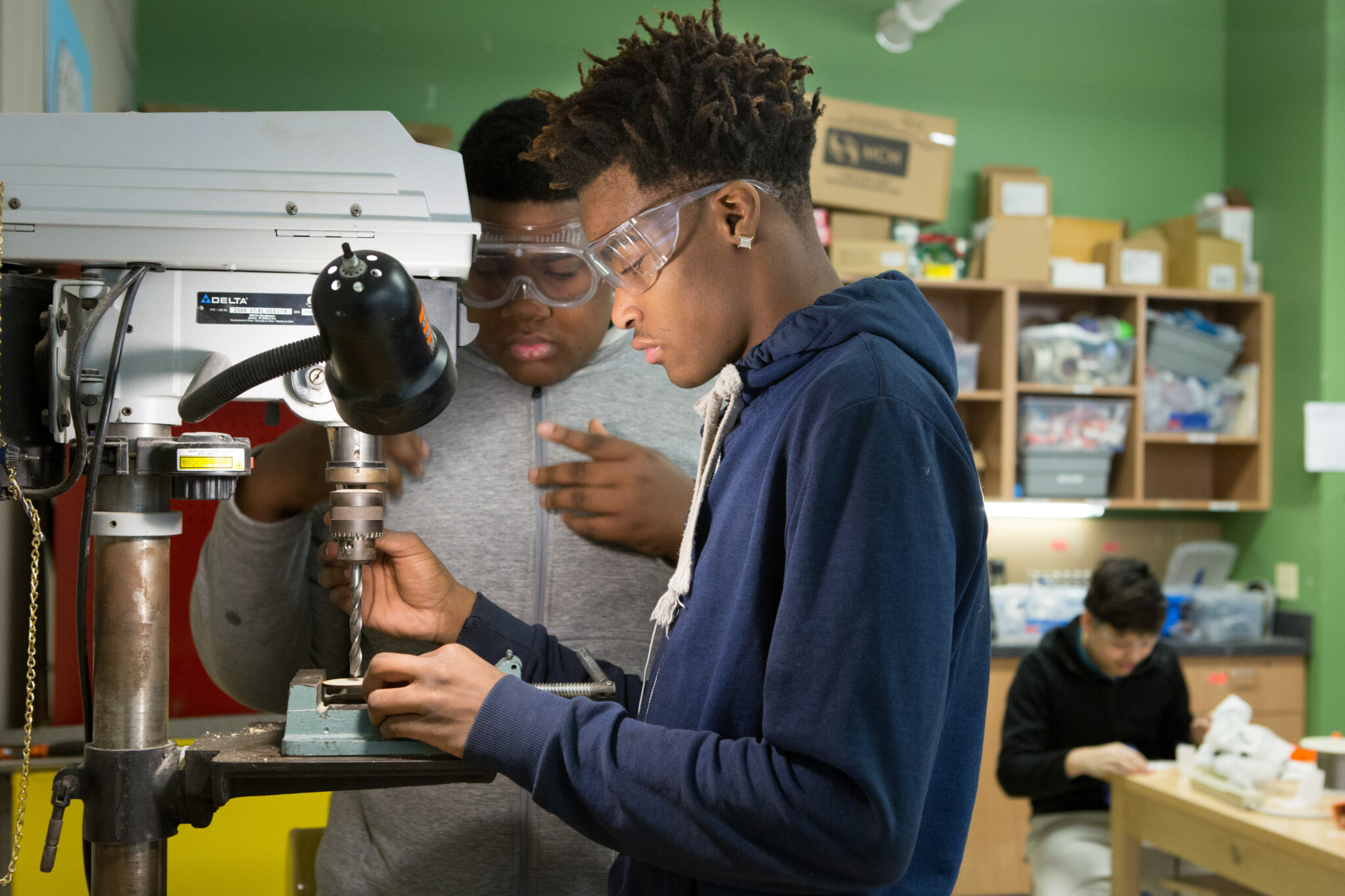
With nearly 15 years of experience in building and leading career-connected learning initiatives, St. Vrain offers a roadmap for districts of all sizes who are beginning the journey to create their own pathways of opportunity for students.
Over the past decade, St. Vrain Valley Schools has launched more than two dozen career pathways and now has a goal to offer quality work-based learning experiences for every graduate. As staff have developed these opportunities, St. Vrain has seen significant increases in graduation rates – approximately 94 percent of St. Vrain students graduate high school in four years – and a significant decrease in dropout rates to less than one percent of students. Graduation rates among our Hispanic students have increased by 30 percentage points, almost completely eliminating graduation rate gaps between all students and students of color. St. Vrain’s post-pandemic achievement has also accelerated at a remarkable pace. Building career-connected programming, and offering it as early and broadly as possible, has demonstrated a compelling case for the effectiveness of career pathways in accelerating achievement and student success.
The value of hands-on learning in prison — from college-inside.beehiiv.com by Charlotte West
Women in Washington reflect on their experience with a pre-apprenticeship that introduces them to the trades.
When I visited the prison in May, Brittany Wright had plans to go down to the Cement Masons & Plasterers Local Union 528 in Seattle when she got out a few days later. She’s now an apprentice working on a light rail expansion project for Sound Transit, making $31 an hour plus benefits. “I’m a little nervous, but more excited to get out there and actually start using the trades,” she told me at the time. “They seem like they’re willing to work with me. And that’s all that matters.”
Regional Colleges Saw Biggest Application Gains After Tuition Resets — from insidehighered.com by Kathryn Palmer
A new report compared post-reset application growth at nationally known and regional institutions.
Dozens of colleges and universities have dropped their sticker prices for tuition over the past decade, even as research has shown that tuition resets have a nominal influence on long-term enrollment increases. But a report released this week shows that regional colleges were more likely than nationally known institutions to see increases in applications after a reset.
“Students are more focused now on return on investment than they used to be,” said Devon McGee, a principal at Kennedy & Company, the higher education consulting firm that produced the report. Compared to bigger-name colleges, “A lot of these regional institutions are great liberal arts–type institutions, but they are less associated—fairly or unfairly—with preparing students for a job.”
Why hybrid learning needs hybrid faculties — from timeshighereducation.com by An Jacobs & Norma Rossi
Online courses should be integrated into everyday faculty functions to improve remote and in-person classes as well as the overall student experience
DC: Sounds like a team-based appt to me; something I’ve long advocated for. https://t.co/qkQhl98bQI
— Daniel Christian (he/him/his) (@dchristian5) October 13, 2023
The Game-Changer: How Legal Technology is Transforming the Legal Sector — from todaysconveyancer.co.uk by Perfect Portal
Rob Lawson, Strategic Sales Manager at Perfect Portal discussed why he thinks legal technology is so important:
“I spent almost 20 years in private practice and was often frustrated at the antiquated technology and processes that were deployed. It is one of the reasons that I love working in legal tech to provide solutions and streamline processes in the modern law firm. One of the major grumbles for practitioners is the amount of admin that they must do to fulfil the needs of their clients. Technology can automate routine tasks, streamline processes, and help manage large volumes of data more effectively. This then allows legal professionals to focus on more strategic aspects of their work. Ultimately this will increase efficiency and productivity.”
Some gen AI vendors say they’ll defend customers from IP lawsuits. Others, not so much. — from techcrunch.com by Kyle Wiggers
A person using generative AI — models that generate text, images, music and more given a prompt — could infringe on someone else’s copyright through no fault of their own. But who’s on the hook for the legal fees and damages if — or rather, when — that happens?
It depends.
In the fast-changing landscape of generative AI, companies monetizing the tech — from startups to big tech companies like Google, Amazon and Microsoft — are approaching IP risks from very different angles.
Clio Goes All Out with Major Product Announcements, Including A Personal Injury Add-On, E-Filing, and (Of Course) Generative AI — from lawnext.com by Bob Ambrogi
At its annual Clio Cloud Conference in Nashville today, the law practice management company Clio introduced an array of major new products and product updates, calling the series of announcements its most expansive product update ever in its 15-year history.
AI will invert the biglaw pyramid — from alexofftherecord.com by Cece Xie
These tasks that GPT can now handle are, coincidentally, common tasks for junior associates. From company and transaction summaries to legal research and drafting memos, analyzing and drafting have long been the purview of bright-eyed, bushy-tailed new law grads.
If we follow the capitalistic impulse of biglaw firms to its logical conclusion, this means that junior associates may soon face obsolescence. Why spend an hour figuring out how to explain an assignment to a first-year associate when you can just ask CoCounsel in five minutes? And the initial output will likely be better than a first-year’s initial work product, too.
Given the immense cost-savings that legal GPT products can confer, I suspect the rise of AI in legal tech will coincide with smaller junior associate classes. Gone are the days of 50+ junior lawyers all working on the same document review or due diligence. Instead, a fraction of those junior lawyers will be hired to oversee and QC the AI’s outputs. Junior associates will edit more than they do currently and manage more than they do right now. Juniors will effectively be more like midlevels from the get-go.
Beyond Law Firms: How Legal Tech’s Real Frontier Lies With SMBs (small and medium-sized businesses) — from forbes.com by Charles Brecque
Data and artificial intelligence are transforming the legal technology space—there’s no doubt about it. A recent Thomson Reuters Institute survey of lawyers showed that a large majority (82%) of respondents believe ChatGPT and generative AI can be readily applied to legal work.
While it’s tempting to think of legal tech as a playground exclusive to law firms, as technology enables employees without legal training to use and create legal frameworks and documentation, I’d like to challenge that narrative. Being the founder of a company that uses AI to manage contracts, the way I see it is the real magic happens when legal tech tools meet the day-to-day challenges of small and medium-sized businesses (known as “SMBs”).
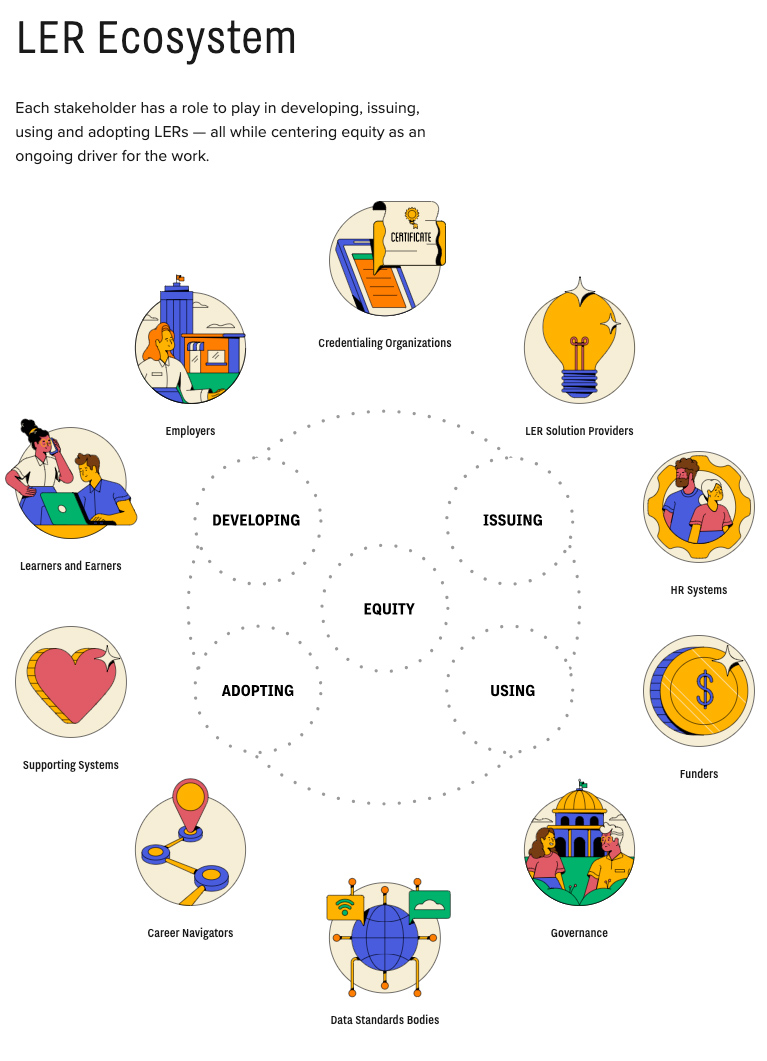
The Learning & Employment Records (LER) Ecosystem Map — with thanks to Melanie Booth on LinkedIn for this resource
Driving Opportunity and Equity Through Learning & Employment Records
Imagine A World Where…
This is the world that we believe can be created by Learning and Employment Records (LERs), i.e. digital records of learning and work experiences that are linked to and controlled by learners and earners. An interoperable, well-governed LER ecosystem has the potential to transform the future of work so that it is more equitable, efficient, and effective for everyone involved— individuals, training and education providers, employers, and policymakers.
Also per Melanie Booth, see:
WHAT WAS GARY MARCUS THINKING, IN THAT INTERVIEW WITH GEOFF HINTON? — from linkedin.com by Stephen Downes
Background (emphasis DSC): 60 Minutes did an interview with ‘the Godfather of AI’, Geoffrey Hinton. In response, Gary Marcus wrote a column in which he inserted his own set of responses into the transcript, as though he were a panel participant. Neat idea. So, of course, I’m stealing it, and in what follows, I insert my own comments as I join the 60 Minutes panel with Geoffrey Hinton and Gary Marcus.
Usually I put everyone else’s text in italics, but for this post I’ll put it all in normal font, to keep the format consistent.

OpenAI’s Revenue Skyrockets to $1.3 Billion Annualized Rate — from maginative.com by Chris McKay
This means the company is generating over $100 million per month—a 30% increase from just this past summer.
OpenAI, the company behind the viral conversational AI ChatGPT, is experiencing explosive revenue growth. The Information reports that CEO Sam Altman told the staff this week that OpenAI’s revenue is now crossing $1.3 billion on an annualized basis. This means the company is generating over $100 million per month—a 30% increase from just this past summer.
Since the launch of a paid version of ChatGPT in February, OpenAI’s financial growth has been nothing short of meteoric. Additionally, in August, the company announced the launch of ChatGPT Enterprise, a commercial version of its popular conversational AI chatbot aimed at business users.
For comparison, OpenAI’s total revenue for all of 2022 was just $28 million. The launch of ChatGPT has turbocharged OpenAI’s business, positioning it as a bellwether for demand for generative AI.
The State of AI Report 2023 is live!
Check it out here to learn about key AI developments in research, industry, politics, safety, and predictions for what’s next.
Produced by @nathanbenaich and @airstreet team. #stateofai @stateofaireport https://t.co/pkTPwbrI5f
— Daniel Christian (he/him/his) (@dchristian5) October 15, 2023
From 10/13:
Insane amounts of AI news came out this week (most of it from Adobe).
Here are the timestamps from this video just to give you an idea:
0:00 Intro
0:40 Firefly Image 2
0:53 Adobe Premiere AI Updates
1:17 Adobe Text-To-Vector
3:37 Project Fast Fill
4:46 Project Draw and Delight… pic.twitter.com/tWzyA788yH— Matt Wolfe (@mreflow) October 13, 2023
New ways to get inspired with generative AI in Search — from blog.google
We’re testing new ways to get more done right from Search, like the ability to generate imagery with AI or creating the first draft of something you need to write.

7thSense powers content on Sphere’s interior and exterior LED displays — from inavateonthenet.net

At 16K x 16K resolution, Sphere’s interior LED display plane is the highest resolution LED screen in the world. Soaring to a height of 240 feet, and with over 3 acres of display surface, the screen wraps up, over, and around the audience to create a fully immersive visual environment.
50-foot-high Hypervsn hologram launches at The Sphere in Las Vegas — from inavateonthenet.net

The pubic atrium of the recently opened MSG Sphere in Las Vegas features Hypervsn’s largest-ever 30 x 50-foot holographic display wall alongside real-life humanoid robots that greet visitors on arrival, a 360-degree avatar capture and a beam-forming sound display.
The 50-foot-high installation project included 420 individual SmartV Hypervsn displays fixed to a secure rack that hangs from the atrium wall.
9 How can a young person stay on the path of purity?
By living according to your word.
10 I seek you with all my heart;
do not let me stray from your commands.
11 I have hidden your word in my heart
that I might not sin against you.
12 Praise be to you, Lord;
teach me your decrees.
20 Listen to advice and accept discipline,
and at the end you will be counted among the wise.
21 Many are the plans in a person’s heart,
but it is the Lord’s purpose that prevails.
7 If at any time I announce that a nation or kingdom is to be uprooted, torn down and destroyed, 8 and if that nation I warned repents of its evil, then I will relent and not inflict on it the disaster I had planned. 9 And if at another time I announce that a nation or kingdom is to be built up and planted, 10 and if it does evil in my sight and does not obey me, then I will reconsider the good I had intended to do for it.
4 You have laid down precepts
that are to be fully obeyed.
5 Oh, that my ways were steadfast
in obeying your decrees!
6 Then I would not be put to shame
when I consider all your commands.