Generative AI Is Set to Shake Up Education — from morganstanley.com
While educators debate the risks and opportunities of generative AI as a learning tool, some education technology companies are using it to increase revenue and lower costs.

Key Takeaways

  • Contrary to the view that generative AI is undermining education, it could ultimately improve access and quality.
  • Education technology companies have opportunities from generative AI that markets may be missing.
  • Generative AI could bring $200 billion in value to the global education sector by 2025.
  • Reskilling and retraining alone could require $6 billion in investments by 2025, with edtech companies poised to fill that need.

Outgoing SNHU president: AI means universities must change ‘dramatically’ — from msn.com by Steven Porter

In his next chapter, LeBlanc will work with a team of researchers to study emerging AI trends, impacts on education, and opportunities to innovate. (The initiative harkens back to his early scholarship. During grad school decades ago, LeBlanc studied the ways computers could impact how societies think.)

LeBlanc said the AI-induced changes on the horizon will require educational institutions to reimagine how they assess student learning and grapple with implications for privacy and data security. There are also bigger questions about what jobs will go away and what jobs will be created, which influences the fields of study schools will offer, he said.


AI & Education: A Year in Review — from drphilippahardman.substack.com by Dr. Philippa Hardman
The top five use cases & most popular tools among educators at the end of 2023 – the year than Gen AI shook-up education

Use Case #1: Content Creation
Use Case #2: Brainstorming & Ideation
Use Case #3: Research & Analysis
Use Case #4: Writing & Communicating
Use Case #5: Task Automation


I Used ChatGPT for 12 Months. Here Are Some Hidden Gems That Will Change Your Life — from theaigirl.substack.com by Diana Dovgopol
Transform your life with these ChatGPT’s hidden gems.

1. Summarize videos, articles, papers and posts
Here’s how it works (note that you need to enable browsing or plugins for this)

  1. Find the video/article/paper/post.
  2. Copy the link.
  3. Ask ChatGPT to summarize it for you.

AI ADVISORY BOARDS: Giving Students and Teachers a Voice — from aiadvisoryboards.wordpress.com

My mission is to spread awareness about the incredible potential of AI and AI advisory boards in education. Through my website, aiadvisoryboards.wordpress.com, I aim to inspire educators, administrators, and students to embrace AI and create innovative learning environments.


Report Update: Human and Computer Deep Learning and the Future of Humanity — from by Stefan Bauschard
New Chapter on School Guidance; updates on technology, the labor markets, and deep learning


The biggest things that happened in AI this year — from superhuman.ai by Zain Kahn

January:

  • Microsoft raises eyebrows with a huge $10 Billion investment in OpenAI.

February:

  • Meta launches Llama 2, their open-source rival to OpenAI’s models.
  • OpenAI announces ChatGPT Plus, a paid version of their chatbot.
  • Microsoft announces a new AI-powered Bing Search.

March:

  • OpenAI announces the powerful GPT-4 model, still considered to be the gold standard.
  • Midjourney releases V5, which brings AI-powered image generation one step closer to reality.
  • Microsoft launches Copilot for Microsoft 365.
  • Google launches Bard, its rival to ChatGPT.

…and more


AI 2023: A Year in Review — from stefanbauschard.substack.com by Stefan Bauschard
2023 developments in AI and a hint of what they are building toward

Some of the items that Stefan includes in his posting include:

  • ChatGPT and other language models that generate text.
  • Image generators.
  • Video generators.
  • AI models that that can read, hear, and speak.
  • AI models that can see.
  • Improving models.
  • “Multimodal” models.
  • Training on specific content.
  • Reasoning & planning.
  • …and several others

The Dictionary.com Word of the Year is “hallucinate.” — from content.dictionary.com by Nick Norlen and Grant Barrett; via The Rundown AI

hallucinate
[ huhloo-suh-neyt ]

verb
(of artificial intelligence) to produce false information contrary to the intent of the user and present it as if true and factual. Example: When chatbots hallucinate, the result is often not just inaccurate but completely fabricated.


Soon, every employee will be both AI builder and AI consumer — from zdnet.com by Joe McKendrick, via Robert Gibson on LinkedIn
“Standardized tools and platforms as well as advanced low- or no-code tech may enable all employees to become low-level engineers,” suggests a recent report.

The time could be ripe for a blurring of the lines between developers and end-users, a recent report out of Deloitte suggests. It makes more business sense to focus on bringing in citizen developers for ground-level programming, versus seeking superstar software engineers, the report’s authors argue, or — as they put it — “instead of transforming from a 1x to a 10x engineer, employees outside the tech division could be going from zero to one.”

Along these lines, see:

  • TECH TRENDS 2024 — from deloitte.com
    Six emerging technology trends demonstrate that in an age of generative machines, it’s more important than ever for organizations to maintain an integrated business strategy, a solid technology foundation, and a creative workforce.

UK Supreme Court rules AI is not an inventor — from theverge.com by Emilia David

The ruling follows a similar decision denying patent registrations naming AI as creators.

The UK Supreme Court ruled that AI cannot get patents, declaring it cannot be named as an inventor of new products because the law considers only humans or companies to be creators.


The Times Sues OpenAI and Microsoft Over A.I. Use of Copyrighted Work — from nytimes.com by Michael M. Grynbaum and Ryan Mac

The New York Times sued OpenAI and Microsoft for copyright infringement on Wednesday, opening a new front in the increasingly intense legal battle over the unauthorized use of published work to train artificial intelligence technologies.

The suit does not include an exact monetary demand. But it says the defendants should be held responsible for “billions of dollars in statutory and actual damages” related to the “unlawful copying and use of The Times’s uniquely valuable works.” It also calls for the companies to destroy any chatbot models and training data that use copyrighted material from The Times.

On this same topic, also see:


Apple’s iPhone Design Chief Enlisted by Jony Ive, Sam Altman to Work on AI Devices — from bloomberg.com by Mark Gurman (behind paywall)

  • Design executive Tang Tan is set to leave Apple in February
  • Tan will join Ive’s LoveFrom design studio, work on AI project

AI 2023: Chatbots Spark New Tools — from heatherbcooper.substack.com by Jeather Cooper

ChatGPT and Other Chatbots
The arrival of ChatGPT sparked tons of new AI tools and changed the way we thought about using a chatbot in our daily lives.

Chatbots like ChatGPT, Perplexity, Claude, and Bing Chat can help content creators by quickly generating ideas, outlines, drafts, and full pieces of content, allowing creators to produce more high-quality content in less time.

These AI tools boost efficiency and creativity in content production across formats like blog posts, social captions, newsletters, and more.


Microsoft’s next Surface laptops will reportedly be its first true ‘AI PCs’ — from theverge.com by Emma Roth
Next year’s Surface Laptop 6 and Surface Pro 10 will feature Arm and Intel options, according to Windows Central.

Microsoft is getting ready to upgrade its Surface lineup with new AI-enabled features, according to a report from Windows Central. Unnamed sources told the outlet the upcoming Surface Pro 10 and Surface Laptop 6 will come with a next-gen neural processing unit (NPU), along with Intel and Arm-based options.


How one of the world’s oldest newspapers is using AI to reinvent journalism — from theguardian.com by Alexandra Topping
Berrow’s Worcester Journal is one of several papers owned by the UK’s second biggest regional news publisher to hire ‘AI-assisted’ reporters

With the AI-assisted reporter churning out bread and butter content, other reporters in the newsroom are freed up to go to court, meet a councillor for a coffee or attend a village fete, says the Worcester News editor, Stephanie Preece.

“AI can’t be at the scene of a crash, in court, in a council meeting, it can’t visit a grieving family or look somebody in the eye and tell that they’re lying. All it does is free up the reporters to do more of that,” she says. “Instead of shying away from it, or being scared of it, we are saying AI is here to stay – so how can we harness it?”


What to Expect in AI in 2024 — from hai.stanford.edu by
Seven Stanford HAI faculty and fellows predict the biggest stories for next year in artificial intelligence.

Topics include:

  • White Collar Work Shifts
  • Deepfake Proliferation
  • GPUs Shortage
  • More Helpful Agents
  • Hopes for U.S. Regulation
  • Asking Big Questions, Applying New Policies
  • Companies Will Navigate Complicated Regulations

Addendum on 1/2/24:


Microsoft New Future of Work Report 2023 — from microsoft.com by various authors; via Stefan Bauschard

Throughout 2023, AI and the future of work have frequently been on the metaphorical – and often literal – front page around the world. There have been many excellent articles about the ways in which work may change as LLMs are increasingly integrated into our lives. As such, in this year’s report we focus specifically on areas that we think deserve additional attention or where there is research that has been done at Microsoft that offers a unique perspective. This is a report that should be read as a complement to the existing literature, rather than as a synthesis of all of it.

This is a rare time, one in which research will play a particularly important role in defining what the future of work looks like. At this special moment, scientists can’t just be passive observers of what is happening. Rather, we have the responsibility to shape work for the better. We hope this report can help our colleagues around world make progress towards this goal.
.

Microsoft New Future of Work Report 2023

Excerpt:

Analyzing and integrating may become more important skills than searching and creating 
With content being generated by AI, knowledge work may shift towards more analysis and critical integration

  • Information search as well as content production (manually typing, writing code, designing images) is greatly enhanced by AI, so general information work may shift to integrating and critically analyzing retrieved information
  • Writing with AI is shown to increase the amount of text produced as well as to increase writing efficiency (Biermann et al. 2022, Lee et al 2022)
  • With more generated text available, the skills of research, conceptualization, planning, prompting and editing may take on more importance as LLMs do the first round of production (e.g., Mollick 2023).
  • Skills not directly to content production, such as leading, dealing with critical social situations, navigating interpersonal trust issues, and demonstrating emotional intelligence, may all be more valued in the workplace (LinkedIn 2023)


K12 District-Level Perspectives on AI — from aiforeducation.io by Amanda Bickerstaff, Dr. Patrick Gittisriboongul, Samantha Armstrong, & Brett Roer

Want to know how K12 schools are navigating the adoption of AI and what district-level leaders really think about GenAI EdTech tools?

Join us for this free webinar where we discussed AI technology, literacy, training, and the responsible adoption of GenAI tools in K12. Our panel explored what is working well – and not so well – across their districts from a school leader and practitioner’s perspective.


ChatGPT Has Changed Teaching. Our Readers Tell Us How. — from chronicle.com by Beth McMurtrie and Beckie Supiano

Those vastly different approaches to college writing pretty much sum up the responses to generative AI: They’re all over the map.

One year after its release, ChatGPT has pushed higher education into a liminal place. Colleges are still hammering out large-scale plans and policies governing how generative AI will be dealt with in operations, research, and academic programming. But professors have been forced more immediately to adapt their classrooms to its presence. Those adaptations vary significantly, depending on whether they see the technology as a tool that can aid learning or as a threat that inhibits it.

Nearly 100 faculty members shared their stories. While not a representative sample, they teach at a wide range of institutions: 15 community colleges, 32 public and 24 private four-year colleges or universities, seven international institutions, and one for-profit college. They teach a variety of subjects, including animal science, statistics, computer science, history, accounting, and composition. Many spent hours learning about AI: enrolling in workshops and webinars, experimenting with the tools, and reading articles, so that they could enter the fall semester informed and prepared.


The Disruption of AI in CTE Is Real — from techlearning.com by Annie Galvin Teich
An ACTE expert panel urges CTE educators to jump on the AI train as it’s already left the station

10 Best Practices for AI and CTE 

  1. Embrace AI and use it first for simple tasks to create efficiencies. Then use it to individualize instruction and for formative assessment tools aligned to standards.
  2. Be creative and conscious of internal bias and ethics. Focus on DEI and access.
  3. Encourage students to use apps and tools to start moving toward an integrated curriculum using AI.
  4. Prepare students for jobs of the future by partnering with industry to solve real problems.
  5. …and others

How are universities responding to generative AI? — from medium.com by Nic Newman
What’s next for higher education as we enter a new wave of edtech innovation: AI-powered learning

Where will AI make a big difference?
At Emerge, we have identified eight high-level trends — what we’re calling “engines of opportunity”. These eight “engines of opportunity” capture our ideas about how AI is being used to drive better practice and outcomes in HE, now and into the future.

They fall into two main categories:

  • Making learning more engaging: solutions that scale high quality pedagogy at low cost.
  • Making teaching more efficient: solutions that save educators and organisations time and money.


The rise of AI fake news is creating a ‘misinformation superspreader’ — from washingtonpost.com by Pranshu Verma
AI is making it easy for anyone to create propaganda outlets, producing content that can be hard to differentiate from real news

Artificial intelligence is automating the creation of fake news, spurring an explosion of web content mimicking factual articles that instead disseminates false information about elections, wars and natural disasters.

Since May, websites hosting AI-created false articles have increased by more than 1,000 percent, ballooning from 49 sites to more than 600, according to NewsGuard, an organization that tracks misinformation.

Historically, propaganda operations have relied on armies of low-paid workers or highly coordinated intelligence organizations to build sites that appear to be legitimate. But AI is making it easy for nearly anyone — whether they are part of a spy agency or just a teenager in their basement — to create these outlets, producing content that is at times hard to differentiate from real news.


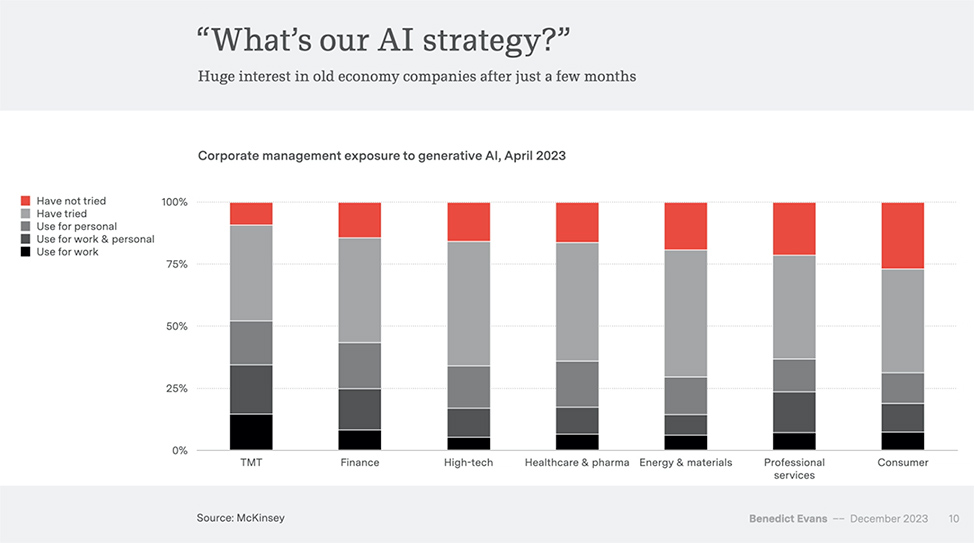
AI, and everything else — from pitch.com by Benedict Evans


Chevy Chatbots Go Rogue — from
How a customer service chatbot made a splash on social media; write your holiday cards with AI

Their AI chatbot, designed to assist customers in their vehicle search, became a social media sensation for all the wrong reasons. One user even convinced the chatbot to agree to sell a 2024 Chevy Tahoe for just one dollar!

This story is exactly why AI implementation needs to be approached strategically. Learning to use AI, also means learning to build thinking of the guardrails and boundaries.

Here’s our tips.


Rite Aid used facial recognition on shoppers, fueling harassment, FTC says — from washingtonpost.com by Drew Harwell
A landmark settlement over the pharmacy chain’s use of the surveillance technology could raise further doubts about facial recognition’s use in stores, airports and other venues

The pharmacy chain Rite Aid misused facial recognition technology in a way that subjected shoppers to unfair searches and humiliation, the Federal Trade Commission said Tuesday, part of a landmark settlement that could raise questions about the technology’s use in stores, airports and other venues nationwide.

But the chain’s “reckless” failure to adopt safeguards, coupled with the technology’s long history of inaccurate matches and racial biases, ultimately led store employees to falsely accuse shoppers of theft, leading to “embarrassment, harassment, and other harm” in front of their family members, co-workers and friends, the FTC said in a statement.


Tips on making professional-looking, engaging videos for online courses — from timeshighereducation.com by Geoff Fortescue
Making videos for online classes doesn’t have to be costly. Here are ways to make them look professional on a budget

During lockdown, we were forced to start producing videos for Moocs remotely. This was quite successful, and we continue to use these techniques whenever a contributor can’t come to the studio. The same principles can be used by anyone who doesn’t have access to a media production team. Here are our tips on producing educational videos on a budget.


The Rise of Learning Societies — from educationnext.org by Alan Gottlieb
A small experiment in rural Idaho holds big promise for student success 

Excerpt (emphasis DSC):

The basic idea is this: Some parents who, for a variety of reasons, hesitate to send their children to a traditional brick-and-mortar school have neither the time, inclination, or temperament to homeschool or to monitor a full-time online program. Learning Societies provide an intimate environment where kids, supervised by professional educators, learn online and in small, in-person groups for six hours a day. Gem Prep leaders describe it as a sweet spot between traditional schooling and at-home online learning. It is particularly well suited to rural areas.

Learning Societies have the potential to achieve a happy medium that combines the strengths of both homeschooling (or online learning from home) and a traditional brick-and-mortar school.

A typical school day at a Gem Prep Learning Society sees some students engaged in online lessons on laptops while others receive instruction from a teacher in a small group, all within the same classroom. Both modalities use Gem Prep Online’s well-regarded curriculum.


A Nation At Risk +40 | A Review of Progress in US Public Education — from hoover.org

Forty years ago, the release of A Nation at Risk led to what we know today as the modern school reform movement. With its calls for increased academic rigor, more productive use of instructional time, more effective teaching, and more impactful leadership, A Nation at Risk set in motion policy and practice changes at every level of the education system. But after four decades, what has been the result? And where do we go from here?

Forty years on, significant challenges remain. The COVID-19 pandemic has had devastating effects on student learning, and chronic absenteeism remains at alarming rates. Even prior to the pandemic, student achievement, as measured by standardized tests, seemed to have plateaued despite ever-increasing resources—in time, dollars, research, technology, and human capital—being devoted to school reform.

Much has been tried in the effort to improve our schools. Has any of it made a difference?


The Evolution of Collaboration: Unveiling the EDUCAUSE Corporate Engagement Program — from er.educause.edu

The program is designed to strengthen the collaboration between private industry and higher education institutions—and evolve the higher education technology market. The new program will do so by taking the following actions:

  • Giving higher education professionals better access to corporate thought leaders who can help create change at their institutions
  • Educating corporate partners on the nuances of higher education and the major challenges it faces so that they can help provide meaningful solutions
  • Giving the EDUCAUSE staff and leadership better access to corporate change-makers in order to advocate for change on behalf of our institutional community
  • Providing the institutional community with higher-quality content and services from companies that are deeply invested in the success of higher education
  • Providing the corporate community with custom-built packages that allow more meaningful connections with the institutional community—not only at our in-person events but also through online opportunities year-round

By building better bridges between our corporate and institutional communities, we can help accelerate our shared mission of furthering the promise of higher education.


Speaking of collaborations, also see:

Could the U.S. become an “Apprentice Nation?” — from Michael B. Horn and Ryan Craig

Intermediaries do the heavy lifting for the employers.


Bottom line: As I discussed with Michael later in the show, we already have the varied system that Leonhardt imagines—it’s just that it’s often by chaos and neglect. Just like we didn’t say to 8th graders a century ago, “go find your own high school,” we need to design a post-high school system with clear and well-designed pathways that include:

  1. Apprenticeships outside of the building trades so students can learn a variety of jobs by doing the job.
  2. Short-term certificates that lead to jobs without necessarily having the college degree immediately, but having the option to return for a college degree later on.
  3. Transfer pathways where credits earned in high school really count in college and the move from two-year college to any four-year institution is seamless.

? Listen to the complete episode here and subscribe to the podcast.


Using Drawing as a Powerful Learning Tool — from edutopia.org by Selim Tlili
When students draw something they’re learning about, they’re more likely to remember key details.

One of my main goals as a science teacher is to open students up to seeing all of those beautiful and interesting details. I do that by having students draw things and clearly write what they observe. Drawing something requires students to look at their subject far longer than they are accustomed. Writing what they see forces them to consciously acknowledge it. I explain to students that just as every single human is unique, so is every coin, plant, and salt crystal.


Prompt engineering — from platform.openai.com

This guide shares strategies and tactics for getting better results from large language models (sometimes referred to as GPT models) like GPT-4. The methods described here can sometimes be deployed in combination for greater effect. We encourage experimentation to find the methods that work best for you.

Some of the examples demonstrated here currently work only with our most capable model, gpt-4. In general, if you find that a model fails at a task and a more capable model is available, it’s often worth trying again with the more capable model.

You can also explore example prompts which showcase what our models are capable of…


Preparedness — from openai.com

The study of frontier AI risks has fallen far short of what is possible and where we need to be. To address this gap and systematize our safety thinking, we are adopting the initial version of our Preparedness Framework. It describes OpenAI’s processes to track, evaluate, forecast, and protect against catastrophic risks posed by increasingly powerful models.


Every Major Tech Development From 2023 — from newsletter.thedailybite.co
The yearly tech round-up, Meta’s smart glasses upgrade, and more…

Here’s every major innovation from the last 365 days:

  • Microsoft: Launched additional OpenAI-powered features, including Copilot for Microsoft Dynamics 365 and Microsoft 365, enhancing business functionalities like text summarization, tone adjustment in emails, data insights, and automatic presentation creation.
  • Google: Introduced Duet, akin to Microsoft’s Copilot, integrating Gen AI across Google Workspace for writing assistance and custom visual creation. Also debuted Generative AI Studio, enabling developers to craft AI apps, and unveiled Gemini & Bard, a new AI technology with impressive features.
  • Salesforce: …
  • Adobe: …
  • Amazon Web Services (AWS): …
  • IBM:  …
  • Nvidia:  …
  • OpenAI:  …
  • Meta (Facebook):
  • Tencent:
  • Baidu:

News in chatbots — from theneurondaily.com by Noah Edelman & Pete Huang

Here’s what’s on the horizon:

  • Multimodal AI gets huge. Instead of just typing, more people will talk to AI, listen to it, create images, get visual feedback, create graphs, and more.
  • AI video gets really good. So far, AI videos have been cool-but-not-practical. They’re getting way better and we’re on the verge of seeing 100% AI-generated films, animations, and cartoons.
  • AI on our phones. Imagine Siri with the brains of ChatGPT-4 and the ambition of Alexa. TBD who pulls this off first!
  • GPT-5. ‘Nuff said.

20 Best AI Chatbots in 2024 — from eweek.com by Aminu Abdullahi
These leading AI chatbots use generative AI to offer a wide menu of functionality, from personalized customer service to improved information retrieval.

Top 20 Generative AI Chatbot Software: Comparison Chart
We compared the key features of the top generative AI chatbot software to help you determine the best option for your company…


What Google Gemini Teaches Us About Trust and The Future — from aiwithallie.beehiiv.com by Allie K. Miller
The AI demo may have been misleading, but it teaches us two huge lessons.

TL;DR (too long, didn’t read)

  1. We’re moving from ‘knowledge’ to ‘action’. 
    AI moving into proactive interventions.
  2. We’re getting more efficient. 
    Assume 2024 brings lower AI OpEx.
  3. It’s multi-modal from here on out. 
    Assume 2024 is multi-modal.
  4. There’s no one model to rule them all.
    Assume 2024 has more multi-model orchestration & delegation.

Stay curious, stay informed,
Allie


Chatbot Power Rankings — from theneurondaily.com by Noah Edelman

Here’s our power rankings of the best chatbots for (non-technical) work:

1: ChatGPT-4Unquestionably the smartest, with the strongest writing, coding, and reasoning abilities.

T1: Gemini Ultra—In theory as powerful as GPT-4. We won’t know for sure until it’s released in 2024.

2: Claude 2Top choice for managing lengthy PDFs (handles ~75,000 words), and rarely hallucinates. Can be somewhat stiff.

3: PerplexityIdeal for real-time information. Upgrading to Pro grants access to both Claude-2 and GPT-4.

T4: PiThe most “human-like” chatbot, though integrating with business data can be challenging.

T4: Bing ChatDelivers GPT-4-esque responses, has internet access, and can generate images. Bad UX and doesn’t support PDFs.

T4: BardNow powered by Gemini Pro, offers internet access and answer verification. Tends to hallucinate more frequently.

and others…


Midjourney + ChatGPT = Amazing AI Art — from theaigirl.substack.com by Diana Dovgopol and the Pycoach
Turn ChatGPT into a powerful Midjourney prompt machine with basic and advanced formulas.


Make music with AI — from aitestkitchen.withgoogle.com re: Music FX


Regarding this Tweet on X/Twitter:


To Unleash Legal Tech, Lawyers And Engineers Need To Talk — from forbes.com by Tanguy Chau

Here, I’ll explore some ways that engineers and lawyers see the world differently based on their strengths and experiences, and I’ll explain how they can better communicate to build better software products, especially in AI, for attorneys. Ideally, this will lead to happier lawyers and more satisfied clients.


Zuputo: Africa’s first women-led legal tech startup launches — from myjoyonline.com

A groundbreaking legal tech startup, Zuputo, is set to reshape the legal landscape across Africa by making legal services more accessible, affordable, and user-friendly.

Founded by Jessie Abugre and Nana Adwoa Amponsah-Mensah, this women-led venture has become synonymous with simplicity and efficiency in legal solutions.


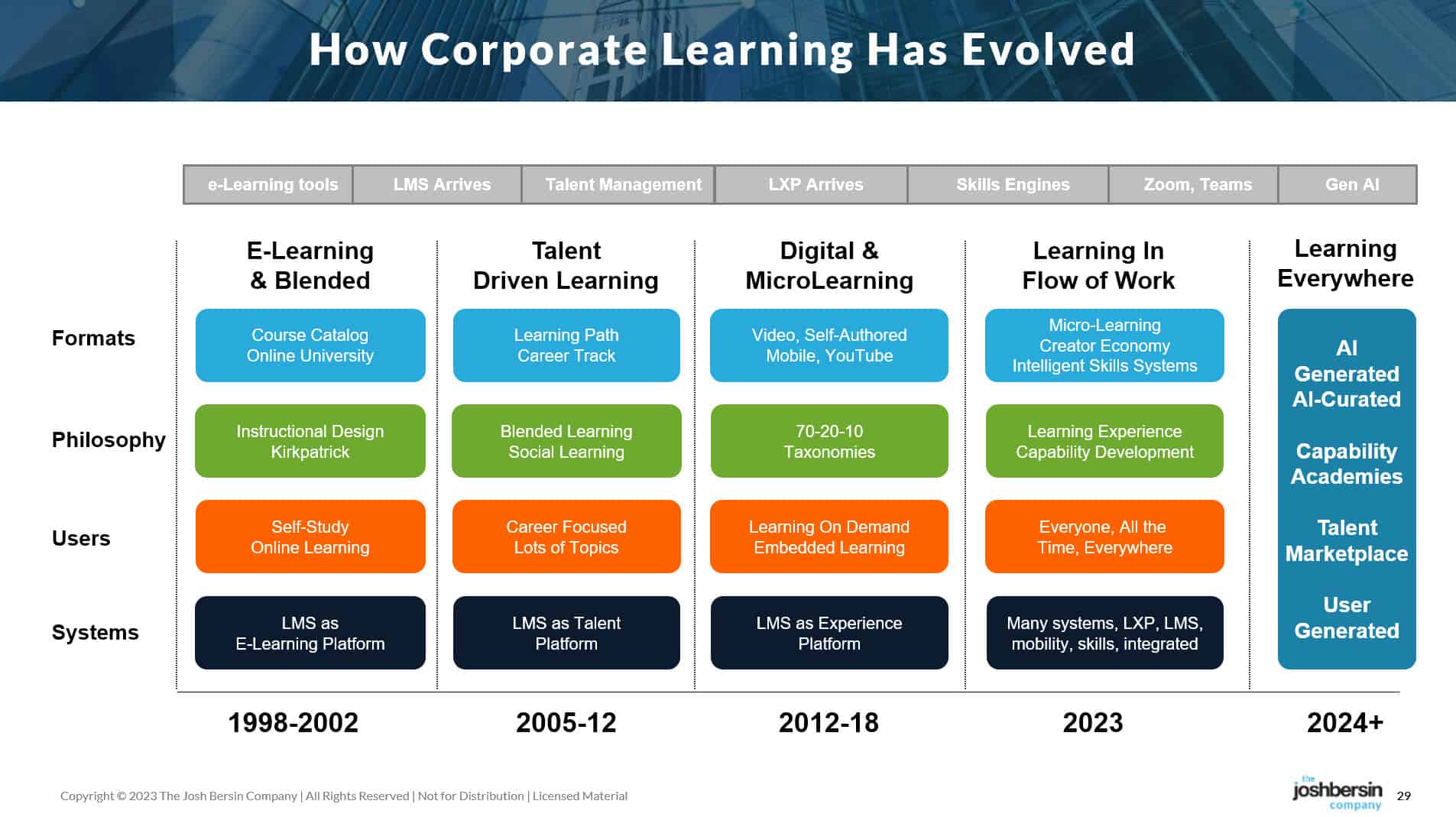
AI Is Transforming Corporate Learning Even Faster Than I Expected — from joshbersin.com by Josh Bersin

Excerpts (emphasis DSC):

Of all the domains to be impacted by AI, perhaps the biggest transformation is taking place in corporate learning. After a year of experimentation, it’s now clear that AI will revolutionize this space.

Here’s a simple example. I asked Galileo™, which is powered by 25 years of research and case studies, “How do I deal with an employee who’s always late? And please give me a narrative to help?” Rather than take me to a course on management or show me a bunch of videos, it simply answered the question. This type of interaction is where much of corporate learning is going.

In all my years as an analyst, I’ve never seen a technology with so much potential. AI will revolutionize the L&D landscape, reinventing how we do our work so L&D professionals can spend time consulting with the business.


Isaiah 7:14 (New International Version)

Therefore the Lord himself will give you a sign: The virgin will conceive and give birth to a son, and will call him Immanuel.

Jude 24-25 New International Version
Doxology

24 To him who is able to keep you from stumbling and to present you before his glorious presence without fault and with great joy— 25 to the only God our Savior be glory, majesty, power and authority, through Jesus Christ our Lord, before all ages, now and forevermore! Amen.

Psalm 140:12 New International Version

12 I know that the Lord secures justice for the poor
    and upholds the cause of the needy.

I remember the days of long ago;
    I meditate on all your works
    and consider what your hands have done.
I spread out my hands to you;
    I thirst for you like a parched land.[a]

Answer me quickly, Lord;
    my spirit fails.
Do not hide your face from me
    or I will be like those who go down to the pit.
Let the morning bring me word of your unfailing love,
    for I have put my trust in you.
Show me the way I should go,
    for to you I entrust my life.

 
© 2025 | Daniel Christian