1. AI already plays a central part in the instructional design process A whopping 95.3% of the instructional designers interviewed said they use AI in their day to day work. Those who don’t use AI cite access or permission issues as the primary reason that they haven’t integrated AI into their process.
2. AI is predominantly used at the design and development stages of the instructional design process
When mapped to the ADDIE process, the breakdown of use cases goes as follows:
Analysis: 5.5% of use cases
Design: 32.1%
Development: 53.2%
Implementation: 1.8%
Evaluation: 7.3%
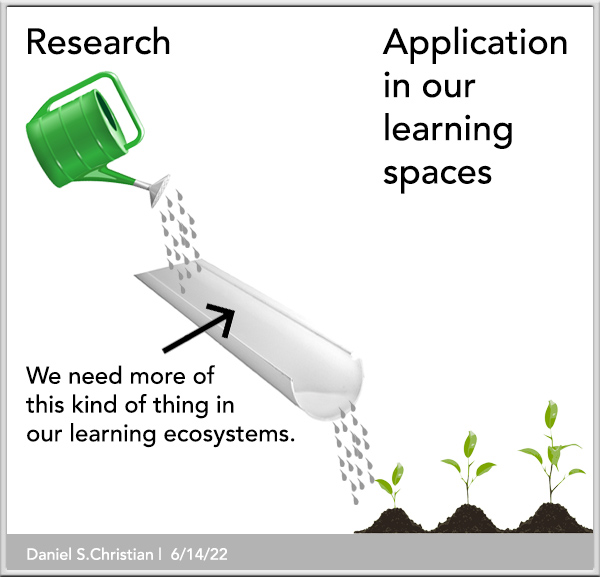
Speaking of AI in our learning ecosystems, also see:
The majority of educators expect use of artificial intelligence tools will increase in their school or district over the next year, according to an EdWeek Research Center survey.
Applying Multimodal AI to L&D — from learningguild.com by Sarah Clark We’re just starting to see Multimodal AI systems hit the spotlight. Unlike the text-based and image-generation AI tools we’ve seen before, multimodal systems can absorb and generate content in multiple formats – text, image, video, audio, etc.
Most people enroll in college because they believe it will help them secure a good job and open the door to economic opportunity. In “Talent Disrupted,” a new and updated version of the 2018 report, “The Permanent Detour,” Strada Institute for the Future of Work and The Burning Glass Institute show that a college degree is not always a guarantee of labor market success.
Using a combination of online career histories of tens of millions of graduates, as well as census microdata for millions of graduates, the report offers a comprehensive picture of how college graduates fare in the job market over their first decade of employment after college.
The report shows that only about half of bachelor’s degree graduates secure employment in a college-level job within a year of graduation.
Roughly half of college graduates end up in jobs where their degrees aren’t needed, and that underemployment has lasting implications for workers’ earnings and career paths.
That is the key finding of a new study tracking the career paths of more than 10 million people who entered the job market over the past decade. It suggests that the number of graduates in jobs that don’t make use of their skills or credentials—52%—is greater than previously thought, and underscores the lasting importance of that first job after graduation.
Teachers are the least empowered, most[-] disrespected, stressed and burned-out of all professions in the U.S. IMAGED CREATED BY DALL-E FOR BRANDON BUSTEED
If your goal was to create a miserable work environment where employees are stressed, burned out, disrespected and given no say in their job just look to U.S. schools for inspiration. They are our ‘best practice of miserable workplaces.’ And if you were looking for one major fix to education in America, you’d do everything in your power to ensure teachers are empowered.
Teacher engagement and empowerment may be the single most important national objective for improving education. Yet years of failed education policy combined with maligned attitudes about teaching have rendered teachers as among the least empowered and most disrespected professions in the country. This is a tragedy of unimaginable proportions. After all, teachers are the gateways to every profession because they are the ones we have tasked with teaching and motivating every young person in the country.
We need to free our teachers to do what they do best – to teach and inspire. Well-intentioned yet failed education policies that have overemphasized standardized testing and driven national and state-level ‘standardized’ curriculum have led to teacher disempowerment.
Putting The Public Back In Education
CommunityShare is an interesting nonprofit organization that has found a way to promote vibrant educational experiences by connecting students and educators to the skills, knowledge, and life experiences of community members.
…
Founded in 2015 in Tucson, Arizona, CommunityShare aims to reimagine the relationship between schools and communities. The organization’s vision is “a world where everyone sees themselves as a learner and educator working together to develop their community’s potential.”
Through CommunityShare, teachers and community partners, from artists to astronauts, co-design enriched learning projects that tap into students’ creativity, cultivate real-world skills, and expose students to available community assets.
An unexpected way to fight chronic absenteeism — from hechingerreport.org by Javeria Salman School districts are having some success with using telemedicine and teletherapy to ensure more kids stay in school
The telemedicine clinic is also a way to relieve the burden on working parents, Oakley said: Many parents in the district’s Title I schools work hourly wage jobs and rely on public transportation, making it difficult to pick up a sick child at school quickly.
Amid ongoing efforts to diversify the K-12 teacher workforce, a United Negro College Fund report finds some historically Black colleges and universities are working to get Black students in the teacher pipeline by tapping into faculty networks, establishing relationships with school districts and using financial aid as a recruitment tool.
Additionally, HBCUs leveraged long-standing connections with their local Black church communities to promote teacher prep programs and financial aid offerings during religious services.
UNCF suggested higher ed institutions develop pipelines for Black educators beginning in high school by offering students opportunities to work with children and then maintaining relationships with them through their matriculation into college and eventual completion of a teacher certification.
The early vibrations of AI have already been shaking the newsroom. One downside of the new technology surfaced at CNET and Sports Illustrated, where editors let AI run amok with disastrous results. Elsewhere in news media, AI is already writing headlines, managing paywalls to increase subscriptions, performing transcriptions, turning stories in audio feeds, discovering emerging stories, fact checking, copy editing and more.
Felix M. Simon, a doctoral candidate at Oxford, recently published a white paper about AI’s journalistic future that eclipses many early studies. Swinging a bat from a crouch that is neither doomer nor Utopian, Simon heralds both the downsides and promise of AI’s introduction into the newsroom and the publisher’s suite.
Unlike earlier technological revolutions, AI is poised to change the business at every level. It will become — if it already isn’t — the beginning of most story assignments and will become, for some, the new assignment editor. Used effectively, it promises to make news more accurate and timely. Used frivolously, it will spawn an ocean of spam. Wherever the production and distribution of news can be automated or made “smarter,” AI will surely step up. But the future has not yet been written, Simon counsels. AI in the newsroom will be only as bad or good as its developers and users make it.
We proposed EMO, an expressive audio-driven portrait-video generation framework. Input a single reference image and the vocal audio, e.g. talking and singing, our method can generate vocal avatar videos with expressive facial expressions, and various head poses, meanwhile, we can generate videos with any duration depending on the length of input video.
New experimental work from Adobe Research is set to change how people create and edit custom audio and music. An early-stage generative AI music generation and editing tool, Project Music GenAI Control allows creators to generate music from text prompts, and then have fine-grained control to edit that audio for their precise needs.
“With Project Music GenAI Control, generative AI becomes your co-creator. It helps people craft music for their projects, whether they’re broadcasters, or podcasters, or anyone else who needs audio that’s just the right mood, tone, and length,” says Nicholas Bryan, Senior Research Scientist at Adobe Research and one of the creators of the technologies.
There’s a lot going on in the world of generative AI, but maybe the biggest is the increasing number of copyright lawsuits being filed against AI companies like OpenAI and Stability AI. So for this episode, we brought on Verge features editor Sarah Jeong, who’s a former lawyer just like me, and we’re going to talk about those cases and the main defense the AI companies are relying on in those copyright cases: an idea called fair use.
The FCC’s war on robocalls has gained a new weapon in its arsenal with the declaration of AI-generated voices as “artificial” and therefore definitely against the law when used in automated calling scams. It may not stop the flood of fake Joe Bidens that will almost certainly trouble our phones this election season, but it won’t hurt, either.
The new rule, contemplated for months and telegraphed last week, isn’t actually a new rule — the FCC can’t just invent them with no due process. Robocalls are just a new term for something largely already prohibited under the Telephone Consumer Protection Act: artificial and pre-recorded messages being sent out willy-nilly to every number in the phone book (something that still existed when they drafted the law).
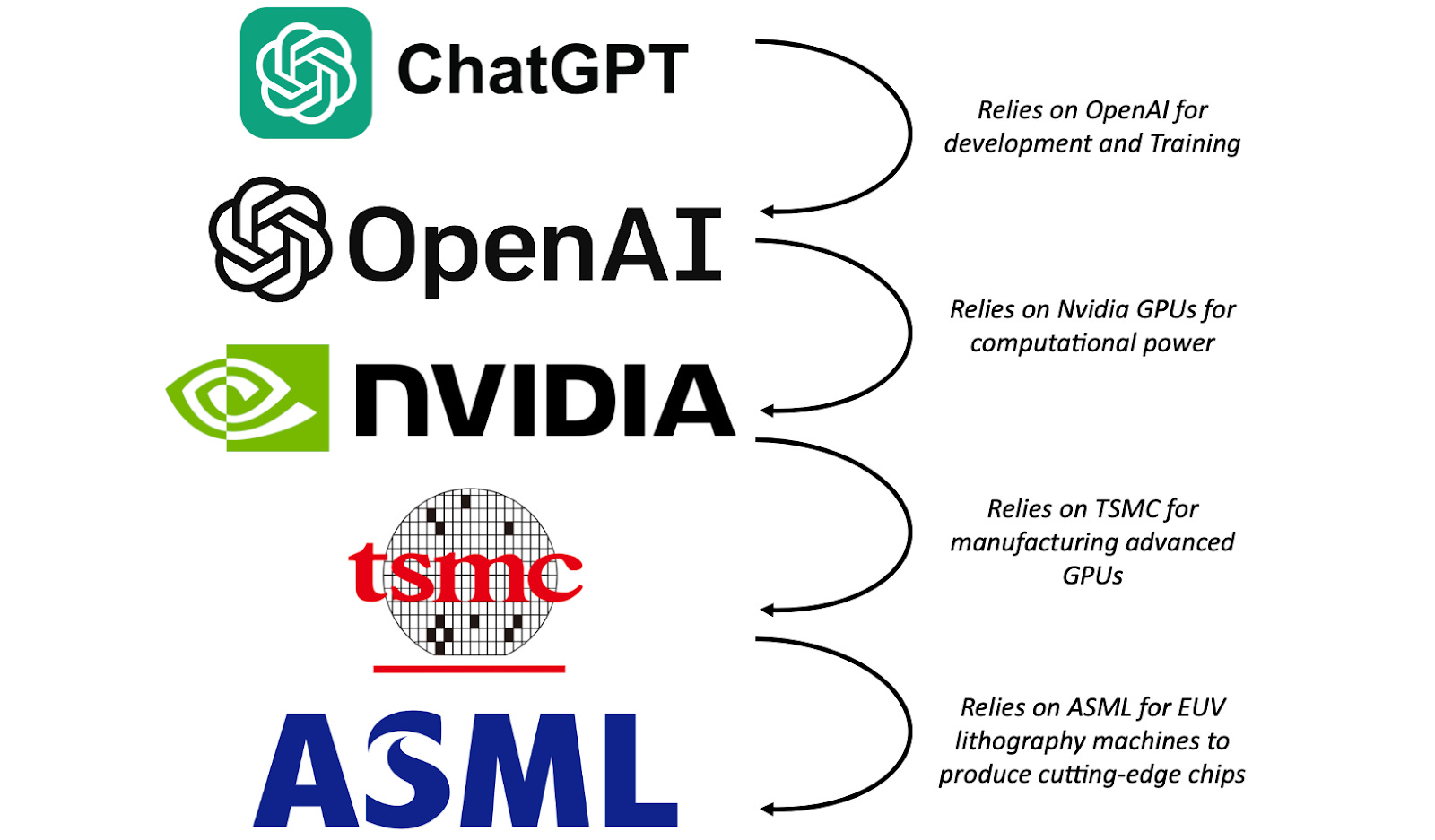
EIEIO…Chips Ahoy!— from dashmedia.co by Michael Moe, Brent Peus, and Owen Ritz
Here Come the AI Worms — from wired.com by Matt Burgess Security researchers created an AI worm in a test environment that can automatically spread between generative AI agents—potentially stealing data and sending spam emails along the way.
Now, in a demonstration of the risks of connected, autonomous AI ecosystems, a group of researchers have created one of what they claim are the first generative AI worms—which can spread from one system to another, potentially stealing data or deploying malware in the process. “It basically means that now you have the ability to conduct or to perform a new kind of cyberattack that hasn’t been seen before,” says Ben Nassi, a Cornell Tech researcher behind the research.
Justice tech — legal tech that helps low-income folks with no or some ability to pay, that assists the lawyers who serve those folks, and that makes the courts more efficient and effective — must contend with a higher hurdle than wooing Silicon Valley VCs: the civil justice system itself.
A checkerboard of technology systems and data infrastructures across thousands of local court jurisdictions makes it nearly impossible to develop tools with the scale needed to be sustainable. Courts are themselves a key part of the access to justice problem: opaque, duplicative and confusing court forms and burdensome filing processes make accessing the civil justice system deeply inefficient for the sophisticated, and an impenetrable maze for the 70+% of civil litigants who don’t have a lawyer.
Noxtua, the first sovereign European legal AI with its proprietary Language Model, allows lawyers in corporations and law firms to benefit securely from the advantages of generative AI. The Berlin-based AI startup Xayn and the largest German business law firm CMS are developing Noxtua as a Legal AI with its own Legal Large Language Model and AI assistant. Lawyers from corporations and law firms can use the Noxtua chat to ask questions about legal documents, analyze them, check them for compliance with company guidelines, (re)formulate texts, and have summaries written. The Legal Copilot, which specializes in legal texts, stands out as an independent and secure alternative from Europe to the existing US offerings.
Gen AI is game-changing technology, directly impacting the way legal work is done and the current law firm-client business model; and while much remains unsettled, within 10 years, Gen AI is likely to change corporate legal departments and law firms in profound and unique ways
Generative artificial intelligence (Gen AI) isn’t a futuristic technology — it’s here now, and it’s already impacting the legal industry in many ways.
Feb 29 (Reuters) – A new venture by a legal technology entrepreneur and a former Kirkland & Ellis partner says it can use artificial intelligence to help lawyers understand how individual judges think, allowing them to tailor their arguments and improve their courtroom results.
The Toronto-based legal research startup, Bench IQ, was founded by Jimoh Ovbiagele, the co-founder of now-shuttered legal research company ROSS Intelligence, alongside former ROSS senior software engineer Maxim Isakov and former Kirkland bankruptcy partner Jeffrey Gettleman.
How Learning Happens — from edutopia.org In this series, we explore how educators can guide all students, regardless of their developmental starting points, to become productive and engaged learners.
These techniques have resonated with educators everywhere: They are focused on taking advantage of the incredible opportunity to help children reach their full potential by creating positive relationships, experiences, and environments in which every student can thrive. In fact, the science is beginning to hint at even more dramatic outcomes. Practices explicitly designed to integrate social, emotional, and cognitive skills in the classroom, the research suggests, can reverse the damages wrought by childhood trauma and stress—while serving the needs of all students and moving them onto a positive developmental and academic path.
Also from edutopia.org recently, see:
How to Introduce Journaling to Young Children— from edutopia.org by Connie Morris Students in preschool through second grade can benefit from drawing or writing to explore their thoughts and feelings.
The symbiotic relationship between reading and writing can help our youngest students grow their emergent literacy skills. The idea of teaching writing at an early age can seem daunting. However, meeting children where they are developmentally can make a journaling activity become a magical experience—and they don’t have to write words but can convey thoughts in pictures.
7 Digital Tools That Help Bring History to Life— from edutopia.org by Daniel Leonard Challenging games, fun projects, and a healthy dose of AI tools round out our top picks for breathing new life into history lessons.
We’ve compiled a list of seven teacher-tested tools, and we lay out how educators are using them both to enhance their lessons and to bring history closer to the present than ever.
New experimental work from Adobe Research is set to change how people create and edit custom audio and music. An early-stage generative AI music generation and editing tool, Project Music GenAI Control allows creators to generate music from text prompts, and then have fine-grained control to edit that audio for their precise needs.
World’s largest projection mapping snags Guinness World Record — from inavateonthenet.net A nightly projection mapping display at the Tokyo metropolitan government headquarters has been recognised by Guinness World Records as the largest in the world.
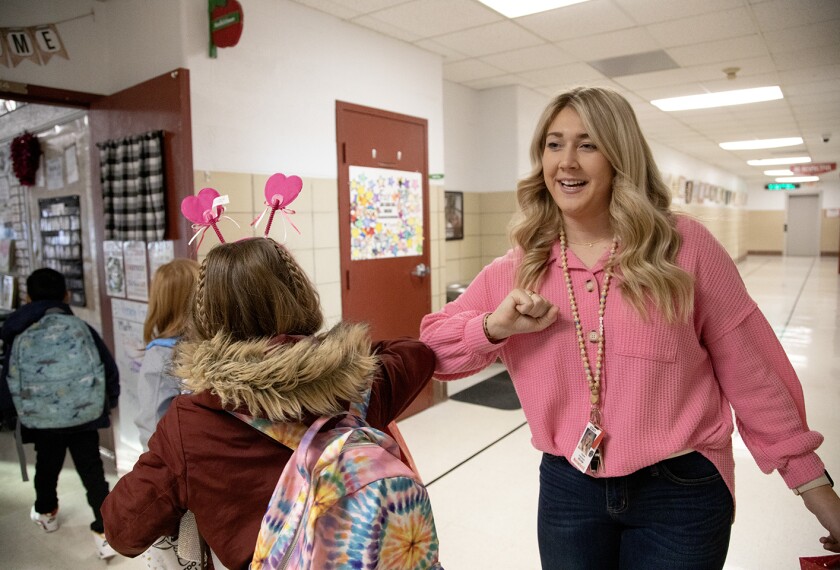
Second grade teacher Kaylee Hutcheson greets her students as they enter their classroom to start their day at Hawthorne Elementary School in Mexico, Mo., on Feb. 14, 2024. |Lisa Krantz for Education Week
Teachers, what if someone told you that engaging in a daily classroom ritual with your students that takes less than five minutes and requires little to no training could improve your students’ mood and behavior immediately, make them more likely to engage in learning, and maybe even elevate your own teaching skills?
Yes, it sounds like a gimmick. But it’s not.
It’s a simple practice that involves greeting each student individually as they walk through the classroom door.
Dave told me that he couldn’t have made Borrowing Time without AI—it’s an expensive project that traditional Hollywood studios would never bankroll. But after Dave’s short went viral, major production houses approached him to make it a full-length movie. I think this is an excellent example of how AI is changing the art of filmmaking, and I came out of this interview convinced that we are on the brink of a new creative age.
We dive deep into the world of AI tools for image and video generation, discussing how aspiring filmmakers can use them to validate their ideas, and potentially even secure funding if they get traction. Dave walks me through how he has integrated AI into his movie-making process, and as we talk, we make a short film featuring Nicolas Cage using a haunted roulette ball to resurrect his dead movie career, live on the show.
In fact a slew of research over the past two decades has found that teaching online makes professors better teachers in their classrooms, so much so that one 2009 study recommended that “faculty should be trained in distance education methods and technologies and should be encouraged to use those methods back in the classroom.”
It’s a message I’ve been arguing for a while. But now that so many educators and students have had direct experience with online formats, it’s a narrative that seems to be sinking in.
Now is the time to fully embrace how physical classrooms can be improved by online techniques.
When professors teaching face-to-face adopt online pedagogy, the classroom is transformed into a “blended” experience, moving from conventional to active learning. And that helps students turn from passive to engaged participants in their own intellectual excursions.
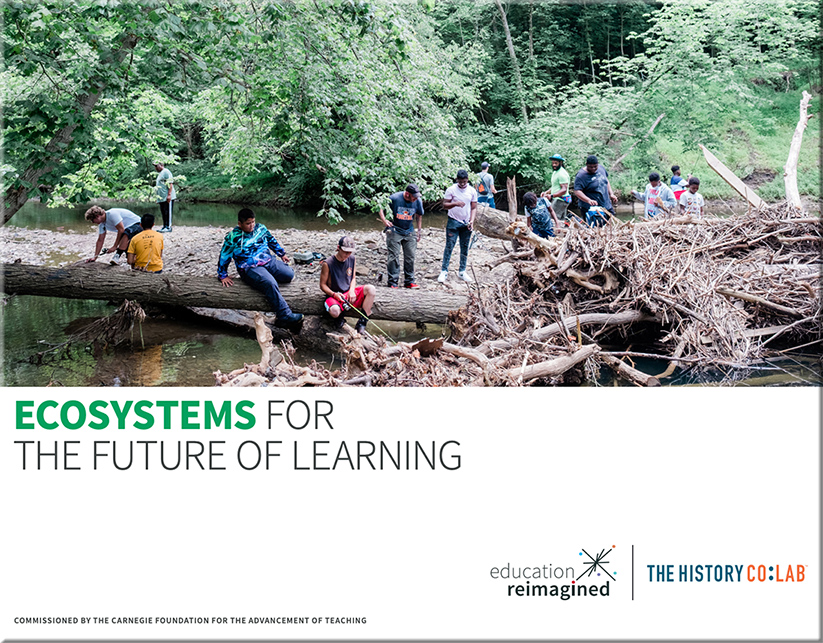
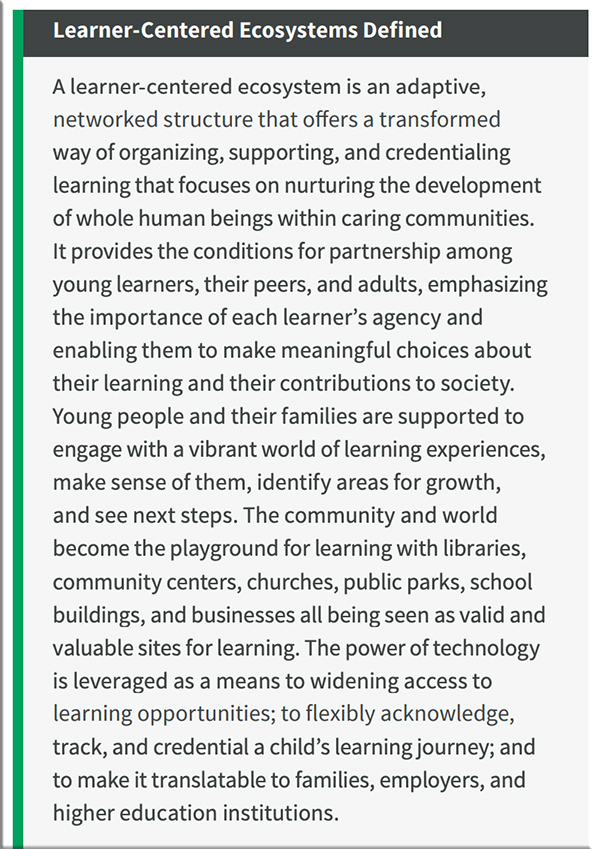
The intent of this report is to help communities build their capacity for transformation of education, advancing toward what our society needs most—a system that works for young people. It draws on the experiences and insights of innovators across the United States who are already answering this challenge—creating learner-centered, community-based ecosystems.
…
This report includes:
a landscape analysis of select communities creating learning ecosystems;
a framework that emerged from the analysis and can be used by communities to consider their readiness and appetite for this transformation;
an invitation to communities to explore and discover their own path for reimagining education; and
a call for national and regional institutions to listen, learn from, and create the conditions for communities to pursue their visions.
From DSC:
The above items was accessed via the article below:
The Norris School District in Wisconsin exemplifies how learner profiles and community connections can enhance authentic learning experiences for young people, fostering a culture of belonging and responsibility.
Purdue Polytechnic High School demonstrates the importance of enabling conditions, such as creating microschools with access to shared services, to support a learner-centered approach while ensuring scalability and access to a variety of resources.
Connecting young people with career awareness needs to start at an early age to provide them with the necessary landscape view of opportunity and skills.
Whether young people engage client-focused opportunities, internships, or endure academically challenging coursework, career-connected learning is an environment to cultivate a sense of self-awareness, determination, and direction, essential for their success in both education and life.
My colleagues and I at the Center for Excellence in Teaching and Learning (CETL) have been reading and discussing Mary C. Wright’s new book Centers for Teaching and Learning: The New Landscape in Higher Education (Johns Hopkins University Press, 2023). Wright identified all the centers for teaching and learning (CTLs) in the United States and then did a content analysis of their websites to see what they were all about. For someone like me, who has spent his career working in CTLs, Wright’s work is a fascinating look at my own field and how it represents itself through mission statements, listings of programs and services, and annual reports.
Thanks for dropping by my Learning Ecosystems blog!
My name is Daniel Christian and this blog seeks to cover the teaching and learning environments within the K-12 (including homeschooling, learning pods/micro-schools), collegiate, and corporate training spaces -- whether those environments be face-to-face, blended, hyflex, or 100% online.
Just as the organizations that we work for have their own learning ecosystems, each of us has our own learning ecosystem. We need to be very intentional about enhancing those learning ecosystems -- as we all need to be lifelong learners in order to remain marketable and employed. It's no longer about running sprints (i.e., getting a 4-year degree or going to a vocational school and then calling it quits), but rather, we are all running marathons now (i.e., we are into lifelong learning these days).


![Teachers are the least empowered, most[-]disrespected, stressed and burned-out of all professions in the U.S. IMAGED CREATED BY DALL-E FOR BRANDON BUSTEED](https://imageio-forbes-com.cdn.ampproject.org/i/s/imageio.forbes.com/specials-images/imageserve/65d8b0ac957e1304a58aea38/Teacher/960x0.png?height=711&width=711&fit=bounds)