Navigating the Changing Landscape of Lifelong Learning — from prsa.org by Susan B. Walton, Ph.D.

The first step to finding the right PR learning program is understanding what’s currently available to learners:

  • Undergraduate and graduate degree programs remain the pathway to earning a college degree in public relations, and now include more online options than ever before.
  • Certificate programs are shorter courses of study that often focus on strengthening specific skills, such as crisis communications or knowledge of a specific industry such as health care. They are offered through professional associations, employers, private entities or academic graduate programs, especially programs geared toward working professionals.
  • Microcertificate or microcredential programs may be even shorter and more focused than certificate programs. They can be a series of short courses and are usually focused on skills needed for a specific employer or job, such as analytical tools for a particular web platform. Successful completion of the microcertificate(s) may earn a microcredential, such as a badge, which can be displayed on the recipient’s social media sites.

If you’re a professional who’s considering jumping back into school, then certificate and microcertificate programs are excellent ways to dip a toe in the water.


On somewhat related notes:

Public Infrastructure on Skills — from the-job.beehiiv.com by Paul Fain
The search for population-level solutions to strengthen links between education and work.

The new Center for Skills by C-BEN seeks to bring clarity and coordination to the skills space. Launched this week with a $1.5M grant from Walmart, the center will attempt to create objective, reliable ways to assess and validate skills, to help bridge the gap between education and the workforce.

The center could help the millions of employers who are looking for skills-based solutions and aren’t going to build their own skills academies, says Clayton Lord, director of foundation programs at SHRM.

“It’s hard for small and mid-sized businesses to find their way into this conversation,” he says. “We can’t create something that is more arduous for employers.”


Closing The Skills Gap: An Inside Look At The Achievement Wallet — from forbes.com by Dr. Sarah DeMark

In the dynamic realm of today’s workforce, skills gaps are increasing. Highly skilled talent is out there, but information gaps and traditional hiring methods make it challenging for skilled talent and employers to find one another. While digital recruiting systems have made it more efficient to find prospective candidates, qualified candidates are often vetted out of the hiring process when they do not match the exact criteria, according to a study conducted by Harvard Business School.

With the rapid pace of change — think automation, new technology, and artificial intelligence — businesses must innovate and think about the best ways to create career mobility and career pathways for their workforces into the roles of tomorrow.

In Pursuit of Agency
Imagine a future where learners can instantly see where they stand in a crowded job market, assess their abilities and gaps, and identify opportunities for growth. Or where employers can identify candidates with specific, often hard-to-spot competencies and skills. Possible? Yes. Western Governors University (WGU), the country’s largest competency-based, workforce-relevant online university, is reimagining that future by deploying the Achievement Wallet for WGU students nationally and working students at educational institutions across the state of Indiana.

Also see:

 

Description:

I recently created an AI version of myself—REID AI—and recorded a Q&A to see how this digital twin might challenge me in new ways. The video avatar is generated by Hour One, its voice was created by Eleven Labs, and its persona—the way that REID AI formulates responses—is generated from a custom chatbot built on GPT-4 that was trained on my books, speeches, podcasts and other content that I’ve produced over the last few decades. I decided to interview it to test its capability and how closely its responses match—and test—my thinking. Then, REID AI asked me some questions on AI and technology. I thought I would hate this, but I’ve actually ended up finding the whole experience interesting and thought-provoking.


From DSC:
This ability to ask questions of a digital twin is very interesting when you think about it in terms of “interviewing” a historical figure. I believe character.ai provides this kind of thing, but I haven’t used it much.


Colleges are now closing at a pace of one a week. What happens to the students? — from hechingerreport.org by Jon Marcus
Most never finish their degrees, and alumni wonder about the value of degrees they’ve earned

About one university or college per week so far this year, on average, has announced that it will close or merge. That’s up from a little more than two a month last year, according to the State Higher Education Executive Officers Association, or SHEEO.

Most students at colleges that close give up on their educations altogether. Fewer than half transfer to other institutions, a SHEEO study found. Of those, fewer than half stay long enough to get degrees. Many lose credits when they move from one school to another and have to spend longer in college, often taking out more loans to pay for it.

Colleges are almost certain to keep closing. As many as one in 10 four-year colleges and universities are in financial peril, the consulting firm EY Parthenon estimates.

Students who transferlose an average of 43 percentof the credits they’ve already earned and paid for, the Government Accountability Office found in the most recent comprehensive study of this problem.

Also relevant:


Smart(er) Glasses: Introducing New Ray-Ban | Meta Styles + Expanding Access to Meta AI with Vision — from meta.com

  • Share Your View on a Video Call
  • Meta AI Makes Your Smart Glasses Smarter
  • All In On AI-Powered Hardware

New Ray-Ban | Meta Smart Glasses Styles and Meta AI Updates — from about.fb.com

Takeaways

  • We’re expanding the Ray-Ban Meta smart glasses collection with new styles.
  • We’re adding video calling with WhatsApp and Messenger to share your view on a video call.
  • We’re rolling out Meta AI with Vision, so you can ask your glasses about what you’re seeing and get helpful information — completely hands-free.


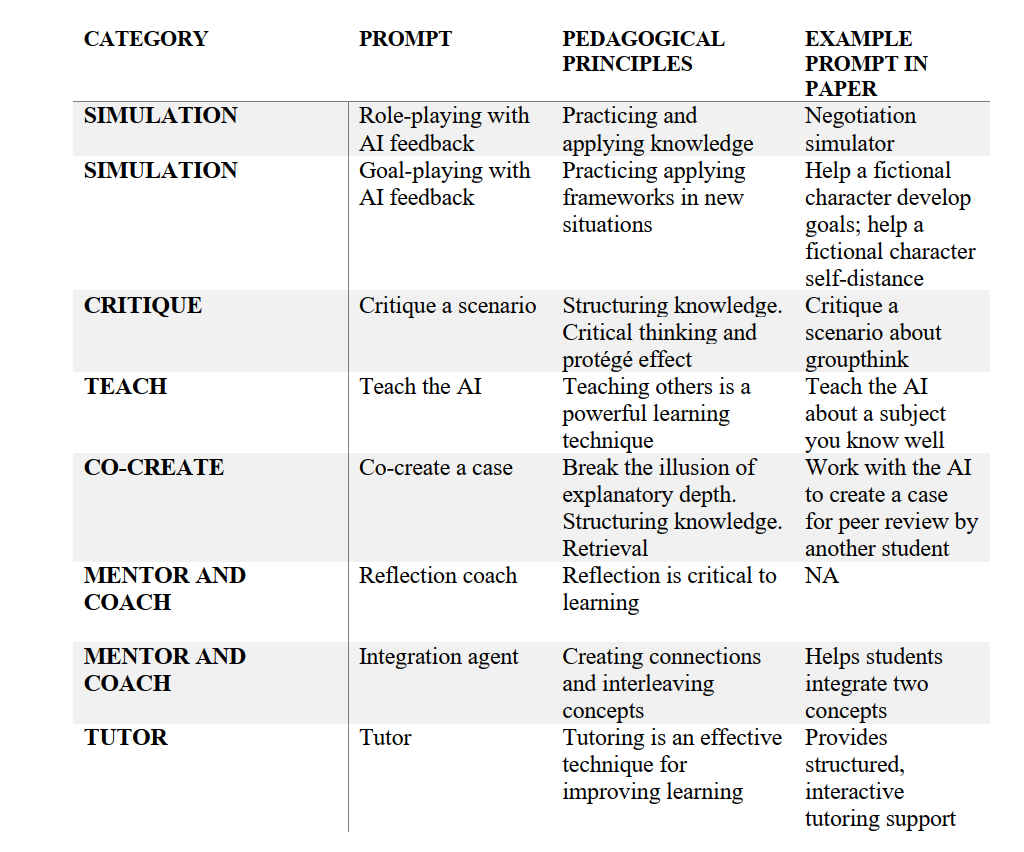
Instructors as Innovators: a Future-focused Approach to New AI Learning Opportunities, With Prompts –from papers.ssrn.com by Ethan R. Mollick and Lilach Mollick

Abstract

This paper explores how instructors can leverage generative AI to create personalized learning experiences for students that transform teaching and learning. We present a range of AI-based exercises that enable novel forms of practice and application including simulations, mentoring, coaching, and co-creation. For each type of exercise, we provide prompts that instructors can customize, along with guidance on classroom implementation, assessment, and risks to consider. We also provide blueprints, prompts that help instructors create their own original prompts. Instructors can leverage their content and pedagogical expertise to design these experiences, putting them in the role of builders and innovators. We argue that this instructor-driven approach has the potential to democratize the development of educational technology by enabling individual instructors to create AI exercises and tools tailored to their students’ needs. While the exercises in this paper are a starting point, not a definitive solutions, they demonstrate AI’s potential to expand what is possible in teaching and learning.


Are we ready to navigate the complex ethics of advanced AI assistants? — from futureofbeinghuman.com by Andrew Maynard
An important new paper lays out the importance and complexities of ensuring increasingly advanced AI-based assistants are developed and used responsibly

Last week a behemoth of a paper was released by AI researchers in academia and industry on the ethics of advanced AI assistants.

It’s one of the most comprehensive and thoughtful papers on developing transformative AI capabilities in socially responsible ways that I’ve read in a while. And it’s essential reading for anyone developing and deploying AI-based systems that act as assistants or agents — including many of the AI apps and platforms that are currently being explored in business, government, and education.

The paper — The Ethics of Advanced AI Assistants — is written by 57 co-authors representing researchers at Google Deep Mind, Google Research, Jigsaw, and a number of prominent universities that include Edinburgh University, the University of Oxford, and Delft University of Technology. Coming in at 274 pages this is a massive piece of work. And as the authors persuasively argue, it’s a critically important one at this point in AI development.

From that large paper:

Key questions for the ethical and societal analysis of advanced AI assistants include:

  1. What is an advanced AI assistant? How does an AI assistant differ from other kinds of AI technology?
  2. What capabilities would an advanced AI assistant have? How capable could these assistants be?
  3. What is a good AI assistant? Are there certain values that we want advanced AI assistants to evidence across all contexts?
  4. Are there limits on what AI assistants should be allowed to do? If so, how are these limits determined?
  5. What should an AI assistant be aligned with? With user instructions, preferences, interests, values, well-being or something else?
  6. What issues need to be addressed for AI assistants to be safe? What does safety mean for this class of technologies?
  7. What new forms of persuasion might advanced AI assistants be capable of? How can we ensure that users remain appropriately in control of the technology?
  8. How can people – especially vulnerable users – be protected from AI manipulation and unwanted disclosure of personal information?
  9. Is anthropomorphism for AI assistants morally problematic? If so, might it still be permissible under certain conditions?
 

The AI Tools in Education Database — from aitoolsdirectory.notion.site; via George Siemens

Since AI in education has been moving at the speed of light, we built this AI Tools in Education database to keep track of the most recent AI tools in education and the changes that are happening every day. This database is intended to be a community resource for educators, researchers, students, and other edtech specialists looking to stay up to date. This is a living document, so be sure to come back for regular updates.


Another Workshop for Faculty and Staff — from aiedusimplified.substack.com by Lance Eaton
A recent workshop with some adjustments.

The day started out with a short talk about AI (slides). Some of it is my usual schtick where I do a bit of Q&A with folks around myths and misunderstandings of generative AI in order to establish some common ground. These are often useful both in setting the tone and giving folks a sense of how I come to explore generative AI: with a mixture of humor, concern, curiosity, and of course, cat pics.

From there, we launched into a series of mini-workshops where folks had time to first play around with some previously created prompts around teaching and learning before moving onto prompts for administrative work. The prompts and other support materials are in this Workshop Resource Document. The goal was to just get them into using one or more AI tools with some useful prompts so they can learn more about its capabilities.


The Edtech Insiders Rundown of ASU+GSV 2024 — from edtechinsiders.substack.com by by Sarah Morin, Alex Sarlin, and Ben Kornell
And more on Edtech Insiders+, upcoming events, Gauth, AI Reading Tutors, The Artificial Intelligence Interdisciplinary Institute, and TeachAI Policy Resources

Alex Sarlin

4. Everyone is Edtech Now
This year, in addition to investors, entrepreneurs, educators, school leaders, university admins, non-profits, publishers, and operators from countless edtech startups and incumbents, there were some serious big tech companies in attendance like Meta, Google, OpenAI, Microsoft, Amazon, Tiktok, and Canva. Additionally, a horde of management consultancies, workforce organizations, mental health orgs, and filmmakers were in attendance.

Edtech continues to expand as an industry category and everyone is getting involved.


Ep 18 | Rethinking Education, Lessons to Unlearn, Become a Generalist, & More — Ana Lorena Fábrega — from mishadavinci.substack.com by Misha da Vinci

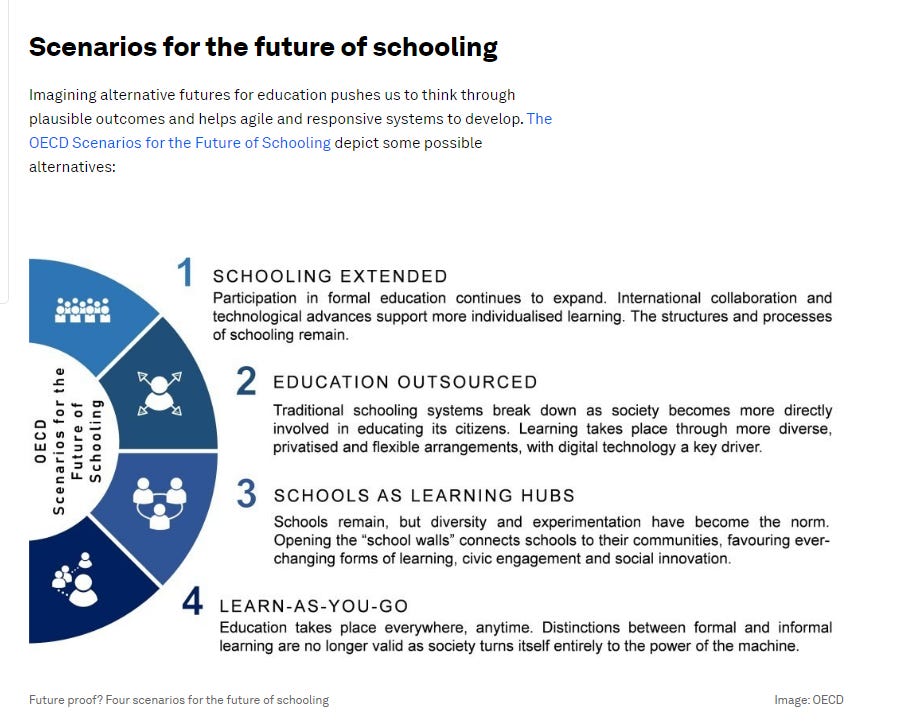
It was such a delight to chat with Ana. She’s brilliant and passionate, a talented educator, and an advocate for better ways of learning for children and adults. We cover ways to transform schools so that students get real-world skills, learn resilience and how to embrace challenges, and are prepared for an unpredictable future. And we go hard on why we must keep learning no matter our age, become generalists, and leverage technology in order to adapt to the fast-changing world.

Misha also featured an item re: the future of schooling and it contained this graphic:


Texas is replacing thousands of human exam graders with AI — from theverge.com by Jess Weatherbed

The Texas Tribune reports an “automated scoring engine” that utilizes natural language processing — the technology that enables chatbots like OpenAI’s ChatGPT to understand and communicate with users — is being rolled out by the Texas Education Agency (TEA) to grade open-ended questions on the State of Texas Assessments of Academic Readiness (STAAR) exams. The agency is expecting the system to save $15–20 million per year by reducing the need for temporary human scorers, with plans to hire under 2,000 graders this year compared to the 6,000 required in 2023.


Debating About AI: An Easy Path to AI Awareness and Basic Literacy — from stefanbauschard.substack.com by Stefan Bauschard
If you are an organization committed to AI literacy, consider sponsoring some debate topics and/or debates next year and expose thousands of students to AI literacy.

Resolved: Teachers should integrate generative AI in their teaching and learning.

The topic is simple but raises an issue that students can connect with.

While helping my students prepare and judging debates, I saw students demonstrate an understanding of many key issues and controversies.

These included—

*AI writing assessment/grading
*Bias
*Bullying
*Cognitive load
*Costs of AI systems
*Declining test scores
*Deep fakes
*Differentiation
*Energy consumption
*Hallucinations
*Human-to-human connection
*Inequality and inequity in access
*Neurodiversity
*Personalized learning
*Privacy
*Regulation (lack thereof)
*The future of work and unemployment
*Saving teachers time
*Soft skills
*Standardized testing
*Student engagement
*Teacher awareness and AI training; training resource trade-offs
*Teacher crowd-out
*Transparency and explainability
*Writing detectors (students had an exaggerated sense of the workability of these tools).


AI Cheatsheet Collection — from enchanting-trader-463.notion.site; via George Siemens
Here are the 30 best AI Cheat Sheets/Guides we collected from the internet


Generative AI: Empower your journey with AI solutions

Empower your journey with AI solutions. Discover, Learn, and Excel in the World of Artificial Intelligence


From The Rundown AI

The Rundown: Adobe just announced a new upgrade to its Firefly image generation model, bringing improvements in image quality, stylization capabilities, speed, and details – along with new AI integrations.

The details:

  • Firefly Image 3 promises new photorealistic quality, improved text rendering, better prompt understanding, and enhanced illustration capabilities.
  • New Structure and Style Reference tools allow users more precise control over generations.
  • Photoshop updates include an improved Generative Fill, Generate Image, Generate Similar, Generate Background, and Enhance Detail.
  • Adobe emphasized training the model on licensed content, with Firefly images automatically getting an AI metadata tag.

Why it matters…


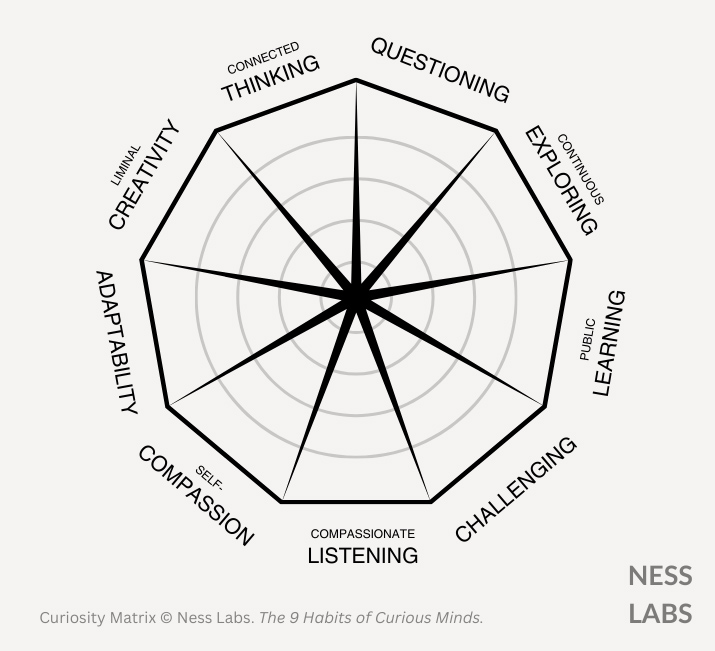
The Curiosity Matrix: 9 Habits of Curious Minds — from nesslabs.com by Anne-Laure Le Cunff; via Roberto Ferraro

As an adaptive trait, curiosity draws us to seek information and new experiences. It’s how we learn about ourselves, others, and the world.

They’re a diverse group of people, but the literature suggests that they share some common habits that support their personal and professional growth.


Wonder Tools | Best apps for building good habits — from wondertools.substack.com by Jeremy Caplan and Andrea Engstrom

Most New Year’s resolutions are buried by now. April’s a great time for a fresh start. So today’s post focuses on simple, useful tools to help you revive a good habit or two. Read on for my favorite app for tracking habits and a few alternatives.

Streaks


Meeting Students’ Needs for Emotional Support — from edutopia.org by Zi Jia Ng
A new survey finds that a large percentage of students don’t feel that they have an adult to turn to at school when they’re troubled.

Only 55 percent of elementary school students (grades three through five), 42 percent of middle school students, and 40 percent of high school students in the United States have an adult at school they can talk to when they feel upset or stressed, according to a survey of more than 200,000 students across 20 different states. At every age, students benefit from a hand to hold, an ear to listen, and a heart to understand them.

Here’s one strategy for helping to ensure that every student has a trusted adult at school.


Getting Middle and High School Students With Low Grades Back on Track — from edutopia.org by Christine Boatman
By sitting down with students and laying out just what they need to do to pass, teachers can give them the tools to succeed.

AN ANTIDOTE TO PROCRASTINATION
There are effective preventive measures that teachers can take to support middle and high school students with time-management and organizational skills. Still, some students inevitably may find themselves behind at the end of the semester and need individualized Tier 2 interventions as a result of their procrastination.

A Tier 2 strategy that teachers can use to support student efforts to pass classes during the end-of-the-semester scramble is the creation of individual PDSA (plan, do, study, act) cycles. A PDSA cycle is a process in which teachers and students work together to create a plan for improvement; implement, or do, the plan; study if the plan’s actions were successful; and act to create long-term improvement actions based on the results of the plan.

In PDSA cycles, teachers work with their students to create plans for success. These plans can be used either with a whole group or on an individual basis. Through working one-on-one with students this way, I’ve seen large gains in student achievement and agency.


A Student’s Perspective on Career and Interview Readiness — from gettingsmart.com by Tyler Robert and Todd Smith

Key Points

  • Sharing experiences in real-world learning is an asset when interviewing for early career opportunities.
  • Building confidence in not only being interviewed but also speaking about your skills in common language is a key part of creating effective pathways.

Asking Students What They Would Do If They Were The Teacher — from thebrokencopier.substack.com by Marcus Luther
one of my favorite practices we’ve normed in our classroom

Though it had been a bit since our previous check-in, the major drop in how students were doing overall was staggering—yet also very much tracked with the “vibe” of the classroom of late: students still feel pretty good about what we’re doing, but overall are exhausted and stressed, each in their own way but collectively as well.

My plan on Monday, then?

To share these results with the entire classroom followed by a simple question:

“If you were the teacher and you saw this feedback, what would you think and, more importantly, what would you do?”

And then I’ll listen to what they have to say.

Reflecting back on my own classroom over the years, though, too often the collecting of the feedback became a dead end as far as how students experienced this: they gave their results and then those results disappeared into the digital ether, in their eyes.


This week in 5 numbers: Education Department voices concern about OPMs — from highereddive.com by Natalie Schwartz
We’re rounding up our top recent stories, from growing worries about 2U’s finances to falling FAFSA submissions from high school seniors.

BY THE NUMBERS

$1.5 billion
The accumulated deficit that 2U has racked up following years of operating losses, according to its financial statements. Student advocacy groups recently called on the U.S. Department of Education to prepare for the “looming collapse” of the online program management company, though 2U has pushed back against those predictions.


5 ways to support today’s online learner — from insidetrack.org
How to help students feel seen, supported and connected as they pursue their programs online

  1. Make online learning learner-centered, demand-driven and career-advancing
  2. Help cultivate a sense of belonging
  3. Reduce barriers to online learning


1 Chronicles 29:10-11 — from biblegateway.com

David’s Prayer

10 David praised the Lord in the presence of the whole assembly, saying,

“Praise be to you, Lord,
    the God of our father Israel,
    from everlasting to everlasting.
11 Yours, Lord, is the greatness and the power
    and the glory and the majesty and the splendor,
    for everything in heaven and earth is yours.
Yours, Lord, is the kingdom;
    you are exalted as head over all.


Why do the nations conspire[a]
    and the peoples plot in vain?
The kings of the earth rise up
    and the rulers band together
    against the Lord and against his anointed, saying,
“Let us break their chains
    and throw off their shackles.”

The One enthroned in heaven laughs;
    the Lord scoffs at them.
He rebukes them in his anger
    and terrifies them in his wrath, saying,
“I have installed my king
    on Zion, my holy mountain.”

I will proclaim the Lord’s decree:

He said to me, “You are my son;
    today I have become your father.
Ask me,
    and I will make the nations your inheritance,
    the ends of the earth your possession.
You will break them with a rod of iron[b];
    you will dash them to pieces like pottery.”

10 Therefore, you kings, be wise;
    be warned, you rulers of the earth.
11 Serve the Lord with fear
    and celebrate his rule with trembling.


Beyond the Hype: Taking a 50 Year Lens to the Impact of AI on Learning — from nafez.substack.com by Nafez Dakkak and Chris Dede
How do we make sure LLMs are not “digital duct tape”?

[Per Chris Dede] We often think of the product of teaching as the outcome (e.g. an essay, a drawing, etc.). The essence of education, in my view, lies not in the products or outcomes of learning but in the journey itself. The artifact is just a symbol that you’ve taken the journey.

The process of learning — the exploration, challenges, and personal growth that occur along the way — is where the real value lies. For instance, the act of writing an essay is valuable not merely for the final product but for the intellectual journey it represents. It forces you to improve and organize your thinking on a subject.

This distinction becomes important with the rise of generative AI, because it uniquely allows us to produce these artifacts without taking the journey.

As I’ve argued previously, I am worried that all this hype around LLMs renders them a “type of digital duct-tape to hold together an obsolete industrial-era educational system”. 


Speaking of AI in our learning ecosystems, also see:


On Building a AI Policy for Teaching & Learning — from by Lance Eaton
How students drove the development of a policy for students and faculty

Well, last month, the policy was finally approved by our Faculty Curriculum Committee and we can finally share the final version: AI Usage Policy. College Unbound also created (all-human, no AI used) a press release with the policy and some of the details.

To ensure you see this:

  • Usage Guidelines for AI Generative Tools at College Unbound
    These guidelines were created and reviewed by College Unbound students in Spring 2023 with the support of Lance Eaton, Director of Faculty Development & Innovation.  The students include S. Fast, K. Linder-Bey, Veronica Machado, Erica Maddox, Suleima L., Lora Roy.

ChatGPT hallucinates fake but plausible scientific citations at a staggering rate, study finds — from psypost.org by Eric W. Dolan

A recent study has found that scientific citations generated by ChatGPT often do not correspond to real academic work. The study, published in the Canadian Psychological Association’s Mind Pad, found that “false citation rates” across various psychology subfields ranged from 6% to 60%. Surprisingly, these fabricated citations feature elements such as legitimate researchers’ names and properly formatted digital object identifiers (DOIs), which could easily mislead both students and researchers.

MacDonald found that a total of 32.3% of the 300 citations generated by ChatGPT were hallucinated. Despite being fabricated, these hallucinated citations were constructed with elements that appeared legitimate — such as real authors who are recognized in their respective fields, properly formatted DOIs, and references to legitimate peer-reviewed journals.

 
© 2025 | Daniel Christian