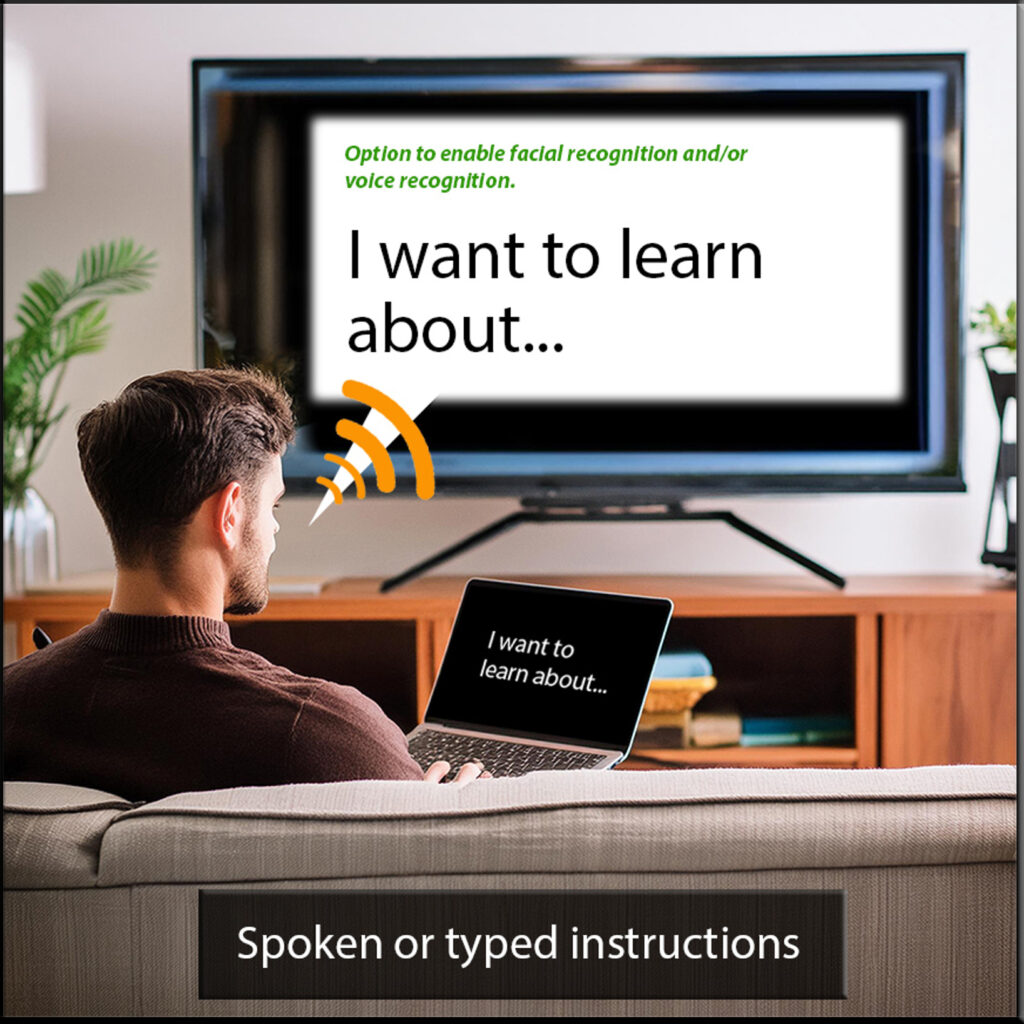
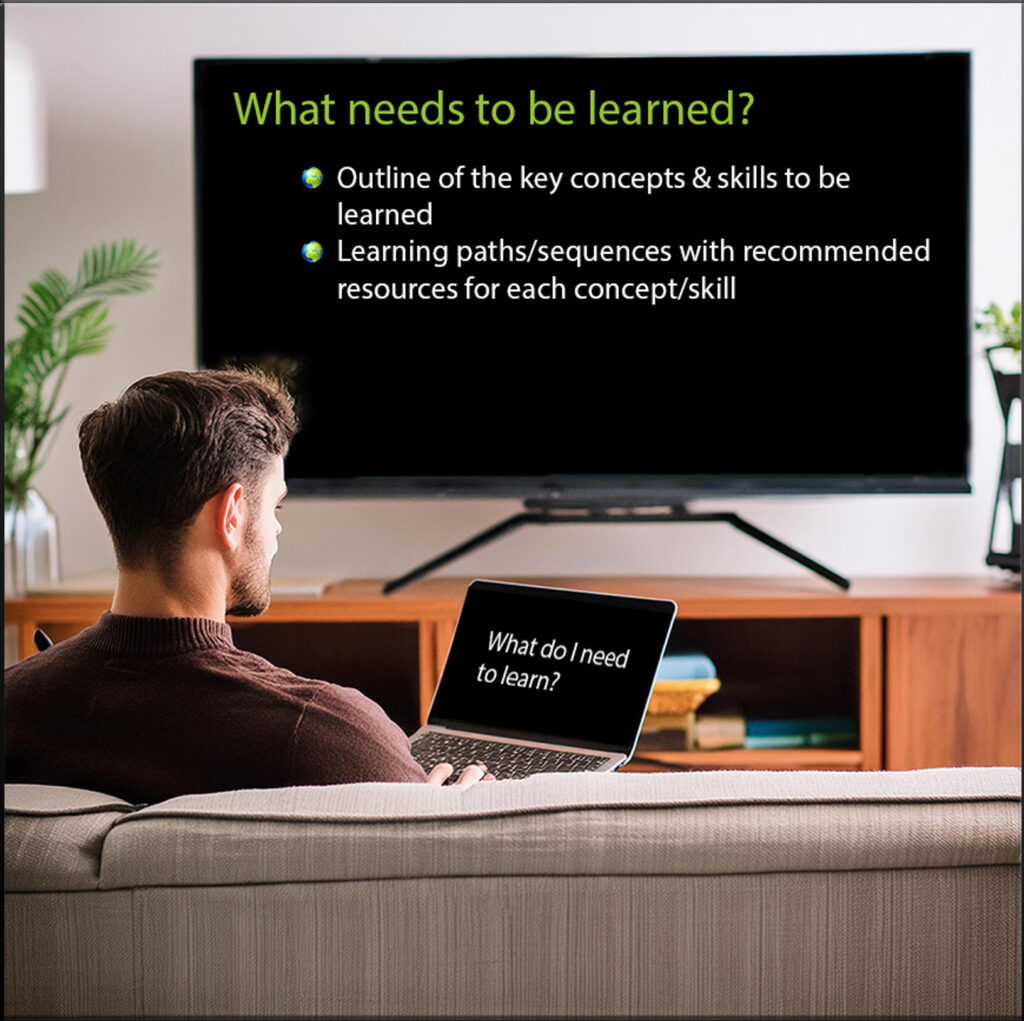
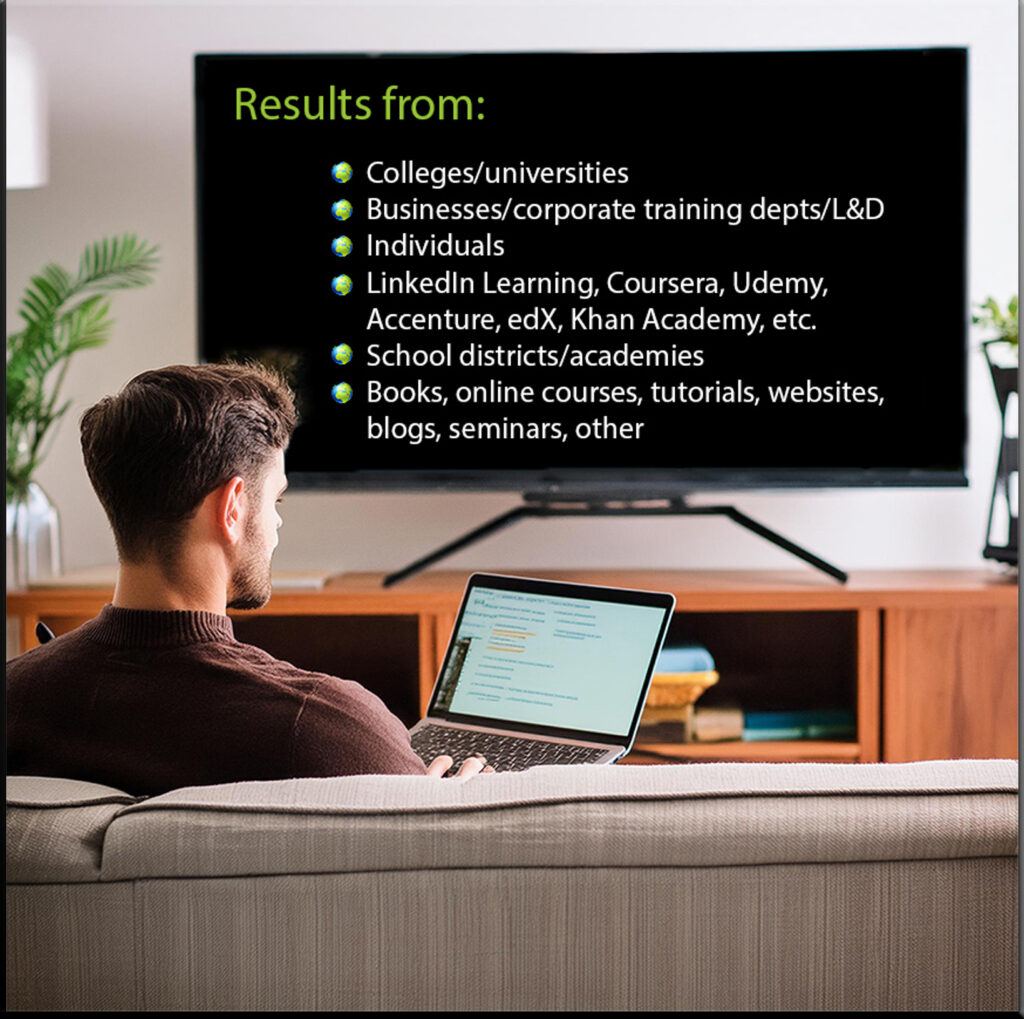
From DSC: Last Thursday, I presented at the Educational Technology Organization of Michigan’s Spring 2024 Retreat. I wanted to pass along my slides to you all, in case they are helpful to you.
Guided by a vision – often captured as a Portrait of a Graduate – co-constructed with local leaders, community members, students, and families, state policymakers can develop policies that equitably and effectively support students and educators in transforming learning experiences.
The Aurora Institute highlights the importance of collaborative efforts in creating education systems that truly meet the diverse needs of every student.
The Aurora Institute has spent years working with states looking to advance competency-based systems, and has identifieda set of key state policy leversthat policymakers can put into action to build more personalized and competency-based systems. These shifts should be guided by a vision–co-constructed with local leaders, community members, students, and families–for what students need to know and be able to do upon graduating.
There has been a move away from the traditional “Bachelor’s or Bust” mentality towards recognizing the value of diverse career pathways that may not necessarily require a four-year degree.
Local entities such as states, school districts, and private organizations have played a crucial role in implementing and scaling up career pathways programs.
While much has been written on this topic (see resources below), this post, in the context of our OECD study of five Anglophone countries, will attempt to provide a backdrop on what was happening at the federal level in the U.S. over the last several decades to help catalyze this shift in career pathways and offer a snapshot of how this work is evolving in two very different states—Delaware and Texas.
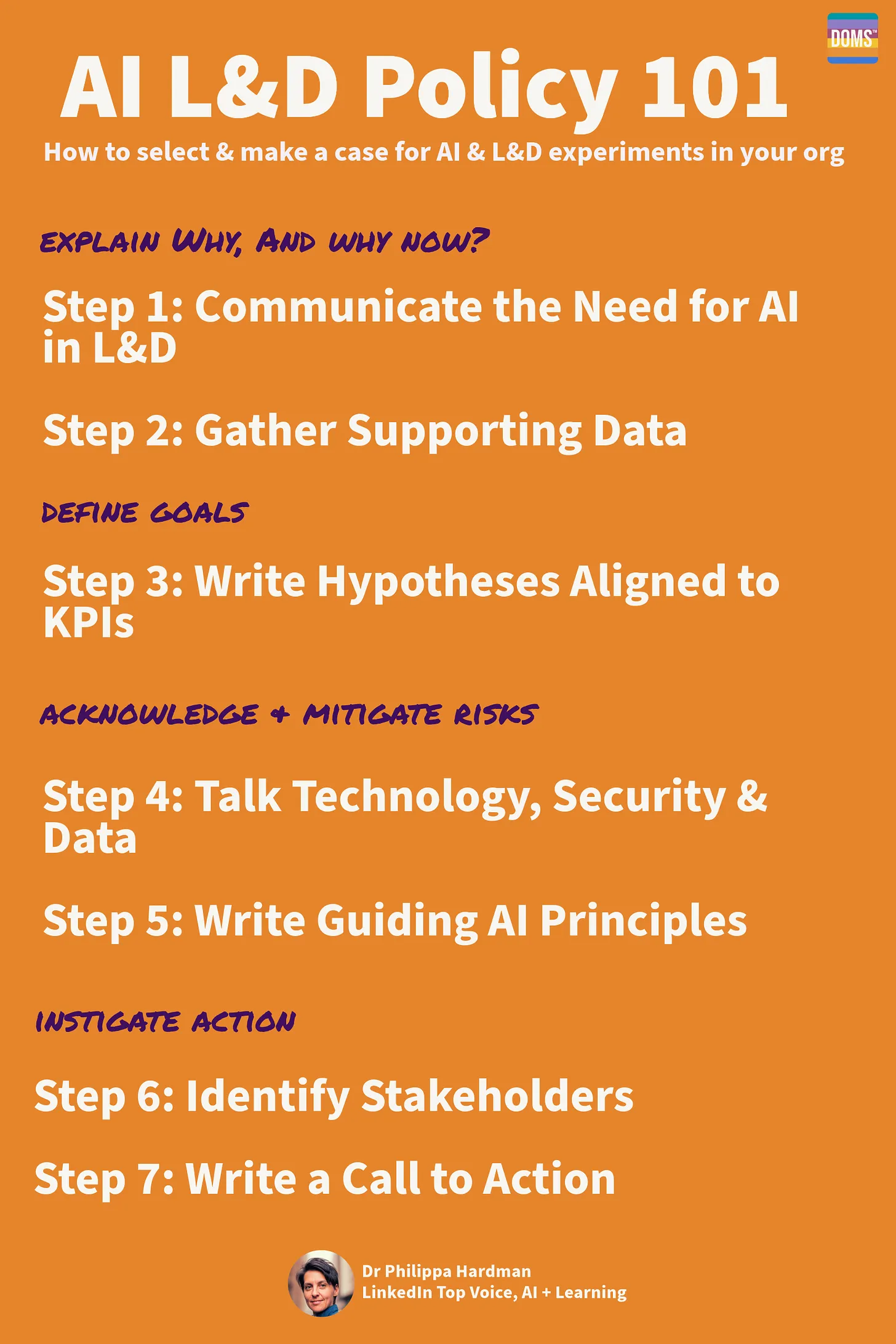
AI Policy 101: a Beginners’ Framework — from drphilippahardman.substack.com by Dr. Philippa Hardman How to make a case for AI experimentation & testing in learning & development
The role of learning & development
Given these risks, what can L&D professionals do to ensure generative AI contributes to effective learning? The solution lies in embracing the role of trusted learning advisors, guiding the use of AI tools in a way that prioritizes achieving learning outcomes over only speed. Here are three key steps to achieve this:
1. Playtest and Learn About AI… 2. Set the Direction for AI to Be Learner-Centered…
3. Become Trusted Learning Advisors…
In the last year, AI has become even more intertwined with our education system. More teachers, parents, and students are aware of it and have used it themselves on a regular basis. It is all over our education system today.
While negative views of AI have crept up over the last year, students, teachers, and parents feel very positive about it in general. On balance they see positive uses for the technology in school, especially if they have used it themselves.
Most K-12 teachers, parents, and students don’t think their school is doing much about AI, despite its widespread use. Most say their school has no policy on it, is doing nothing to offer desired teacher training, and isn’t meeting the demand of students who’d like a career in a job that will need AI.
The AI vacuum in school policy means it is currently used “unauthorized,” while instead people want policies that encourage AI. Kids, parents, and teachers are figuring it out on their own/without express permission, whereas all stakeholders would rather have a policy that explicitly encourages AI from a thoughtful foundation.
There is much discourse about the rise and prevalence of AI in education and beyond. These debates often lack the perspectives of key stakeholders – parents, students and teachers.
In 2023, the Walton Family Foundation commissioned the first national survey of teacher and student attitudes toward ChatGPT. The findings showed that educators and students embrace innovation and are optimistic that AI can meaningfully support traditional instruction.
A new survey conducted May 7-15, 2024, showed that knowledge of and support for AI in education is growing among parents, students and teachers. More than 80% of each group says it has had a positive impact on education.
Apple announced “Apple Intelligence” at WWDC 2024, its name for a new suite of AI features for the iPhone, Mac, and more. Starting later this year, Apple is rolling out what it says is a more conversational Siri, custom, AI-generated “Genmoji,” and GPT-4o access that lets Siri turn to OpenAI’s chatbot when it can’t handle what you ask it for.
SAN FRANCISCO — Apple officially launched itself into the artificial intelligence arms race, announcing a deal with ChatGPT maker OpenAI to use the company’s technology in its products and showing off a slew of its own new AI features.
The announcements, made at the tech giant’s annual Worldwide Developers Conference on Monday in Cupertino, Calif., are aimed at helping the tech giant keep up with competitors such as Google and Microsoft, which have boasted in recent months that AI makes their phones, laptops and software better than Apple’s. In addition to Apple’s own homegrown AI tech, the company’s phones, computers and iPads will also have ChatGPT built in “later this year,” a huge validation of the importance of the highflying start-up’s tech.
The highly anticipated AI partnership is the first of its kind for Apple, which has been regarded by analysts as slower to adopt artificial intelligence than other technology companies such as Microsoft and Google.
The deal allows Apple’s millions of users to access technology from OpenAI, one of the highest-profile artificial intelligence companies of recent years. OpenAI has already established partnerships with a variety of technology and publishing companies, including a multibillion-dollar deal with Microsoft.
The real deal here is that Apple is literally putting AI into the hands of >1B people, most of whom will probably be using AI for the 1st time. And it’s delivering AI that’s actually useful (forget those Genmojis, we’re talking about implanting ChatGPT-4o’s brain into Apple devices).
It’s WWDC 2024 keynote time! Each year Apple kicks off its Worldwide Developers Conference with a few hours of just straight announcements, like the long-awaited Apple Intelligence and a makeover for smart AI assistant, Siri. We expected much of them to revolve around the company’s artificial intelligence ambitions (and here), and Apple didn’t disappoint. We also bring you news about Vision Pro and lots of feature refreshes.
Why Gamma is great for presentations — from Jeremy Caplan
Gamma has become one of my favorite new creativity tools. You can use it like Powerpoint or Google Slides, adding text and images to make impactful presentations. It lets you create vertical, square or horizontal slides. You can embed online content to make your deck stand out with videos, data or graphics. You can even use it to make quick websites.
Its best feature, though, is an easy-to-use application of AI. The AI will learn from any document you import, or you can use a text prompt to create a strong deck or site instantly. .
ChatGPT has 180.5 million users out of which 100 million users are active weekly.
In January 2024, ChatGPT got 2.3 billion website visits and 2 million developers are using its API.
The highest percentage of ChatGPT users belong to USA (46.75%), followed by India (5.47%). ChatGPT is banned in 7 countries including Russia and China.
OpenAI’s projected revenue from ChatGPT is $2billion in 2024.
Running ChatGPT costs OpenAI around $700,000 daily.
Sam Altman is seeking $7 trillion for a global AI chip project while Open AI is also listed as a major shareholder in Reddit.
ChatGPT offers a free version with GPT-3.5 and a Plus version with GPT-4, which is 40% more accurate and 82% safer costing $20 per month.
ChatGPT is being used for automation, education, coding, data-analysis, writing, etc.
43% of college students and 80% of the Fortune 500 companies are using ChatGPT.
A 2023 study found 25% of US companies surveyed saved $50K-$70K using ChatGPT, while 11% saved over $100K.
In an ever-evolving digital landscape, the fusion of technology and legal services has ushered in a new era of efficiency, accessibility, and innovation. The traditional image of legal professionals buried in stacks of paperwork and endless research has been transformed by cutting-edge technologies that promise to revolutionize how legal services are delivered, accessed, and executed. From artificial intelligence to blockchain, cloud computing to automation, the impact of technology on modern legal services is palpable and profound.
Technology Trends Shaping Legal Services The legal industry is experiencing a seismic shift driven by technology, with key trends reshaping legal services. Artificial Intelligence (AI) is revolutionizing legal research, document analysis, and predictive analytics, enabling legal professionals to streamline their workflow and deliver more accurate and timely insights to clients. Blockchain technology improves the safety and transparency of legal transactions, while cloud computing optimizes data storage and accessibility in the legal sector.
A new survey finds that clients care deeply about their attorney’s tech tools and tech skills. The numbers don’t lie: Legal tech matters. An efficient, integrated system is no longer “nice to have.” It’s table stakes, from case management to client communications to online filing and billing.
17 so that Christ may dwell in your hearts through faith. And I pray that you, being rooted and established in love,18 may have power, together with all the Lord’s holy people, to grasp how wide and long and high and deep is the love of Christ,19 and to know this love that surpasses knowledge—that you may be filled to the measure of all the fullness of God.
Yours, Lord, is the greatness and the power and the glory and the majesty and the splendor, for everything in heaven and earth is yours. Yours, Lord, is the kingdom; you are exalted as head over all.
7 “Two things I ask of you, Lord;
do not refuse me before I die: 8 Keep falsehood and lies far from me;
give me neither poverty nor riches,
but give me only my daily bread. 9 Otherwise, I may have too much and disown you
and say, ‘Who is the Lord?’
Or I may become poor and steal,
and so dishonor the name of my God.
We are current and former employees at frontier AI companies, and we believe in the potential of AI technology to deliver unprecedented benefits to humanity.
We also understand the serious risks posed by these technologies. These risks range from the further entrenchment of existing inequalities, to manipulation and misinformation, to the loss of control of autonomous AI systems potentially resulting in human extinction. AI companies themselves have acknowledged these risks [1, 2, 3], as have governments across the world [4, 5, 6] and other AI experts [7, 8, 9].
We are hopeful that these risks can be adequately mitigated with sufficient guidance from the scientific community, policymakers, and the public. However, AI companies have strong financial incentives to avoid effective oversight, and we do not believe bespoke structures of corporate governance are sufficient to change this.
Every six months or so, I write a guide to doing stuff with AI. A lot has changed since the last guide, while a few important things have stayed the same. It is time for an update.
…
To learn to do serious stuff with AI, choose a Large Language Model and just use it to do serious stuff – get advice, summarize meetings, generate ideas, write, produce reports, fill out forms, discuss strategy – whatever you do at work, ask the AI to help. A lot of people I talk to seem to get the most benefit from engaging the AI in conversation, often because it gives good advice, but also because just talking through an issue yourself can be very helpful. I know this may not seem particularly profound, but “always invite AI to the table” is the principle in my book that people tell me had the biggest impact on them. You won’t know what AI can (and can’t) do for you until you try to use it for everything you do. And don’t sweat prompting too much, though here are some useful tips, just start a conversation with AI and see where it goes.
You do need to use one of the most advanced frontier models, however.
Stable Audio Open is an open source text-to-audio model for generating up to 47 seconds of samples and sound effects.
Users can create drum beats, instrument riffs, ambient sounds, foley and production elements.
The model enables audio variations and style transfer of audio samples.
Some comments from Rundown AI:
Why it matters: While the AI advances in text-to-image models have been the most visible (literally), both video and audio are about to take the same leap. Putting these tools in the hands of creatives will redefine traditional workflows — from musicians brainstorming new beats to directors crafting sound effects for film and TV.
Young Americans are quickly embracing generative AI as a tool, but few have yet made it a part of their daily lives, according to new data shared exclusively with Axios from Common Sense Media, Hopelab and the Harvard Graduate School of Education’s Center for Digital Thriving.
Why it matters: Since the rise of the web 30 years ago, young users have typically adopted and shaped each new dominant tech platform.
By the numbers: The survey of 1,274 U.S.-based teens and young adults, conducted in October and November 2023, found that only 4% of respondents, all aged 14-22, said they use AI tools daily or almost daily.
Remember Microsoft’s shiny new AI tool, “Recall”? It’s like your personal time machine, answering questions about your browsing history and laptop activity by taking screenshots every 5 seconds. Sounds cool, right? Well, it gets problematic.
What’s going on here?
Security researchers have found a potential privacy nightmare lurking within this seemingly convenient tool.
What does this mean?
Recall stores all those screenshots in an unencrypted database on your laptop. This means anyone with access to your device could potentially see everything you’ve been doing. Cybersecurity experts are already comparing it to spyware, and one ethical hacker even built a tool called “TotalRecall” (yes, like the movie) that can pull all the information Recall saves. Yikes.
Hybrid learning through podcasts: a practical approach — from timeshighereducation.com by Catherine Chambers Adapting practice-based learning to a blend of synchronous and asynchronous delivery gives learners more control and creates opportunities for real-world learning of skills such as podcast production, writes Catherine Chambers
Hybrid learning provides students with greater control over their learning and enables the development of employability skills, supporting practice-based group work through in situ activities.
Aligned with Keele’s curriculum expectations framework, the module was designed around podcasts to support inclusivity, active learning, digital capability and external engagement.
Is College Worth It? — from pewresearch.org by Richard Fry, Dana Braga, and Kim Parker As economic outcomes for young adults with and without degrees have improved, Americans hold mixed views on the value of college
From DSC: I post items like this in the hopes that those working within the world of higher education will lower the price of obtaining a degree while moving much more aggressively to offer more affordable ways of learning throughout one’s life.
With college costs rising and some students and families questioning the return on investment of a four-year degree, a few pioneering state universities are exploring programs that would grant certain bachelor’s degrees in three years.
The programs, which also are being tried at some private schools, would require 90 credits instead of the traditional 120 for a bachelor’s degree, and wouldn’t require summer classes or studying over breaks. In some cases, the degrees would be designed to fit industry needs.
Despite modern technological advancements in classroom tools, many educational settings still center around a traditional model where the teacher is the primary source of information and students passively receive content.
Slowly, learning environments are inviting students to actively participate and take ownership of their learning through collaborative projects, inquiry-based experiences, and real-world problem-solving, thereby transforming traditional educational roles and practices.
Thanks for dropping by my Learning Ecosystems blog!
My name is Daniel Christian and this blog seeks to cover the teaching and learning environments within the K-12 (including homeschooling, learning pods/micro-schools), collegiate, and corporate training spaces -- whether those environments be face-to-face, blended, hyflex, or 100% online.
Just as the organizations that we work for have their own learning ecosystems, each of us has our own learning ecosystem. We need to be very intentional about enhancing those learning ecosystems -- as we all need to be lifelong learners in order to remain marketable and employed. It's no longer about running sprints (i.e., getting a 4-year degree or going to a vocational school and then calling it quits), but rather, we are all running marathons now (i.e., we are into lifelong learning these days).