Half A Million Students Given ChatGPT As CSU System Makes AI History — from forbes.com by Dan Fitzpatrick

The California State University system has partnered with OpenAI to launch the largest deployment of AI in higher education to date.

The CSU system, which serves nearly 500,000 students across 23 campuses, has announced plans to integrate ChatGPT Edu, an education-focused version of OpenAI’s chatbot, into its curriculum and operations. The rollout, which includes tens of thousands of faculty and staff, represents the most significant AI deployment within a single educational institution globally.

We’re still in the early stages of AI adoption in education, and it is critical that the entire ecosystem—education systems, technologists, educators, and governments—work together to ensure that all students globally have access to AI and develop the skills to use it responsibly

Leah Belsky, VP and general manager of education at OpenAI.


HOW educators can use GenAI – where to start and how to progress — from aliciabankhofer.substack.com by Alicia Bankhofer
Part of 3 of my series: Teaching and Learning in the AI Age

As you read through these use cases, you’ll notice that each one addresses multiple tasks from our list above.

1. Researching a topic for a lesson
2. Creating Tasks For Practice
3. Creating Sample Answers
4. Generating Ideas
5. Designing Lesson Plans
6. Creating Tests
7. Using AI in Virtual Classrooms
8. Creating Images
9. Creating worksheets
10. Correcting and Feedback


What if students had the power to design their own learning journeys?

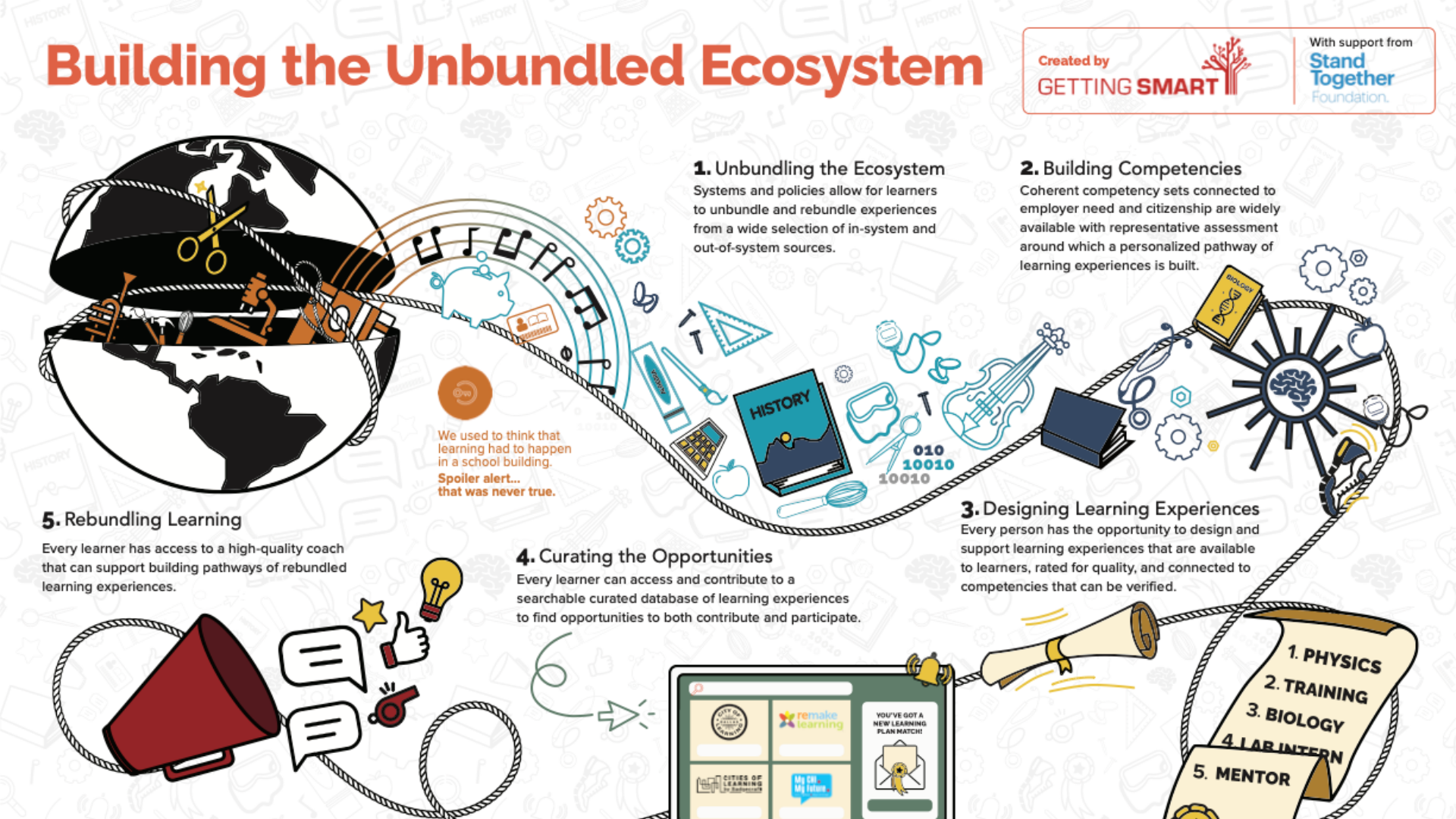
Across the U.S., states are moving beyond one-size-fits-all education and embracing unbundled learning, creating personalized pathways that equip students with the skills they need for the future. Getting Smart’s Unbundled Learning Podcast Series explores how Colorado, Arizona, and New Hampshire are leading the way—expanding real-world learning, shifting to competency-based models, empowering learner agency, and aligning education with workforce needs.

For policymakers, the newly released Policymaker’s Guide offers a roadmap for fostering unbundled systems. It highlights key priorities such as competency-driven accountability, flexible credentialing, and funding models that prioritize equity, helping state leaders create policies that expand opportunities for all learners.

Explore how unbundled learning is shaping the future of education and how states can build more personalized, future-ready systems.

New Pathways > Unbundled Learning — from gettingsmart.com
We used to think that learning had to happen in a school building. Spoiler alert…that was never true.

How might we create an ecosystem where learning doesn’t just happen at school? With Unbundled Learning, learners don’t need permission to have equitable experiences. Unbundled Learning removes all the barriers and allows learning to happen at school, after school, with industry partners and anywhere a learner can imagine. Unbundled Learning is the foundation for which new learning models are built, learners are supported and systems are scaled.

If we used to think that school was the only answer, now we know we have options.
.


Degree in hand, jobs out of reach: Why recent grads are struggling in a competitive market — from cnn.com by Nayeli Jaramillo-Plata; via Ryan Craig

Bellebuono’s story isn’t unique. A recent study from the Federal Reserve Bank of New York reported the widest unemployment gap between new graduates and experienced degree holders since the 1990s.

The struggle to find work
The unemployment gap is partly due to the increase in competition and changing employer expectations, said David Deming, professor of public policy at the Harvard Kennedy School.

Skill requirements for entry-level roles are higher today than a decade ago, he said. But the change has been gradual from year to year.


Wonder Tools: An investigative journalist’s favorites — from wondertools.substack.com by Jeremy Caplan and Madison Hopkins
A field guide to a reporter’s core digital tools

How do investigative journalists organize years of research, thousands of documents, and piles of notes? With toolkits like that of Madison Hopkins, whose Pulitzer Prize-winning reporting has exposed Chicago’s fatal fire safety failures and flawed surveillance programs.

Read on for Madison’s tools for managing long-term investigative projects — from her note-taking system to her workflow for tracking public records. Whether you’re a journalist or manage other kinds of projects, you’ll find multiple resources for your own work. – Jeremy


Also see:

Introducing deep research — from openai.com
An agent that uses reasoning to synthesize large amounts of online information and complete multi-step research tasks for you. Available to Pro users today, Plus and Team next.

[On 2/2/25 we launched] deep research in ChatGPT, a new agentic capability that conducts multi-step research on the internet for complex tasks. It accomplishes in tens of minutes what would take a human many hours.

Deep research is OpenAI’s next agent that can do work for you independently—you give it a prompt, and ChatGPT will find, analyze, and synthesize hundreds of online sources to create a comprehensive report at the level of a research analyst.

Comments/information per The Rundown AI:
The Rundown: OpenAI just launchedDeep Research, a new ChatGPT feature that conducts extensive web research on complex topics and delivers detailed reports with citations in under 30 minutes.

The details:

  • The system uses a specialized version of o3 to analyze text, images, and PDFs across multiple sources, producing comprehensive research summaries.
  • Initial access is limited to Pro subscribers ($200/mo) with 100 queries/month, but if safety metrics remain stable, it will expand to Plus and Team users within weeks.
  • Research tasks take between 5-30 minutes to complete, with users receiving a list of clarifying questions to start and notifications when results are ready.
  • Deep Research achieved a 26.6% on Humanity’s Last Exam, significantly outperforming other AI models like Gemini Thinking (6.2%) and GPT-4o (3.3%).

Why it matters: ChatGPT excels at quick, instant answers, but Deep Research represents the first major consumer attempt at tackling complex tasks that take humans days. Combined with the release of Operator, the landscape is shifting towards longer thinking with autonomous actions — and better results to show for it.

Also see:

The End of Search, The Beginning of OpenAI’s Deep Research — from theaivalley.com by Barsee

The quality of citations are also genuinely advance. Unlike traditional AI-generated sources prone to hallucinations, Deep Research provides legitimate academic references. Clicking a citation often takes users directly to the relevant highlighted text.

In a demo, the agent generated a comprehensive report on iOS and Android app market trends, showcasing its ability to tackle intricate subjects with accuracy.


Top 13 AI insights — from theneurondaily.com

Which links to and discusses Andrej Karpathy’s video at:

.

.

This is a general audience deep dive into the Large Language Model (LLM) AI technology that powers ChatGPT and related products. It is covers the full training stack of how the models are developed, along with mental models of how to think about their “psychology”, and how to get the best use them in practical applications. I have one “Intro to LLMs” video already from ~year ago, but that is just a re-recording of a random talk, so I wanted to loop around and do a lot more comprehensive version.


11 “‘Do not steal.
“‘Do not lie.
“‘Do not deceive one another.

Deuteronomy 6:4-5

4 Hear, O Israel: The Lord our God, the Lord is one. 5 Love the Lord your God with all your heart and with all your soul and with all your strength.

Romans 1:16

16 For I am not ashamed of the gospel, because it is the power of God that brings salvation to everyone who believes: first to the Jew, then to the Gentile.

Psalm 33:4-5

4 For the word of the Lord is right and true; he is faithful in all he does. 5 The Lord loves righteousness and justice; the earth is full of his unfailing love.

13 “‘Do not defraud or rob your neighbor.
“‘Do not hold back the wages of a hired worker overnight.


How to Make Learning as Addictive as Social Media | Duolingo’s Luis Von Ahn | TED — from youtube.com; via Kamil Banc at AI Adopter

When technologist Luis von Ahn was building the popular language-learning platform Duolingo, he faced a big problem: Could an app designed to teach you something ever compete with addictive platforms like Instagram and TikTok? He explains how Duolingo harnesses the psychological techniques of social media and mobile games to get you excited to learn — all while spreading access to education across the world.
.


Eight Legal Tech Trends Set To Impact Law Firms In 2025 — from forbes.com by Daniel Farrar

Trends To Watch This Year

1. A Focus On Client Experience And Technology-Driven Client Services
2. Evolution Of Pricing Models In Legal Services
3. Cloud Computing, Remote Work, Globalization And Cross-Border Legal Services
4. Legal Analytics And Data-Driven Decision Making
5. Automation Of Routine Legal Tasks
6. Integration Of Artificial Intelligence
7. AI In Mergers And Acquisitions
8. Cybersecurity And Data Privacy


The Future of Legal Tech Jobs: Trends, Opportunities, and Skills for 2025 and Beyond — from jdjournal.com by Maria Lenin Laus

This guide explores the top legal tech jobs in demand, key skills for success, hiring trends, and future predictionsfor the legal industry. Whether you’re a lawyer, law student, IT professional, or business leader, this article will help you navigate the shifting terrain of legal tech careers.

Top Legal Tech Hiring Trends for 2025

1. Law Firms Are Prioritizing Tech Skills
Over 65% of law firms are hiring legal tech experts over traditional attorneys.
AI implementation, automation, and analytics skills are now must-haves.
2. In-House Legal Teams Are Expanding Legal Tech Roles
77% of corporate legal teams say tech expertise is now mandatory.
More companies are investing in contract automation and legal AI tools.
3. Law Schools Are Adding Legal Tech Courses
Institutions like Harvard and Stanford now offer AI and legal tech curriculums.
Graduates with legal tech skills gain a competitive advantage.


Legal tech predictions for 2025: What’s next in legal innovation? — from jdsupra.com

  1. Collaboration tools reshape communication and documentation
  2. From chatbots to ‘AI agents’: The next evolution
  3. Governance AI frameworks take center stage
  4. Local governments drive AI accountability
  5. Continuous growing legal fees and ROI become a primary focus

Meet Ivo, The Legal AI That Will Review Your Contracts — from forbes.com by David Prosser

Contract reviews and negotiations are the bread-and-butter work of many corporate lawyers, but artificial intelligence (AI) promises to transform every aspect of the legal profession. Legaltech start-up Ivo, which is today announcing a $16 million Series A funding round, wants to make manual contract work a thing of the past.

“We help in-house legal teams to red-line and negotiate contract agreements more quickly and easily,” explains Min-Kyu Jung, CEO and co-founder of Ivo. “It’s a challenge that couldn’t be solved well by AI until relatively recently, but the evolution of generative AI has made it possible.”


A&O Shearman, Cooley Leading Legal Tech Investment at Law Firms — from news.bloomberglaw.com by Evan Ochsner

  • Leading firms are investing their own resources in legal tech
  • Firms seek to tailor tech development to specific functions
 

LinkedIn’s AI Helps People Hunt for a New Job — from wired.com by Will Knight

LinkedIn is testing a new job-hunting tool that uses a custom large language model to comb through huge quantities of data to help people find prospective roles.

The company believes that artificial intelligence will help users unearth new roles they might have missed in the typical search process.

“The reality is, you don’t find your dream job by checking a set of keywords,” the company’s CEO, Ryan Roslansky, told me in a statement. The new tool, he says, “can help you find relevant jobs you never even knew to search for.”

The move comes as AI continues to change how people use the web.


Book Review: Designing Accessible Learning Content — from learningguild.com by Jane Bozarth

What a great treat to receive a review copy of Susi Miller’s new book! This updated edition of her wonderful Designing Accessible Learning Content: A Practical Guide to Applying Best Practice Accessibility Standards to L&D Resources (2nd edition) is a must-have for anyone trying to make sense of accessibility standards. Updates in this new version include a deep dive into the revised WCAG 2.2 standards, affordances of and concerns about the evolution of AI, and information about the new European Accessibility Act, which puts pressure on commercial endeavors as well as public sector entities to ensure good accessibility practices.


10 Extreme Challenges Facing Schools — from stefanbauschard.substack.com by Stefan Bauschard

TL;DR
Schools face 10 extreme challenges

– assessment
– funding
– deportations
– opposition to trans students
– mental health
– AI/AGI world
– a struggle to engage students
– too many hats
– war risks
– resource redistribution and civil conflict


Hundreds of thousands of students are entitled to training and help finding jobs. They don’t get it — from hechingerreport.org by Meredith Kolodner
The best program to help students with disabilities get jobs is so hidden, ‘It’s like a secret society’

There’s a half-billion-dollar federal program that is supposed to help students with disabilities get into the workforce when they leave high school, but most parents — and even some school officials — don’t know it exists. As a result, hundreds of thousands of students who could be getting help go without it. New Jersey had the nation’s lowest proportion — roughly 2 percent — of eligible students receiving these services in 2023.

More than a decade ago, Congress recognized the need to help young people with disabilities get jobs, and earmarked funding for pre-employment transition services to help students explore and train for careers and send them on a pathway to independence after high school. Yet, today, fewer than 40 percent of people with disabilities ages 16 to 64 are employed, even though experts say most are capable of working.

The article links to:

Pre-Employment Transition Services

Both vocational rehabilitation agencies and schools are required by law to provide certain transition services and supports to improve post-school outcomes of students with disabilities.

The Workforce Innovation and Opportunity Act (WIOA) amends the Rehabilitation Act of 1973 and requires vocational rehabilitation (VR) agencies to set aside at least 15% of their federal funds to provide pre-employment transition services (Pre-ETS) to students with disabilities who are eligible or potentially eligible for VR services.  The intent of pre-employment transition services is to:

improve the transition of students with disabilities from school to postsecondary education or to an employment outcome, increase opportunities for students with disabilities to practice and improve workplace readiness skills, through work-based learning experiences in a competitive, integrated work setting and increase opportunities for students with disabilities to explore post-secondary training options, leading to more industry recognized credentials, and meaningful post-secondary employment.


Repurposing Furniture to Support Learning in the Early Grades — from edutopia.org by Kendall Stallings
A kindergarten teacher gives five practical examples of repurposing classroom furniture to serve multiple uses.

I’m a supporter of evolving classroom spaces—of redesigning the layout of the room as the needs and interests of students develop. The easiest way to accommodate students, I’ve found, is to use the furniture itself to set up a functional, spacious, and logical classroom. There are several benefits to this approach. It provides children with safe, low-stakes environmental changes; fosters flexibility; and creates opportunities for spatial adaptation and problem-solving. Additionally, rearranging the room throughout the school year enables teachers to address potential catalysts for challenging behaviors and social conflicts that may arise, while sparking curiosity in an otherwise-familiar space.


How Teacher-Generated Videos Support Students in Science — from edutopia.org by Shawn Sutton
A five-minute video can help students get a refresher on important science concepts at their own pace.

While instructional videos were prepared out of necessity in the past, I’ve rediscovered their utility as a quick, flexible, and personal way to enhance classroom teaching. Instructional videos can be created through free screencasting software such as ScreencastifyScreenRecLoom, or OBS Studio. Screencasting would be ideal for the direct presentation of information, like a slide deck of notes. Phone cameras make practical recording devices for live content beyond the computer screen, like a science demo. A teacher could invest in a phone stand and ring light at a nominal cost to assist in this type of recording.

However, not all teacher videos are created equal, and I’ve discovered four benefits and strategies that help make these teaching tools more effective.


Some sharp photography, art, and creativity


DeepSeek: How China’s AI Breakthrough Could Revolutionize Educational Technology — from nickpotkalitsky.substack.com by Nick Potkalitsky
Can DeepSeek’s 90% efficiency boost make AI accessible to every school?

The most revolutionary aspect of DeepSeek for education isn’t just its cost—it’s the combination of open-source accessibility and local deployment capabilities. As Azeem Azhar notes, “R-1 is open-source. Anyone can download and run it on their own hardware. I have R1-8b (the second smallest model) running on my Mac Mini at home.”

Real-time Learning Enhancement

  • AI tutoring networks that collaborate to optimize individual learning paths
  • Immediate, multi-perspective feedback on student work
  • Continuous assessment and curriculum adaptation

The question isn’t whether this technology will transform education—it’s how quickly institutions can adapt to a world where advanced AI capabilities are finally within reach of every classroom.


Over 100 AI Tools for Teachers — from educatorstechnology.com by Med Kharbach, PhD

I know through your feedback on my social media and blog posts that several of you have legitimate concerns about the impact of AI in education, especially those related to data privacy, academic dishonesty, AI dependence, loss of creativity and critical thinking, plagiarism, to mention a few. While these concerns are valid and deserve careful consideration, it’s also important to explore the potential benefits AI can bring when used thoughtfully.

Tools such as ChatGPT and Claude are like smart research assistants that are available 24/7 to support you with all kinds of tasks from drafting detailed lesson plans, creating differentiated materials, generating classroom activities, to summarizing and simplifying complex topics. Likewise, students can use them to enhance their learning by, for instance, brainstorming ideas for research projects, generating constructive feedback on assignments, practicing problem-solving in a guided way, and much more.

The point here is that AI is here to stay and expand, and we better learn how to use it thoughtfully and responsibly rather than avoid it out of fear or skepticism.


Beth’s posting links to:


Derek’s posting on LinkedIn


From Theory to Practice: How Generative AI is Redefining Instructional Materials — from edtechinsiders.substack.com by Alex Sarlin
Top trends and insights from The Edtech Insiders Generative AI Map research process about how Generative AI is transforming Instructional Materials

As part of our updates to the Edtech Insiders Generative AI Map, we’re excited to release a new mini market map and article deep dive on Generative AI tools that are specifically designed for Instructional Materials use cases.

In our database, the Instructional Materials use case category encompasses tools that:

  • Assist educators by streamlining lesson planning, curriculum development, and content customization
  • Enable educators or students to transform materials into alternative formats, such as videos, podcasts, or other interactive media, in addition to leveraging gaming principles or immersive VR to enhance engagement
  • Empower educators or students to transform text, video, slides or other source material into study aids like study guides, flashcards, practice tests, or graphic organizers
  • Engage students through interactive lessons featuring historical figures, authors, or fictional characters
  • Customize curriculum to individual needs or pedagogical approaches
  • Empower educators or students to quickly create online learning assets and courses

On a somewhat-related note, also see:


© 2025 | Daniel Christian