Frontline Justice — from the-job.beehiiv.com by Paul Fain Campaign seeks to create training standards and certification for a new type of legal job.
Democratizing Legal Help Most Americans struggle with a legal problem at some point, whether it’s a dispute with a landlord or a challenge accessing public benefits. Yet low-income people typically can’t afford a lawyer, and more than 90% fail to get enough help with their civil legal problems.
To expand access to high-quality legal assistance, the nonprofit Frontline Justiceis leading a campaign to develop a new type of job role—frontline legal helpers. As part of that effort, a recently launched task force is working on standards and credentialing for training these workers.
The Big Idea: Community justice workers won’t be lawyers. In fact, the campaign’s leaders say lawyer-only solutions don’t scale, and that focusing on lawyers can exclude people who are closest to the problems of unmet legal needs.
From DSC: I realize that I lose a lot of readers because I put some scripture from the Bible on this blog and I mention the names of Jesus Christ, the Holy Spirit, and our Heavenly Father here as well. I address matters of faith from time to time. So I have hesitated greatly to put anything out here re: politics. I will lose further readership most likely.
But I can no longer be silent on the matter of Donald Trump and the Republican Administration* as a whole. Like many others, I’m very disappointed that our nation elected him — and I think it’s time we Americans took a long, hard look in the mirror on that one.
Donald Trump scorns the Constitution and he seeks to destroy our democracy — something many people have given their lives to develop and support.
He orchestrated the January 6, 2021 insurrection on the U.S. Capitol building. His supporters called for the life of the (then-current) Vice President if he didn’t do what they wanted him to do.
Speaking of the insurrection…Donald Trump is a convicted felon and would have likely lost several more court cases had he not been able to make a MOCKERY of our judicial system. His money, power, and position were able to postpone many of those court cases. As a relevant aside here, who knows how many people were given access to confidential records of the U.S. (for a price no doubt). He should be in jail right now. You and I would have been thrown in jail a looooong time ago. But Donald Trump laughs at justice — he distorts justice.
He acts like a toddler — at most, a junior high school student.
He bullies people and nations.
He threatens retribution if someone doesn’t agree with him.
He belittles people and nations.
He creates massive division, not unity. He reminds me of Adolph Hitler.
He is an embarrassment to the United States. He has destroyed so much diplomatic work and goodwill on the global stage. Our allies — or perhaps I should say former allies now — were shocked to recently hear about Donald Trump’s stances on many things.
And the tariffs aren’t helpful either. They create barriers and will likely increase prices here in the U.S.
I can’t believe a word that comes out of his mouth. For a President of the United States to exhibit this characteristic over and over again, it sets a horrible example for the younger generations to see. It further establishes a culture in America that is NOT the type of culture I want to live in or have my descendants live in. I do not support the type of culture that Donald Trump creates.
I, for one, apologize to the rest of the world that our nation elected him as President. This was a massive mistake.
So I’m beginning to think that the LORD allowed Donald Trump to become President NOT to make America Great Again (MAGA) — as that whole campaign seems to be a lie too — but rather to HUMBLE America.
By the way, I don’t think Donald Trump is a Christian — at all. Besides his hatred of the truth as well as the other items listed above…if he were truly a Christian, he would not have balked at the Bishop’s urging him to be compassionate to others (at his Inauguration). He would have listened to her wisdom. Plus, he would have put his hand on the Bible when he took his oaths.
14 if my people, who are called by my name, will humble themselves and pray and seek my face and turn from their wicked ways, then I will hear from heaven, and I will forgive their sin and will heal their land. .
* In the past, I have voted for members of the Republican and Democratic Parties — Presidents, VPs,
Governors, Senators, Representatives, and more. But when Karl Rove & Company started
playing too many games for my taste, I moved towards voting mostly for Democrats.
Assistive tech in your classroom: A practical guide — from understood.org by Andrew M.I. Lee, JD Assistive technology (AT) are tools that let people with differences work around challenges. They make tasks and activities accessible at school, work, and home. Learn how AT apps and software can help with reading, writing, math, and more.
People who learn and think differently can use technology to help work around their challenges. This is called assistive technology (AT). AT helps people with disabilities learn, communicate, or function better. It can be as high-tech as a computer, or as low-tech as a pencil grip. It’s a type of accommodation that involves tools.
Assistive technology has two parts: devices (the actual tools people use) and services (the support to choose and use the tools).
Students who struggle with learning can use AT to help with subjects like reading, writing, and math. AT can also help kids and adults with the tasks of daily life. And many adults use these tools on the job, too. .
The legal industry is experiencing swift changes, with technology becoming an ever more crucial factor in its evolution. As law firms respond to shifting client demands and regulatory changes, the pace of change is accelerating. Embracing legal tech is no longer just an advantage; it’s a necessity.
According to a Forbes report, 66% of legal leaders acknowledge this trend and intend to boost their investments in legal tech moving forward. From artificial intelligence streamlining workflows to cloud computing enabling globalized legal services, the legal landscape is undergoing a digital revolution.
In this article, we’ll explore five key legal tech trends that will define how law firms operate in 2025.
A new study from the Blickstein Group reveals some distributing trends for law firms that represent businesses, particularly large ones. The Study is entitled Legal Service Delivery in the Age of AI. The Study was done jointly by FTI Technologies, a consulting group, and Blickstein. It looks at law department legal operations.
The Findings
GenAI Use by Legal Ops Personnel
The responses reflect a bullish view of what GenAI can do in the legal marketplace but also demonstrate GenAi has a ways to go:
Almost 80% of the respondents think that GenAI will become an “essential part of the legal profession.
81% believe GenAi will drive improved efficiencies
Despite this belief, only some 30% have plans to purchase GenAI tools. For 81%, the primary reason for obtaining and using GenAI tools is the efficiencies these tools bring.
52% say their GenAI strategy is not as sophisticated as they would like or nonexistent.
The biggest barrier to the use of GenAI among the legal ops professions is cost and security concerns and the lack of skilled personnel available to them.
Voting has now closed and your votes have been tallied to pick the 15 legal tech startups that will get to participate as finalists in the ninth-annual Startup Alley at ABA TECHSHOW 2025, taking place April 2-5 in Chicago.
These 15 finalists will face off in an opening-night pitch competition that is the opening event of TECHSHOW, with the conference’s attendees voting at the conclusion of the pitches to pick the top winners.
Generative artificial intelligence (GenAI) has brought a new wave of opportunities to the legal profession, opening doors to greater efficiency and innovation. Its rapid development has also raised questions about its integration within the legal industry. As legal professionals are presented with more options for adopting new technologies, they now face the important task of understanding how GenAI can be seamlessly — and ethically — incorporated into their daily operations.
The court reporting industry is evolving rapidly, propelled by technological advancements and the increasing demand for efficiency in the legal sector. For 2025, trends such as artificial intelligence (AI), real-time transcription technologies, and data-driven tools are reshaping how legal professionals work. Here’s an overview of these emerging trends and five reasons law firms should embrace these advancements.
Employers and opportunity seekers are excited about the possibilities of a skills-based ecosystem, but this new process for codifying a person’s experiences and abilities into skills requires one significant, and missing, piece: Trust.Employers need to trust that the credentials they receive from opportunity seekers are valid representations of their skills. Jobseekers need to trust that their digital credentials are safe, accurate, and will lead to employment and advancement.
Our hypothesis
We posit that the trust needed for the validation of skills to be brought into a meaningful reality is established through a network of skills validation methods and opportunities. We also recognize that the routes through which an individual can demonstrate skills are as varied as the individuals themselves. Therefore, in order to equitably create a skills-based employment ecosystem, the routes by which skills are validated must be held together with common standards and language, but flexible enough to accommodate a multitude of validation practices.
The L&D Global Sentiment Survey, now in its 12th year, once again asked two key questions of L&D professionals worldwide:
What will be hot in workplace learning in 2025?
What are your L&D challenges in 2025?
For the obligatory question on what they considered ‘hot’ topics, respondents voted for one to three of 15 suggested options, plus a free text ‘Other’ option. Over 3,000 voters participated from nearly 100 countries. 85% shared their challenges for 2025.
The results show more interest in AI, a renewed focus on showing the value of L&D, and some signs of greater maturity around our understanding of AI in L&D.
“The good news is, though, with early intervention and with the appropriate types of modifications and intervention, people with dyslexia thrive in today’s world.”
From DSC: I have a retired friend who is dyslexic and, to this very day, feels the pain of being told — and treated like — he was stupid in the majority of his K-12 years. He later went on to get trained on how to operate missiles, solve a variety of highly technical IT-related problems, set up networks, run security departments, and more. He is a highly intelligent individual. But he is dsylexic. And he recalls the pain of those early education days.
I’m glad that we’ve made some significant progress in understanding dsylexia. And I hope that today’s dyslexic students don’t have experiences like his.
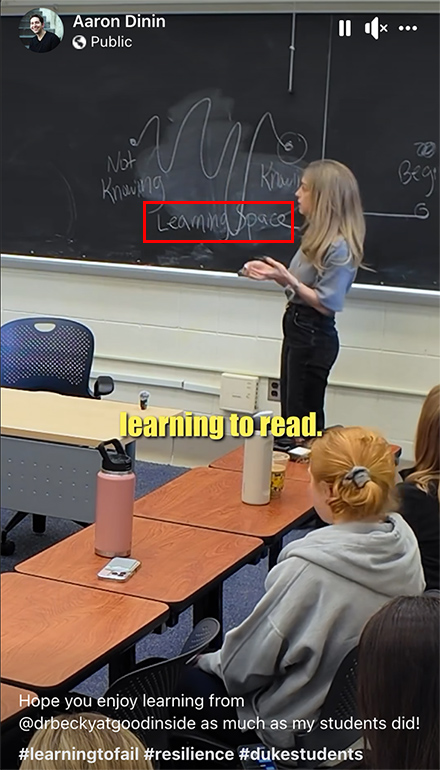
The learning space is that space between “not knowing” and “knowing.” It can be very frustrating. But don’t be discouraged when you are frustrated. It means that you are learning. Eventually, you’ll get to “knowing.” .
When education is limited, so is opportunity. Without education, students with disabilities face higher rates of poverty, unemployment, poor health, and social isolation. Education is the foundation for independence, inclusion, and a future with choices. Strip it away, and we are not just limiting potential—we are forcing millions of people into a lifetime of barriers and hardship.
This issue is personal for me. As a former deputy assistant secretary in the Department of Education’s Office of Special Education and a lifelong advocate for disability rights, I have seen firsthand what happens when children with disabilities face barriers—and how the Department of Education steps in to make things right.
An excerpt from Derek Bruff’s newsletter entitled, “Digital reading, belonging stories, escape rooms, and more”
Course Contributors
At the Top Hat Engage conference last week, I met Whitney Silvis-Sawyer, who teaches education courses at Louisiana Tech University. She regularly invites her students to provide feedback on her courses, and when she makes a change to a course in response to student feedback, she acknowledges that student by name (and with permission) in a “course contributors” section of her syllabus.Some of her course syllabi now have dozens of students listed who have helped shape her courses. I love this as a way to help students see that you take their feedback seriously and as a way to acknowledge sources of inspiration for one’s teaching.
… In-Class Escape Rooms
Over on Bluesky, I was delighted to see that Lisa Fazio, who teaches psychology at Vanderbilt University, shared images of the escape room activity she designed as a review for her social cognition course. Her students worked in teams of four to complete a series of puzzles and open a number of combination locks, all of which required them to apply social cognition concepts they had been studying. Lisa writes, “Watching them race through the puzzles today brought me joy!” See Lisa’s thread for all the details.
Designing the Classroom of the Future: 5 Easy Pieces — from ed-spaces.com by Leslie Stebbins When designing new classrooms the most important factors to consider are designs that encourage movement, provide space for collaborative and independent work, seamlessly embed technology, promote creativity, and provide flexibility.
Design for Movement: Sitting is the new smoking!
Build for Collaboration and Independent Work
Embed Technology Seamlessly: Clean up your Cables!
3 Ways to Begin to Develop Preschoolers’ Literacy Skills— from edutopia.org by Jacquelyn Bobien-Blanton Developmentally appropriate activities focused on foundational reading skills can help young children have fun while they learn.
7 Learning Myths Your Students Probably Believe — from edutopia.org by Daniel Leonard
From left- and right-brain thinking to the notion that talent beats persistence, these common myths can hinder student learning. Here’s how teachers can help.
A Triangular Approach to Science Instruction— from edutopia.org by Kristin Acchione
Combining science literacy, data science, and hands-on learning helps get elementary students engaged in science lessons.
AI in K12: Today’s Breakthroughs and Tomorrow’s Possibilities (webinar) How AI is Transforming Classrooms Today and What’s Next
Audio-Based Learning 4.0— from drphilippahardman.substack.com by Dr. Philippa Hardman A new & powerful way to leverage AI for learning?
At the end of all of this my reflection is that the research paints a pretty exciting picture – audio-based learning isn’t just effective, it’s got some unique superpowers when it comes to boosting comprehension, ramping up engagement, and delivering feedback that really connects with learners.
While audio has been massively under-used as a mode of learning, especially compared to video and text, we’re at an interesting turning point where AI tools are making it easier than ever to tap into audio’s potential as a pedagogical tool.
What’s super interesting is how the solid research backing audio’s effectiveness is and how well this is converging with these new AI capabilities.
From DSC: I’ve noticed that I don’t learn as well via audio-only based events. It can help if visuals are also provided, but I have to watch the cognitive loads. My processing can start to get overloaded — to the point that I have to close my eyes and just listen sometimes. But there are people I know who love to listen to audiobooks and prefer to learn that way. They can devour content and process/remember it all. Audio is a nice change of pace at times, but I prefer visuals and reading often times. It needs to be absolutely quiet if I’m tackling some new information/learning.
In Conversation With… Ashton Cousineau — from drphilippahardman.substack.com by Dr. Philippa Hardman A new video series exploring how L&D professionals are working with AI on the ground
In Conversation With… Ashton Cousineau by Dr Philippa Hardman
A new video series exploring how L&D professionals are working with AI on the ground
AI-Infused Learning Design – A structured approach to AI-enhanced assignments using a three-step model for AI integration.
Mathematical Dance and Creativity in STEAM – Using AI-powered motion capture to translate dance movements into mathematical models.
AI-Generated Instructional Videos – How adaptive AI-powered video learning enhances problem-solving and knowledge retention.
Immersive Language Learning with XR & AI – A new framework for integrating AI-driven conversational agents with Extended Reality (XR) for task-based language learning.
Decision-Making in Learning Design – A scoping review on how instructional designers navigate complex instructional choices and make data-driven decisions.
Interactive E-Books and Engagement – Examining the impact of interactive digital books on student motivation, comprehension, and cognitive engagement.
Elevating Practitioner Voices in Instructional Design – A new initiative to amplify instructional designers’ contributions to research and innovation.
Here’s a quick teaser of key developments in the world of AI & learning this month:
DeepSeek R-1, OpenAI’s Deep Seek & Perplexity’s ‘Deep Research’ are the latest additions to a growing number of “reasoning models” with interesting implications for evidence-based learning design & development.
The U.S. Education Dept release an AI Toolkit and a fresh policy roadmap enabling the adoption of AI use in schools.
Anthropic Release “Agentic Claude”, another AI agent that clicks, scrolls, and can even successfully complete e-learning courses…
Oxford University Announce the AIEOU Hub, a research-backed research lab to support research and implementation on AI in education.
“AI Agents Everywhere”: A Forbes peek at how agentic AI will handle the “boring bits” of classroom life.
[Bias klaxon!] Epiphany AI: My own research leads to the creation of a specialised, “pedagogy first” AI co-pilot for instructional design marking the continued growth of specialised AI tools designed for specific industries and workflows.
Through my work with leading educational institutions at Kaltura, I’ve seen firsthand how AI agents are rapidly becoming indispensable. These agents alleviate the mounting burdens on educators and provide new generations of tech-savvy students with accessible, personalized learning, giving teachers the support they need to give their students the personalized attention and engagement they deserve.
This HQ includes all of my AI guides, organized by tool/platform. This list is updated each time a new one is released, and outdated guides are removed/replaced over time.
Artificial intelligence is poised to fundamentally change the job of teaching. AI-powered tools can shave hours off the amount of time teachers spend grading, lesson-planning, and creating materials. AI can also enrich the lessons they deliver in the classroom and help them meet the varied needs of all students. And it can even help bolster teachers’ own professional growth and development.
Despite all the promise of AI, though, experts still urge caution as the technology continues to evolve. Ethical questions and practical concerns are bubbling to the surface, and not all teachers feel prepared to effectively and safely use AI.
In this special report, see how early-adopter teachers are using AI tools to transform their daily work, tackle some of the roadblocks to expanded use of the technology, and understand what’s on the horizon for the teaching profession in the age of artificial intelligence.
Unfortunately, without regulatory protections, we humans will likely become the objective that AI agents are tasked with optimizing.
I am most concerned about the conversational agents that will engage us in friendly dialog throughout our daily lives. They will speak to us through photorealistic avatars on our PCs and phones and soon, through AI-powered glasses that will guide us through our days. Unless there are clear restrictions, these agents will be designed to conversationally probe us for information so they can characterize our temperaments, tendencies, personalities and desires, and use those traits to maximize their persuasive impact when working to sell us products, pitch us services or convince us to believe misinformation. .
The higher education community continues to grapple with questions related to using artificial intelligence (AI) in learning and work. In support of these efforts, we present the 2025 EDUCAUSE AI Landscape Study, summarizing our community’s sentiments and experiences related to strategy and leadership, policies and guidelines, use cases, the higher education workforce, and the institutional digital divide.
Love is patient, love is kind. It does not envy, it does not boast, it is not proud. It does not dishonor others, it is not self-seeking, it is not easily angered, it keeps no record of wrongs.
34 “A new command I give you: Love one another. As I have loved you, so you must love one another. 35 By this everyone will know that you are my disciples, if you love one another.”
In the coming years, AI systems will have a major impact on the ways people work. For that reason, we’re launching the Anthropic Economic Index, an initiative aimed at understanding AI’s effects on labor markets and the economy over time.
The Index’s initial report provides first-of-its-kind data and analysis based on millions of anonymized conversations on Claude.ai, revealing the clearest picture yet of how AI is being incorporated into real-world tasks across the modern economy.
We’re also open sourcing the datasetused for this analysis, so researchers can build on and extend our findings.
The opening weeks of the second Trump administration convince us, as law professors who have spent years studying the American legal system, that we are beginning to see unfold the gravest threat to the rule of law and its constituent principles – the separation of governmental powers, the independence of prosecutorial authority, the inviolability of human rights, the transparency of government action, and the sanctity of constitutional accountability itself – ever presented in our lifetimes. The president’s and his associates’ actions, and threats of action, profoundly undermine the bedrock principle of our federal government system – that the Chief Executive and his agents are constrained by the United States Constitution. The fundamental guardrails of our constitutional democracy itself are threatened and notably battered. They are, as we write, at risk of complete collapse.
Thanks for dropping by my Learning Ecosystems blog!
My name is Daniel Christian and this blog seeks to cover the teaching and learning environments within the K-12 (including homeschooling, learning pods/micro-schools), collegiate, and corporate training spaces -- whether those environments be face-to-face, blended, hyflex, or 100% online.
Just as the organizations that we work for have their own learning ecosystems, each of us has our own learning ecosystem. We need to be very intentional about enhancing those learning ecosystems -- as we all need to be lifelong learners in order to remain marketable and employed. It's no longer about running sprints (i.e., getting a 4-year degree or going to a vocational school and then calling it quits), but rather, we are all running marathons now (i.e., we are into lifelong learning these days).