Railroad-journal dot com -- for those folks who love trains and photography!

From DSC:
My brother-in-law, Bob Bender, captures a lot of great trains out at railroad-journal.com. He has an artistic way of capturing the scenes and he provides a lot of interesting background/information for each picture. If you like trains, you should check his site out! 


Social strikes back — from a16z.com
Social Strikes Back is a series exploring the next generation of social networks and how they’re shaping the future of consumer tech. See more at a16z.com/social-strikes-back.

Excerpt:

Until recently, it was commonly accepted that “social” was done. The market had been fully saturated, the thinking went, dominated by the holy trinity of Facebook, Twitter, and Instagram. Turns out, rumors of social’s demise have been greatly exaggerated. Not only are we seeing the rise of innovative new social networks—from the earshare of Clubhouse to the seamless interactivity of cloud gaming—but having a social component has become a powerful acquisition and retention tool for every consumer product, across education, shopping, fitness, food, entertainment, and more. In this series, we reveal what new social looks like, the forces that are driving it, and how to build it.

Meet Me in the Metaverse — from a16z.com by Jonathan Lai

Excerpts:

There are many competing visions for how we’ll build the Metaverse: a persistent, infinitely-scaling virtual space with its own economy and identity system.

New social modalities will emerge in the Metaverse. Advances in cloud streaming and AI will enable new forms of engagement with friends—for example, the ability to pop into a persistent virtual world and discover new people and experiences together, entirely unplanned.

Live, Social, and Shoppable: The Future of Video — from a16z.com by Connie Chan

Excerpt:

Now, we’re about to enter a whole new era of video-first products that extend far beyond entertainment and gaming. If phase one of video was a laid-back experience, video 2.0 will be far more interactive and participatory, with users engaging with the platform, giving direct feedback on the content, and fundamentally shaping the experience in real time.

Also see:

Edtech’s Answer to Remote Learning Burnout — from a16z.com by Anne Lee Skates and Connie Chan

Excerpt:

While previous generations of edtech largely focused on in-school content distribution, more recently founders have turned their attention to after-school and out-of-school education. There’s a lot left to build. We believe post-COVID online education will differ from the past in key ways.
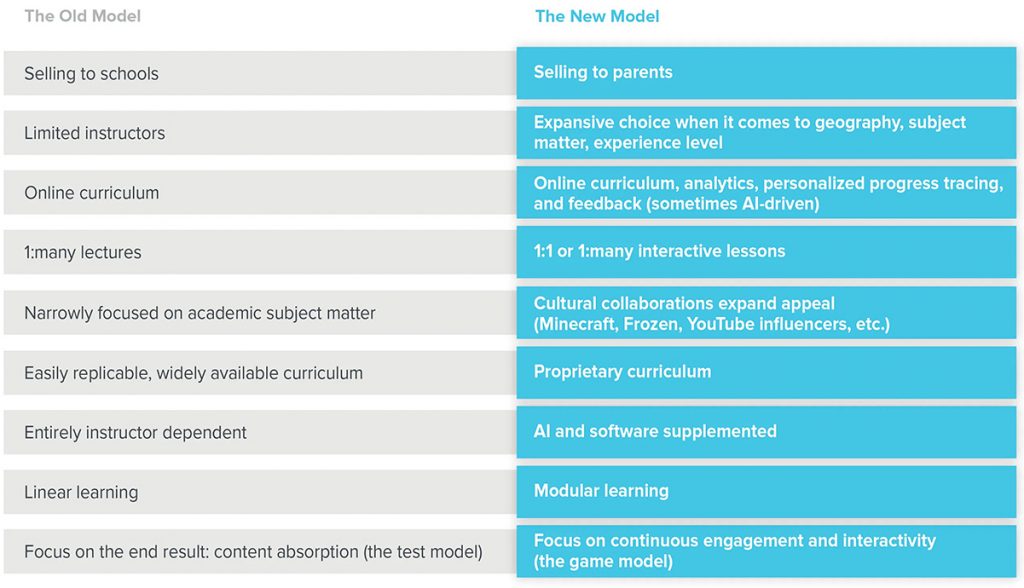
The old and new models of education -- post-COVID online education will differ from the past in key ways.


Some sharp creativity from two artists!!


Campus Consolidation: America’s Higher-Ed Footprint Changes Amid Challenging Times — from fierceeducation.com by Alison Diana

Excerpt:

Beset upon by students unable to afford tuition, the ongoing pandemic, competition between schools, and even some individual’s questioning of a degree’s value, college consolidation continues to reshape the secondary education landscape, and faculty careers in the process.

More than 90 nonprofit universities and colleges shut their doors or announced their intentions to close between January 2016 and February 2020, one industry estimate recorded. And more than 230 institutions, almost 10% of 2,300-plus researched over eight years, could close or merge, given the stressors they face, according to recently published book, The College Stress Test: Tracking Institutional Futures Across a Crowded Market.

In addition, 10% were deemed likely to close and 30% more were expected to struggle, according to Susan Baldridge, a professor at Middlebury College, who co-authored the book with Robert Zemsky, higher education division chair at the University of Pennsylvania, and Susan S. Shaman.


A new category of devices from Cisco -- the Webex Desk Hub

From DSC:
In yesterday’s webexone presentations, Cisco mentioned a new device category, calling it the Webex Desk Hub. It gets at the idea of walking into a facility and grabbing any desk, and making that desk you own — at least for that day and time. Cisco is banking on the idea that sometimes people will be working remotely, and sometimes they will be “going into the office.” But the facilities will likely be fewer and smaller — so one might not have their own office.

In that case, you can plug in your smart device, and things are set up the way they would be if you did have that space as a permanent office.

Applying this concept to the smart classrooms of the future, what might that concept look like for classrooms? A faculty member or a teacher could walk into any room that supports such a setup, put in their personal smart device, and the room conditions are instantly implemented:

  • The LMS comes on
  • The correct class — based on which day it is and then on the particular time of day it is — is launched
  • The lights are dimmed to 50%
  • The electric window treatments darken the room
  • The projector comes on and/or the displays turn on
  • Etc.
 

Google Launches Code Next Connect — from thejournal.com by David Nagel

Excerpt:

Google’s free computer science education program, Code Next, is adding a virtual component and expanding into more states. The launch of the virtual component of the program, called Code Next Connect, was announced as part of Google’s Computer Science Education Week activities yesterday.

The Code Next program is aimed at black and Latinx high school students (primarily grades 10 and 11, but open to all high school students), providing training and experience in coding and leadership and offering mentoring and other experiences for participants.


Cisco to Acquire Best-in-Class Audience Interaction Company, Slido — from blogs.cisco.com

Excerpt:

At Cisco, our goal is to deliver Webex experiences that are 10X better than in-person interactions and an important part of that is making these experiences inclusive and equal for all. We are making sure everyone is included and part of the conversation, whether working from their dining table or in an office building.

Today, I’m pleased to announce Cisco’s intent to acquire privately-held Slido s.r.o., a technology company that provides a best-in-class audience interaction platform. Slido technology enables higher levels of user engagement — before, during and after meetings and events. The Slido technology will be part of the Cisco Webex platform and enhance Cisco’s ability to offer new levels of inclusive audience engagement across both in-person and virtual experiences.

Soon, meeting owners will be able to:

    • Create engaging and dynamic participant experiences with dynamic Q&As and polls using graphic visual representations to express the results clearly.
    • Get real-time critical insights and understanding before, during and after meetings and events, from all-hands and townhalls to conferences and training sessions.
    • Obtain inclusive feedback so every voice is heard.
    • Give presenters the confidence that they are connecting in a meaningful way with their audience.

Also see:

Slido to be acquired by Cisco to help transform virtual meetings — from blog.sli.do


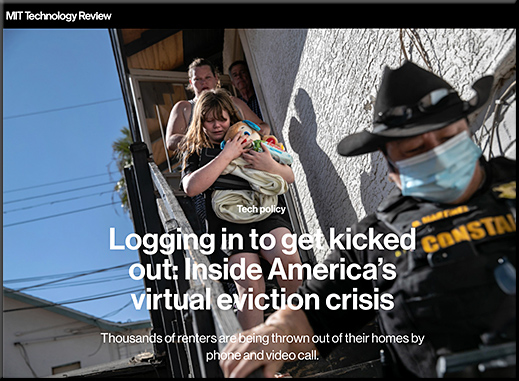
Logging in to get kicked out: Inside America’s virtual eviction crisis -- from technologyreview.com by Eileen Guo

Logging in to get kicked out: Inside America’s virtual eviction crisis — from technologyreview.com by Eileen Guo

Excerpts:

An unprecedented, imperfect moratorium
Before the pandemic, an average of 3.6 million Americans lost their homes to evictions every year, according to Princeton University’s Eviction Lab. By the end of 2020, this number could increase exponentially, with one report from the Aspen Institute estimating that, without further federal aid, between 30 to 40 million people may be at risk of eviction in the next several months. The financial hardship exacerbated by covid-19 has left many in a precarious situation.

.

Legal aid attorneys chart course for 2021 after spike in demand

Legal aid attorneys chart course for 2021 after spike in demand — from law360.com by Justin Wise

Excerpts: (emphasis DSC)

The coronavirus pandemic and the economic downturn it caused sparked a massive spike in demand for legal aid services from America’s most marginalized communities, leaving a field already under-resourced facing even greater strain in 2020.

At the same time, many organizations had to close their offices in the spring and significantly reduce in-person communication with clients to comply with health guidelines. It all amounted to a “pretty crushing” year in which attorneys transitioned to a primarily remote operation with new channels including a COVID-19 legal intake line, Southeast Louisiana Legal Services Executive Director Laura Tuggle said.

Tuggle said 3 in 4 of the calls on the SLLS hotline are from people seeking assistance on matters relating to housing and evictions. Overall, the group has had a 300% increase in eviction cases this year. It also had a 600% increase in unemployment assistance cases in the first few months of the pandemic.

“The most pressing legal need America faces as we enter 2021 is the tsunami of potential evictions that threaten the millions of people who have lost jobs during the pandemic,” LSC Executive Director Ronald Flagg said, pointing to a study showing that evictions can cause increases in COVID-19 cases and deaths.


Addendum on 12/9/20:


Marni Baker Stein on What’s Next For Higher Education — — from gettingsmart.com by Getting Smart Staff

Excerpt:

On this episode of the Getting Smart Podcast, we’re talking with Marni Baker Stein, Provost and Chief Academic Officer at Western Governors University (WGU).

For example, with regards to skills: WGU put together a skills architecture team alongside national competency networks. They then used EMSI, a common way to describe skills, to tag them to a competency and execute dynamic audits of performance.

“Learners desperately need education to organize itself around what they need it to become.”


Digital Credentials: A Better Way to Capture and Communicate Learning — from gettingsmart.com by Tom Vander Ark, Rebecca Midles and Rashawn Caruthers

Excerpt (emphasis DSC):

There is an invention opportunity to better credential units of learning, to open up individual learning pathways, to better communicate capabilities, and to reduce friction in talent transactions.

The pandemic is accelerating this shift to verified credentials. Enrollment in short-term credential classes increased by 70% over last year while freshman college enrollment dropped by 16%.

There are six opportunities to better capture and communicate learning.


The Opportunity for Personalized and Local Guidance — from gettingsmart.com by Tom Vander Ark, Rebecca Midles and Rashawn Caruthers

Excerpt:

There is a big opportunity to create tools that complement advisor efforts to help learners better understand themselves, spot and try out possible futures, make informed decisions about what’s next, and persist through challenges.


5 things we’ve learned about virtual school in 2020 — from npr.org by Anya Kamenetz

Excerpts:

  1. The digital divide is still big and complex.
  2. Relationships are everything when it comes to keeping kids engaged remotely.
  3. Digital teaching can be good, even great with the right support for teachers. But that’s far from the norm.
  4. Hybrid models are extremely challenging.
  5. Some kids are not learning much online. They’ll be playing catch-up in years to come.
 

Survey: Employee Success is Becoming Increasingly Dependent on Automation Skills — from uipath.com by Toni Iafrate; with thanks to Ryan Craig for this resource

Excerpt:

Since the start of the pandemic in particular, digital adoption has accelerated to solve for evolving market conditions, new customer needs and changed employee circumstances. In fact, a new McKinsey study found that 85% of C-suite executives reported a significant acceleration of digitization and automation during the pandemic in an effort to stay agile and maintain continuity amid business disruptions.


DC: This is not right! When will there be justice?! We need to help Native American colleges, universities, & communities out!

The Digital Divide for Tribal College Students — COVID, CARES Act, and Critical Next Steps — from diverseeducation.com

Excerpt:

In this episode staff writer Sara Weissman shares a story that focuses on the digital divide for Native Americans by bringing in voices of tribal college leaders and their students during the COVID 19 pandemic.

Many don’t know but Native American colleges and universities have long struggled with the worst internet connectivity in the nation while ironically paying the highest rates for service. Hear first-hand how students from Diné College and other institutions are currently affected. Carrie Billie (Big Water Clan), President & CEO of the American Indian Higher Education Consortium (AIHEC) and Dr. Cynthia Lindquist (Star Horse Woman), President of Cankdeska Cikana Community College in North Dakota, break down the data and lay out critical next steps necessary to address the digital divide.

Many don’t know but Native American colleges and universities have long struggled with the worst internet connectivity in the nation while ironically paying the highest rates for service.

From DSC:
When will there be justice!? Let’s join in and make amends and provide the funding, concrete assistance, products, and services to Native American colleges, universities, and communities. Some potential ideas:

  • For the short term, could there be Loon balloons deployed immediately to provide free and stronger access to the Internet?

Could Project Loon assist Native American colleges, universities, and communities?

  • Could our Federal Government make amends and do the right thing here? (e-rate program, put Internet access in, make policy changes, offer more grants, other?)
  • Could Silicon Valley assist with hardware and software? For example:
    • Can Apple, HP, Microsoft, and others donate hardware and software?
    • Can Zoom, Adobe, Cisco Webex, Microsoft Teams, and others donate whatever these communities need to provide videoconferencing licenses?
  • Could telecom providers provide free internet access?
  • Could MOOCs offer more free courses?
  • Could furniture makers such as Steelcase, Herman Miller, and others donate furniture and help establish connected learning spaces?
  • How might faculty members and staff within higher education contribute?
  • How could churches, synagogues, and such get involved?
  • Could the rest of us locate and donate to charities that aim to provide concrete assistance to Native American schools, colleges, universities, and communities?

We need to do the right thing here. This is another area* where our nation can do much better.

* Here’s another example/area where we can do much better and make amends/changes.


Addendum on 12/7/20:


From DSC:
The good…

London A.I. lab claims breakthrough that could accelerate drug discovery — from nytimes.com by
Researchers at DeepMind say they have solved “the protein folding problem,” a task that has bedeviled scientists for more than 50 years

This long-sought breakthrough could accelerate the ability to understand diseases, develop new medicines and unlock mysteries of the human body.

…and the not so good…


The Journal 2020 Award Winners

THE Journal 2020 New Product Award Winners

For THE Journal’s first-ever New Product Award program, judges selected winners in 30 categories spanning all aspects of technology innovations in K–12 education, from the classroom to the server room and beyond. We are proud to honor these winners for their outstanding contributions to the institution of education, in particular at this time of upheaval in the way education is being delivered to the nation’s 50 million students.


A New Report and Recommendations: Civil Justice for All — from amacad.org (the American Academy of Arts & Sciences)

Also see:

  • Expiring Eviction Moratoriums and COVID-19 Incidence and Mortality — from papers.ssrn.com by Kathryn Leifheit, Sabriya Linton, Julia Raifman, Gabriel Schwartz, Emily Benfer, Frederick Zimmerman, and Craig Pollack
    Excerpt of Abstract:
    Background: The COVID-19 pandemic and associated economic crisis has rendered millions of U.S. households unable to pay rent, placing them at risk for eviction. Evictions may accelerate COVID-19 transmission by increasing household crowding and decreasing individuals’ ability to comply with social distancing directives. We leveraged variation in the expiration of eviction moratoriums in U.S. states to test for associations between evictions and COVID-19 incidence and mortality.
 
© 2025 | Daniel Christian