Teaching with Amazon Alexa — from Sylvia Martinez

Excerpt:

Alexa is a voice-activated, cloud-based virtual assistant, similar to Siri on Apple devices, or Google Assistant. Alexa is an umbrella name for the cloud-based functionality that responds to verbal commands. Alexa uses artificial intelligence to answer questions or control smart devices, and has a range of “skills” — small programs that you can add to increase Alexa’s capabilities.

Many teachers are experimenting with using smart devices like Alexa in the classroom. Like most other Amazon features and products, Alexa is primarily designed for home use, anticipating that users will be household members. So in thinking about Alexa in a classroom, keeping this in mind will help determine the best educational uses.

Alexa is most often accessed in three ways…


23 Greatest Engineering Highlights from 2020 — from interestingengineering.com by Christopher McFadden
These are some of the greatest engineering highlights from 2020.

23 Greatest Engineering Highlights from 2020


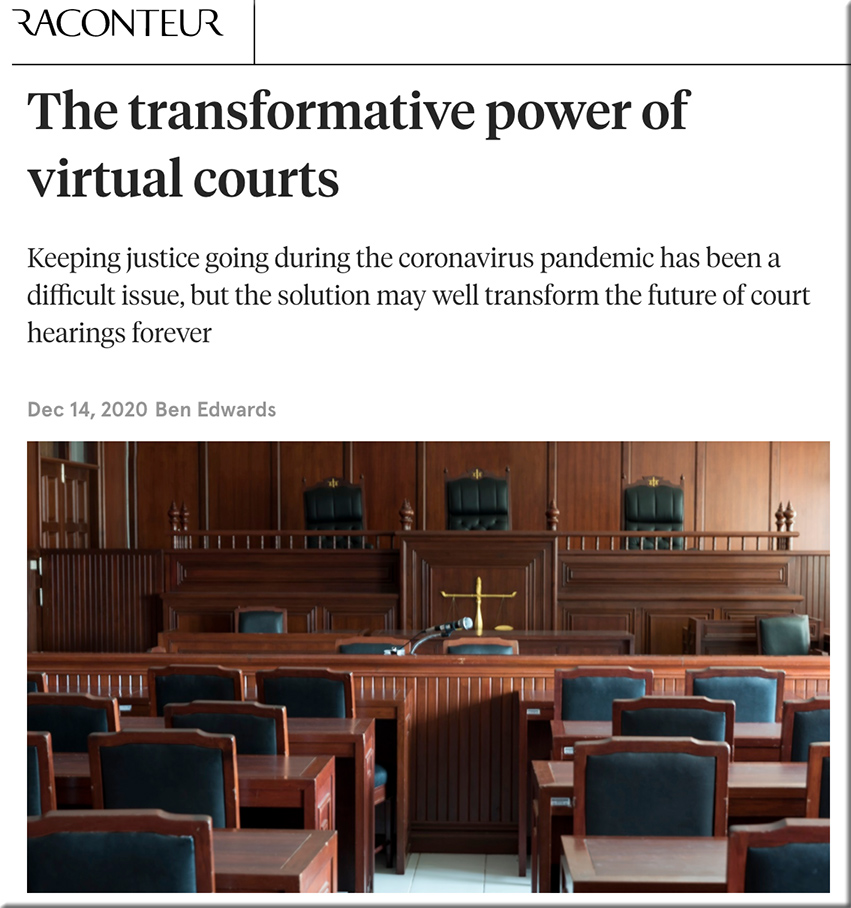
The transformative power of virtual courts

The transformative power of virtual courts — from raconteur.net by Ben Edwards

Excerpt:

At the Odeon cinema in Edinburgh’s Fort Kinnaird retail park, the movie posters have been taken down and the popcorn machines covered up as jurors take their seats in one of the four auditoriums to attend a virtual court hearing.

These remote jury centres have allowed the Scottish High Court to restart criminal trials by beaming live court action directly onto the cinema screen, allowing jurors to watch and hear evidence while maintaining social distancing, something that wouldn’t have been possible inside the main court building. With a further 11 screens available in Glasgow, the court is now back up to full capacity.

“The real beauty in this approach is it provides a way of scaling up; we have a model that works and can be applied anywhere,” says Tim Barraclough, executive director of the Judicial Office for Scotland.

Also see:

Reynen Court Now Lets You Take Legal Tech Products For A Test Drive — from legaltechmonitor.com by Bob Ambrogi

Excerpt:

Reynen Court, the platform that describes itself as the app store for legal technology, has introduced a new feature, appropriately called One-Click Test Drive, that makes it easy for law firms and legal departments to test products without having to buy them or negotiate trial licenses.

Using Test Drive, a user can quickly deploy a pilot of a pre-configured application in a secure environment. The application comes fully loaded with dummy data and transaction or case materials. It can be easily launched without requiring IT support.

Legal Tech Traditionally Favored Law Firms. That May Be Changing — from law.com by Frank Ready
Ironclad’s “State of Digital Contracting, Winter 2020: AI and the Elusive Promise of Smart Contracting” virtual event delved into how changes in service delivery models could help to drive a new wave of legal tech directed toward in-house attorneys and nonlawyers.

Excerpts from Working Remote: Advantages Gained from Legal Technology Adoption — from law.com
In this episode of the Perspectives podcast, sponsored by AbacusNext and hosted on Law.com, we’ll hear highlights from the September 9th presentation titled, Working Remote: Advantages Gained Through Legal Technology Adoption.

The Top 25 Artificial Lawyer Articles of 2020 — from artificiallawyer.com by Richard Tromans

What Is Quantum Computing and How Is It Disrupting Law Firms? — from lawtechnologytoday.org by Shannon Flynn


CEO group stresses skills over degrees in hiring — from highereddive.com by Natalie Schwartz

Dive Brief: 

  • Business Roundtable, a nonprofit representing CEOs of major U.S. companies, announced a new initiative this week to recognize skills, rather than only college degrees, in the hiring process.
  • More than 80 member companies have signed onto the initiative. In addition to implementing new recruitment strategies, they also are updating training programs to help employees gain the skills they need for promotions.
  • The news comes as more large companies launch training programs and as many employers look to education benefits to help retain their workers.
 

Hundreds are seeking legal aid for eviction, unemployment and debt tied to pandemic. A new one-stop site provides free help — from friendly robot guides. — from chicagotribune.com by Darcel Rockett

Excerpts (emphasis DSC):

But the legal aid community knew the need for their help would be dire, as COVID-19 pummeled the economy and left people financially strapped, unemployed and unable to pay their rent. They’ve sounded the alarm, warning of what could be the worst housing crisis in U.S. history, with up to 43% of American renters facing eviction in the coming months.

At the end of November, the state’s legal aid system launched a new site, Illinois COVID H.E.L.P. (Housing and Economic Loss Prevention), for residents in need of help finding employment or with unemployment benefits assistance; aid with personal debt and bankruptcy; housing or disputes between tenants and landlords; and wills, estates and guardianship.

Also see:

  • Pandemic Pushes Corporate Law Department Upgrades, Study Finds — from news.bloomberglaw.com by Brian Baxter
    Excerpt: “The coronavirus pandemic is accelerating a transformation of corporate law departments, from technology use to staffing levels, said a survey released Thursday. Nearly 75% of departments significantly or moderately increased adoption of legal technology compared to last year, according to an HBR Consulting analysis.”
 

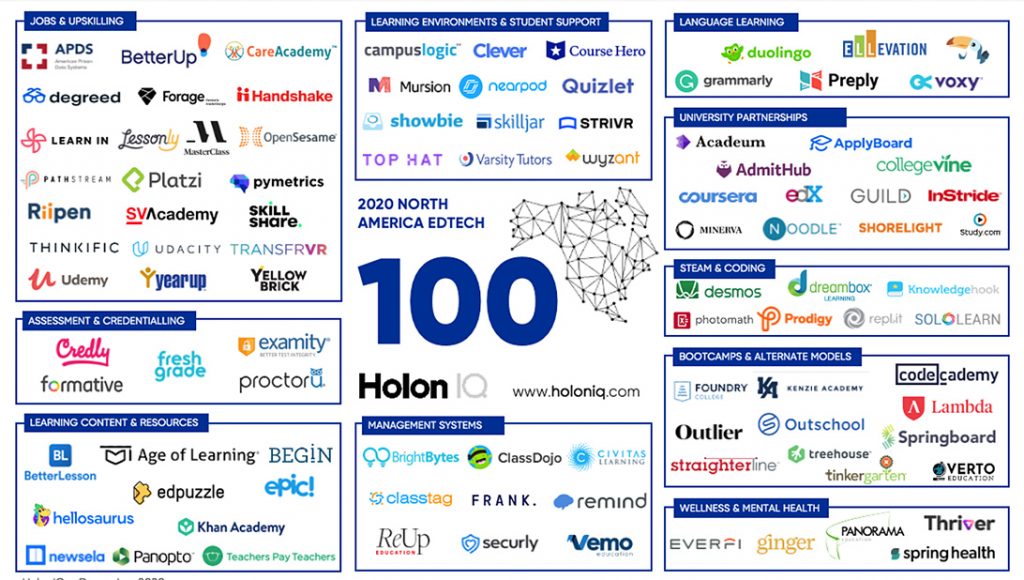
HolonIQ North America EdTech 100 — from holoniq.com
HolonIQ’s annual list of the most innovative EdTech startups across North America.

This annual list helps to surface the innovations occurring across all parts of the market, and the teams who are supporting institutions, teachers, parents, learners and employers.

HolonIQ North America EdTech 100 HolonIQ’s annual list of the most innovative EdTech startupsacross North America.


Raising Lifelong Learners #98: Enjoying literature with Kendra Fletcher — from raisinglifelonglearners.com by Colleen Kessler

Excerpt:

Nearly every level of learning involves literature in some form, but the study of literature is really more than simply reciting plot lines or following themes. In this podcast, Colleen speaks with Kendra Fletcher, long-time homeschooler and teacher of all things literature, on how enjoying the study of literature helps our kids to see it’s importance for themselves and for humanity.


Designed to Deceive: Do These People Look Real to You? — from nytimes.com by Kashmir Hill and Jeremy White
These people may look familiar, like ones you’ve seen on Facebook or Twitter. Or people whose product reviews you’ve read on Amazon, or dating profiles you’ve seen on Tinder. They look stunningly real at first glance. But they do not exist. They were born from the mind of a computer. And the technology that makes them is improving at a startling pace.

Is this humility or hubris? Do we place too little value in human intelligence — or do we overrate it, assuming we are so smart that we can create things smarter still?


Report: There’s More to Come for AI in Ed — from thejournal.com by Dian Schaffhauser

Excerpts:

The group came up with dozens of “opportunities” for AI in education, from extending what teachers can do to better understanding human learning:

  • Using virtual instructors to free up “personalization time” for classroom teachers;
  • Offloading the “cognitive load” of teaching;
  • Providing “job aids” for teachers;
  • Identifying the links between courses, credentials, degrees and skills;
  • “Revolutionizing” testing and assessment;
  • Creating new kinds of “systems of support”;
  • Helping with development of “teaching expertise”; and
  • Better understanding human learning through “modeling and building interfaces” in AI.

But contributors also offered just as many barriers to success:

  • Differences in the way teachers teach would require “different job aids”;
  • Teachers would fear losing their jobs;
  • Data privacy concerns;
  • Bias worries;
  • Dealing with unrealistic expectations and fears about AI pushed in “popular culture”;
  • Lack of diversity in gender, ethnicity and culture in AI projects; and
  • Smart use of data would require more teacher training.
 

Oracle joins Silicon Valley exodus — from linkedin.com by Jake Perez

Excerpt:

Oracle is joining the Silicon Valley exodus and moving its headquarters to Austin, Texas. A spokesperson for the tech giant said the move will “best position Oracle for growth and provide our personnel with more flexibility about where and how they work.” As the pandemic has spurred a gradual acceptance of remote work, some major companies are bailing on California’s high taxes and cost of living. Earlier this month, Hewlett Packard Enterprise announced it was moving from San Jose, Calif., to Houston, and Tesla founder Elon Musk announced his move to Texas this week.


24 Big Ideas that will change our world in 2021 — from linkedin.com by Scott Olster

Excerpt:

The remote classroom will get a much-needed upgrade

One key idea: making it easy for students to “sit” together at tables of two to eight learners, while an instructor’s lesson unfolds. Students can confer with table-mates without being heard by the larger group. Meanwhile, the instructor can explain things to all the tables at once, while still being able to visit specific tables to make sure everything is on track. Avida says educators prefer this model to the rigid constraints of other vendors’ breakout rooms, which were built to suit corporate needs.

Meanwhile, leading business-video players such as Zoom, Cisco’s WebEx, and Microsoft Teams are likely to move quickly to address the needs of the education market in 2021, too. (Microsoft also owns LinkedIn.) But Avida says Engageli has been filing lots of patents to protect its ideas, adding that its single-minded focus on education may help it move faster than other rivals for whom education is only a niche market. — George Anders

 
But when the set time had fully come, God sent his Son, born of a woman, born under the law, to redeem those under the law, that we might receive adoption to sonship.*
.

.*The Greek word for adoption to sonship is a legal term referring to the full legal standing of an adopted male heir in Roman culture.


Higher Ed Faces a Long and Uneven Recovery, Ratings Agencies Warn — from chronicle.com by Scott Carlson

Excerpt:

Two financial outlooks for higher ed appeared on Tuesday, and their most compelling parts were the longer-term prospects for the nation’s colleges and universities — because the near-term picture should be clear to nearly everyone by now. It’s not good.

In their predictions, both Moody’s Investors Service and Fitch Ratings note the various ways that institutions are in pain right now: The pandemic has undercut tuition revenue, as colleges have seen sliding enrollment or have had to discount tuition heavily to bring in students. The proceeds of auxiliary services — such as student housing and dining — “remain the hardest-hit revenue stream,” Moody’s says, given that such income can account for 5 to 30 percent of a college’s operating revenue.

 
© 2025 | Daniel Christian