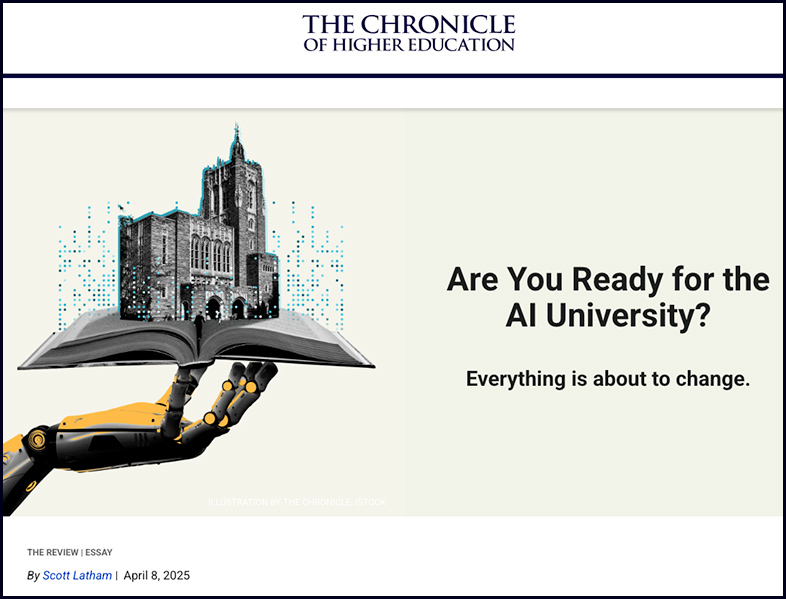
Reflections on “Are You Ready for the AI University? Everything is about to change.” [Latham]

.
Are You Ready for the AI University? Everything is about to change. — from chronicle.com by Scott Latham

Over the course of the next 10 years, AI-powered institutions will rise in the rankings. US News & World Report will factor a college’s AI capabilities into its calculations. Accrediting agencies will assess the degree of AI integration into pedagogy, research, and student life. Corporations will want to partner with universities that have demonstrated AI prowess. In short, we will see the emergence of the AI haves and have-nots.

What’s happening in higher education today has a name: creative destruction. The economist Joseph Schumpeter coined the term in 1942 to describe how innovation can transform industries. That typically happens when an industry has both a dysfunctional cost structure and a declining value proposition. Both are true of higher education.

Out of the gate, professors will work with technologists to get AI up to speed on specific disciplines and pedagogy. For example, AI could be “fed” course material on Greek history or finance and then, guided by human professors as they sort through the material, help AI understand the structure of the discipline, and then develop lectures, videos, supporting documentation, and assessments.

In the near future, if a student misses class, they will be able watch a recording that an AI bot captured. Or the AI bot will find a similar lecture from another professor at another accredited university. If you need tutoring, an AI bot will be ready to help any time, day or night. Similarly, if you are going on a trip and wish to take an exam on the plane, a student will be able to log on and complete the AI-designed and administered exam. Students will no longer be bound by a rigid class schedule. Instead, they will set the schedule that works for them.

Early and mid-career professors who hope to survive will need to adapt and learn how to work with AI. They will need to immerse themselves in research on AI and pedagogy and understand its effect on the classroom. 

From DSC:
I had a very difficult time deciding which excerpts to include. There were so many more excerpts for us to think about with this solid article. While I don’t agree with several things in it, EVERY professor, president, dean, and administrator working within higher education today needs to read this article and seriously consider what Scott Latham is saying.

Change is already here, but according to Scott, we haven’t seen anything yet. I agree with him and, as a futurist, one has to consider the potential scenarios that Scott lays out for AI’s creative destruction of what higher education may look like. Scott asserts that some significant and upcoming impacts will be experienced by faculty members, doctoral students, and graduate/teaching assistants (and Teaching & Learning Centers and IT Departments, I would add). But he doesn’t stop there. He brings in presidents, deans, and other members of the leadership teams out there.

There are a few places where Scott and I differ.

  • The foremost one is the importance of the human element — i.e., the human faculty member and students’ learning preferences. I think many (most?) students and lifelong learners will want to learn from a human being. IBM abandoned their 5-year, $100M ed push last year and one of the key conclusions was that people want to learn from — and with — other people:

To be sure, AI can do sophisticated things such as generating quizzes from a class reading and editing student writing. But the idea that a machine or a chatbot can actually teach as a human can, he said, represents “a profound misunderstanding of what AI is actually capable of.” 

Nitta, who still holds deep respect for the Watson lab, admits, “We missed something important. At the heart of education, at the heart of any learning, is engagement. And that’s kind of the Holy Grail.”

— Satya Nitta, a longtime computer researcher at
IBM’s Watson
Research Center in Yorktown Heights, NY
.

By the way, it isn’t easy for me to write this. As I wanted AI and other related technologies to be able to do just what IBM was hoping that it would be able to do.

  • Also, I would use the term learning preferences where Scott uses the term learning styles.

Scott also mentions:

“In addition, faculty members will need to become technologists as much as scholars. They will need to train AI in how to help them build lectures, assessments, and fine-tune their classroom materials. Further training will be needed when AI first delivers a course.”

It has been my experience from working with faculty members for over 20 years that not all faculty members want to become technologists. They may not have the time, interest, and/or aptitude to become one (and vice versa for technologists who likely won’t become faculty members).

That all said, Scott relays many things that I have reflected upon and relayed for years now via this Learning Ecosystems blog and also via The Learning from the Living [AI-Based Class] Room vision — the use of AI to offer personalized and job-relevant learning, the rising costs of higher education, the development of new learning-related offerings and credentials at far less expensive prices, the need to provide new business models and emerging technologies that are devoted more to lifelong learning, plus several other things.

So this article is definitely worth your time to read, especially if you are working in higher education or are considering a career therein!


Addendum later on 4/10/25:

U-M’s Ross School of Business, Google Public Sector launch virtual teaching assistant pilot program — from news.umich.edu by Jeff Karoub; via Paul Fain

Google Public Sector and the University of Michigan’s Ross School of Business have launched an advanced Virtual Teaching Assistant pilot program aimed at improving personalized learning and enlightening educators on artificial intelligence in the classroom.

The AI technology, aided by Google’s Gemini chatbot, provides students with all-hours access to support and self-directed learning. The Virtual TA represents the next generation of educational chatbots, serving as a sophisticated AI learning assistant that instructors can use to modify their specific lessons and teaching styles.

The Virtual TA facilitates self-paced learning for students, provides on-demand explanations of complex course concepts, guides them through problem-solving, and acts as a practice partner. It’s designed to foster critical thinking by never giving away answers, ensuring students actively work toward solutions.
 

The 2025 AI Index Report — from Stanford University’s Human-Centered Artificial Intelligence Lab (hai.stanford.edu); item via The Neuron

Top Takeaways

  1. AI performance on demanding benchmarks continues to improve.
  2. AI is increasingly embedded in everyday life.
  3. Business is all in on AI, fueling record investment and usage, as research continues to show strong productivity impacts.
  4. The U.S. still leads in producing top AI models—but China is closing the performance gap.
  5. The responsible AI ecosystem evolves—unevenly.
  6. Global AI optimism is rising—but deep regional divides remain.
  7. …and several more

Also see:

The Neuron’s take on this:

So, what should you do? You really need to start trying out these AI tools. They’re getting cheaper and better, and they can genuinely help save time or make work easier—ignoring them is like ignoring smartphones ten years ago.

Just keep two big things in mind:

  1. Making the next super-smart AI costs a crazy amount of money and uses tons of power (seriously, they’re buying nuclear plants and pushing coal again!).
  2. Companies are still figuring out how to make AI perfectly safe and fair—cause it still makes mistakes.

So, use the tools, find what helps you, but don’t trust them completely.

We’re building this plane mid-flight, and Stanford’s report card is just another confirmation that we desperately need better safety checks before we hit major turbulence.


Addendum on 4/16:


Jeremiah 31:33-34

33 “This is the covenant I will make with the people of Israel
    after that time,” declares the Lord.
“I will put my law in their minds
    and write it on their hearts.
I will be their God,
    and they will be my people.
34 No longer will they teach their neighbor,
    or say to one another, ‘Know the Lord,’
because they will all know me,
    from the least of them to the greatest,”
declares the Lord.
“For I will forgive their wickedness
    and will remember their sins no more.”

12 Salvation is found in no one else, for there is no other name under heaven given to mankind by which we must be saved.”

Therefore tell the people: This is what the Lord Almighty says: ‘Return to me,’ declares the Lord Almighty, ‘and I will return to you,’ says the Lord Almighty.

Hebrews 1:3

The Son is the radiance of God’s glory and the exact representation of his being, sustaining all things by his powerful word. After he had provided purification for sins, he sat down at the right hand of the Majesty in heaven.
 

The 2025 ABA Techshow Startup Alley Pitch Competition Ended In A Tie – Here Are The Winners — from lawnext.com by Bob Ambrogi

This year, two startups ended up with an equal number of votes for the top spot:

  • Case Crafter, a company from Norway that helps legal professionals build compelling visual timelines based on case files and evidence.
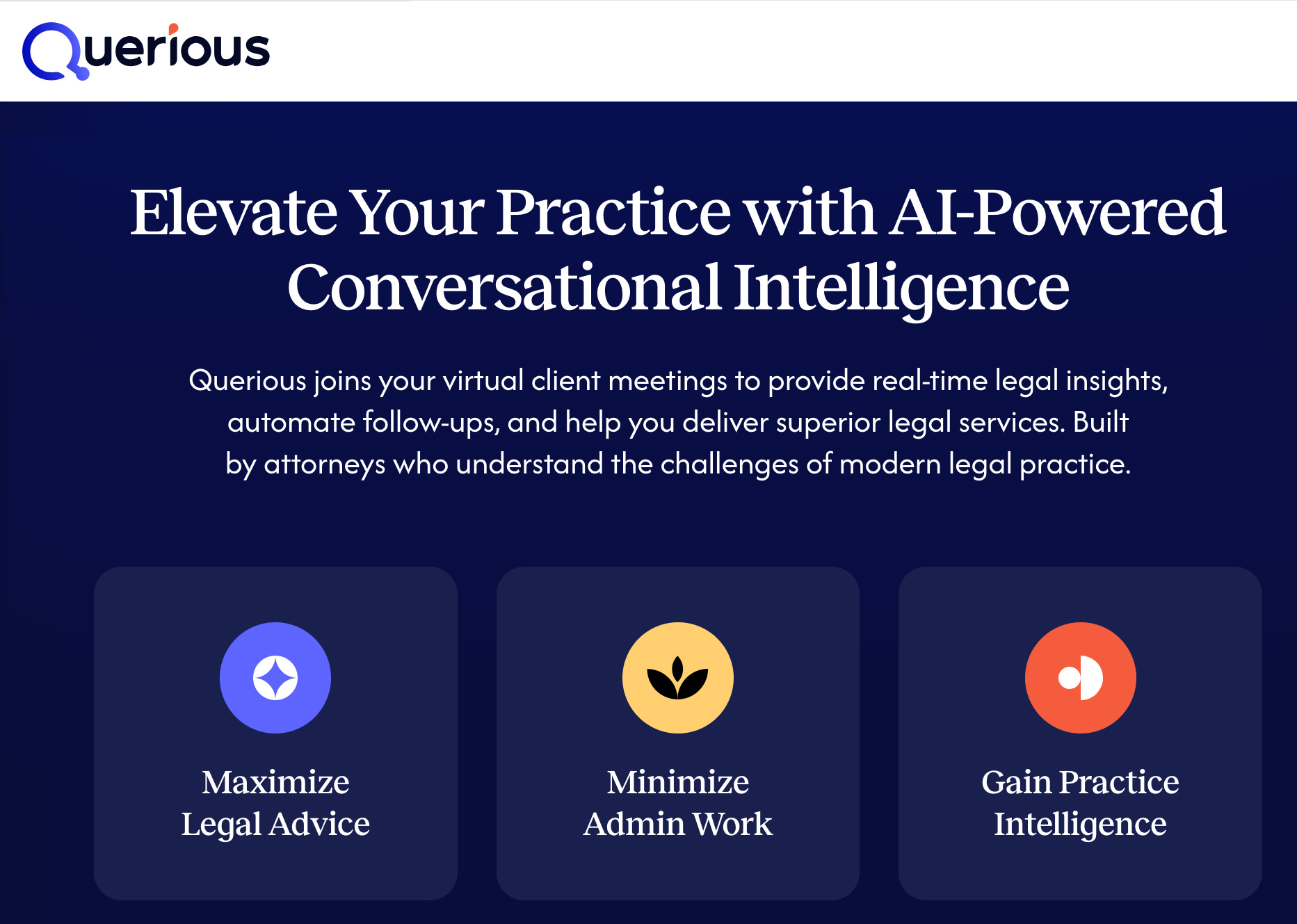
  • Querious, a product that provides attorneys with real-time insights during client conversations into legal issues, relevant content, and suggested questions and follow-ups.
    .


AI academy gives law students a head start on legal tech, says OBA innovator — from canadianlawyermag.com by Branislav Urosevic

The Ontario Bar Association has recently launched a hands-on AI learning platform tailored for lawyers. Called the AI Academy, the initiative is designed to help legal professionals explore, experiment with, and adopt AI tools relevant to their practice.

Colin Lachance, OBA’s innovator-in-residence and the lead designer of the platform, says that although the AI Academy was built for practising lawyers, it is also well-suited for law students.


Is collaboration the key to digital accessibility? — from timeshighereducation.com by Sal Jarvis and George Rhodes
Digital accessibility is ethically important, and a legal requirement, but it’s also a lot of work. Here’s how universities can collaborate and pool their expertise to make higher education accessible for all

How easy do you find it to navigate your way around your university’s virtual estate – its websites, virtual learning environment and other digital aspects? If the answer is “not very”, we suspect you may not be alone. And for those of us who might access it differently – without a mouse, for example, or through a screen reader or keyboard emulator – the challenge is multiplied. Digital accessibility is the wide-ranging work to make these challenges a thing of the past for everyone. It is a legal requirement and a moral imperative.

Make Things Accessible is the outcome of a collaboration, initially between the University of Westminster and UCL, but now incorporating many other universities. It is a community of practice, a website and an archive of resources. It aims to make things accessible for all.


Job hunting and hiring in the age of AI: Where did all the humans go? — from washingtonpost.com by Taylor Telford
The proliferation of artificial intelligence tools and overreliance on software such as ChatGPT is making the job market increasingly surreal.

The speedy embrace of AI tools meant to make job hunting and hiring more efficient is causing headaches and sowing distrust in these processes, people on both sides of the equation say. While companies embrace AI recruiters and application scanning systems, many job seekers are trying to boost their odds with software that generates application materials, optimizes them for AI and applies to hundreds of jobs in minutes.

Meanwhile, recruiters and hiring managers are fielding more applicants than they can keep up with, yet contend that finding real, qualified workers amid the bots, cheaters and deepfakes is only getting tougher as candidates use AI to write their cover letters, bluff their way through interviews and even hide their identities.

“I’m pro-AI in the sense that it allows you to do things that were impossible before … but it is being misused wildly,” Freire said. The problem is “when you let it do the thinking for you, it goes from a superpower to a crutch very easily.”


From DSC:
I value our constitutional democracy and I want to help preserve it. If you are an American, I encourage you to do the same. I’m not interested in living under an authoritarian government. The founders of this great nation developed an important document that integrated a system of checks and balances between the legislative, judicial, and executive branches of government. The rule of law was important then, and it should still be important now. That’s why I’m posting the following two items.


Several Hundred Law Professors File Amicus Brief Defending Biglaw Firms Against Trump’s Executive Order Attacks — from jdjournal.com by Maria Lenin Laus

In an unprecedented show of solidarity, over 300 law professors from leading American law schools have filed an amicus brief condemning former President Donald Trump’s executive orders targeting major law firms. The professors argue that the orders—issued in retaliation for the firms’ clients, diversity initiatives, and legal work opposing Trump policies—represent a dangerous abuse of executive power and a direct violation of constitutional protections.

The amicus brief, filed in support of the law firms’ challenge, was signed by professors from nearly every top-tier U.S. law school, including Harvard, Yale, Stanford, Columbia, NYU, and the University of Chicago. The professors argue that Trump’s orders:

  • Violate the First Amendment by penalizing firms for the viewpoints they express through advocacy and representation;
  • Undermine the rule of law by discouraging legal professionals from taking on controversial or unpopular clients;
  • Set a dangerous precedent for political retaliation against attorneys and the institutions of justice.

Law school deans around the country react to Trump’s undercutting the legal foundations/principles of our nation — from linkedin.com by Georgetown University Law Center

“We write to reaffirm basic principles: The government should not punish lawyers and law firms for the clients they represent, absent specific findings that such representation was illegal or unethical. Punishing lawyers for their representation and advocacy violates the First Amendment and undermines the Sixth Amendment.

We thus speak as legal educators, responsible for training the next generation of lawyers, in condemning any government efforts to punish lawyers or their firms based on the identity of their clients or for their zealous lawful and ethical advocacy.”


For related postings, also see:

President’s Third Term Talk Defies Constitution and Tests Democracy — from nytimes.com by Peter Baker (DSC: This is a free/gifted article for you.)
The 22nd Amendment is clear: President Trump has to give up his office after his second term. But his refusal to accept that underscores how far he is willing to consider going to consolidate power.

“This is in my mind a culmination of what he has already started, which is a methodical effort to destabilize and undermine our democracy so that he can assume much greater power,” Representative Daniel Goldman, Democrat of New York and lead counsel during Mr. Trump’s first impeachment, said in an interview.

“A lot of people are not talking about it because it’s not the most pressing issue of that particular day,” he said on Friday as stock markets were plunging in reaction to Mr. Trump’s newly declared trade war. But an attack on democracy, he added, “is actually in motion and people need to recognize that it is not hypothetical or speculative anymore.”

Mr. Trump’s autocratic tendencies and disregard for constitutional norms are well documented. In this second term alone, he has already sought to overrule birthright citizenship embedded in the 14th Amendment, effectively co-opted the power of Congress to determine what money will be spent or agencies closed, purged the uniformed leadership of the armed forces to enforce greater personal loyalty and punished dissent in academia, the news media, the legal profession and the federal bureaucracy.

BigLaw gives up on its future — from jordanfurlong.substack.com by Jordan Furlong
By putting business ahead of the rule of law when faced with assaults on their independence, many large US law firms have tarnished their reputations. Tomorrow’s lawyers could make them pay the price.

Two young Skadden associates, Rachel Cohen and Brenna Trout Frey, resigned from the firm, the former before its deal with Trump and the latter afterwards. “If my employer cannot stand up for the rule of law,” wrote Ms. Frey, “then I cannot ethically continue to work for them.” There might’ve been other public resignations I haven’t seen, but I’m confident there have been private ones from both firms, as well as intense efforts by other associates to find positions elsewhere.

This is the risk these firms are taking: It matters to young lawyers when their law firms fail to defend the rule of law. And it matters especially to young lawyers who are women and members of visible minorities when law firms jettison their vaunted diversity, equity, and inclusion programs under pressure from the government.


1 Samuel 16:7

7 But the Lord said to Samuel, “Do not consider his appearance or his height, for I have rejected him. The Lord does not look at the things people look at. People look at the outward appearance, but the Lord looks at the heart.”

1 John 4:11

Dear friends, since God so loved us, we also ought to love one another.

Lamentations 3:40

Let us examine our ways and test them,
and let us return to the Lord.

Lamentations 3:22-26

22 Because of the Lord’s great love we are not consumed,
for his compassions never fail.
23 They are new every morning;
great is your faithfulness.
24 I say to myself, “The Lord is my portion;
therefore I will wait for him.”

25 The Lord is good to those whose hope is in him,
to the one who seeks him;
26 it is good to wait quietly
for the salvation of the Lord.


Uplimit raises stakes in corporate learning with suite of AI agents that can train thousands of employees simultaneously — from venturebeat.com by Michael Nuñez|

Uplimit unveiled a suite of AI-powered learning agents today designed to help companies rapidly upskill employees while dramatically reducing administrative burdens traditionally associated with corporate training.

The San Francisco-based company announced three sets of purpose-built AI agents that promise to change how enterprises approach learning and development: skill-building agents, program management agents, and teaching assistant agents. The technology aims to address the growing skills gap as AI advances faster than most workforces can adapt.

“There is an unprecedented need for continuous learning—at a scale and speed traditional systems were never built to handle,” said Julia Stiglitz, CEO and co-founder of Uplimit, in an interview with VentureBeat. “The companies best positioned to thrive aren’t choosing between AI and their people—they’re investing in both.”


Introducing Claude for Education — from anthropic.com

Today we’re launching Claude for Education, a specialized version of Claude tailored for higher education institutions. This initiative equips universities to develop and implement AI-enabled approaches across teaching, learning, and administration—ensuring educators and students play a key role in actively shaping AI’s role in society.

As part of announcing Claude for Education, we’re introducing:

  1. Learning mode: A new Claude experience that guides students’ reasoning process rather than providing answers, helping develop critical thinking skills
  2. University-wide Claude availability: Full campus access agreements with Northeastern University, London School of Economics and Political Science (LSE), and Champlain College, making Claude available to all students
  3. Academic partnerships: Joining Internet2 and working with Instructure to embed AI into teaching & learning with Canvas LMS
  4. Student programs: A new Claude Campus Ambassadors program along with an initiative offering API credits for student projects

A comment on this from The Rundown AI:

Why it matters: Education continues to grapple with AI, but Anthropic is flipping the script by making the tech a partner in developing critical thinking rather than an answer engine. While the controversy over its use likely isn’t going away, this generation of students will have access to the most personalized, high-quality learning tools ever.


Should College Graduates Be AI Literate? — from chronicle.com by Beth McMurtrie (behind a paywall)
More institutions are saying yes. Persuading professors is only the first barrier they face.

Last fall one of Jacqueline Fajardo’s students came to her office, eager to tell her about an AI tool that was helping him learn general chemistry. Had she heard of Google NotebookLM? He had been using it for half a semester in her honors course. He confidently showed her how he could type in the learning outcomes she posted for each class and the tool would produce explanations and study guides. It even created a podcast based on an academic paper he had uploaded. He did not feel it was important to take detailed notes in class because the AI tool was able to summarize the key points of her lectures.


Showing Up for the Future: Why Educators Can’t Sit Out the AI Conversation — from marcwatkins.substack.com with a guest post from Lew Ludwig

The Risk of Disengagement
Let’s be honest: most of us aren’t jumping headfirst into AI. At many of our institutions, it’s not a gold rush—it’s a quiet standoff. But the group I worry most about isn’t the early adopters. It’s the faculty who’ve decided to opt out altogether.

That choice often comes from a place of care. Concerns about data privacy, climate impact, exploitative labor, and the ethics of using large language models are real—and important. But choosing not to engage at all, even on ethical grounds, doesn’t remove us from the system. It just removes our voices from the conversation.

And without those voices, we risk letting others—those with very different priorities—make the decisions that shape what AI looks like in our classrooms, on our campuses, and in our broader culture of learning.


Turbocharge Your Professional Development with AI — from learningguild.com by Dr. RK Prasad

You’ve just mastered a few new eLearning authoring tools, and now AI is knocking on the door, offering to do your job faster, smarter, and without needing coffee breaks. Should you be worried? Or excited?

If you’re a Learning and Development (L&D) professional today, AI is more than just a buzzword—it’s transforming the way we design, deliver, and measure corporate training. But here’s the good news: AI isn’t here to replace you. It’s here to make you better at what you do.

The challenge is to harness its potential to build digital-ready talent, not just within your organization but within yourself.

Let’s explore how AI is reshaping L&D strategies and how you can leverage it for professional development.


5 Recent AI Notables — from automatedteach.com by Graham Clay

1. OpenAI’s New Image Generator
What Happened: OpenAI integrated a much more powerful image generator directly into GPT-4o, making it the default image creator in ChatGPT. Unlike previous image models, this one excels at accurately rendering text in images, precise visualization of diagrams/charts, and multi-turn image refinement through conversation.

Why It’s Big: For educators, this represents a significant advancement in creating educational visuals, infographics, diagrams, and other instructional materials with unprecedented accuracy and control. It’s not perfect, but you can now quickly generate custom illustrations that accurately display mathematical equations, chemical formulas, or process workflows — previously a significant hurdle in digital content creation — without requiring graphic design expertise or expensive software. This capability dramatically reduces the time between conceptualizing a visual aid and implementing it in course materials.
.


The 4 AI modes that will supercharge your workflow — from aiwithallie.beehiiv.com by Allie K. Miller
The framework most people and companies won’t discover until 2026


Five Legal Tech Insights From New York — from artificiallawyer.com by Richard Tromans
A week spent in Manhattan gave Artificial Lawyer plenty to think about. Here are five insights inspired by a series of ‘New York moments’, often about legal AI.

On the way back from Paddington the cab driver was also questioned on the topic. He replied with wisdom: ‘When they made Heathrow Express a lot of us feared it would take away work. The funny thing is, it pushes more people to Paddington and generates a steady flow of fares. Before, you might spend ages getting to Heathrow with one passenger and sometimes have to drive all the way back with no fare.’

The end result: the effort to increase speed and efficiency ended up making the taxi drivers of London much happier and their lives more flexible. Whereas the taxi drivers of New York remain stuck doing huge, one-off journeys, while the general public suffers high costs and slow – and unpredictable – travel times.

Now, one wonders where there could be a connection to how the legal world works…..?


ABA TECHSHOW 2025 to spotlight future of legal technology — from americanbar.org
Artificial intelligence, cloud-based practice management, data privacy and e-discovery will be among the hot topics featured at the American Bar Association TECHSHOW 2025, which spotlights the most useful and practical technologies available in the legal industry, April 2-5 in Chicago.


Legaltech leaders roundtable: The challenges and emerging best practices of GenAI adoption — from legaltechnology.com

One of the key themes to emerge was the need to encourage creativity and open mindedness  around use cases. Conan Hines, Fried Frank’s director of practice innovation, said: “I felt a lot of ‘imaginative play’ vibes. This is where we give lawyers secure AI tools and support to explore the possibilities. The support is even more interesting as innovative teams are complementing their current staff with behavioural science and anthropological approaches to unlock this potential.”


Inhouse World Is Embracing Legal AI – Survey — from artificiallawyer.com


Investigating Informal Learning with Technology — from learningguild.com by Katie Belle (Curry) Nelson

Informal learning is having a moment right now, and it’s about time.

As learning professionals, we can often get caught up in designing, developing, and implementing formal learning experiences, which can cause informal learning to fall to the wayside and easily be overlooked. However, informal learning experiences can have major, long-term effects on learning and business outcomes, so finding creative ways to track them can be valuable for L&D departments.

Start small
These three methods are small steps to understanding the informal learning environment and its impact on your organization. The assuring thing about informal learning is that you can start small and incorporate more methods later because formal learning is always taking place. Start with one area and begin to explore what you can find out the content your learners want to know more about, how they are learning about things, and how others in the organization are solving problems.


Outsourcing Thought: The Hidden Cost of Letting AI Think for You — from linkedin.com by Robert Atkinson

I’ve watched it unfold in real time. A student submits a flawless coding assignment or a beautifully written essay—clean syntax, sharp logic, polished prose. But when I ask them to explain their thinking, they hesitate. They can’t trace their reasoning or walk me through the process. The output is strong, but the understanding is shallow. As a professor, I’ve seen this pattern grow more common: AI-assisted work that looks impressive on the surface but reveals a troubling absence of cognitive depth underneath.

This article is written with my students in mind—but it’s meant for anyone navigating learning, teaching, or thinking in the age of artificial intelligence. Whether you’re a student, educator, or professional, the question is the same: What happens to the brain when we stop doing our own thinking?

We are standing at a pivotal moment. With just a few prompts, generative AI can produce essays, solve complex coding problems, and summarize ideas in seconds. It feels efficient. It feels like progress. But from a cognitive neuroscience perspective, that convenience comes at a hidden cost: the gradual erosion of the neural processes that support reasoning, creativity, and long-term learning.


3 Strategies for Asking Better Questions. — from edutopia.org by Cathleen Beachboard
By reframing your questions slightly, you can create more opportunities for students to think deeply, reflect, and engage.

Try these reframes:

  • Instead of Why didn’t you finish the assignment? ask, What helped you complete the parts you did finish?
  • Instead of What’s the problem with this argument? ask, What’s a strength in this argument that you could build on?

Tip for question formation: Identify the problem-based question, shift the focus to strengths or opportunities, and ask in a way that encourages forward movement.


Using Weekly Routines to Build Speaking Skills — from edutopia.org by Marianne Rule
These six strategies guide students to build confidence in their speaking skills through low-stakes, highly engaging discussions.

By making dialogue a daily practice, we equip students not just for academic success but for meaningful engagement with the world. Even small shifts—like dedicating five minutes to student-generated prompts—can positively shape classroom culture at a time when conversations can feel like battles that are won or lost.


What to Do When Your Lesson Goes Kaput — from edutopia.org by Sarah Gonser
Teacher-tested strategies for handling instructional snafus—including when to call it quits on a lesson and regroup.

To put you back on track, we checked in with veteran teachers across grade levels, set the scene, and asked for guidance.


5 Axioms to Promote Deeper Discussions — from edutopia.org by Matthew R. Kay
Getting students engaged in sustained conversations requires a combination of inquiry, routine, and relationship building.

All great discussions have one thing in common, whether they exist in a classroom, a barber shop, a boardroom, or on a marriage counselor’s couch: inquiry. All participants in a great discussion are trying to figure something out.

Sometimes it starts like this:


How Letting Go of Perfectionism Made Me a Better Teacher — from edutopia.org by Michelle Singh
Shifting the focus of a classroom from performance to process means embracing mistakes as a necessary part of learning.

The good news? Every mindset we challenge opens the door to deeper learning, stronger student connections, and a more fulfilling teaching experience. Shifting even one of these beliefs can create lasting change—for both you and your students. Choose one shift to try this week, and notice what changes.


Here is the link to this item on Linkedin.com


Also see:

Our Law Firm Won’t Cave to Trump. Who Will Join Us? — from nytimes.com by John W. Keker, Robert A. Van Nest, and Elliot R. Peters (DSC: This is a gifted article.)

If lawyers and law firms won’t stand up for the rule of law, who will?

Beyond the Perkins Coie executive order, Mr. Trump has issued similar, and equally unlawful, executive orders directed at other law firms that have represented causes or people he doesn’t like, including because they have sued him, investigated him or contributed in some way to civil and criminal legal matters brought against him. That includes executive orders in recent days targeting the firms WilmerHale and Jenner & Block. He also issued a memorandum directed across the board at lawyers and law firms that have taken on causes he disfavors, including the pro bono representation of political asylum seekers.

We applaud Jenner & Block’s and WilmerHale’s lawsuits, filed Friday, challenging the administration’s executive orders.

To the shock and dismay of many in our profession, the law firm Paul, Weiss, with a tradition of fighting for justice — and also the subject of one of Mr. Trump’s executive orders — chose not to fight for itself or for our legal system. Instead, the firm capitulated, agreeing to direct $40 million worth of free legal work to causes Mr. Trump supports. (Mr. Trump said on Friday that another major firm, Skadden, Arps, had agreed to a similar arrangement to avoid an executive order punishing it.) Paul, Weiss’s choice was particularly disappointing because it further empowered Mr. Trump’s attack on our profession and because Perkins Coie had already charted an alternative path, with a high likelihood of success.


It’s the end of work as we knew it
and I feel…

powerless to fight the technology that we pioneered
nostalgic for a world that moved on without us
after decades of paying our dues
for a payday that never came
…so yeah
not exactly fine.


The Gen X Career Meltdown — from nytimes.com by Steeven Kurutz (DSC: This is a gifted article for you)
Just when they should be at their peak, experienced workers in creative fields find that their skills are all but obsolete.

If you entered media or image-making in the ’90s — magazine publishing, newspaper journalism, photography, graphic design, advertising, music, film, TV — there’s a good chance that you are now doing something else for work. That’s because those industries have shrunk or transformed themselves radically, shutting out those whose skills were once in high demand.

“I am having conversations every day with people whose careers are sort of over,” said Chris Wilcha, a 53-year-old film and TV director in Los Angeles.

Talk with people in their late 40s and 50s who once imagined they would be able to achieve great heights — or at least a solid career while flexing their creative muscles — and you are likely to hear about the photographer whose work dried up, the designer who can’t get hired or the magazine journalist who isn’t doing much of anything.

In the wake of the influencers comes another threat, artificial intelligence, which seems likely to replace many of the remaining Gen X copywriters, photographers and designers. By 2030, ad agencies in the United States will lose 32,000 jobs, or 7.5 percent of the industry’s work force, to the technology, according to the research firm Forrester.


From DSC:
This article reminds me of how tough it is to navigate change in our lives. For me, it was often due to the fact that I was working with technologies. Being a technologist can be difficult, especially as one gets older and faces age discrimination in a variety of industries. You need to pick the right technologies and the directions that will last (for me it was email, videoconferencing, the Internet, online-based education/training, discovering/implementing instructional technologies, and becoming a futurist).

For you younger folks out there — especially students within K-16 — aim to develop a perspective and a skillset that is all about adapting to change. You will likely need to reinvent yourself and/or pick up new skills over your working years. You are most assuredly required to be a lifelong learner now. That’s why I have been pushing for school systems to be more concerned with providing more choice and control to students — so that students actually like school and enjoy learning about new things.


© 2025 | Daniel Christian