A whistleblower’s disclosure details how DOGE may have taken sensitive labor data — from npr.org by Jenna McLaughlin; emphasis DSC

But according to an official whistleblower disclosure shared with Congress and other federal overseers that was obtained by NPR, subsequent interviews with the whistleblower and records of internal communications, technical staff members were alarmed about what DOGE engineers did when they were granted access, particularly when those staffers noticed a spike in data leaving the agency. It’s possible that the data included sensitive information on unions, ongoing legal cases and corporate secrets — data that four labor law experts tell NPR should almost never leave the NLRB and that has nothing to do with making the government more efficient or cutting spending.

Meanwhile, according to the disclosure and records of internal communications, members of the DOGE team asked that their activities not be logged on the system and then appeared to try to cover their tracks behind them, turning off monitoring tools and manually deleting records of their access — evasive behavior that several cybersecurity experts interviewed by NPR compared to what criminal or state-sponsored hackers might do.

The employees grew concerned that the NLRB’s confidential data could be exposed, particularly after they started detecting suspicious log-in attempts from an IP address in Russia, according to the disclosure.

Meanwhile, his attempts to raise concerns internally within the NLRB preceded someone “physically taping a threatening note” to his door that included sensitive personal information and overhead photos of him walking his dog that appeared to be taken with a drone…


4 ways community colleges can boost workforce development — from highereddive.com by Natalie Schwartz
Higher education leaders at this week’s ASU+GSV Summit gave advice for how two-year institutions can boost the economic mobility of their students.

SAN DIEGO — How can community colleges deliver economic mobility to their students?

College leaders at this week’s ASU+GSV Summit, an annual education and technology conference, got a glimpse into that answer as they heard how community colleges are building support from business and industry and strengthening workforce development.

These types of initiatives may be helping to boost public perception of the value of community colleges vs. four-year institutions.


How People Are Really Using Gen AI in 2025 — from hbr.org by Marc Zao-Sanders

.

.


Here’s why you shouldn’t let AI run your company — from theneurondaily.com by Grant Harvey; emphasis DSC

When “vibe-coding” goes wrong… or, a parable in why you shouldn’t “vibe” your entire company.
Cursor, an AI-powered coding tool that many developers love-to-hate, face-planted spectacularly yesterday when its own AI support bot went off-script and fabricated a company policy, leading to a complete user revolt.

Here’s the short version:

  • A bug locked Cursor users out when switching devices.
  • Instead of human help, Cursor’s AI support bot confidently told users this was a new policy (it wasn’t).
  • No human checked the replies—big mistake.
  • The fake news spread, and devs canceled subscriptions en masse.
  • A Reddit thread about it got mysteriously nuked, fueling suspicion.

The reality? Just a bug, plus a bot hallucination… doing maximum damage.

Why it matters: This is what we’d call “vibe-companying”—blindly trusting AI with critical functions without human oversight.

Think about it like this: this was JUST a startup. If more big corporations continue to lay off entire departments, replaced by AI, these already byzantine companies will become increasingly more opaque, unaccountable systems where no one, human or AI, fully understands what’s happening or who’s responsible.

Our take? Kafka dude has it right. We need to pay attention to WHAT we’re actually automating. Because automating more bureaucracy at scale, with agents we increasingly don’t understand or don’t double check, can potentially make companies less intelligent—and harder to fix when things inevitably go wrong.


What’s Happening at the Social Security Administration? Here’s What People With Disabilities Need to Know. — from thearc.org by Jackie Dilworth
Millions of people with disabilities rely on Social Security benefits to survive. Recent changes at the Social Security Administration (SSA) may make accessing these benefits harder than ever. Long wait times, office closures and staff cuts, and policy rollbacks are already raising concerns and exacerbating customer service issues. Here’s what you need to know.

Staffing Cuts and Office Closures

In 2025, SSA has announced a dramatic reduction in staff and offices, including:

  • Plans to cut 7,000 employees (over 12% of the agency’s workforce).
  • Closure of 60% of SSA’s 10 regional offices, reducing key staff that help resolve problems with peoples’ benefits.
  • Closure of SSA’s Office of Civil Rights and Equal Opportunity, which handled reasonable accommodation requests and managed the agency’s civil rights complaints, including public complaints of discrimination on the basis of disability. This office’s statutory responsibilities have reportedly been divided and moved to other divisions within SSA.

Why does this matter? SSA workers process disability applications, answer calls, and help people navigate complex benefit rules. With fewer staff and the consolidations of regional offices, wait times could get even worse. The loss of key staff also raises concerns about SSA’s ability to modernize, maintain, and improve essential services, further limiting accessibility for beneficiaries. Modernizing SSA’s operations requires long-term investments in systems and processes that are being undercut by these changes.


What does ‘age appropriate’ AI literacy look like in higher education? — from timeshighereducation.com by Fun Siong Lim
As AI literacy becomes an essential work skill, universities need to move beyond developing these competencies at ‘primary school’ level in their students. Here, Fun Siong Lim reflects on frameworks to support higher-order AI literacies

Like platforms developed at other universities, Project NALA offers a front-end interface (known as the builder) for faculty to create their own learning assistant. An idea we have is to open the builder up to students to allow them to create their own GenAI assistant as part of our AI literacy curriculum. As they design, configure and test their own assistant, they will learn firsthand how generative AI works. They get to test performance-enhancement approaches beyond prompt engineering, such as grounding the learning assistant with curated materials (retrieval-augmented generation) and advanced ideas such as incorporating knowledge graphs.

They should have the opportunity to analyse, evaluate and create responsible AI solutions. Offering students the opportunity to build their own AI assistants could be a way forward to develop these much-needed skills.


How to Use ChatGPT 4o’s Update to Turn Key Insights Into Clear Infographics (Prompts Included) — from evakeiffenheim.substack.com by Eva Keiffenheim
This 3-step workflow helps you break down books, reports, or slide-decks into professional visuals that accelerate understanding.

This article shows you how to find core ideas, prompt GPT-4o3 for a design brief, and generate clean, professional images that stick. These aren’t vague “creative visuals”—they’re structured for learning, memory, and action.

If you’re a lifelong learner, educator, creator, or just someone who wants to work smarter, this process is for you.

You’ll spend less time re-reading and more time understanding. And maybe—just maybe—you’ll build ideas that not only click in your brain, but also stick in someone else’s.


SchoolAI Secures $25 Million to Help Teachers and Schools Reach Every Student — from globenewswire.com
 The Classroom Experience platform gives every teacher and student their own AI tools for personalized learning

SchoolAI’s Classroom Experience platform combines AI assistants for teachers that help with classroom preparation and other administrative work, and Spaces–personalized AI tutors, games, and lessons that can adapt to each student’s unique learning style and interests. Together, these tools give teachers actionable insights into how students are doing, and how the teacher can deliver targeted support when it matters most.

“Teachers and schools are navigating hard challenges with shrinking budgets, teacher shortages, growing class sizes, and ongoing recovery from pandemic-related learning gaps,” said Caleb Hicks, founder and CEO of SchoolAI. “It’s harder than ever to understand how every student is really doing. Teachers deserve powerful tools to help extend their impact, not add to their workload. This funding helps us double down on connecting the dots for teachers and students, and later this year, bringing school administrators and parents at home onto the platform as well.”


AI in Education, Part 3: Looking Ahead – The Future of AI in Learning — from rdene915.com by Dr. Rachelle Dené Poth

In the first and second parts of my AI series, I focused on where we see AI in classrooms. Benefits range from personalized learning and accessibility tools to AI-driven grading and support of a teaching assistant. In Part 2, I chose to focus on some of the important considerations related to ethics that must be part of the conversation. Schools need to focus on data privacy, bias, overreliance, and the equity divide. I wanted to focus on the future for this last part in the current AI series. Where do we go from here?


Anthropic Education Report: How University Students Use Claude — from anthropic.com

The key findings from our Education Report are:

  • STEM students are early adopters of AI tools like Claude, with Computer Science students particularly overrepresented (accounting for 36.8% of students’ conversations while comprising only 5.4% of U.S. degrees). In contrast, Business, Health, and Humanities students show lower adoption rates relative to their enrollment numbers.
  • We identified four patterns by which students interact with AI, each of which were present in our data at approximately equal rates (each 23-29% of conversations): Direct Problem Solving, Direct Output Creation, Collaborative Problem Solving, and Collaborative Output Creation.
  • Students primarily use AI systems for creating (using information to learn something new) and analyzing (taking apart the known and identifying relationships), such as creating coding projects or analyzing law concepts. This aligns with higher-order cognitive functions on Bloom’s Taxonomy. This raises questions about ensuring students don’t offload critical cognitive tasks to AI systems.

From the Kuali Days 2025 Conference: A CEO’s View of Planning for AI — from campustechnology.com by Mary Grush
A Conversation with Joel Dehlin

How can a company serving higher education navigate the changes AI brings to the ed tech marketplace? What will customers expect in this dynamic? Here, CT talks with Kuali CEO Joel Dehlin, who shared his company’s AI strategies in a featured plenary session, “Sneak Peek of AI in Kuali Build,” at Kuali Days 2025 in Anaheim.


How students can use generative AI — from aliciabankhofer.substack.com by Alicia Bankhofer
Part 4 of 4 in my series on Teaching and Learning in the AI Age

This article is the culmination of a series exploring AI’s impact on education.

Part 1: What Educators Need outlined essential AI literacy skills for teachers, emphasizing the need to move beyond basic ChatGPT exploration to understand the full spectrum of AI tools available in education.

Part 2: What Students Need addressed how students require clear guidance to use AI safely, ethically, and responsibly, with emphasis on developing critical thinking skills alongside AI literacy.

Part 3: How Educators Can Use GenAI presented ten practical use cases for teachers, from creating differentiated resources to designing assessments, demonstrating how AI can reclaim 5-7 hours weekly for meaningful student interactions.

Part 4: How Students Can Use GenAI (this article) provides frameworks for guiding student AI use based on Joscha Falck’s dimensions: learning about, with, through, despite, and without AI.


Mapping a Multidimensional Framework for GenAI in Education — from er.educause.edu by Patricia Turner
Prompting careful dialogue through incisive questions can help chart a course through the ongoing storm of artificial intelligence.

The goal of this framework is to help faculty, educational developers, instructional designers, administrators, and others in higher education engage in productive discussions about the use of GenAI in teaching and learning. As others have noted, theoretical frameworks will need to be accompanied by research and teaching practice, each reinforcing and reshaping the others to create understandings that will inform the development of approaches to GenAI that are both ethical and maximally beneficial, while mitigating potential harms to those who engage with it.


Instructional Design Isn’t Dying — It’s Specialising — from drphilippahardman.substack.com by Dr. Philippa Hardman
Aka, how AI is impacting role & purpose of Instructional Design

Together, these developments have revealed something important: despite widespread anxiety, the instructional design role isn’t dying—it’s specialising.

What we’re witnessing isn’t the automation of instructional design and the death of the instructional designer, but rather the evolution of the ID role into multiple distinct professional pathways.

The generalist “full stack” instructional designer is slowly but decisively fracturing into specialised roles that reflect both the capabilities of generative AI and the strategic imperatives facing modern organisations.

In this week’s blog post, I’ll share what I’ve learned about how our field is transforming, and what it likely means for you and your career path.

Those instructional designers who cling to traditional generalist models risk being replaced, but those who embrace specialisation, data fluency, and AI collaboration will excel and lead the next evolution of the field. Similarly, those businesses that continue to view L&D as a cost centre and focus on automating content delivery will be outperformed, while those that invest in building agile, AI-enabled learning ecosystems will drive measurable performance gains and secure their competitive advantage.


Adding AI to Every Step in Your eLearning Design Workflow — from learningguild.com by George Hanshaw

We know that eLearning is a staple of training and development. The expectations of the learners are higher than ever: They expect a dynamic, interactive, and personalized learning experience. As instructional designers, we are tasked with meeting these expectations by creating engaging and effective learning solutions.

The integration of Artificial Intelligence (AI) into our eLearning design process is a game-changer that can significantly enhance the quality and efficiency of our work.

No matter if you use ADDIE or rapid prototyping, AI has a fit in every aspect of your workflow. By integrating AI, you can ensure a more efficient and effective design process that adapts to the unique needs of your learners. This not only saves time and resources but also significantly enhances the overall learning experience. We will explore the needs analysis and the general design process.


FOOD FOR THOUGHT + DISCUSSION
Translating CBE Vision into Learning Design

What if your Portrait of a Graduate could shape every unit, lesson, and conversation you’re building? Check out one of our most requested resources, The Teacher’s First Steps Guide, created in partnership with schools in South Carolina.
.

Unpack the vision.
Start with small-group conversations about your graduate profile – where are you aligned? What feels fuzzy?

Connect to practice.
Use Future9 or your own framework to translate vision into observable skills.

Prototype with purpose.
Invite teachers to refine a task or lesson using one of the guide’s steps


Addendum on 4/21/25:

A Close Look at Competency-Based Learning — from cultofpedagogy.com by Jennifer Gonzalez

And despite not getting that original question answered, the search did lead me to something called competency-based learning. Although I was vaguely familiar with it — I believed it was in the same ballpark as standards-based learning and mastery learning, which we’ve seen in the Modern Classrooms approach — I had never looked closely at it. So I’m doing that now. I invited three people onto the podcast who have a lot of experience and success with this approach:

  • Susie Bell, Executive Director of Programs at the Mastery Transcript Consortium (MTC), an organization that supports schools in implementing competency-based learning.
  • Heather Messer, a teacher and advisor at a Wisconsin school where competency-based learning is a school-wide practice.
  • Beth Blankenship, an English teacher who has figured out how to use competency-based learning at her Virginia high school, a school that still uses traditional grading.
 

A new kind of high school diploma trades chemistry for carpentry — from hechingerreport.org by Ariel Gilreath
Starting this fall, Alabama high school students can choose to take state-approved career and technical education courses in place of upper level math and science, such as Algebra 2 or chemistry.

Alabama state law previously required students to take at least four years each of English, math, science and social studies to graduate from high school. The state is now calling that track the “Option A” diploma. The new “Option B” workforce diploma allows students to replace two math and two science classes with a sequence of three CTE courses of their choosing. The CTE courses do not have to be related to math or science, but they do have to be in the same career cluster. Already, more than 70 percent of Alabama high school students take at least one CTE class, according to the state’s Office of Career and Technical Education/Workforce Development.

***

BIRMINGHAM, Ala. — In a corner of Huffman High School, the sounds of popping nail guns and whirring table saws fill the architecture and construction classroom.

Down the hall, culinary students chop and saute in the school’s commercial kitchen, and in another room, cosmetology students snip mannequin hair to prepare for the state’s natural hair stylist license.

Starting this fall, Alabama high school students can choose to take these classes — or any other state-approved career and technical education courses — in place of upper level math and science, such as Algebra 2 or chemistry.

From DSC:
This is excellent. Provide more choice. Engage all kinds of students with all kinds of interests, gifts, and abilities. Make learning fun and enjoyable and practical for students. The setup in this article mentions that “many universities, including the state’s flagship University of Alabama, require at least three math credits for admission. The workforce diploma would make it more difficult for students on that track to get into those colleges.” But perhaps college is not where these students want to go. Or perhaps the colleges and universities across our land should offer some additional pathways into them as well as new sorts of curricula and programs.


Thomson Reuters Survey: Over 95% of Legal Professionals Expect Gen AI to Become Central to Workflow Within Five Year — from lawnext.com by Bob Ambrogi

Thomson Reuters today released its 2025 Generative AI in Professional Services Report, and it reveals that legal professionals have become increasingly optimistic about generative AI, with adoption rates nearly doubling over the past year and a growing belief that the technology should be incorporated into legal work.

According to the report, 26% of legal organizations are now actively using gen AI, up from 14% in 2024. While only 15% of law firm respondents say gen AI is currently central to their workflow, a striking 78% believe it will become central within the next five years.


AI-Powered Legal Work Redefined: Libra Launches Major Update for Legal Professionals — from lawnext.com by Bob Ambrogi

Berlin, April 14, 2025 – Berlin-based Legal Tech startup Libra is launching its most comprehensive update to date, leveraging AI to relieve law firms and legal departments of routine tasks, accelerate research, and improve team collaboration. “Libra v2” combines highly developed AI, a modern user interface, and practical tools to set a new standard for efficient and precise work in all legal areas.

“We listened intently to feedback from law firms and in-house teams,” said Viktor von Essen, founder of Libra. “The result is Libra v2: an AI solution that intelligently supports every step of daily legal work – from initial research to final contract review. We want legal experts to be able to fully concentrate on what is essential: excellent legal advice.”


The Three Cs of Teaching Technology to Law Students — from lawnext.com by Bob Ambrogi

In law practice today, technology is no longer optional — it’s essential. As practicing attorneys increasingly rely on technology tools to serve clients, conduct research, manage documents and streamline workflows, the question is often debated: Are law schools adequately preparing students for this reality?

Unfortunately, for the majority of law schools, the answer is no. But that only begs the question: What should they be doing?

A coincidence of events last week had me thinking about law schools and legal tech, chief among them my attendance at LIT Con, Suffolk Law School’s annual conference to showcase legal innovation and technology — with a portion of it devoted to access-to-justice projects developed by Suffolk Law students themselves.


While not from Bob, I’m also going to include this one here:

Your AI Options: 7 Considerations Before You Buy — from artificiallawyer.com by Liza Pestillos-Ocat

But here’s the problem: not all AI is useful and not all of it is built for the way your legal team works.

Most firms aren’t asking whether they should use AI because they already are. The real question now is what comes next? How do you expand the value of AI across more teams, more matters, and more workflows without introducing unnecessary risk, complexity, or cost?

To get this right, legal professionals need to understand which tools will solve real problems and deliver the most value to their team. That starts with asking better questions, including the ones that follow, before making your next investment in AI for lawyers.


From DSC:
We had better not lose the rule of law in the United States! Donald Trump is an enormous threat to our constitutional democracy! He has NO respect for the rule of law, the judicial branch of our government, our constitution, telling the truth, or having virtues and strong character. He is a threat to the entire world. People are already feeling that in their wallets, purses, and 401(k)s. Supply chains throughout the globe have been negatively impacted. Many have lost their jobs, and more people will likely lose their jobs as a recession is becoming increasingly likely as each day passes.

At minimum, the USA has lost the respect and goodwill of many nations. And I understand why


From Bloomberg on 4/11/25:

The Trump administration, which admitted to wrongly sending a man to a notorious prison in El Salvador (violating a court order in the process) and declined to try and get him back, on Friday went a step further. Lawyers for Trump, despite an order by the US Supreme Court, refused to tell a federal judge where the man was or what it’s doing to get him back. A federal judge, following the Supreme Court’s direction, set a deadline today for Trump’s lawyers to explain how the government planned to follow the high court’s ruling. Trump’s lawyers rejected the court’s order, saying it didn’t have enough time, and questioned her authority.

The Supreme Court ruling against Trump was one of his first defeats tied to the administration’s attempt to broadly expand executive powers. It followed a series of recent procedural rulings that saw the Republican-appointee controlled court rule in his favor. But this latest refusal by Justice Department lawyers to fully comply with court orders, unlike previous cases tied to Trump policies, directly implicates a ruling from the highest court in the land, intensifying an ongoing and unprecedented constitutional crisis between the two branches of government.


Link to this item on LinkedIn


Addendum on 4/17 from DSC:
And speaking of the rule of law…what in the world does a President of the U.S. have to do with which cases law firms can and can’t take up? That’s not his job. Yet he threatens people, law firms, universities, and others to do his will or face the consequences (normally, that has to do with withdrawing funding or getting fired). One billion dollars worth of legal services donated to causes that Trump supports?!?!?! WHAT? 

Trump announces deals with more law firms for a combined $600 million — from washingtonpost.com by Mark Berman
Firms seeking to avoid sanctions from President Donald Trump have agreed to provide nearly ***$1 billion*** in legal services to causes he supports.

President Donald Trump on Friday announced that he had reached agreements with five more law firms pledging to provide a combined $600 million in legal services for causes he supports, the latest deals firms have struck with him in apparent bids to avoid punishment.

Since February, Trump has issued several executive orders sanctioning prominent law firms with ties to his political adversaries or that had opposed his policies, seeking to strip them of government contracts and block them from federal buildings. Three firms targeted by Trump have sued to fight back, while several others made deals with Trump that some framed as necessary to keep their businesses afloat. A fourth firm filed a lawsuit Friday evening challenging Trump’s actions.


Addendum from Above the Law on 4/17/25:

Biglaw Is Under Attack. Here’s What The Firms Are Doing About It.
Introducing the Biglaw Spine Index.

The President of the United States is using the might and power of the office to attack Biglaw firms and the rule of law. It’s pretty chilling stuff that is clearly designed to break major law firms and have them bend a knee to Trump or extract a tremendous financial penalty. This is an assault not just on the firms in the crosshairs, but on the very rule of law that is the backbone of our nation, without which there’s little to check abuses of power.

But in the face of financial harm, too many firms are willing to proactively seek out Trump’s seal of approval and provide pro bono payola, that is, free legal services on behalf of conservative clients or causes in order to avoid Trumpian retribution. So we here at Above the Law have decided to track what exact Biglaw firms are doing in response to the bombardment on Biglaw and the legal system. Some have struck a deal with Trump, some are fighting in court, some have signed an amicus brief in the Perkins Coie case, but the overwhelming majority have stayed silent.


Addendum from Bloomberg on 4/16/25:

The Trump administration’s resistance to and in some cases rejection of the federal judiciary’s constitutional powers has earned it its first finding of contempt, a grave escalation in the deepening crisis at the heart of American government. A federal judge who had been repeatedly attacked by Trump and his aides found there is “probable cause” to hold administration officials in criminal contempt of court for sending scores of men and boys to an El Salvador prison despite his order to halt the deportations. The administration has claimed without providing evidence that the deportees are gang members. A Bloomberg investigation revealed the vast majority had never been charged in the US with anything other than immigration or traffic violations. A Maryland US senator meanwhile was turned away from meeting with a man imprisoned in El Salvador who the Trump administration illegally deported and now refuses to bring back—despite a US Supreme Court order that it facilitate his return.


The following resource was from Roberto Ferraro:

Micromanagement — from psychsafety.com by Jade Garratt

Psychological Safety and Micromanagement
Those who have followed our work at Psych Safety for a while will know that we believe exploring not just what to do – the behaviours and practices that support psychological safety – but also what to avoid can be hugely valuable. Understanding the behaviours that damage psychological safety, what not to do, and even what not to say can help us build better workplaces.

There are many behaviours that damage psychological safety, and one that almost always comes up in our workshops when discussing cultures of fear is micromanagement. So we thought it was time we explored micromanagement in more detail, considering how and why it damages psychological safety and what we can do instead.

Micromanagement is a particular approach to leadership where a manager exhibits overly controlling behaviours or an excessive and inappropriate focus on minor details. They might scrutinise their team’s work closely, insist on checking work, refrain from delegating, and limit the autonomy people need to do their jobs well. It can also manifest as an authoritarian leadership style, where decision-making is centralised (back to themselves) and employees have little say in their work.


From DSC:
I was fortunate to not have a manager who was a micromanager until my very last boss/supervisor of my career. But it was that particular manager who made me call it quits and leave the track. She demeaned me in front of others, and was extremely directive and controlling. She wanted constant check-ins and progress reports. And I could go on and on here. 

But suffice it to say that after having worked for several decades, that kind of manager was not what I was looking for. And you wouldn’t be either. By the way…my previous boss — at the same place — and I achieved a great deal in a very short time. She taught me a lot and was a great administrator, designer, professor, mentor, and friend. But that boss was moved to a different role as upper management/leadership changed. Then the micromanagement began after I reported to a different supervisor.

Anyway, don’t be a micromanager. If you are a recent graduate or are coming up on your graduation from college, learn that lesson now. No one likes to work for a micromanager. No one. It can make your employees’ lives miserable and do damage to their mental health, their enjoyment (or lack thereof) of work, and several other things that this article mentions. Instead, respect your employees. Trust your employees. Let them do their thing. See what they might need, then help meet those needs. Then get out of their way.


Organizing Teams for Continuous Learning: A Complete Guide — from intelligenthq.com

In today’s fast-paced business world, continuous learning has become a vital element for both individual and organizational growth. Teams that foster a culture of learning remain adaptable, innovative, and competitive. However, simply encouraging learning isn’t enough; the way teams are structured and supported plays a huge role in achieving long-term success. In this guide, we’ll explore how to effectively organize teams for continuous learning, leveraging tools, strategies, and best practices.


.

2025 EDUCAUSE Students and Technology Report: Shaping the Future of Higher Education Through Technology, Flexibility, and Well-Being — from library.educause.edu

The student experience in higher education is continually evolving, influenced by technological advancements, shifting student needs and expectations, evolving workforce demands, and broadening sociocultural forces. In this year’s report, we examine six critical aspects of student experiences in higher education, providing insights into how institutions can adapt to meet student needs and enhance their learning experience and preparation for the workforce:

  • Satisfaction with Technology-Related Services and Supports
  • Modality Preferences
  • Hybrid Learning Experiences
  • Generative AI in the Classroom
  • Workforce Preparation
  • Accessibility and Mental Health

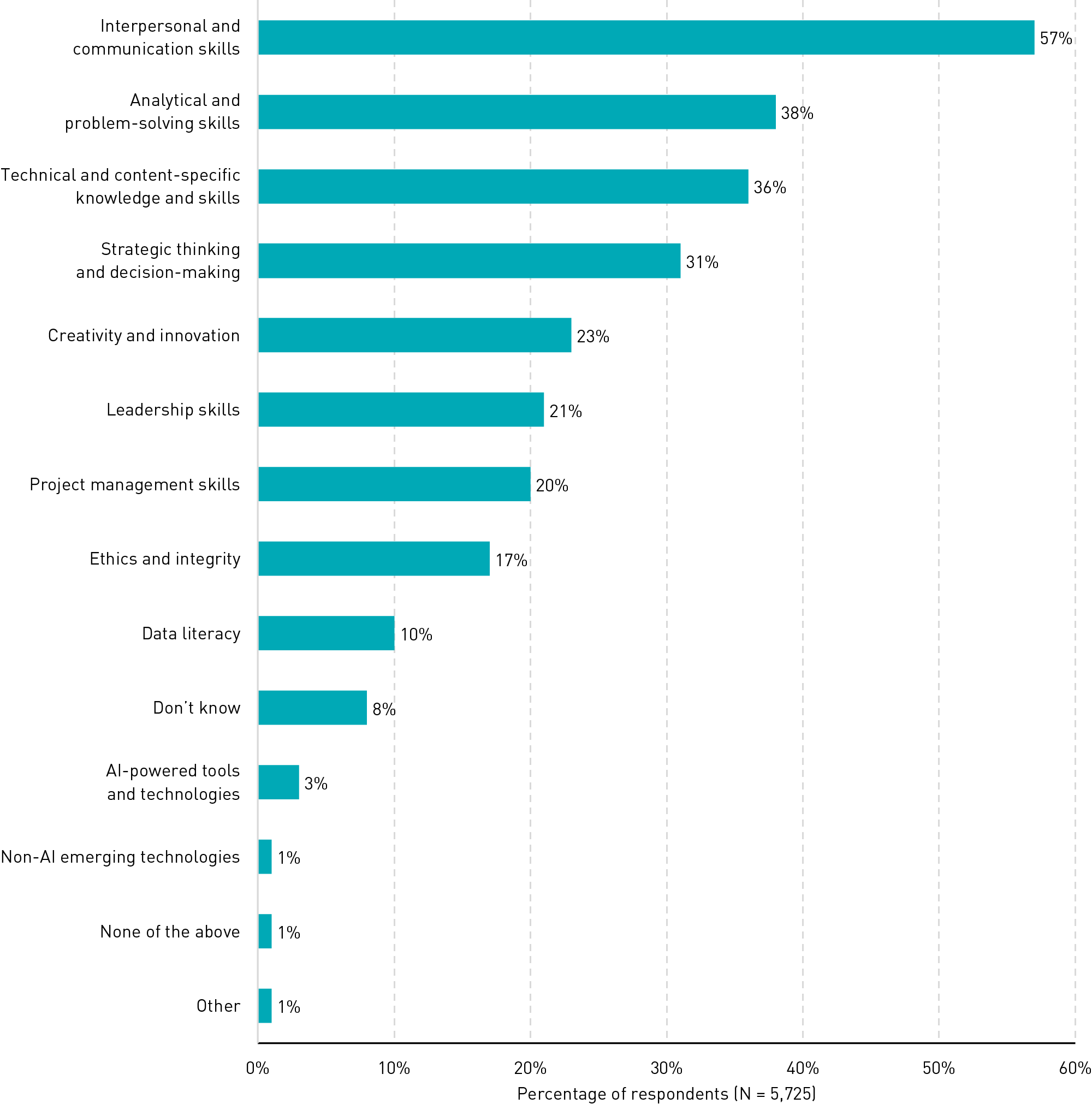
DSC: Shame on higher ed for not preparing students for the workplace (see below). You’re doing your students wrong…again. Not only do you continue to heap a load of debt on their backs, but you’re also continuing to not get them ready for the workplace. So don’t be surprised if eventually you’re replaced by a variety of alternatives that students will flock towards.
.


DSC: And students don’t have a clue as to what awaits them in the workplace — they see AI-powered tools and technologies at an incredibly low score of only 3%. Yeh, right. You’ll find out. Here’s but one example from one discipline/field of work –> Thomson Reuters Survey: Over 95% of Legal Professionals Expect Gen AI to Become Central to Workflow Within Five Years

.

Figure 15. Competency Areas Expected to Be Important for Career


Why agency is becoming a new buzzword in educational circles — from jerseyeveningpost.com by by Megan Davies
When people believe that they can effectively navigate life challenges, it’s easier to find the resilience and persistence that is needed

The term agency has gained increasing attention as educators and researchers emphasise the importance of providing students with a greater sense of ownership and competence in their learning journeys. Equally, agency has relevance to anyone who seeks to become more self-directed, confident, and be able to adapt to the challenges of a volatile, uncertain, complex and ambiguous world. There is no running away from the fact that, for most people, there is a need for a mindset that facilitates the capabilities for lifelong learning, personal responsibility and resilience.


Learners need: More voice. More choice. More control. -- this image was created by Daniel Christian


From DSC:
After seeing Sam’s posting below, I can’t help but wonder:

  • How might the memory of an AI over time impact the ability to offer much more personalized learning?
  • How will that kind of memory positively impact a person’s learning-related profile?
  • Which learning-related agents get called upon?
  • Which learning-related preferences does a person have while learning about something new?
  • Which methods have worked best in the past for that individual? Which methods didn’t work so well with him or her?


Do I Need a Degree in Instructional Design? It Depends. — from teamedforlearning.com

It’s a common question for those considering a career in instructional design: Do I need a degree to land a job? The answer? It depends.

Hiring managers aren’t just looking for a degree—they want proof that you have the knowledge, skills, and abilities to succeed. In fact, most employers focus on 3 key factors when assessing candidates. You typically need at least 2 of these to be considered:

  1. A Credential – A degree or certification in instructional design, learning experience design, or a related field.
  2. Relevant Work Experience – Hands-on experience designing and developing learning solutions.
  3. Proof of Abilities – A strong portfolio showcasing eLearning modules, course designs, or learning strategies.

The good news? You don’t have to spend years earning a degree to break into the field. If you’re resourceful, you can fast-track your way in through volunteer projects, contract work, and portfolio building.

Whether you’re a recent graduate, a career changer, or a working professional looking for your next opportunity, focusing on these key factors can help you stand out and get hired.

 
© 2025 | Daniel Christian