Teacher, Are You There? Being “Present” in Online Learning — from er.educause.edu by Richard West

Excerpt:

Video technologies are part of that shift in helping online learners feel connected to teachers and peers. This connection comes from people developing the sense that they are “present” in the class, even if they are not physically in the same room. How is it possible to be present when you are physically separated?


Public Viewpoint: COVID-19 Work and Education Research — from cci.stradaeducation.org

Excerpt:

In the recovering economy, employers will play a central role as Americans look to reskill, upskill, and compete in the workforce. But what do people want and expect from employers’ hiring, advancement, and training practices? In this research we explore the public’s perceptions on skills-based hiring, preferences for employer-provided education and training benefits, and beliefs about who should fund education and training.

This week’s data are based on the Strada Student Viewpoint and Strada-Gallup Education Consumer surveys. The research is intended to provide insights to the education and training providers, policymakers, employers, and individual Americans who are navigating the COVID-19 crisis.


It’s Time to Take College Student Hunger and Homelessness Seriously — from edsurge.com by Jireh Deng, Nicole Delgado, Rashida Crutchfield and Stephanie Ibarra

Excerpt:

Students cooking ramen noodle packets in the dorm microwave have come to symbolize what is deemed to be the universal college experience. However, that image demeans the dire situation of students experiencing food and housing insecurity in higher education.

But it doesn’t have to be this way. Through advocacy on campuses and in communities and ongoing state and federal investment in the real cost of higher education—including housing, food and other supports—we can and should make a firm commitment to students who are doing everything they can to become economically self-sufficient.


The Triple Threat Facing Generalist Law Firms, Part 2: Legal Tech — from jdsupra.com by Katherine Hollar Barnard

Excerpts:

In Legaltech, a Walmart associate general counsel estimated the product provided a 60 to 80 percent time savings. That’s great news for Walmart – less so for lawyers who bill by the hour.

Sterling Miller, the former general counsel of Marketo, Inc., Sabre Corporation and Travelocity.com, made a compelling case for why law firm clients are turning to technology: In-house lawyers are incentivized to find the most efficient, lowest-cost way to do things. Many law firm lawyers are incentivized to do just the opposite.

To be sure, software is unlikely to replace lawyers altogether; legal minds are essential for strategy, and robots have yet to be admitted to the bar. However, technology’s impact on an industry dominated by the billable hour will be profound.

Also see:

Judge John Tran spearheaded adoption of tech to facilitate remote hearings and helped train lawyers — from abajournal.com by Stephanie Francis Ward; with thanks to Gabe Teninbaum for this resource

Excerpt:

If you need a judge who can be counted on to research all courtroom technology offerings that can help proceedings continue during the COVID-19 pandemic, look no further than John Tran of the Fairfax County Circuit Court in Virginia.

After the Virginia Supreme Court issued an order June 22 stating that remote proceedings should be used to conduct as much business as possible, Tran offered webinars to help lawyers with the Fairfax Bar Association get up to speed with Webex, the platform the court uses for remote proceedings.

“When Webex has a news release, he’s all over that. He’s already had a private demo. He is one of a small number of exceptionally tech-savvy judges,” says Sharon Nelson, a Fairfax attorney and co-founder and president of the digital forensics firm Sensei Enterprises.


The Art World Goes Blockchain — from protocol.com by David Pierce

Excerpt:

The NFT explosion is tied up in the rise of Bitcoin and other cryptocurrencies, which is tied up in a general frenzy of investment, and so who knows what will eventually crash when the rest of it does.

  • But there’s something here. You probably don’t want to spend half a mil on a Pop Tart cat, but the idea that digital goods can be authenticated and verified — that you might someday buy a GIF the same way you buy a painting or a Rolex — is transformational.
 

Henningsvaer at sunset by Yiannis Pavlis


Foster Partners Southern Dunes Hotel in Saudi Arabia -- the Red Sea Project

Foster + Partners’ hotel to be built amid Saudi Arabian sand dunes — from dezeen.com by Tom Ravenscroft


A beautiful image of a person silhoutted against the sun at dusk


Panorama Project Releases Immersive Media & Books 2020 Research Report — from panoramaproject.org

Excerpt:

The Panorama Project, a cross-industry publishing initiative, released today Immersive Media & Books 2020 a comprehensive market study that gauges the role of books and consumer engagement by age groups, ethnicity, and more.  This report contains survey data from 4,300+ pre-qualified respondents and was authored by Dr. Rachel Noorda and Dr. Kathi Inman Berens, faculty members of the Portland State University graduate program in Book Publishing.

 Data collection and analysis for Immersive Media & Books 2020 were conducted in the midst of the COVID-19 pandemic and represent Panorama Project’s ongoing commitment to research.  The report is rich with data, including graphs and tables to illustrate provocative findings that will stimulate discourse between publishers, authors, librarians, booksellers, thought leaders, advocacy groups and the media.

Panorama Project -- Data-informed insights on public libraries and their impact on book discovery, author brand development, and sales


ADDitude: Resources for families touched by attention deficit disorder (ADD/ADHD).

ADDitude: Resources for families touched by attention deficit disorder (ADD/ADHD)

Example article:

“I’m a Teacher with Nonverbal Learning Disorder. And I’m Exactly Who I Needed As a Child.” — from additudemag.com by Brittany Kramer
“I strive to create a classroom environment where my students know they will be successful, no matter what. It’s the environment I would have felt safe in as a child; one that is encouraging, warm, and free of judgment or anger.”

Excerpt:

“They tried to bury me, but they didn’t know that I was a seed.”

As a special education teacher for students with learning disabilities and developmental disorders, and as a neurodivergent individual myself, this quote defines my life.

I was formally diagnosed with Nonverbal Learning Disorder (NVLD) at 23 years old. As a child and teen, I struggled in ways that most people cannot possibly comprehend.

When people think of learning disabilities, they picture a child with dyslexia or dysgraphia who cannot read or write very well. They do not envision an intelligent and articulate child for whom tying shoes or making a paper fit into a folder is arduous at best.


Here Is A Great Reading App for Students with Dyslexia — from educatorstechnology.com

Excerpt:

Omoguru is an excellent reading app for students with dyslexia. It offers a wide variety of tools ‘designed to make the text more readable’. Some of these features include: tools to adjust text appearance and enhance its readability (e.g., letter spacing, line height setting, contrast setting colours, text size and weight), syllable marking (the tool allows you to mark syllables in different colours enabling readers to easily identify and read multi-syllable words), speed reading, and many more.


G Suite for Ed Gets New Name and Pile of New Features — from thejournal.com by Dian Schaffhauser

Excerpt:

Google announced a spate of changes to its education offerings, including a renaming of its education bundle of productivity applications and a limit to free storage for schools and colleges. Security and engagement updates are also being added to the education version of Google Meet, and Google Classroom will see enhancements later this year. The announcements came during a 90-minute virtual session on “learning with Google.”

A New Name
G Suite for Education has been renamed. Starting today, it’s known as Google Workspace for Education. 

Addendum on 2/24/21:


AI in the Legal Industry: 3 Impacts and 3 Obstacles — from exigent-group.com

Excerpt:

In this article, we’ll talk about three current impacts AI has had on the legal industry as well as three obstacles it needs to overcome before we see widespread adoption.

Consider JPMorgan’s Contract Intelligence (COIN) software. Rather than rely on lawyers to pour over their commercial loan contracts, the banking giant now uses COIN to review these documents for risk, accuracy and eligibility. Not only does this save JPMorgan 360,000 hours per year in contract review, it also results in fewer errors. One can also look to major law firms like DLA Piper, which now regularly rely on AI for M&A due diligence. At Exigent, we’ve had first-hand experience using AI to support document analysis for our clients as well.

2. Legal departments need to build cross-functional expertise
…bringing greater diversity into the legal department is essential if the efficiencies promised by AI in the legal industry are to be realized.

Fortunately, some legal departments have begun to bring data scientists on board in addition to lawyers. And the industry is beginning to open up to hybrid roles, like legal technologists, legal knowledge engineers, legal analysts and other cross-functional experts. It’s clear that a greater diversity of skills are in the legal department’s future; it’s just a matter of how smoothly the transition goes.


We want students to be creative, but how do we assess this? — from spencerauthor.com by John Spencer

Excerpt:

We know that creativity is vital for student learning. We also know that we tend to value the things we assess. However, when we assess creativity, we can unwittingly cause students to become risk-averse. So, how do we assess creativity in a way that encourages students to become more creative?


20 of the best free science apps for iPad & iOS — from teachthought.com by TeachThought Staff

Excerpt:

The ease-of-use and engagement factor of an iPad can really liven up a lesson.

Combine that with an app’s ability to simulate reality in br, such as chemical reactions, and you have a tool that is both safe and fun for your students.

Below, we’ve gathered 20 of the best free science apps currently available for iPhone/iPad/iOS. Note, many of the science apps below have in-app purchases but are free to download and use. The main criteria here was that it’s a science app and is worth using/teaching and learning with without making any additional purchases.


Interplay Raises $18M to Build a Lynda.com for Essential Skilled Trades — from edsurge.com by Tony Wan

Excerpt:

Plumbing is just one of many good-paying skilled trades that remain in high demand but which have largely been glossed over by the education technology industry, says Doug Donovan, co-founder and CEO of Interplay Learning. “There’s been a lot of great edtech serving the knowledge worker, such as tools like Pluralsight. But there’s a vacuum in the digital marketplace for skills for hands-on workers.”

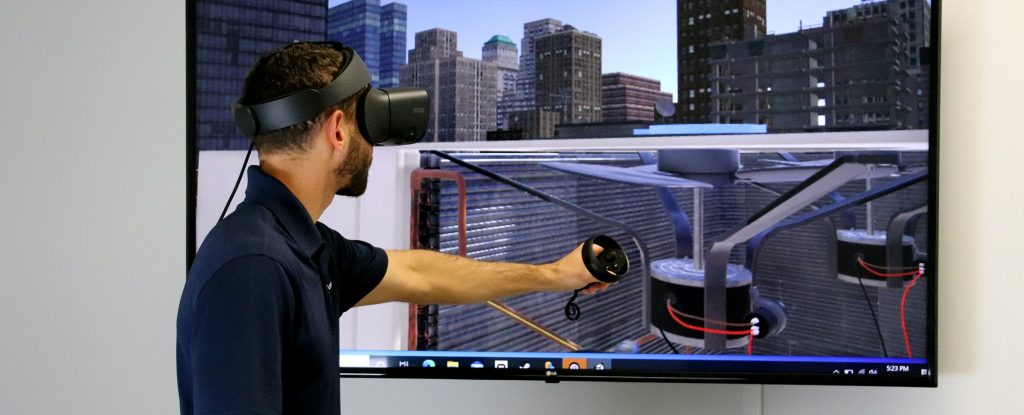
Interplay Learning VR training for HVAC repair

 
© 2025 | Daniel Christian