Udemy, an Online Course Platform Where Anyone Can Teach, Keeps Raising Money. What’s Next? — from edsurge.com by Jeffrey R. Young

Excerpt:

Udemy has become one of the best-funded companies in edtech, having raised another $80 million at the end of 2020 bringing its total raised to nearly $300 million. So, what are its plans, and how does it see the market for online courses changing after the pandemic?

Those were some questions we brought to Udemy’s CEO, Gregg Coccari, in a recent interview.

“They become professional at this,” he says. “They have assistants that handle the questions. They work at this every day. They’re always looking for new publishing ideas, more courses, they’re upgrading the courses they have. And so these become very professional online teachers.”

But those millionaires are, by and large, the exception.


Walmart is pulling plug on more robots — from wsj.com by Sarah Nassauer
Retailer has been phasing out automated pickup towers as curbside services have become popular

Excerpt:

At Walmart Inc., the robots are losing their jobs.

The retailer is phasing out the hulking automated pickup towers that were erected in more than 1,500 stores to dispense online orders. The decision reflects a growing focus on curbside pickup services that have become more popular during the Covid-19 pandemic and continues a broader retreat from some initiatives to use highly visible automation in stores.


Law Society votes to approve regulatory sandbox for innovative legal tech development — from lawtimesnews.com by Aidan Macnab

Excerpt:

At Convocation Thursday morning, the Law Society of Ontario passed a motion to launch a five-year regulatory sandbox pilot for innovative legal tech services.

The initiative recommended by the Law Society’s technology task force would open up a regulatory safe zone for innovative technological legal services. Participants will report to and be monitored by the Law Society, which will study the sandbox to inform policy and regulatory decision-making.

Rocket Lawyer Raises $223 Million To Meet Growing Demand For Its Services — from lawsitesblog.com by Bob Ambrogi

Excerpt:

The online legal services provider Rocket Lawyer has raised $223 million in growth capital financing to help it meet what it says has been a strong and accelerating demand for its digital legal documents and advice.

Legal technology start-up JUSTLAW notches an impressive milestone — from einnews.com
Small business legal protection offering experiences rapid growth.

Excerpt:

NEW YORK, NY, UNITED STATES, April 13, 2021 /EINPresswire.com/ — Launched in 2020 in the face of the worst pandemic in a century, legal tech startup JUSTLAW set out with the lofty vision to give ordinary Americans access to top attorneys on a 24/7 basis. It’s working. The number of small businesses enrolled in its small business legal protection plan just surpassed 1,000.


Design full rooms in AR with the IKEA Studio app — from vrscout.com by Kyle Melnick

Use the IKEA Studio app to design a room -- this image pictures a floating blue couch in a living room

Excerpt:

Whereas the IKEA Place app—released back in 2017 alongside the launch of Apple’s ARKit—allows you to place single pieces of AR furniture and decorations throughout your real-world environment, IKEA Studio lets you furnish entire rooms. Developed by IKEA’s own Copenhagen-based studio SPACE10, this iOS-exclusive app works by capturing 3D room plans and measurements using the LiDAR sensors featured on the iPhone 12 Pro and iPhone 12 Pro Max. Put simply, this new technology generates a mesh scale capable of identifying surfaces, objects, and the geometry of your real-world environment, resulting in more realistic AR experiences.


The art of the pivot — from chieflearningofficer.com by Jay Campbell and Doug Glener
Try these four tactics the next time you have to change direction.

Excerpt:

The ”first pancake” metaphor — a test to see if the batter and heat are just right — is an example of framing. The results are informative, but not pretty. Framing an experiment as a first pancake lowers the stress and pressure while simultaneously making the experiment fun and playful. Leaders who successfully frame a situation can shift people’s attitudes about even the most intimidating changes.

Supporting healthier minds through learning and development — from chieflearningofficer.com by Elizabeth Loutfi
L&D teams have helped to alleviate some of the stress and anxieties people are feeling as their organizations grapple with pandemic-related changes and challenges.

Meet the CLO Advisory Board: Bob Mosher — from chieflearningofficer.com by Elizabeth Loutfi
Meet longtime CLO advisory board member Bob Mosher, CEO and chief learning evangelist for APPLY Synergies.

CLO: What lessons did you learn back in 2020 that you’ve taken with you into 2021?
For me, it’s the art of listening. As educators, we’re supposed to have answers and we’re supposed to be the owners of content and the developers of programs. We get help from the business, but we’re very locked in our ways. Understandably so, but all of our ways were thrown out last year. My instinct, and many, was to rush to solution, rush to help. That was fairly humbling for me. It was a year to reflect and sit back and examine my commitment to things over doing the right thing. It taught me that — which L&D should do well anyway, but when you get senior like me and you’ve done it a bunch of times — you guess people’s right answer, or think you can. Because there was no normal and we weren’t making courses like we always used to, it was a year of reflection and listening for me to kind of rekindle that skill.

5 ways to foster a learning culture — from chieflearningofficer.com by Jonathan Finkelstein
By placing importance on growth at all levels of the organization, you can foster a learning culture that serves your people and helps your business grow.


How to Learn Animation At Home: Beginner’s Guide to Online Courses, Software and Resources — from graphicmama.com by Al Boicheva

Excerpt:

On the bright side of the current reality, it’s the perfect time to be productive and learn new skills. Why not trying to learn animation? If this is something you’ve always been interested in and would like to try, it’s not necessary to do it the traditional way and study it at a university. In fact, you can do it online in the comfort of your home.

So, what are the options to become a self-taught animation designer? Let’s walk through the process together.


How to Design a Hybrid Workplace — from nytimes.com

Excerpt:

But many companies have hatched a postpandemic plan in which employees return to the office for some of the time while mixing in more work from home than before. The appeal of this compromise is clear: Employers hope to give employees the flexibility and focus that come from working at home without sacrificing the in-person connections of the office.

From DSC:
There has been — and likely will continue to be — huge pressure and incentives put on companies like Cisco, Zoom, Microsoft, and others that develop the products and platforms to help people collaborate and communicate over a distance. It will be very interesting to see where these (and other) vendors, products, and platforms are 2-3 years from now! How far will we be down the XR-related routes?

How will those new ways of doing things impact telehealth? Telelegal? Virtual courts? Other?


Two items for the engineers out there!

The World’s Most Powerful Tidal Turbine Is Almost Complete — from interestingengineering.com by Christopher McFadden
Allegedly the world’s most powerful turbine, the O2 is almost complete.

Picture of the Orbital 02, purportedly the world's most powerful tidal turbine

Excerpt:

Once operational, the turbine will kick out nearly 2 megawatts of power. That is enough to power at least 2,000 homes in the UK every year. The turbine will be connected to the European Marine Energy Centre off the Orkney Islands.


Genesis Breaks World Record by Flying 3,281 Drones Over Shanghai — from interestingengineering.com by Fabienne Lang
The impressive stunt now holds the record of Most Unmanned Aerial Vehicles (UAVs) Airborne Simultaneously in the Guinness World Record book.

Genesis' drones over Shanghai


From DSC:
I read an interesting article out at Inside Higher Ed from the other day:

Rejecting Remote Proctoring — from insidehighered.com by Elizabeth Redden
University of Michigan Dearborn made a universitywide decision to reject remote proctoring and invest in faculty development instead.

At the same time many other colleges were considering whether to employ the technologies, UM Dearborn’s leadership made the choice that eproctoring was unacceptably invasive, at least when it comes to students who hadn’t signed up for that kind of surveillance.

From DSC:
Lower stakes assessments offered with a greater variety of ways to check for mastery. That fits in with what I’m reading about re: the topic of Universal Design for Learning (UDL), which offers:

  • Multiple methods of engagement
  • Multiple methods of representation
  • Multiple methods of action & expression <– to demonstrate what they are learning

It also reduces anxiety — something that’s needed in this period of time.


Making VR a Reality in the Classroom — from er.educause.edu by Cat Flynn and Peter Frost
Faculty and staff at Southern New Hampshire University piloted virtual reality in an undergraduate psychology course to see if it can be an effective pedagogical tool.

Excerpt:

Meeting the Learning Needs of Gen Z and Beyond
While this study was conducted with current SNHU undergraduates, our team aimed to understand the implications of immersive learning for both today’s students and future learners.

Given Gen Z’s documented love for gaming and their desire for higher education to equip them with problem-solving and practical skills, VR provides a confluence of experiential learning and engagement.

From DSC:
Cost and COVID-19 are major issues here, but this is an interesting article nonetheless.

I think Virtual Reality (VR), Mixed Reality (MR), and Augmented Reality (AR) will play a significant role in the future of how we learn. It may take us some time to get there, but I believe that we will.


A reasonable robot in the eyes of the law — from innovationaus.com by Stuart Corner

Excerpts:

“But what happens when an autonomous vehicle kills someone? A robot is not subject to the law. So is the car manufacturer liable, or the developer of the software? And how do you pinpoint the cause of such an accident?”

You can’t tax a robot worker
“If my employer, the University of Surrey could get a robot to automate my job, which they will someday, they would save money doing that, even if we were both equally good, because they have to make National Insurance contributions [a UK earnings tax that funds state pensions and other benefits] for my work and a host of other reasons, but the machine is taxed more favourably.


All Eyes on Utah: Launching the ‘First Nonlawyer-Owned’ Law Firm — from law.com by Alaina Lancaster
Daniel Wilde, an attorney for Law On Call, which claims to be the first nonlawyer-owned law firm in the nation, says the entire country can benefit from the innovative business models coming out of Utah.

Excerpt:

[The week of April 5], a registered agent service provider announced that it launched the first nonlawyer-owned law firm in the United States.

The move comes after the Utah Supreme Court approved a pilot program that would allow nonlawyers to provide certain legal services—a proposition that’s been kicked around in California, Arizona, Illinois and the District of Columbia. Under Northwest Registered Agent’s Law On Call model, clients can pay a $9 monthly subscription, where they can ring up lawyers directly. They can also hire Law on Call’s attorneys for legal work at discounted rates.


3 Best Practices for Tackling Tech Trends in the Legal Field — from by Heather Thomas
Law firms cannot be idle and ignore technology; they must find ways to use tech that matters and be aware of tech that could be relevant.

Excerpt:

Despite some of the early advantages seen from recent legal technology adoption, most law firms prefer to tread cautiously. The key, then, is finding simple ways to keep up with trends and use technology, without creating unnecessary dependencies or unforeseen issues. Three best practices for law firms wanting to strategically incorporate tech trends into their practices include verifying compliance, augmenting processes and filling gaps, and outsourcing processes to legal vendors.

Also see:

Legal technology start-up JUSTLAW notches an impressive milestone — from einnews.com

Excerpts:

NEW YORK, NY, UNITED STATES, April 13, 2021 /EINPresswire.com/ — Launched in 2020 in the face of the worst pandemic in a century, legal tech startup JUSTLAW set out with the lofty vision to give ordinary Americans access to top attorneys on a 24/7 basis. It’s working. The number of small businesses enrolled in its small business legal protection plan just surpassed 1,000.

JUSTLAW’s proprietary “Peace of Mind 365” inverts the traditional practice of law. Instead of waiting to react to legal issues – just as we did with medical issues in the stone ages – JUSTLAW takes a tech-enabled, proactive approach to identifying, managing and mitigating potential risks. JUSTLAW lets companies connect with lawyers over the web, via SMS, video or phone. Their small business legal protection plans — which start at less than $10 a week – allow companies to match with a lawyer who is in their jurisdiction, has expertise in the problem they’re dealing with and has availability when the owner needs to talk. 


Penn students use digital platform Gather to imitate in-person office hours — from thedp.com by Isaac Lee; with thanks to Professor Sue Ellen Christian for this resource

Excerpt:

As students yearn for in-person interaction and the familiarity of their school buildings, platforms like Gather are filling the void — virtually.

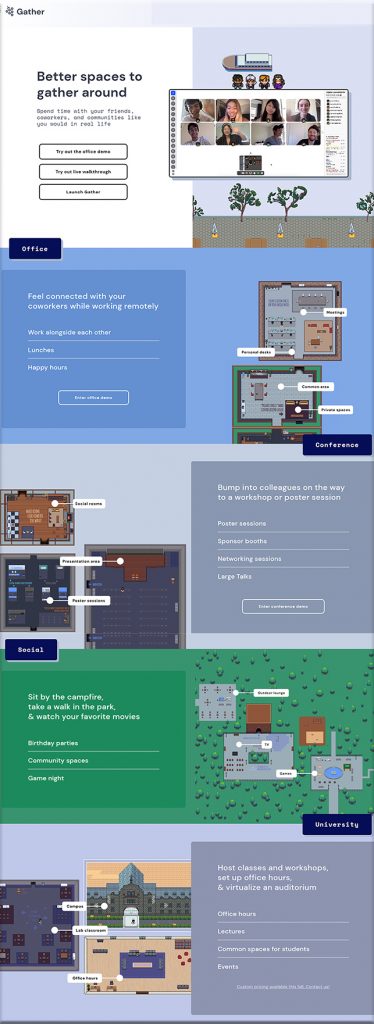
Gather, also known as Gather.town, simulates buildings and classrooms on campus where students, professors, and teaching assistants can interact with one another through personal avatars during office hours. Its main feature, “Interaction Distance,” launches a video call between users whose avatars are within five steps from each other in the virtual space. As the users’ avatars walk away from each other, their video and audio quality decrease, simulating an in-person interaction.

Also see:

Image shows how people can gather around at the office, in a conference room, at a university, other -- https://gather.town/

From DSC:
Now picture this in VR.


This is an abstract picture of a person's head made of connections peering sideways -- it links to Artificial intelligence and the future of national security from ASU

Artificial intelligence and the future of national security — from news.asu.edu

Excerpt:

Artificial intelligence is a “world-altering” technology that represents “the most powerful tools in generations for expanding knowledge, increasing prosperity and enriching the human experience” and will be a source of enormous power for the companies and countries that harness them, according to the recently released Final Report of the National Security Commission on Artificial Intelligence.

This is not hyperbole or a fantastical version of AI’s potential impact. This is the assessment of a group of leading technologists and national security professionals charged with offering recommendations to Congress on how to ensure American leadership in AI for national security and defense. Concerningly, the group concluded that the U.S. is not currently prepared to defend American interests or compete in the era of AI.

Also see:

EU Set to Ban Surveillance, Start Fines Under New AI Rules — from bloomberg.com by Natalia Drozdiak

Excerpt:

The European Union is poised to ban artificial intelligence systems used for mass surveillance or for ranking social behavior, while companies developing AI could face fines as high as 4% of global revenue if they fail to comply with new rules governing the software applications.

Also see:

Wrongfully arrested man sues Detroit police over false facial recognition match — from washingtonpost.com by Drew Harwell
The case could fuel criticism of police investigators’ use of a controversial technology that has been shown to perform worse on people of color

Excerpts:

A Michigan man has sued Detroit police after he was wrongfully arrested and falsely identified as a shoplifting suspect by the department’s facial recognition software in one of the first lawsuits of its kind to call into question the controversial technology’s risk of throwing innocent people in jail.

Robert Williams, a 43-year-old father in the Detroit suburb of Farmington Hills, was arrested last year on charges he’d taken watches from a Shinola store after police investigators used a facial recognition search of the store’s surveillance-camera footage that identified him as the thief.

Prosecutors dropped the case less than two weeks later, arguing that officers had relied on insufficient evidence. Police Chief James Craig later apologized for what he called “shoddy” investigative work. Williams, who said he had been driving home from work when the 2018 theft had occurred, was interrogated by detectives and held in custody for 30 hours before his release.

Williams’s attorneys did not make him available for comment Tuesday. But Williams wrote in The Washington Post last year that the episode had left him deeply shaken, in part because his young daughters had watched him get handcuffed in his driveway and put into a police car after returning home from work.

“How does one explain to two little girls that a computer got it wrong, but the police listened to it anyway?” he wrote. “As any other black man would be, I had to consider what could happen if I asked too many questions or displayed my anger openly — even though I knew I had done nothing wrong.”

Addendum on 4/20/21:

 
© 2025 | Daniel Christian