2025: The Year the Frontier Firm Is Born — from Microsoft

We are entering a new reality—one in which AI can reason and solve problems in remarkable ways. This intelligence on tap will rewrite the rules of business and transform knowledge work as we know it. Organizations today must navigate the challenge of preparing for an AI-enhanced future, where AI agents will gain increasing levels of capability over time that humans will need to harness as they redesign their business. Human ambition, creativity, and ingenuity will continue to create new economic value and opportunity as we redefine work and workflows.

As a result, a new organizational blueprint is emerging, one that blends machine intelligence with human judgment, building systems that are AI-operated but human-led. Like the Industrial Revolution and the internet era, this transformation will take decades to reach its full promise and involve broad technological, societal, and economic change.

To help leaders understand how knowledge work will evolve, Microsoft analyzed survey data from 31,000 workers across 31 countries, LinkedIn labor market trends, and trillions of Microsoft 365 productivity signals. We also spoke with AI-native startups, academics, economists, scientists, and thought leaders to explore what work could become. The data and insights point to the emergence of an entirely new organization, a Frontier Firm that looks markedly different from those we know today. Structured around on-demand intelligence and powered by “hybrid” teams of humans + agents, these companies scale rapidly, operate with agility, and generate value faster.

Frontier Firms are already taking shape, and within the next 2–5 years we expect that every organization will be on their journey to becoming one. 82% of leaders say this is a pivotal year to rethink key aspects of strategy and operations, and 81% say they expect agents to be moderately or extensively integrated into their company’s AI strategy in the next 12–18 months. Adoption is accelerating: 24% of leaders say their companies have already deployed AI organization-wide, while just 12% remain in pilot mode.

The time to act is now. The question for every leader and employee is: how will you adapt?


On a somewhat related note, also see:

Exclusive: Anthropic warns fully AI employees are a year away — from axios.com by Sam Sabin

Anthropic expects AI-powered virtual employees to begin roaming corporate networks in the next year, the company’s top security leader told Axios in an interview this week.

Why it matters: Managing those AI identities will require companies to reassess their cybersecurity strategies or risk exposing their networks to major security breaches.

The big picture: Virtual employees could be the next AI innovation hotbed, Jason Clinton, the company’s chief information security officer, told Axios.


 

Values in the wild: Discovering and analyzing values in real-world language model interactions — from anthropic.com

In the latest research paper from Anthropic’s Societal Impacts team, we describe a practical way we’ve developed to observe Claude’s values—and provide the first large-scale results on how Claude expresses those values during real-world conversations. We also provide an open dataset for researchers to run further analysis of the values and how often they arise in conversations.

Per the Rundown AI

Why it matters: AI is increasingly shaping real-world decisions and relationships, making understanding their actual values more crucial than ever. This study also moves the alignment discussion toward more concrete observations, revealing that AI’s morals and values may be more contextual and situational than a static point of view.

Also from Anthropic, see:

Anthropic Education Report: How University Students Use Claude


Adobe Firefly: The next evolution of creative AI is here — from blog.adobe.com

In just under two years, Adobe Firefly has revolutionized the creative industry and generated more than 22 billion assets worldwide. Today at Adobe MAX London, we’re unveiling the latest release of Firefly, which unifies AI-powered tools for image, video, audio, and vector generation into a single, cohesive platform and introduces many new capabilities.

The new Firefly features enhanced models, improved ideation capabilities, expanded creative options, and unprecedented control. This update builds on earlier momentum when we introduced the Firefly web app and expanded into video and audio with Generate Video, Translate Video, and Translate Audio features.

Per The Rundown AI (here):

Why it matters: OpenAI’s recent image generator and other rivals have shaken up creative workflows, but Adobe’s IP-safe focus and the addition of competing models into Firefly allow professionals to remain in their established suite of tools — keeping users in the ecosystem while still having flexibility for other model strengths.


AI agents arrive in US classrooms — from zdnet.com by Radhika Rajkumar
Kira AI’s personalized learning platform is currently being implemented in Tennessee schools. How will it change education?

AI for education is a new but rapidly expanding field. Can it support student outcomes and help teachers avoid burnout?

On Wednesday, AI education company Kira launched a “fully AI-native learning platform” for K-12 education, complete with agents to assist teachers with repetitive tasks. The platform hosts assignments, analyzes progress data, offers administrative assistance, helps build lesson plans and quizzes, and more.

“Unlike traditional tools that merely layer AI onto existing platforms, Kira integrates artificial intelligence directly into every educational workflow — from lesson planning and instruction to grading, intervention, and reporting,” the release explains. “This enables schools to improve student outcomes, streamline operations, and provide personalized support at scale.”

Also relevant/see:

Coursera Founder Andrew Ng’s New Venture Brings A.I. to K–12 Classrooms — from observer.com by Victor Dey
Andrew Ng’s Kira Learning uses A.I. agents to transform K–12 education with tools for teachers, students and administrators.

“Teachers today are overloaded with repetitive tasks. A.I. agents can change that, and free up their time to give more personalized help to students,” Ng said in a statement.

Kira was co-founded by Andrea Pasinetti and Jagriti Agrawal, both longtime collaborators of Ng. The platform embeds A.I. directly into lesson planning, instruction, grading and reporting. Teachers can instantly generate standards-aligned lesson plans, monitor student progress in real time and receive automated intervention strategies when a student falls behind.

Students, in turn, receive on-demand tutoring tailored to their learning styles. A.I. agents adapt to each student’s pace and mastery level, while grading is automated with instant feedback—giving educators time to focus on teaching.


‘Using GenAI is easier than asking my supervisor for support’ — from timeshighereducation.com
Doctoral researchers are turning to generative AI to assist in their research. How are they using it, and how can supervisors and candidates have frank discussions about using it responsibly?

Generative AI is increasingly the proverbial elephant in the supervisory room. As supervisors, you may be concerned about whether your doctoral researchers are using GenAI. It can be a tricky topic to broach, especially when you may not feel confident in understanding the technology yourself.

While the potential impact of GenAI use among undergraduate and postgraduate taught students, especially, is well discussed (and it is increasingly accepted that students and staff need to become “AI literate”), doctoral researchers often slip through the cracks in institutional guidance and policymaking.


AI as a Thought Partner in Higher Education — from er.educause.edu by Brian Basgen

When used thoughtfully and transparently, generative artificial intelligence can augment creativity and challenge assumptions, making it an excellent tool for exploring and developing ideas.

The glaring contrast between the perceived ubiquity of GenAI and its actual use also reveals fundamental challenges associated with the practical application of these tools. This article explores two key questions about GenAI to address common misconceptions and encourage broader adoption and more effective use of these tools in higher education.


AI for Automation or Augmentation of L&D? — from drphilippahardman.substack.com by Dr. Philippa Hardman
An audio summary of my Learning Technologies talk

Like many of you, I spent the first part of this week at Learning Technologies in London, where I was lucky enough to present a session on the current state of AI and L&D.

In this week’s blog post, I summarise what I covered and share an audio summary of my paper for you to check out.


Bridging the AI Trust Gap — from chronicle.com by Ian Wilhelm, Derek Bruff, Gemma Garcia, and Lee Rainie

In a 2024 Chronicle survey, 86 percent of administrators agreed with the statement: “Generative artificial intelligence tools offer an opportunity for higher education to improve how it educates, operates, and conducts research.” In contrast, just 55 percent of faculty agreed, showing the stark divisions between faculty and administrative perspectives on adopting AI.

Among many faculty members, a prevalent distrust of AI persists — and for valid reasons. How will it impact in-class instruction? What does the popularity of generative AI tools portend for the development of critical thinking skills for Gen-Z students? How can institutions, at the administrative level, develop policies to safeguard against students using these technologies as tools for cheating?

Given this increasing ‘trust gap,’ how can faculty and administrators work together to preserve academic integrity as AI seeps into all areas of academia, from research to the classroom?

Join us for “Bridging the AI Trust Gap,” an extended, 75-minute Virtual Forum exploring the trust gap on campus about AI, the contours of the differences, and what should be done about it.


Culminating Art Projects That Boost Students’ Confidence — from edutopia.org by Mary Beth Hertz
At the end of the year, high school students enjoy the opportunity to create a final product dictated by their own interests.


Boosting Engagement by Taking Math Outdoors — from edutopia.org by Sandy Vorensky
Bringing elementary students outside for math lessons provides a welcome change of pace and a chance for new activities.


Using a School Mural Project to Showcase Students’ Growth — from edutopia.org by Gloria Sevilla
Step-by-step instructions from an elementary school educator whose annual mural assignment is displayed at the spring open house.


How to Help Students Avoid Procrastinating — from edutopia.org by Sarah Kesty
A simple strategy can help students map out their assignments in manageable chunks so they can stay on top of their work.

Long-term projects and assignments present a unique challenge for many students, requiring several layers of executive function skills, like planning and time management, to be able to manage steps over an extended period of time. Much to our frustration, students may procrastinate or avoid working on an assignment when it seems overwhelming. This can lead to late, missing, or incomplete work, or it can push students into a stressful all-nighter, as they complete an assignment designed to take weeks in the span of just a few hours.

An effective way to address the challenges of overwhelm and procrastination—and a way that requires only a tweak to your teaching instead of another task on your plate—is to teach students to “scan and plan.” Scan and plans happen during the introduction of an assignment, usually one that takes more than a few steps. Teachers organically fold in the scan and plan approach as a layer to the assignment’s announcement to the class.


Record Law Grad Employment Rates Suggest AI Isn’t Killing Off Lawyers Just Yet — from lawnext.com by Bob Ambrogi

At a time when legal doomsayers have been predicting the imminent replacement of junior associates by AI legal assistants, the law school graduating class of 2024 has delivered a contrary verdict: Human lawyers aren’t going anywhere just yet.

According to the latest American Bar Association employment report, the legal job market is showing not just resilience, but growth. The data, reported as of March 17, 2025 — approximately 10 months after spring graduations — reveals that 82.2% of the 38,937 2024 law school graduates secured positions requiring bar admission — a two-point increase from the previous year.

Also see:


Leeds to host UK’s largest LegalTech event outside London as sector booms in the region by 50% — from yorkshirepost.co.uk by Jo Jessop
Leeds is gearing up to welcome hundreds of Legal and Tech professionals [on 4/24/25], as it hosts the fourth annual LegalTech in Leeds Conference – now the largest LegalTech event outside of London.

Set to take place on April 24 at Cloth Hall Court, Leeds, the 2025 conference comes at a time of extraordinary growth for the region’s LegalTech sector, which has seen a 50% increase in LegalTech firms between 2023 and 2024, according to a new report from Whitecap Consulting.

The event, themed “People & Technology,” will spotlight how digital innovation is transforming the legal sector while keeping human experience at its core. This year’s agenda will delve into the practical ways individuals and organisations can collaborate to deliver more efficient, accessible, and forward-thinking legal services. With hundreds of attendees expected, it’s set to be a landmark gathering of legal professionals, lawyers, tech professionals, entrepreneurs, academics and policymakers.


How Legal Tech is Reshaping the Broader Legal Ecosystem — from community.nasscom.in

The legal profession, long characterized by tradition and precedent, is undergoing a transformative shift driven by technological innovation. Legal technology, or “legal tech,” is not merely a tool for efficiency; it is a catalyst redefining the practice of law, the structure of legal services, and the accessibility of justice.

1. Streamlining Legal Operations
2. Enhancing Access to Justice
3. Transforming Legal Education and Roles
4. Redefining Client Expectations and Service Delivery
5. plus several more


Teens, Social Media and Mental Health — from pewresearch.org by Michelle Faverio, Monica Anderson, and Eugenie Park
Most teens credit social media with feeling more connected to friends. Still, roughly 1 in 5 say social media sites hurt their mental health, and growing shares think they harm people their age

Rising rates of poor mental health among youth have been called a national crisis. While this is often linked to factors like the COVID-19 pandemic or poverty, some officials, like former Surgeon General Vivek Murthy, name social media as a major threat to teenagers.

Our latest survey of U.S. teens ages 13 to 17 and their parents finds that parents are generally more worried than their children about the mental health of teenagers today.

And while both groups call out social media’s impact on young people’s well-being, parents are more likely to make this connection.1

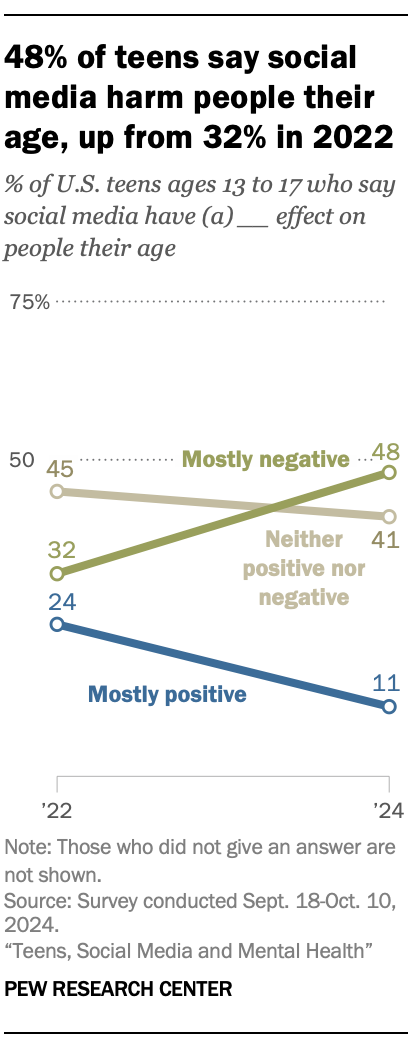
Still, teens are growing more wary of social media for their peers. Roughly half of teens (48%) say these sites have a mostly negative effect on people their age, up from 32% in 2022. But fewer (14%) think they negatively affect them personally.


Schools push career ed classes ‘for all,’ even kids heading to college — from hechingerreport.org by Javeria Salman
As backlash to ‘college for all’ grows, a new ‘CTE for all’ model blossoms. Backers say it engages students and prepares them for the future, but others worry it comes at a cost

The credit union is one small piece of a districtwide effort, Academies of Louisville, to embed career and technical education, or CTE, alongside core subjects like math and English and require every student to pick a career pathway by 10th grade. Piloted in 2017 at 11 high schools, the model has expanded to all 15 of the district’s main high schools. As part of that effort, the district has also launched a career exploration program at 14 middle schools, partnered with local colleges and universities to provide dual credit courses and smoothed the path for students to graduate with industry-recognized certifications.

The Academies of Louisville is one of roughly 30 such programs that are working to provide CTE for all students, regardless of whether they plan to go to college or directly into the workforce, according to Jessica Delgado, marketing and communications director of Ford Next Generation Learning, which supports school districts in adopting the approach.


A Stunning Image of the Australian Desert Illuminates the Growing Problem of Satellite Pollution — from thisiscolossal.com by Grace Ebert and Joshua Rozells


Fight the Trump Administration’s Defiance of the Constitution and Courts — from 5calls.org

On April 14th, the Trump administration openly defied a unanimous order from the Supreme Court by refusing to bring back a person they knowingly sent to a torture prison in El Salvador by mistake.

Since Day 1, the Trump administration has been consistently eroding the constitutional separation of powers and system of checks and balances. They have…


From DSC:
Be more like Harvard.

Harvard sues the Trump administration in escalating confrontation — from washingtonpost.com by Susan Svrluga and Danielle Douglas-Gabriel
Lawsuit argues that government actions, including freezing $2.2 billion in federal funding, violated the First Amendment and didn’t follow legal procedures.

Harvard University sued the Trump administration in federal court Monday, the latest move in the escalating feud between the nation’s wealthiest school and the White House.

The lawsuit, filed in U.S. District Court in Massachusetts against multiple federal agencies, seeks to block the Trump administration from withholding federal funding “as leverage to gain control of academic decision making at Harvard.”

Alan M. Garber, the president of Harvard, said in a message to the university community Monday that the Trump administration’s actions are unlawful and beyond the government’s authority.

From DSC:
Trump has WAAAAY overstepped his jurisdiction and has crossed boundaries left and right. He has single-handedly wreaked havoc across the world — especially with the trade wars and by undermining the Federal Reserve. But he has also trampled on the rights of people living in America. Perhaps we need to write or revisit the job description of a President of the USA. But that’s not really going to help. He wouldn’t listen to it or read it anyway.


How to Use AI and Universal Design to Empower Diverse Thinkers with Susan Tanner — from legaltalknetwork.com by Zack Glaser, Stephanie Everett, and Susan Tanner

What if the key to better legal work isn’t just smarter tools but more inclusive ones? Susan Tanner, Associate Professor at the University of Louisville Brandeis School of Law, joins Zack Glaser to explore how AI and universal design can improve legal education and law firm operations. Susan shares how tools like generative AI can support neurodiverse thinkers, enhance client communication, and reduce anxiety for students and professionals alike. They also discuss the importance of inclusive design in legal tech and how law firms can better support their teams by embracing different ways of thinking to build a more accessible, future-ready practice. The conversation emphasizes the need for educators and legal professionals to adapt to the evolving landscape of AI, ensuring that they leverage its capabilities to better serve their clients and students.


Maximizing Microsoft Copilot in Your Legal Practice — from legaltalknetwork.com by Tom Mighell, Dennis Kennedy, and Ben Schorr

Copilot is a powerful tool for lawyers, but are you making the most of it within your Microsoft apps? Tom Mighell is flying solo at ABA TECHSHOW 2025 and welcomes Microsoft’s own Ben Schorr to the podcast. Ben shares expert insights into how lawyers can implement Copilot’s AI-assistance to work smarter, not harder. From drafting documents to analyzing spreadsheets to streamlining communication, Copilot can handle the tedious tasks so you can focus on what really matters. Ben shares numerous use-cases and capabilities for attorneys and later gives a sneak peek at Copilot’s coming enhancements.


Another ‘shock’ is coming for American jobs — from washingtonpost.com by Heather Long. DSC: This is a gifted article
Millions of workers will need to shift careers. Our country is unprepared.

The United States is on the cusp of a massive economic shift due to AI, and it’s likely to cause greater change than anything President Donald Trump does in his second term. Much good can come from AI, but the country is unprepared to grapple with the need for millions — or perhaps tens of millions — of workers to shift jobs and entire careers.

“There’s a massive risk that entry-level, white-collar work could get automated. What does that do to career ladders?” asked Molly Kinder, a fellow at the Brookings Institution. Her research has found the jobs of marketing analysts are five times as likely to be replaced as those of marketing managers, and sales representative jobs are three times as likely to be replaced as those of sales managers.

Young people working in these jobs will need to be retrained, but it will be hard for them to invest in new career paths. Consider that many college graduates already carry a lot of debt (an average of about $30,000 for those who took student loans).What’s more, the U.S. unemployment insurance system covers only about 57 percent of unemployed workers and replaces only a modest amount of someone’s pay.

From DSC:
This is another reason why I think this vision here is at least a part of our future. We need shorter, less expensive credentials.

  • People don’t have the time to get degrees that take 2+ years to complete (after they have already gone through college once).
  • They don’t want to come out with more debt on their backs.
  • With inflation going back up, they won’t have as much money anyway.
  • Also, they may already have enough debt on their backs.
 

Higher Ed Institutions Rely Less on OPMs While Increasingly Hiring Fee-For-Service Models — from iblnews.org

market report from Validated Insights released this month notes that fewer colleges and universities hire external online program management (OPM) companies to develop their courses.

For 2024, higher education institutions launched only 81 new partnerships with OPMs —  a drop of 42% and the lowest number since 2016.

The report showed that institutions increasingly pay OPMs a fee-for-service instead of following a revenue-sharing model with big service bundles and profit splits.

Experts say revenue-sharing models, which critics denounce as predatory arrangements, incentivize service providers to use aggressive recruiting tactics to increase enrollments and maximize tuition revenue.

According to the report, fee-for-service has become the dominant business model for OPMs.


6 Online Edtech Professional Learning Communities & Resources for Teachers — from techlearning.com by Stephanie Smith Budhai, Ph.D.
These resources can help provide training, best practices, and advice, for using digital tools such as Canva, Curipod, Kahoot!, and more

While school-led professional development can be helpful, there are online professional learning communities on various edtech websites that can be leveraged. Also, some of these community spaces offer the chance to monetize your work.

Here is a summary of six online edtech professional learning spaces.


Outdated Microschool Laws Turn Parents into Criminals — from educationnext.org by Erica Smith Ewing
By over-regulating the pandemic-era schooling alternative, states ignore families’ constitutional rights

Public schools do not work for everyone. But options have increased since 1922, when Oregon tried to ban private education. The Supreme Court shut down that scheme fast. But now, after more than 100 years, political insiders are rallying again to stop a new source of choice.

The target this time is microschooling, a Covid-era alternative that has outlasted the pandemic. Key players in the movement will gather May 8–9, 2025, at the International Microschools Conference in Washington, D.C. I will join them.

Most likely, I will meet educators running all kinds of programs in all kinds of community spaces. Microschools blur the lines between home, public, and private schooling—combining elements from all three models.

The result is a fourth category of schooling that hinges on flexibility. Some parents pool their resources and hire outside instructors. Other groups rotate teaching duties among themselves, gathering daily or perhaps only once or twice per week. These are the do-it-yourselfers. Professionals also get involved with standalone enterprises and national networks.


Undergraduate Degree Earners for Academic Year 2023-24 — from nscresearchcenter.org; via Ryan Craig

The number of learners earning certificates continued its record-breaking growth, reaching a new 10-year high for the third consecutive year. Both first-time certificate earners (+12.6%, +41,500) and those with a prior award returning to earn a certificate (+8.0%, +11,500) saw significant increases.

In contrast, both bachelor’s degree and associate degree earners declined for the third consecutive year. Fewer students earned an associate degree this year than in any of the last ten years, and bachelor’s degree earners declined to their lowest level since 2015-16. As a result of ongoing certificate growth and associate and bachelor’s decline, the proportion of first-time completers who earn a certificate has risen from about 1 in 9 (11.3%) in 2014-15 to about 1 in 7 (15.4%) in 2023-24.

The 2023-24 academic year marks the first time that certificate completers aged 24 and younger outnumbered those 25 and older. Certificate completers 18-20 years old grew by 19,400 (17.8%) and those under 18 (likely dual enrolled high school students) grew by 7,100 (27.2%) in 2023-24.


What are colleges’ legal options when threatened with federal funding cuts? — from highereddive.com/ by Lilah Burke
Higher education experts said colleges could work together or lean on their associations if they take up a legal fight against the Trump administration.

Understand your allies
In fact, colleges may struggle to fight the administration on their own.

“I don’t think that institutions should necessarily fight it by themselves,” said Jeffrey Sun, a higher education and law professor at the University of Louisville. “I don’t think they’ll win.”

What will have more power is several institutions, or even many, working together to fight the attacks on higher education.

“I don’t think we have an option unless we work in collective action,” Sun said.


Harvard University won’t yield to Trump administration’s demands— from highereddive.com by Natalie Schwartz
Alan Garber, the Ivy League institution’s president, said the university wouldn’t forfeit its “independence or its constitutional rights.”

Harvard University President Alan Garber said Monday that officials there would not yield to the Trump administration’s litany of demands to maintain access to federal funding, arguing the federal government had overstepped its authority by issuing the ultimatum. 

“The University will not surrender its independence or relinquish its constitutional rights,” Garber wrote in a community message

The move tees up a battle between the Ivy League institution and the Trump administration, which threatened the university with the loss of $9 billion in federal funding over what it claimed was a failure to protect Jewish students from antisemitism.


Harvard Professors Sue the Trump Administration While Other Universities Are Targeted — from iblnews.org

Two groups representing Harvard University professors (the American Association of University Professors and the Harvard faculty chapter) filed a lawsuit against the Trump Administration on Friday, saying that the threat to cut billions in federal funding for the institution violates free speech and other First Amendment rights.

The Trump Administration announced two weeks ago that it reviewed about $9 billion in federal funding that Harvard receives and would send a list of demands to unfreeze the money.

In a statement, Andrew Manuel Crespo, a law professor at Harvard and general counsel of the AAUP-Harvard Faculty Chapter, said the “Trump administration’s policies are a pretext to chill universities and their faculties from engaging in speech, teaching, and research that don’t align with President Trump’s views.”


OPINION: For our republic to survive, education leaders must remain firm in the face of authoritarianism — from hechingerreport.org by Jason E. Glass
We face direct threats to the values around access, opportunity and truth our schools are meant to uphold

Across the country, education leaders are being forced to make some tough decisions — to choose between defending core values, such as equity and historical truth, or yielding to political coercion in hopes of avoiding conflict. There is no strategy that does not involve conflict and trade-offs. Every education leader operates in their own political context with unique legal and cultural constraints.

But make no mistake: Inaction is not neutral. Even the decision to do nothing is a choice, one that has consequences.


Northwestern to self-fund federally threatened research — from highereddive.com by Laura Spitalniak
Leaders at the well-known institution said the support would sustain “vital research” until they had a “better understanding of the funding landscape.”

Northwestern University will pull from its coffers to continue funding “vital research” that has been threatened by the Trump administration, the private institution announced Thursday.


Trump is bullying, blackmailing and threatening colleges, and they are just beginning to fight back — from hechingerreport.org by Liz Willen
After Harvard rejected the president’s demands, more university leaders have started to speak out — but many say a bigger response is needed

Many hope it is the beginning of a new resistance in higher education. “Harvard’s move gives others permission to come out on the ice a little,” McGuire said. “This is an answer to the tepid and vacillating presidents who said they don’t want to draw attention to themselves.”

Harvard paved the way for other institutions to stand up to the administration’s demands, Ted Mitchell, president of the American Council on Education, noted in an interview with NPR this week.

Stanford University President Jonathan Levin immediately backed Harvard, noting that “the way to bring about constructive change is not by destroying the nation’s capacity for scientific research, or through the government taking command of a private institution.”

“I tell them, you will never regret doing what is right, but if you allow yourself to be co-opted, you will have regret that you caved to a dictator who doesn’t care about you or your institution.”

 
© 2025 | Daniel Christian