DC: I’m not necessarily recommending this, but the next two items point out how the use of agents continues to move forward:

The Future is Here: Visa Announces New Era of Commerce Featuring AI

  • Global leader brings its trusted brand and powerful network to enable payments with new technologies
  • Launches new innovations and partnerships to drive flexibility, security and acceptance

SAN FRANCISCO–(BUSINESS WIRE)–The future of commerce is on display at the Visa Global Product Drop with powerful AI-enabled advancements allowing consumers to find and buy with AI plus the introduction of new strategic partnerships and product innovations.

Also related/see:

Find and Buy with AI: Visa Unveils New Era of Commerce — from businesswire.com

  • Collaborates with Anthropic, IBM, Microsoft, Mistral AI, OpenAI, Perplexity, Samsung, Stripe and more
  • Will make shopping experiences more personal, more secure and more convenient as they become powered by AI

Introduced [on April 30th] at the Visa Global Product Drop, Visa Intelligent Commerce enables AI to find and buy. It is a groundbreaking new initiative that opens Visa’s payment network to the developers and engineers building the foundational AI agents transforming commerce.


AI agents are the new buyers. How can you market to them? — from aiwithallie.beehiiv.com by Allie Miller
You’re optimizing for people. But the next buyers are bots.

In today’s newsletter, I’m unpacking why your next major buyers won’t be people at all. They’ll be AI agents, and your brand might already be invisible to them. We’ll dig into why traditional marketing strategies are breaking down in the age of autonomous AI shoppers, what “AI optimization” (AIO) really means, and the practical steps you can take right now to make sure your business stays visible and competitive as the new digital gatekeepers take over more digital tasks.

AI platforms and AI agents—the digital assistants that browse and actually do things powered by models like GPT-4o, Claude 3.7 Sonnet, and Gemini 2.5 Pro—are increasingly becoming the gatekeepers between your business and potential customers.

“AI is the new front door to your business for millions of consumers.”

The 40-Point (ish) AI Agent Marketing Playbook 
Here’s the longer list. I went ahead and broke these into four categories so you can more easily assign owners: Content, Structure & Design, Technical & Dev, and AI Strategy & Testing. I look forward to seeing how this space, and by extension my advice, changes in the coming months.


Microsoft CEO says up to 30% of the company’s code was written by AI — from techcrunch.com by Maxwell Zeff

During a fireside chat with Meta CEO Mark Zuckerberg at Meta’s LlamaCon conference on Tuesday, Microsoft CEO Satya Nadella said that 20% to 30% of code inside the company’s repositories was “written by software” — meaning AI.


The Top 100Gen AI Consumer Apps — from a16z.com

In just six months, the consumer AI landscape has been redrawn. Some products surged, others stalled, and a few unexpected players rewrote the leaderboard overnight. Deepseek rocketed from obscurity to a leading ChatGPT challenger. AI video models advanced from experimental to fairly dependable (at least for short clips!). And so-called “vibe coding” is changing who can create with AI, not just who can use it. The competition is tighter, the stakes are higher, and the winners aren’t just launching, they’re sticking.

We turned to the data to answer: Which AI apps are people actively using? What’s actually making money, beyond being popular? And which tools are moving beyond curiosity-driven dabbling to become daily staples?

This is the fourth installment of the Top 100 Gen AI Consumer Apps, our bi-annual ranking of the top 50 AI-first web products (by unique monthly visits, per Similarweb) and top 50 AI-first mobile apps (by monthly active users, per Sensor Tower). Since our last report in August 2024, 17 new companies have entered the rankings of top AI-first web products.


Deep Research with AI: 9 Ways to Get Started — from wondertools.substack.com by Jeremy Caplan
Practical strategies for thorough, citation-rich AI research

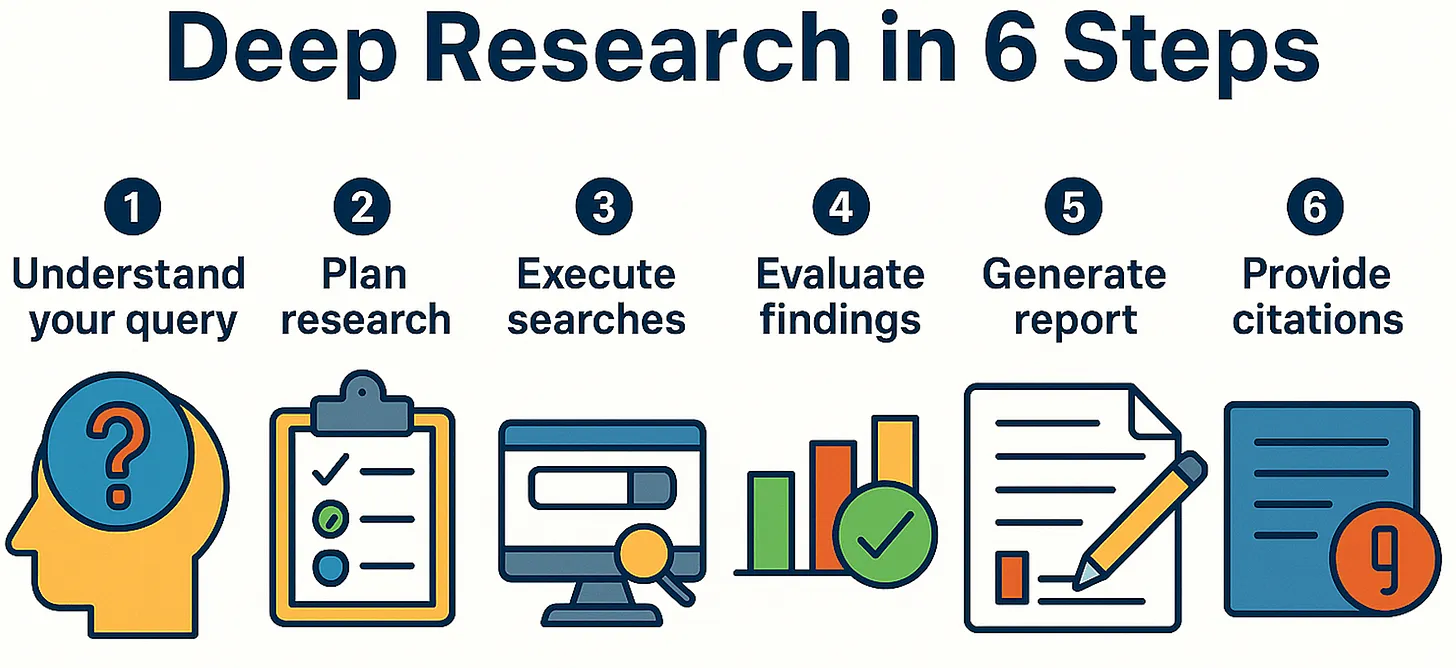
The AI search landscape is transforming at breakneck speed. New “Deep Research” tools from ChatGPT, Gemini and Perplexity autonomously search and gather information from dozens — even hundreds — of sites, then analyze and synthesize it to produce comprehensive reports. While a human might take days or weeks to produce these 30-page citation-backed reports, AI Deep Research reports are ready in minutes.

What’s in this post

    • Examples of each report type I generated for my research, so you can form your own impressions.
    • Tips on why & how to use Deep Research and how to craft effective queries.
    • Comparison of key features and strengths/limitations of the top platforms

AI Agents Are Here—So Are the Threats: Unit 42 Unveils the Top 10 AI Agent Security Risks — from marktechpost.com

As AI agents transition from experimental systems to production-scale applications, their growing autonomy introduces novel security challenges. In a comprehensive new report, AI Agents Are Here. So Are the Threats,” Palo Alto Networks’ Unit 42 reveals how today’s agentic architectures—despite their innovation—are vulnerable to a wide range of attacks, most of which stem not from the frameworks themselves, but from the way agents are designed, deployed, and connected to external tools.

To evaluate the breadth of these risks, Unit 42 researchers constructed two functionally identical AI agents—one built using CrewAI and the other with AutoGen. Despite architectural differences, both systems exhibited the same vulnerabilities, confirming that the underlying issues are not framework-specific. Instead, the threats arise from misconfigurations, insecure prompt design, and insufficiently hardened tool integrations—issues that transcend implementation choices.


LLMs Can Learn Complex Math from Just One Example: Researchers from University of Washington, Microsoft, and USC Unlock the Power of 1-Shot Reinforcement Learning with Verifiable Reward — from marktechpost.com by Sana Hassan


..which links to:

Duolingo will replace contract workers with AI — from theverge.com by Jay Peters
The company is going to be ‘AI-first,’ says its CEO.

Duolingo will “gradually stop using contractors to do work that AI can handle,” according to an all-hands email sent by cofounder and CEO Luis von Ahn announcing that the company will be “AI-first.” The email was posted on Duolingo’s LinkedIn account.

According to von Ahn, being “AI-first” means the company will “need to rethink much of how we work” and that “making minor tweaks to systems designed for humans won’t get us there.” As part of the shift, the company will roll out “a few constructive constraints,” including the changes to how it works with contractors, looking for AI use in hiring and in performance reviews, and that “headcount will only be given if a team cannot automate more of their work.”


Relevant links:

Something strange, and potentially alarming, is happening to the job market for young, educated workers.

According to the New York Federal Reserve, labor conditions for recent college graduates have “deteriorated noticeably” in the past few months, and the unemployment rate now stands at an unusually high 5.8 percent. Even newly minted M.B.A.s from elite programs are struggling to find work. Meanwhile, law-school applications are surging—an ominous echo of when young people used graduate school to bunker down during the great financial crisis.

What’s going on? I see three plausible explanations, and each might be a little bit true.


It’s Time To Get Concerned As More Companies Replace Workers With AI — from forbes.com by Jack Kelly

The new workplace trend is not employee friendly. Artificial intelligence and automation technologies are advancing at blazing speed. A growing number of companies are using AI to streamline operations, cut costs, and boost productivity. Consequently, human workers are facing facing layoffs, replaced by AI. Like it or not, companies need to make tough decisions, including layoffs to remain competitive.

Corporations including Klarna, UPS, Duolingo, Intuit and Cisco are replacing laid-off workers with AI and automation. While these technologies enhance productivity, they raise serious concerns about future job security. For many workers, there is a big concern over whether or not their jobs will be impacted.


The future of career navigation — from medium.com by Sami Tatar

  1. Career navigation market overview

Key takeaway:
Career navigation has remained largely unchanged for decades, relying on personal networks and static job boards. The advent of AI is changing this, offering personalised career pathways, better job matching, democratised job application support, democratised access to career advice/coaching, and tailored skill development to help you get to where you need to be. Hundreds of millions of people start new jobs every year, this transformation opens up a multi-billion dollar opportunity for innovation in the global career navigation market.

A.4 How will AI disrupt this segment?
Personalised recommendations: AI can consume a vast amount of information (skills, education, career history, even youtube history, and x/twitter feeds), standardise this data at scale, and then use data models to match candidate characteristics to relevant careers and jobs. In theory, solutions could then go layers deeper, helping you position yourself for those future roles. Currently based in Amsterdam, and working in Strategy at Uber and want to work in a Product role in the future? Here are X,Y,Z specific things YOU can do in your role today to align yourself perfectly. E.g. find opportunities to manage cross functional projects in your current remit, reach out to Joe Bloggs also at Uber in Amsterdam who did Strategy and moved to Product, etc.


Tales from the Front – What Teachers Are Telling Me at AI Workshops — from aliciabankhofer.substack.com by Alicia Bankhofer
Real conversations, real concerns: What teachers are saying about AI

“Do I really have to use AI?”

No matter the school, no matter the location, when I deliver an AI workshop to a group of teachers, there are always at least a few colleagues thinking (and sometimes voicing), “Do I really need to use AI?”

Nearly three years after ChatGPT 3.5 landed in our lives and disrupted workflows in ways we’re still unpacking, most schools are swiftly catching up. Training sessions, like the ones I lead, are springing up everywhere, with principals and administrators trying to answer the same questions: Which tools should we use? How do we use them responsibly? How do we design learning in this new landscape?

But here’s what surprises me most: despite all the advances in AI technology, the questions and concerns from teachers remain strikingly consistent.

In this article, I want to pull back the curtain on those conversations. These concerns aren’t signs of reluctance – they reflect sincere feelings. And they deserve thoughtful, honest answers.


Welcome To AI Agent World! (Everything you need to know about the AI Agent market.) — from joshbersin.com by Josh Bersin

This week, in advance of major announcements from us and other vendors, I give you a good overview of the AI Agent market, and discuss the new role of AI governance platforms, AI agent development tools, AI agent vendors, and how AI agents will actually manifest and redefine what we call an “application.”

I discuss ServiceNow, Microsoft, SAP, Workday, Paradox, Maki People, and other vendors. My goal today is to “demystify” this space and explain the market, the trends, and why and how your IT department is going to be building a lot of the agents you need. And prepare for our announcements next week!


DeepSeek Unveils Prover V2 — from theaivalley.com

DeepSeek has quietly launched Prover V2, an open-source model built to solve math problems using Lean 4 assistant, which ensures every step of a proof is rigorously verified.

What’s impressive about it?

  • Massive scale: Based on DeepSeek-V3 with 671B parameters using a mixture-of-experts (MoE) architecture, which activates only parts of the model at a time to reduce compute costs.
  • Theorem solving: Uses long context windows (32K+ tokens) to generate detailed, step-by-step formal proofs for a wide range of math problems — from basic algebra to advanced calculus theorems.
  • Research grade: Assists mathematicians in testing new theorems automatically and helps students understand formal logic by generating both Lean 4 code and readable explanations.
  • New benchmark: Introduces ProverBench, a new 325-question benchmark set featuring problems from recent AIME exams and curated academic sources to evaluate mathematical reasoning.

Artificial Intelligence: Lessons Learned from a Graduate-Level Final Exam — from er.educause.edu by Craig Westling and Manish K. Mishra

The need for deep student engagement became clear at Dartmouth Geisel School of Medicine when a potential academic-integrity issue revealed gaps in its initial approach to artificial intelligence use in the classroom, leading to significant revisions to ensure equitable learning and assessment.


Deep Research with AI: 9 Ways to Get Started — from wondertools.substack.com by Jeremy Caplan
Practical strategies for thorough, citation-rich AI research
.


From George Siemens “SAIL: Transmutation, Assessment, Robots e-newsletter on 5/2/25

All indications are that AI, even if it stops advancing, has the capacity to dramatically change knowledge work. Knowing things matters less than being able to navigate and make sense of complex environments. Put another way, sensemaking, meaningmaking, and wayfinding (with their yet to be defined subelements) will be the foundation for being knowledgeable going forward.

 That will require being able to personalize learning to each individual learner so that who they are (not what our content is) forms the pedagogical entry point to learning.(DSC: And I would add WHAT THEY WANT to ACHIEVE.)LLMs are particularly good and transmutation. Want to explain AI to a farmer? A sentence or two in a system prompt achieves that. Know that a learner has ADHD? A few small prompt changes and it’s reflected in the way the LLM engages with learning. Talk like a pirate. Speak in the language of Shakespeare. Language changes. All a matter of a small meta comment send to the LLM. I’m convinced that this capability to change, transmute, information will become a central part of how LLMS and AI are adopted in education.

Speaking of Duolingo– it took them 12 years to develop 100 courses. In the last year, they developed an additional 148. AI is an accelerant with an impact in education that is hard to overstate. “Instead of taking years to build a single course with humans the company now builds a base course and uses AI to quickly customize it for dozens of different languages.”


FutureHouse Platform: Superintelligent AI Agents for Scientific Discovery — from futurehouse.org by Michael Skarlinski, Tyler Nadolski, James Braza, Remo Storni, Mayk Caldas, Ludovico Mitchener, Michaela Hinks, Andrew White, &  Sam Rodriques

FutureHouse is launching our platform, bringing the first publicly available superintelligent scientific agents to scientists everywhere via a web interface and API. Try it out for free at https://platform.futurehouse.org.


Nearly half of Gen Z and millennials say college was a waste of money—AI has already made degrees obsolete — from fortune.com by Preston Fore

College is often advertised as the best four years of one’s life, but many Americans now have regrets.

More than a third of all graduates now say their degree was a “waste of money,” according to a new survey by Indeed. This frustration is especially pronounced among Gen Z, with 51% expressing remorse—compared to 41% of millennials and just 20% of baby boomers.

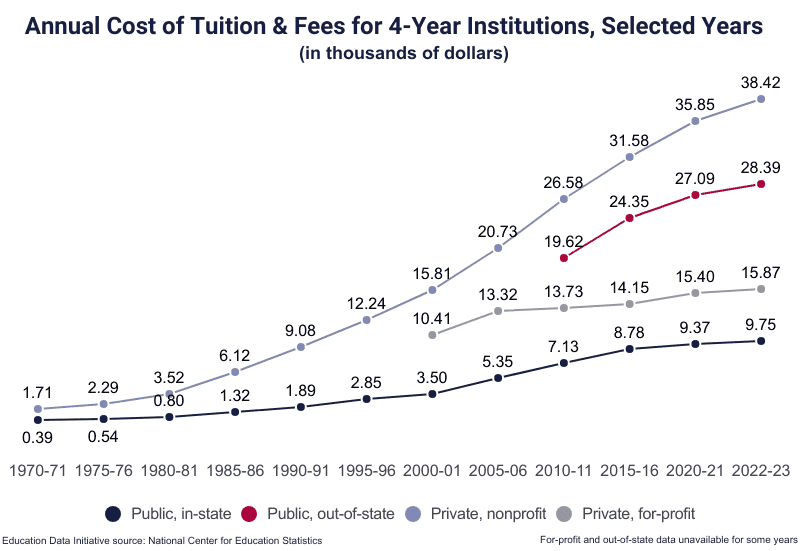
Overall, a growing share of college-educated workers are questioning the return on investment (ROI) of their degree, Kyle M.K., a career trend expert at Indeed, told Fortune. It’s something that’s not all too surprising considering that the average cost of a bachelor’s degree has doubled in the last two decades to over $38,000, and total student loan debt has ballooned to nearly $2 trillion.

“Another 38% feel student loans have limited their career growth more than their diploma has accelerated it,” M.K. said.

“AI won’t invalidate a solid education, but it will reward those who keep upgrading their toolkit.”


Average Cost of College & Tuition — from educationdata.org
Last Updated: March 8, 2025

Report Highlights. The average cost of college* in the United States is $38,270 per student per year, including books, supplies, and daily living expenses.

  • The average cost of college has more than doubled in the 21st century; the compound annual growth rate (CAGR) of tuition is 4.04%.
  • The average in-state student attending a public 4-year institution and living on-campus spends $27,146 for one academic year.
  • The average cost of in-state tuition alone is $9,750; out-of-state tuition averages $28,386.
  • The average private, nonprofit university student spends $58,628 per academic year living on campus, $38,421 of it on tuition and fees.
  • Considering student loan interest and loss of income, investing in a bachelor’s degree can ultimately cost in excess of $500,000.

.


From DSC:
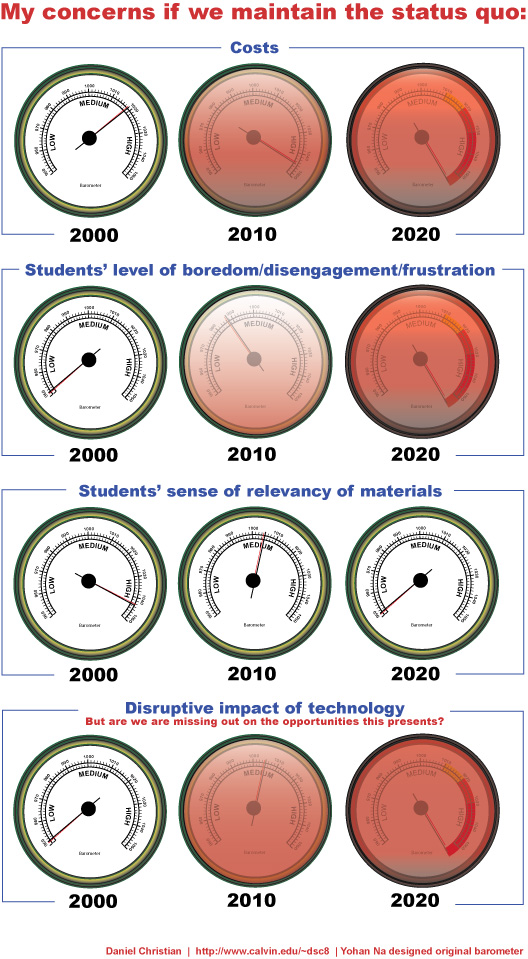
Reminds me of a graphic that Yohan Na and I created back in 2009:
.


John 13:34

34 “A new command I give you: Love one another. As I have loved you, so you must love one another.

2 Chronicles 7:14

…if my people, who are called by my name, will humble themselves and pray and seek my face and turn from their wicked ways, then I will hear from heaven, and I will forgive their sin and will heal their land.

Hebrews 11:6

And without faith it is impossible to please God, because anyone who comes to him must believe that he exists and that he rewards those who earnestly seek him.

James 3:17-18

17 But the wisdom that comes from heaven is first of all pure; then peace-loving, considerate, submissive, full of mercy and good fruit, impartial and sincere. 18 Peacemakers who sow in peace reap a harvest of righteousness.

Psalm 30:11-12

11 You turned my wailing into dancing; you removed my sackcloth and clothed me with joy, 12 that my heart may sing your praises and not be silent. Lord my God, I will praise you forever.

This is how God showed his love among us: He sent his one and only Son into the world that we might live through him. 10 This is love: not that we loved God, but that he loved us and sent his Son as an atoning sacrifice for our sins. 11 Dear friends, since God so loved us, we also ought to love one another.


MOOC-Style Skills Training — from the-job.beehiiv.com by Paul Fain
WGU and tech companies use Open edX for flexible online learning. Could community colleges be next?

Open Source for Affordable Online Reach
The online titan Western Governors University is experimenting with an open-source learning platform. So are Verizon and the Indian government. And the platform’s leaders want to help community colleges take the plunge on competency-based education.

The Open edX platform inherently supports self-paced learning and offers several features that make it a good fit for competency-based education and skills-forward learning, says Stephanie Khurana, Axim’s CEO.

“Flexible modalities and a focus on competence instead of time spent learning improves access and affordability for learners who balance work and life responsibilities alongside their education,” she says.

“Plus, being open source means institutions and organizations can collaborate to build and share CBE-specific tools and features,” she says, “which could lower costs and speed up innovation across the field.”

Axim thinks Open edX’s ability to scale affordably can support community colleges in reaching working learners across an underserved market. 


DOGE abruptly cut a program for teens with disabilities. This student is ‘devastated’ — from npr.org by Cory Turner

If you visit the website for Elon Musk’s Department of Government Efficiency (DOGE), you’ll find a “Wall of Receipts” listing more than 7,000 federal contracts it has terminated.

One of these programs, cancelled on Feb. 10, was called Charting My Path for Future Success. It was a research-based effort to help students with disabilities make the sometimes difficult transition from high school into college or the world of work and self-sufficiency.

Stepping stones to post-school independence
Charting My Path was built on research that shows students with disabilities who get quality transition services “are more likely to be employed after high school. They’re more likely to be enrolled in post-secondary education, and they’re more likely to identify that they have a higher quality of life,” says Catherine Fowler, a special education researcher at the University of North Carolina at Charlotte who has been involved with Charting My Path since 2019, when the contract began.

At the heart of Charting My Path was one of the most promising, research-based services: building students’ self-determination skills by working with them to set goals, then helping create concrete plans to achieve them.

Based on the early results he saw in Newton, John Curley says he was hopeful and calls the decision to cut Charting My Path “a huge mistake. I think investing in students with disabilities is investing in all of us because they’re part of our community, right? They’re our brothers and sisters, our kids, our neighbors, our coworkers.


From DSC:
If you don’t have a child with special needs, you probably don’t care about this article. But, as with so many things with us human beings, if we know of someone special to us who has disabilities, we suddenly care a lot more. Our youngest daughter fits right into this story. It could have been her pictured in this article. Such programs are needed and it sounded like this study was doing solid work. 

How does cutting this program make America great again? It doesn’t. It just makes life more difficult for the 1,600 high school juniors with disabilities that this study was helping (not to mention future students). Their pathways to a productive life just got harder, once again. I dare you to try and go figure out the spaghetti mess of how to get funding and assistance for a special needs youth graduating from high school — and all of the restrictions mentioned therein. And good luck to you if you are that individual and your parents are no longer alive. 


Micro-Credentials Impact Report — from coursera.org
Get exclusive insights on how industry-aligned micro- credentials are bridging skill gaps, driving career outcomes, and building a future-ready workforce—with data from 2,000+ students and employers across six regions.

See how micro-credentials are driving student success, meeting industry demand, and transforming higher education institutions. Deliver industry-aligned learning with confidence—whether you’re leading a university or designing workforce development programs.

Our data shows that 90% of employers are willing to offer higher starting salaries to those with micro-credentials. Most offer 10–15% more for credit-bearing vs. non-credit credentials—even higher for GenAI. Help your graduates earn more by integrating micro-credentials into your programs.

Students are 2x as likely to choose programs with micro-credentials—even more if credentials are credit-bearing, the report finds. Higher education leaders echo this trend, with 7 in 10 saying students are more likely to enroll in programs that offer micro-credentials for academic credit.


Sam Altman’s Eye-Scanning Orb Is Now Coming to the US — from wired.com by Lauren Goode
At a buzzy event in San Francisco, World announced a series of Apple-like stores, a partnership with dating giant Match Group, and a new mini gadget to scan your eyeballs.

The device-and-app combo scans people’s irises, creates a unique user ID, stores that information on the blockchain, and uses it as a form of identity verification. If enough people adopt the app globally, the thinking goes, it could ostensibly thwart scammers.

The bizarre identity verification process requires that users get their eyeballs scanned, so Tools for Humanity is expanding its physical footprint to make that a possibility.

But World is also a for-profit cryptocurrency company that wants to build a borderless, “globally inclusive” financial network. And its approach has been criticized by privacy advocates and regulators. In its early days, World was explicitly marketing its services to countries with a high percentage of unbanked or underbanked citizens, and offering free crypto as an incentive for people to sign up and have their irises scanned.


From DSC:
If people and governments could be trusted with the level of power a global ID network/service could bring, this could be a great technology. But I could easily see it being abused. Heck, even our own President doesn’t listen to the Judicial Branch of our government! He’s in contempt of court, essentially. But he doesn’t seem to care. 


Some sharp artwork — via embroidery!


2025 EDUCAUSE Teaching and Learning Workforce in Higher Education — from library.educause.edu

This report is the first in a series that examines three distinct workforce domains in higher education in 2025 (teaching and learning, cybersecurity and privacy, and IT leadership) to determine the priorities and challenges facing the profession. The findings in this report, taken from a survey of teaching and learning professionals in higher education, highlight their perspectives on a range of topics:

  • Flexible work arrangements
  • Integration of technologies
  • Workload and staffing
  • Job satisfaction and transition/succession planning
  • Mental health and well-being
  • Culture of belonging
  • Professional development


Encouraging Students’ Curiosity With Animal Observations — from edutopia.org by Shelby Guthrie
Watching animals—either outdoors or via an online live cam—is an engaging way for students to build their critical thinking skills.

A moment of stillness can spark a lifetime of curiosity. Watching animals—whether it’s a bird outside or a zoo cam online—helps learners slow down, notice patterns, and ask questions. Structured observation builds patience, critical thinking, and a stronger connection to nature.

More than just engaging, these small moments contribute to bigger ideas—like understanding ecosystems, animal behavior, and the ever-changing world. Observation teaches learners to care, question, and conserve. These skills are foundational not only for scientific thinking but also for fostering empathy and awareness. When students observe closely, they begin to notice patterns, ask better questions, and connect deeply with the natural world. This kind of curiosity-driven learning empowers them to take informed action, whether that means advocating for a local habitat, participating in citizen science, or simply seeing their environment through a more thoughtful lens.


3 Ways to Help Students Build Attention Stamina — from edutopia.org by Donna Phillips
These simple tools and strategies can improve focus in the classroom.

I set out to create some helpful tools and strategies for my students, who have diverse learning profiles, including processing delays, anxiety, attention challenges, and autism. I knew going in that whatever I came up with needed to be flexible. The goal was never perfection; it was access and agency.

What’s resulted are three classroom strategies that don’t feel like extra work for students. Instead, they help students own their attention. I named the strategies “The Listening Gym,” “The Noise Diet,” and “Focus GPS.”


Keeping Students Engaged During Long Class Periods — from edutopia.org by Maggie Espinola
By chunking class time using gradual release of responsibility, teachers can vary their teaching strategies to help students maintain focus.

For a new teacher, figuring out how to manage a long class period can feel particularly daunting. In order to maximize the attention of your students during longer class periods, consider the following tips.

Creating a Student Leadership Program — from edutopia.org by Danica Derksen
These strategies for building leadership skills can be implemented as an elective or by creating other opportunities for students.

Running an effective student leadership program takes structure and vision from all levels of a school. When we create opportunities for students to lead, we are building competencies that they will take with them for the rest of their lives.

I currently co-teach a middle school student leadership elective each semester. I am passionate about teaching my students to lead by example, find solutions to problems, and make their school a place where all students know they belong. Here are four ideas to create a strong student leadership program or other student leadership opportunities.


Personal Finance for Students? Teachers Could Use It, Too — from edweek.org by Elizabeth Heubeck

More states are mandating personal finance courses for high schoolers, but what if their teachers aren’t confident managing money themselves?

But as momentum grows around students’ financial education, a key issue is often overlooked: Many teachers don’t feel confident in their own financial knowledge.

It’s not a problem unique to teachers. Experts report that many U.S. adults lack financial literacy, which, until very recently, was rarely required as a high school graduation requirement. Few teachers study it in college, despite recent surveys of K-12 educators indicating a strong interest in the subject. And once in the classroom, teachers rarely take time to learn subjects that would benefit their own lives, like personal finance, says Yanely Espinal, a financial educator and former classroom teacher.

It’s very rare that you see a teacher pause and consider their own needs, asking themselves things like, ‘How can I set myself up financially? Am I on track?,’”


From DSC:
If you are working in K-12 or in higher education, don’t rely on the contributions that your organization makes to your 403(b) or your 401k plans (the type of plan depends upon your organization’s for-profit or non-profit/tax-exempt status). You should be investing wisely. Those 6-10% contributions won’t cut it these days, even after working 30+ years at a place that contributes that kind of funds to your retirement accounts. You need to invest aggressively if you are going to retire at age 65 (or even younger).

I worked in the corporate world for half of my career and I’m glad that I did. It helped me understand more about personal finance and investing. It helped me get started building a nest egg. But it was really aggressive investments in a couple of key companies that helped me the most. I’m not here to specify which companies to invest in. I’m just saying that if you are relying on 6%-10% contributions to meet your retirement-related needs, you may end up with far less than you’ll need to retire.

I’m glad that they are teaching personal finance these days in K-12. I hope they add some basic legal knowledge to the curricula as well.


We Visited Rumeysa Ozturk in Detention. What We Saw Was a Warning to Us All. — from nytimes.com by Edward J. Markey, Jim McGovern, and Ayanna Pressley. This is a gifted article.

When we met Ms. Ozturk in Basile, she told us she feared for her life when she was taken off the streets of her neighborhood, not knowing who had grabbed her or where they were taking her. She said that at each step of her transit — from Massachusetts to New Hampshire to Vermont to Louisiana — her repeated requests to contact her lawyer were denied. Inside the detention center, she was inadequately fed, kept in facilities with extremely cold temperatures and denied personal necessities and religious accommodations. She suffered asthma attacks for which she lacked her prescribed medication. Despite all this — and despite being far away from her loved ones — we were struck by her unwavering spirit.

Why did the Trump administration target her? By all accounts, it’s because she was one of the authors of an opinion essay for The Tufts Daily criticizing her university’s response to resolutions that the Tufts student senate passed regarding Israel and Gaza.

This is not immigration enforcement. This is repression. This is authoritarianism.
.

.

 
© 2025 | Daniel Christian