Psalm 143:8 — from BibleGateway.com
8 Let the morning bring me word of your unfailing love,
for I have put my trust in you.
Show me the way I should go,
for to you I entrust my life.
8 Let the morning bring me word of your unfailing love,
for I have put my trust in you.
Show me the way I should go,
for to you I entrust my life.
“The government even went a step further in promoting the cryptocurrency’s use by giving $30 in free bitcoins to citizens who sign up for its national digital wallet…” https://t.co/Y4Apz1mKcp
— Daniel Christian (he/him/his) (@dchristian5) September 4, 2021
The Story is in the Structure: A Multi-Case Study of Instructional Design Teams — from the Online Learning Consortium by Jason Drysdale (other articles here)
Excerpt:
Given the results of this study, it is recommended that institutions that are restructuring or building new instructional design teams implement centralized structures with academic reporting lines for their teams. The benefits of both centralization and academic reporting lines are clear: better advocacy and empowerment, better alignment with the pedagogical work of both designers and faculty, and less role misperception for instructional designers. Structuring these teams toward empowerment and better definitions of their roles as pedagogy experts may help them sustain their leadership on the initiatives they led, to great effect, during the COVID-19 pandemic. This study also revealed the importance of three additional structural elements: appropriate instructional design staffing for the size and scale of the institution, leadership experience with instructional design, and positional parity with faculty.
Also see:

More Companies Are Looking to Hire Accessibility Specialists — from wsj.com by Ann-Marie Alcántara
Effects of the Covid-19 pandemic, lawsuits, and diversity and inclusion efforts explain the increase in accessibility job postings, advocates and executives say
Excerpt:
Accessibility jobs, ranging from “head of accessibility” to “accessibility analyst,” are increasing at a rapid pace across industries as companies strive to make their products and services more tailored to people with disabilities.
The number of job listings with “accessibility” in the title grew 78% in the year ended in July from the previous 12 months, LinkedIn said in response to a data request from The Wall Street Journal. Such listings had risen 38% in the year between August 2019 and July 2020 compared with the previous year, according to the professional networking site owned by Microsoft Corp.
#augmentedreality #xr #ar #future #piano #music #tech #engineering #design
Interactive keyboard projection mapping with @m_audio
using @notchvfx & @touchdesigner by @foraus .incImage/video credits: @vr_accelerator rt @WevolverApp
cc @CurieuxExplorer @tantriclens @Shi4Tech pic.twitter.com/LUkDWUfn9s— Heinz V. Hoenen (@HeinzVHoenen) August 24, 2021
Top 300 Tools for Learning 2021 — from toptools4learning.com by Jane Hart
Excerpt:
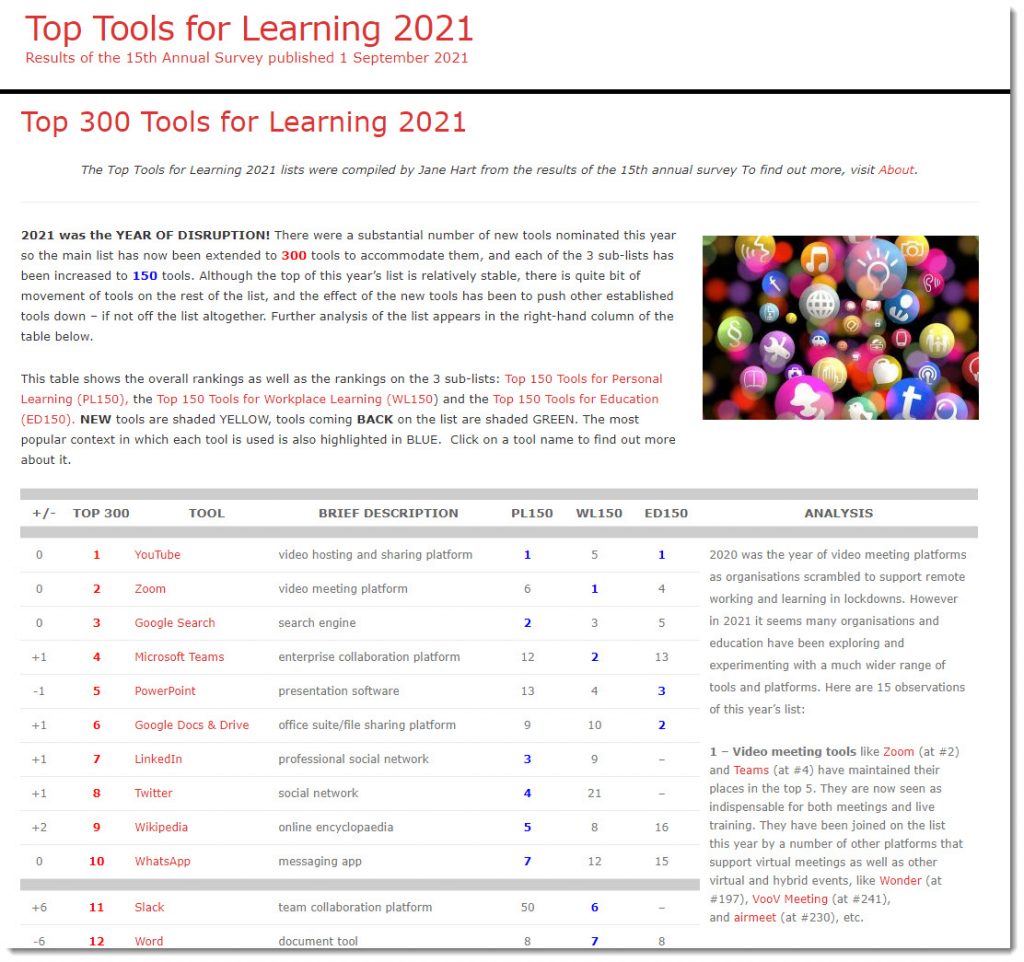
2021 was the YEAR OF DISRUPTION! There were a substantial number of new tools nominated this year so the main list has now been extended to 300 tools to accommodate them, and each of the 3 sub-lists has been increased to 150 tools. Although the top of this year’s list is relatively stable, there is quite bit of movement of tools on the rest of the list, and the effect of the new tools has been to push other established tools down – if not off the list altogether. Further analysis of the list appears in the right-hand column of the table below.
This table shows the overall rankings as well as the rankings on the 3 sub-lists: Top 150 Tools for Personal Learning (PL150), the Top 150 Tools for Workplace Learning (WL150) and the Top 150 Tools for Education (ED150). NEW tools are shaded YELLOW, tools coming BACK on the list are shaded GREEN. The most popular context in which each tool is used is also highlighted in BLUE. Click on a tool name to find out more about it.
American Association of Law Libraries (AALL) Innovation Showcase — from aallnet.org
Excerpt:
Law librarians and legal information professionals innovate every day—especially in the past year. The AALL Innovation Showcase is an opportunity to explore your colleagues’ innovations, presented as short videos and categorized by three library types: government, law firm, and law school.
US Justice Needs Data Reveals No Americans Unaffected by Justice Crisis — from legaltechmonitor.com by Logan Cornett
Excerpt:
It’s no secret that the United States is deeply embroiled in a justice crisis. According to the World Justice Project’s Rule of Law Index, the U.S. ranks 30th out of the world’s 37 high-income countries on the civil justice factor and 22nd on the criminal justice factor. Numerous studies have shone light on aspects of the crisis—some focusing on how it impacts low-income Americans, others homing in on the crisis’s effects in specific geographic regions. Now, with the new report from IAALS’ and HiiL’s joint US Justice Needs project, we have data from more than 10,000 surveyed individuals that illuminates the contours of the justice crisis in this country.
Scaling HyFlex for the Post-Pandemic Campus — from er.educause.edu by Jennifer Rider and Ayla Moore
Excerpt:
Setting up HyFlex courses on any campus requires thoughtful planning, careful analysis, continual assessment, and faculty support. But is HyFlex something that higher education institutions can and should permanently adopt in a post-pandemic world?
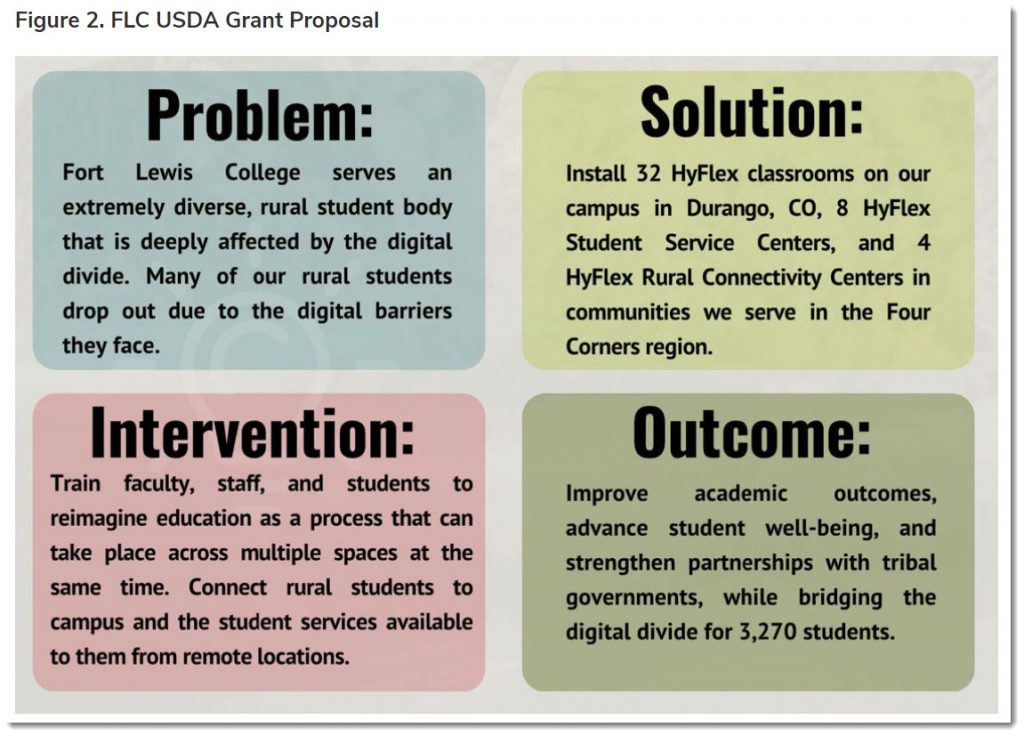
The Tomorrow Room on campus is a space where new technology will be showcased so that faculty can become familiar with the room design and technology before teaching in a HyFlex classroom.
Geometric Shapes and Three-Dimensional Illusions Disrupt Existing Architecture in Peeta’s Anamorphic Murals — from thisiscolossal.com by Grace Ebert