On 10/09/2021,
in 24x7x365 access, adult learning, Alternatives, business, career development, cloud-based computing / apps / other cloud-related, communities of practice, computer science, creativity, digital learning, experimentation, health, ideas, languages and translation, learning, learning ecosystem, Learning from the Living [Class] Room, learning preferences, lifelong learning, love of learning, MBA, MOOCs -- Massive Open Online Courses, more voice more choice more control, music, online learning, online media, platforms, programming, tools, training / L&D, UK, United States, universities, vendors, virtual field trips, vision/possibilities, web-based collaboration,
by Daniel Christian
8 ways to keep learning and developing new skills while at home — from babbel.com by Alice Austin
Being stuck inside doesn’t have to mean an end to personal development. Here’s how to keep learning new things while staying at home.
Excerpt:
Free Code Camp has been assembling a long list of courses that span multiple disciplines, from Data Science and Business to Personal Development and Art. They’re all Massive Open Online Courses (MOOCs), and they allow you to take university-created online classes through providers such as Coursera or Udacity.
So that class you missed out your first time going to college? Now would be the time to go back and really enjoy it.
There are tons of online tutorials on YouTube and many apps that can help you hone your skills. Yousician is an app that provides video tutorials to learn piano, guitar, bass and ukulele. There are other apps that specialize in one area, like Flowkey for piano, or SingTrue for vocals. Whatever instrument you have lying around, there are definitely resources out there for you to improve your skills.
On 10/09/2021,
in change, collaboration, colleges, community colleges, content development, aggregation, repositories, engagement / engaging students, experimentation, face-to-face, faculty/staff, higher education, Hyflex learning, innovation, instructional design, learning, learning ecosystem, Learning Experience Design, Learning from the Living [Class] Room, learning preferences, more voice more choice more control, online learning, participation, pedagogy, teaching & learning, United States, universities,
by Daniel Christian
Common Anxieties in Beginning HyFlex: Learning to Teach a HyFlex Class — from hyflexlearning.org by Brian Beatty
Excerpt:
Not surprisingly, one of the biggest anxieties – FEARS – for many faculty considering or implementing a HyFlex approach for the first time is learning how to do so, and to do so effectively the very first time. No one likes to feel like they aren’t equipped to do the work they are required (or challenged) to do; perhaps especially teachers who are normally in full control of their classrooms and the activities that take place in them. When you are planning to teach HyFlex, it may seem like you are planning for CHAOS, or at least planning to lose control over the class environment(s), the teaching process, and ultimately student learning. Let’s address those concerns one at a time, but briefly.
If we assume you are an effective classroom teacher, then a common design path that I usually recommend is to start with your plans for an effective classroom experience and work to translate those to the other modes, accessing expert guidance as needed (such as, instructional designers, online course design books, your colleagues). What are the learning outcomes (or instructional objectives) for the classroom? How will those translate into the online mode(s) you are planning? What about the instructional content and associated activities for the classroom? How do those translate? What about plans for assessment? Start with what you know, and are confident with, and then layer in approaches for the other modes.
On 10/08/2021,
in faith, global / globalization, hearts -- matters of the heart, history, relationships, religion,
by Daniel Christian
Isaiah 9:1-7 NIV — from biblegateway.com
9 [a]Nevertheless, there will be no more gloom for those who were in distress. In the past he humbled the land of Zebulun and the land of Naphtali, but in the future he will honor Galilee of the nations, by the Way of the Sea, beyond the Jordan—
2 The people walking in darkness
have seen a great light;
on those living in the land of deep darkness
a light has dawned.
3 You have enlarged the nation
and increased their joy;
they rejoice before you
as people rejoice at the harvest,
as warriors rejoice
when dividing the plunder.
4 For as in the day of Midian’s defeat,
you have shattered
the yoke that burdens them,
the bar across their shoulders,
the rod of their oppressor.
5 Every warrior’s boot used in battle
and every garment rolled in blood
will be destined for burning,
will be fuel for the fire.
6 For to us a child is born,
to us a son is given,
and the government will be on his shoulders.
And he will be called
Wonderful Counselor, Mighty God,
Everlasting Father, Prince of Peace.
7 Of the greatness of his government and peace
there will be no end.
He will reign on David’s throne
and over his kingdom,
establishing and upholding it
with justice and righteousness
from that time on and forever.
The zeal of the Lord Almighty
will accomplish this.
On 10/08/2021,
in 21st century, career development, change, changing business models, law schools, Legal operations, legal technologies, workplace,
by Daniel Christian
‘A very big deal.’ Nonlawyer licensing plan clears hurdle in California — from reuters.com by Karen Sloan; with thanks to Law 2030’s October 2021 newsletter from the University of Pennsylvania’s Carey Law School
Excerpt:
(Reuters) – California is on track to become the largest state to let specially trained nonlawyers offer legal advice in limited settings, such as employment and consumer debt.
The State Bar of California’s Board of Trustees on Thursday gave its preliminary blessing to a proposed “paraprofessional” program by voting to gather public comment on the plan. The public will have 110 days to weigh in on the proposal, which if adopted has the potential to jumpstart the fledgling movement behind legal paraprofessionals, or limited license legal professionals, as they are sometimes called.
On 10/07/2021,
in 21st century, 24x7x365 access, Access to Justice (A2J), change, changing business models, disruption, expectations, innovation, law schools, leadership, Legal operations, legal reform, legal technologies, legislatures / government / legal, new business models, programming, strategy, United States, user experience (UX), workplace,
by Daniel Christian
The Disruption Of Legal Services Is Here — from forbes.com by John Arsneault
Excerpt:
For the first time in those 12 years, I am now convinced we are on the precipice of the promised disruption in legal. Not because anyone in the law firms are driving toward this — but because venture capital and tech innovators have finally turned their attention to the industry.
Legal services are a much smaller overall market than, say, retail, financial services or biotech. In the world of disruption and the promised gold rush for the companies that do the disrupting, size matters. Legal has just been low on the industry list. Its number is now up.
It’s easy to Monday morning quarterback that industry now. Easy to see how big of a threat Amazon was to those companies. But when you are being rewarded for doing what you have always done and what your predecessors always did, it’s easy to miss what is around the bend. By the time those companies’ executives realized Amazon was a direct competitor with a much better fulfillment model, it was too late.
On 10/07/2021,
in love of learning, mathematics, multimedia, music, parents/guardians, programming, science, teachers, teaching & learning, tools, United States, vendors, vision/possibilities, youth,
by Daniel Christian
Sites and apps to enjoy with your kids — from wondertools.substack.com by Jeremy Caplan
Check out Jeremy’s list of sites and apps to review with your kids re:
- Making music delightful
- Bringing joy to science, math, and coding
- Other fantastic resources for kids and families
On 10/06/2021,
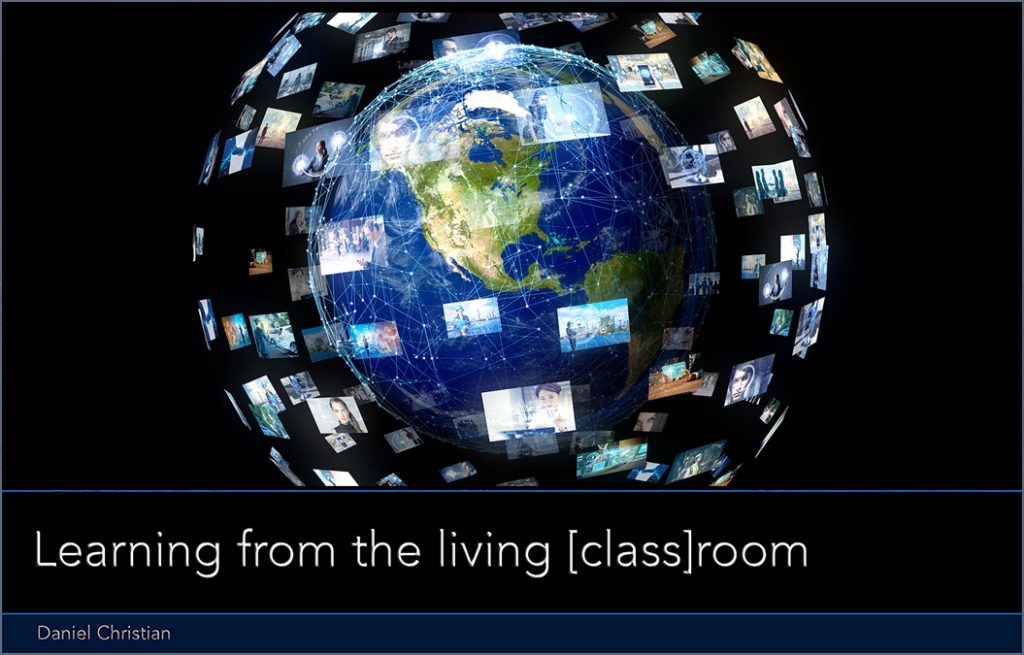
in 21st century, 24x7x365 access, accreditation, adjunct faculty, adult learning, analytics, Artificial Intelligence/Agents/LLMs/and Related, assessment, career development, cloud-based computing / apps / other cloud-related, CMS/LMS, collaboration, colleges, communications, communities of practice, community colleges, competency-based learning/education, content development, aggregation, repositories, corporate / business world, corporate universities / corporate training, credentialing, curriculum, Daniel S. Christian, data related items, emerging technologies, entrepreneurship, experimentation, faculty/staff, future, future of higher education, game-changing environment, higher education, human-computer interaction (HCI), ideas, innovation, instructional design, intelligent systems, law schools, leadership, learning, learning ecosystem, Learning from the Living [Class] Room, Legal operations, legislatures / government / legal, lifelong learning, Michigan, new business models, online learning, platforms, professional development, reinvent, society, surviving, technologies for your home, tools, training / L&D, TVs, United States, universities, vision/possibilities, vocational / trades,
by Daniel Christian
On 10/06/2021,
in accessibility / UDL, assistive technologies, computer science, Michigan, neurodivergent/special needs, platforms, society, tools, usability, user experience (UX), user interface design, vendors,
by Daniel Christian
Also see:
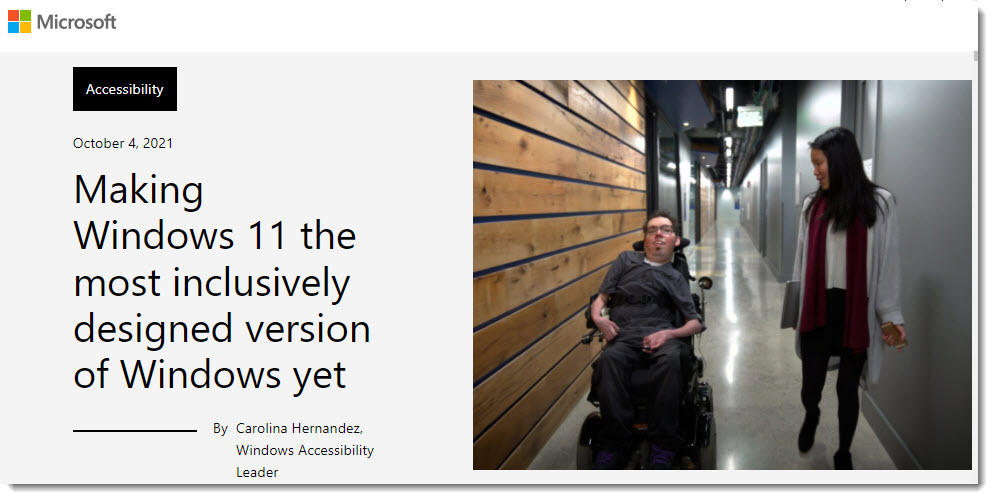
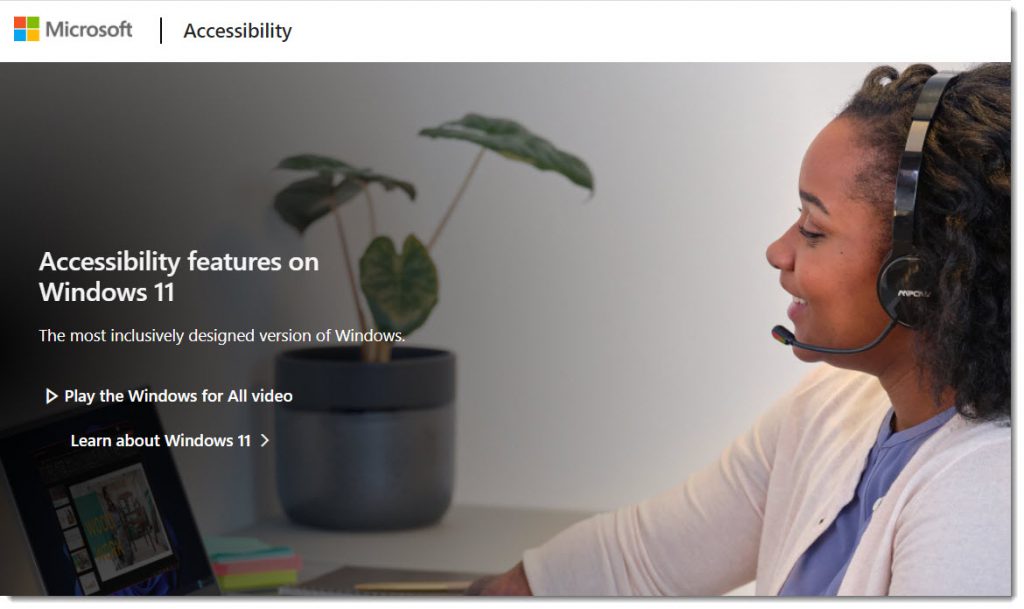
Making Windows 11 the most inclusively designed version of Windows yet — from blogs.windows.com by Carolina Hernandez