Three sets of would-be pathway providers are converging on this massive opportunity. It’s going to get crowded very fast. Here’s the current landscape and prospects for each at the outset of the Great Convergence:
Education-as-a-Benefit Providers
Education Platform Companies
Learning Experience Platforms
While one of these three sectors is likely to win the Great Convergence, there are two other possible outcomes.
While the Accessibility Guidelines Working Group (AGWG) is still working on getting WCAG 2.2 finalized, they are also working on the upcoming WCAG 3.0 standards.
[On December 7th, 2021], they released a new Working Draft of WCAG 3.0. We’ll go over the changes made from the previous Working Draft that came out in June 2021.
Aderant, a global provider of business software to law firms, announced yesterday that it acquired American LegalNet, which provides court forms, eFiling, calendaring, and docketing solutions.
Artificial intelligence tech brings a lot of benefits to different fields, including education. Many researchers claim that artificial intelligence can lead to positive student outcomes in education.
Current innovations allow developers to train a computer to do complicated tasks. This can help to improve the teaching and learning processes; however, it’s not intended to replace the teacher or professor. Artificial intelligence provides some surprising benefits for learners and educators.
In this brief blog, we’ll discuss the benefits of artificial intelligence for educators and learners.
As we enter 2022, changes in how we work, where we work, who we work with, why we work, and the technologies we use are in continual flux. Many of these changes started prior to the pandemic, were accelerated by it, and have become permanent aspects of the workplace.
Just as I have done in 2016,2017, 2018, 2019, 2020, and 2021, here is my countdown of what you should include on your HR roadmap for 2022.
Amazon Gift Signals Confidence in Community Colleges — from insidehighered.com by Suzanne Smalley The company is giving $3 million to kick-start a computer science bachelor’s degree program at community and technical colleges throughout Washington State.
Excerpt:
Amazon is funding a pilot that will support the launch of new computer science bachelor’s degree programs at community and technical colleges in Seattle and across Washington State, an investment meant to address a workforce shortage plaguing the e-commerce giant and other employers who can’t find qualified candidates for unfilled computer science positions.
It’s impressive to behold, and honestly a bit difficult to describe. The best comparison I can muster is that it feels like sitting in front of a huge VR headset designed for a giant, but rather than wearing it, you’re peering into the display from a short distance away. The concave screen fills your field of vision much like a large, curved gaming monitor might, but doesn’t block out the outside world entirely as most VR headsets do.
Or, perhaps, it’s the idea of an “NFT aggregation platform” being built into the television. It sounds insane — baking something that most people don’t understand, let alone engage in — into a TV. Most of us can’t even describe what a non-fungible token is, let alone tell someone how to go get one. It’s a multi-layered process that’s far more difficult than taking a screenshot of something you saw on Instagram and then sticking it up on your TV.
But that’s also not the point.
…
“In 2022, Samsung is introducing the world’s first TV screen-based NFT explorer and marketplace aggregator,” reads the press release, “a groundbreaking platform that lets you browse, purchase, and display your favorite art — all in one place.”
In my search for relevant material for the k-12 sector for the third edition of Teaching in a Digital Age, I came across this very good report on the use of competency-based learning in a California school system. I have condensed the article somewhat so please read the original article for more detail.
With the growing prominence of online education and its integration into the daily lives of students, teachers can play an active role in helping students in their online learning journey. Here’s how:
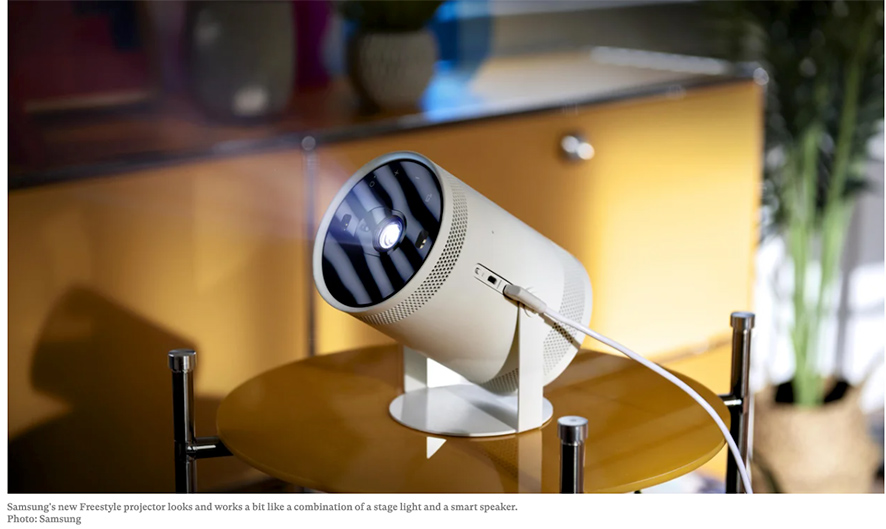
Samsung just made the TV disappear— from protocol.com by Janko Roettgers Samsung’s Freestyle projector is a smart TV. And not a TV at all. And a smart speaker. And … a lamp?
Excerpt:
Samsung’s TV R&D team seemingly never runs out of ideas: After giving the world a TV the size of a wall, a TV that looked like a giant phone and a TV that doubles as art, at this year’s CES, the company debuted a TV that’s capable of turning anything and everything into a screen.
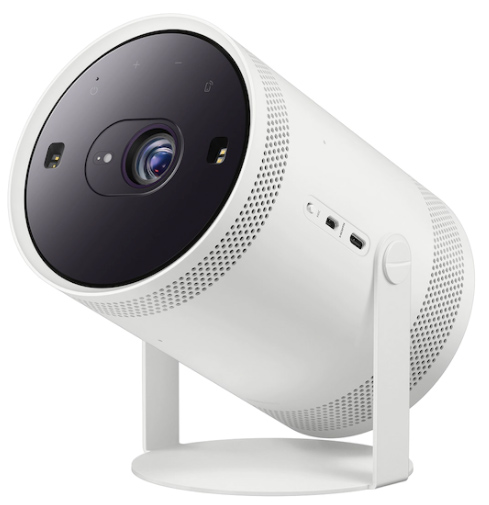
The new Samsung Freestyle is a portable projector capable of projecting video from 30 inches to 100 inches. It offers access to the very same UI and apps as any of the company’s other 2022 smart TVs, but that’s pretty much where the similarities to a traditional TV end.
The new hyperflexible, hyperportable, hypercustomizable, hyperpersonalizable projector is all about what it can be for the individual user. Unconstrained by cables or presets, the Freestyle is marketed as an anything-you-want-it-to-be machine. Samsung says it will ship in the next few months.
Surveying the animation boom and its effects on the creative industry — from itsnicethat.com by Dalia Dawood and Alex Moy “We’re seeing animation go into spaces that it’s not been in before” – leading studios shed light on a transforming industry and what it means for our screens.
Excerpt:
While kids’ animation remains popular – India-based children’s studio Toonz saw increased demand not only for feature films but “edutainment”, especially “social and emotional learning, an area kids missed out on when schools were shut,” says CEO P. Jayakumar – adult long-form animation has flourished. Such shows have evolved beyond slapstick humour to meet contemporary audiences’ interests, exploring serious issues such as mental health.
Photography and imaging
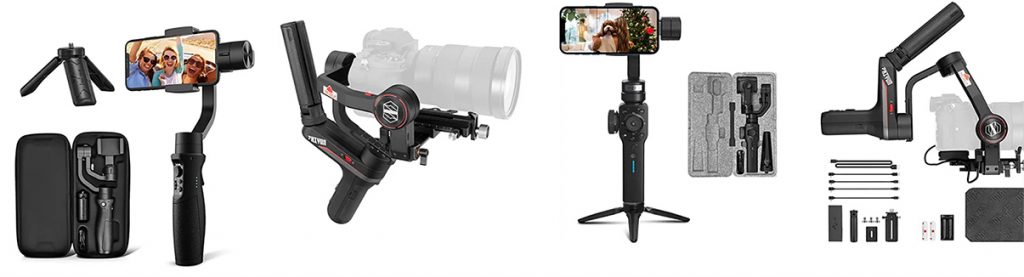
Gimbals are also used to mount everything from small camera lenses to large photographic telescopes.
In portable photography equipment, single-axis gimbal heads are used in order to allow a balanced movement for camera and lenses. This proves useful in wildlife photography as well as in any other case where very long and heavy telephoto lenses are adopted: a gimbal head rotates a lens around its center of gravity, thus allowing for easy and smooth manipulation while tracking moving subjects.
Very large gimbal mounts in the form 2 or 3 axis altitude-altitude mounts are used in satellite photography for tracking purposes.
Gyrostabilized gimbals which house multiple sensors are also used for airborne surveillance applications including airborne law enforcement, pipe and power line inspection, mapping, and ISR (intelligence, surveillance, and reconnaissance). Sensors include thermal imaging, daylight, low light cameras as well as laser range finder, and illuminators.
Gimbal systems are also used in scientific optics equipment. For example, they are used to rotate a material sample along an axis to study their angular dependence of optical properties.
Thanks for dropping by my Learning Ecosystems blog!
My name is Daniel Christian and this blog seeks to cover the teaching and learning environments within the K-12 (including homeschooling, learning pods/micro-schools), collegiate, and corporate training spaces -- whether those environments be face-to-face, blended, hyflex, or 100% online.
Just as the organizations that we work for have their own learning ecosystems, each of us has our own learning ecosystem. We need to be very intentional about enhancing those learning ecosystems -- as we all need to be lifelong learners in order to remain marketable and employed. It's no longer about running sprints (i.e., getting a 4-year degree or going to a vocational school and then calling it quits), but rather, we are all running marathons now (i.e., we are into lifelong learning these days).