12 So in everything, do to others what you would have them do to you, for this sums up the Law and the Prophets.
On 01/19/2022,
in faith, global / globalization, hearts -- matters of the heart, relationships, religion, society,
by Daniel Christian
Can A New Online Learning Platform Improve Employment For Those With Visual Impairment? [Mollenkamp]
On 01/19/2022,
in accessibility / UDL, assistive technologies, Bias | Diversity Equity & Inclusion (DE&I), business, career development, content development, aggregation, repositories, corporate / business world, corporate universities / corporate training, education technology, elearning, neurodivergent/special needs, online learning, platforms, training / L&D, workplace,
by Daniel Christian
Can A New Online Learning Platform Improve Employment For Those With Visual Impairment? — from edsurge.com by Daniel Mollenkamp
Excerpt:
A workplace technology report from the American Foundation for the Blind, published this month, notes that many people who are blind, have low vision or are deafblind say that they experience difficulties with accessibility for workplace training.
According to researchers from the foundation, the participants in the study described problems with online trainings that were incompatible with screen-reading software or visual adjustments like changing the font size, with quizzes that didn’t work with a keyboard and with educational images and videos that weren’t verbally described.
Many of the participants say they needed to get help from a manager or coworker to complete mandatory training, the report notes, causing delays and feelings of exclusion.
On 01/19/2022,
in Blockchain, copyright/ownership/NFTs, cryptocurrencies, economics, emerging technologies,
by Daniel Christian
NFTs, DeFi & Metaverse To Rule Crypto Space In 2022 — from 101blockchains.com by Georgia Weston
Excerpt:
The year 2021 has been an exceptional milestone in the world of cryptocurrencies for various reasons. In 2021, the crypto market hit the $3 trillion dollar market cap while China imposed a complete ban on crypto trading and mining. In a dramatic year for cryptocurrencies, new trends such as non-fungible tokens, decentralized finance (DeFi), and the metaverse emerged as prominent highlights in the crypto space.
The discussions around NFTs, DeFi, and the ever-growing hype surrounding the web 3.0 and metaverse have been making the rounds of online communities. How would these technologies evolve in 2022? What will be the state of NFT in 2022? What will DeFi or the metaverse look like in 2022? How will they influence the larger picture of the crypto industry? Let us discover the answers to your questions by reflecting the prominent trends for NFTs, DeFi, and the metaverse in 2022 in the following discussion.
From DSC:
Perhaps these topics could also be addressed in that discussion I was wondering about for Economics classes.
On 01/18/2022,
in 21st century, 24x7x365 access, Access to Justice (A2J), law schools, Legal operations, legal reform, legal technologies, legislatures / government / legal, United States, vendors,
by Daniel Christian
A2J Tech in the US: #LSCITC Part I — from law-tech-a2j.org by Roger Smith
Excerpt:
Get to my age and you develop a pretty high intolerance level for conferences – online or off. You get more intolerant; more arrogant about what you think you know already; more easily bored; more demanding of content, presentation and presenters. But I am a longtime fan of the Legal Services Corporation’s annual technology conference as the best I attend in a year, see an example from 2019. And this year’s event, currently half completed, is no exception. This is consistently a premiere event. As delegates, we have done two online days with two more to come later this week. It may be far too soon to evaluate themes but early enough to highlight some of the more striking content.
Also see:

On 01/18/2022,
in 21st century, Blockchain, business, change, changing business models, cloud-based computing / apps / other cloud-related, Daniel S. Christian, emerging technologies, internet, law schools, legislatures / government / legal, platforms, policy, political science,
by Daniel Christian
From DSC:
I post the following item because I’ve often wondered how law schools should best handle/address the area of emerging technologies. It’s not just newly-minted lawyers that need to be aware of these technologies’ potential pros and cons — and the developing laws around them. It’s also judges, legislators, politicians, C-Suites, and others who need to keep a pulse check on these things.
Hermès Sues NFT Creator Over ‘MetaBirkin’ Sales — from by Robert Williams
The French leather goods giant alleges trademark infringement and dilutive use of its iconic Birkin name.
Excerpt (emphasis DSC):
The complaint, which was first reported on The Fashion Law, raises questions about how trademark protections for real-world items will be enforced in the digital realm as commercial activity heats up in the metaverse. Brands including Balenciaga and Nike are experimenting with virtual fashion. Non-fungible tokens, or NFTs (unique digital assets authenticated using blockchain technology), depicting fashion items have sold for millions in recent months.
On 01/18/2022,
in Cost of legal services - including access, innovation, law schools, Legal operations, legal technologies, Michigan, tools, trends,
by Daniel Christian
Looking Forward and Backward at Legal Technology – 2021 and 2022 — from legaltechmonitor.com by Dennis Kennedy, Tom Mighell, Debbie Foster
Excerpt:
Tom Mighell and I, with help from Debbie Foster, continued our annual tradition of looking backward and forward at #legaltech at the end/beginning of each year on our podcast. Of course, we do that in our own way.
Here are the two episodes of The Kennedy-Mighell Report podcast:
- Pardon the Interruption: 2021 Edition
- Dennis & Tom’s 2022 Tech Resolutions
Also see:
- #363: What Is the Future of Legal Tech?, with Zack Glaser — from legaltalknetwork.com
Also see:
On 01/18/2022,
in law schools, Legal operations, legal reform, legal technologies, legislatures / government / legal, United States,
by Daniel Christian
SKILLS 2022 – Recap — from legaltechmonitor.com by Greg Lambert
Excerpt:
Last Thursday, a group of some 400 legal knowledge management professionals came together for the Strategic Knowledge & Innovation Legal Leaders Summit (SKILLS) conference. Oz Benamram asked me to pull together a 20 minute recap of all of the presentations that day, and share it with the 3 Geeks’ readers. So, here’s about a 20-minute recap of the 20 presentations for that day. Enjoy!!
So the biggest challenge I see is, is structural, and as much as the business model works pretty well for about right now. But it doesn’t necessarily work great for where we’re going.
Jason Barnwell
Also see:
On 01/17/2022,
in art, Asia, creativity, design, digital photography, photography, reading,
by Daniel Christian
Concentric Vessels Nest Within Larger Forms in Matthew Chambers’ Perplexing Ceramic Sculptures — from thisiscolossal.com by Grace Ebert and Matthew Chambers

Sunlight Caps the Snowy Meili Mountain Range in a Majestic Photo Series — from thisiscolossal.com by Grace Ebert & Rainlook

Royal Portuguese Reading Room, Brazil. pic.twitter.com/AJir344WCY
— 3:00am (@3hr00am) December 15, 2021
In ‘Two Worlds,’ Split-View Photos Frame the Dual Environments Above and Below the Water’s Surface — from thisiscolossal.com by Grace Ebert

Artist Spotlight: Sara-Vide Ericson — from booooooom.com

Black Sand Beach — from 500px.com by dronographer

Amazing Paper Art Made for Different Medias — from fubiz.net by Reina Takahashi, aka Reinasaur

On 01/17/2022,
in 21st century, global / globalization, legislatures / government / legal, political science, robotics,
by Daniel Christian
UN fails to agree on ‘killer robot’ ban as nations pour billions into autonomous weapons research — from robohub.org by James Dawes
Excerpt:
Autonomous weapon systems – commonly known as killer robots – may have killed human beings for the first time ever last year, according to a recent United Nations Security Council report on the Libyan civil war. History could well identify this as the starting point of the next major arms race, one that has the potential to be humanity’s final one.
The United Nations Convention on Certain Conventional Weapons debated the question of banning autonomous weapons at its once-every-five-years review meeting in Geneva Dec. 13-17, 2021, but didn’t reach consensus on a ban. Established in 1983, the convention has been updated regularly to restrict some of the world’s cruelest conventional weapons, including land mines, booby traps and incendiary weapons.
On 01/17/2022,
in 21st century, colleges, community colleges, economics, legislatures / government / legal, platforms, policy, political science, United States,
by Daniel Christian
From DSC:
Should Economics classes be looking at the idea of a digital dollar?
The battle for control of the digital dollar — from protocol.com
Excerpt:
After months of delay, the Federal Reserve’s much-awaited report on a digital dollar could be out soon. Federal Reserve Chairman Jerome Powell told the Senate Banking Committee Tuesday that the white paper on a planned central bank digital currency (CBDC) is “ready to go,” possibly in weeks.
But don’t expect a detailed blueprint for an American CBDC. The white paper will be more of “an exercise in asking questions” about how the digital dollar should work, Powell said.
And there are plenty of questions. Some have already sparked a heated debate: How should consumers gain access to the digital dollar? And how much control should the Fed have?
Will a digital dollar lead to “digital authoritarianism”? That’s one of the biggest fears about a digital currency: a Big Brother future where the Fed has the power to track how people spend their money.
On 01/17/2022,
in 21st century, 24x7x365 access, Artificial Intelligence/Agents/LLMs/and Related, Asia, change, Daniel S. Christian, data related items, emerging technologies, legal reform, legislatures / government / legal, platforms, policy, political science, privacy, society, the downsides of how people use tech, tools, United States,
by Daniel Christian
Feds’ spending on facial recognition tech expands, despite privacy concerns — from by Tonya Riley
Excerpt:
The FBI on Dec. 30 signed a deal with Clearview AI for an $18,000 subscription license to the company’s facial recognition technology. While the value of the contract might seem just a drop in the bucket for the agency’s nearly $10 billion budget, the contract was significant in that it cemented the agency’s relationship with the controversial firm. The FBI previously acknowledged using Clearview AI to the Government Accountability Office but did not specify if it had a contract with the company.
From DSC:
What?!? Isn’t this yet another foot in the door for Clearview AI and the like? Is this the kind of world that we want to create for our kids?! Will our kids have any privacy whatsoever? I feel so powerless to effect change here. This technology, like other techs, will have a life of its own. Don’t think it will stop at finding criminals.
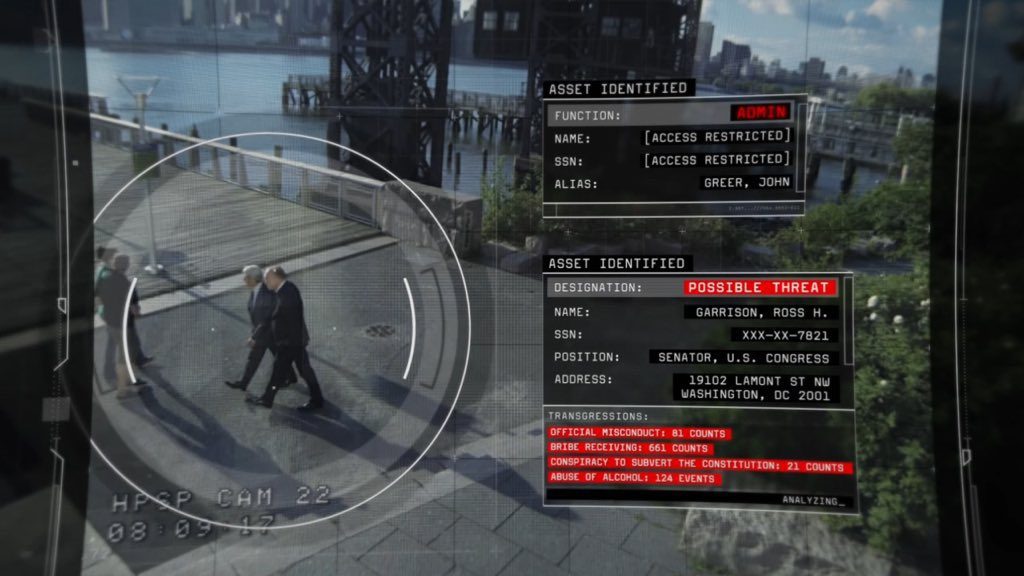
This is a snapshot from the series entitled, “Person of Interest.“
Will this show prove to be right on the mark?
Addendum on 1/18/22:
As an example, check out this article:
- Tencent is scanning kids’ faces to stop them using older relatives’ gaming accounts to get around China’s gaming restrictions — from businessinsider.com by Weilun Soon
Tencent is set to ramp up facial recognition on Chinese children who log into its gaming platform. The increased surveillance comes as the tech giant caps how long kids spend gaming on its platform. In August 2021, China imposed strict limits on how much time children could spend gaming online.
On 01/17/2022,
in 21st century, 24x7x365 access, change, changing business models, future, game-changing environment, ideas, innovation, law schools, Legal operations, legal reform, legal technologies, legislatures / government / legal, new business models,
by Daniel Christian
Thomson Reuters’ Report May Signal Sea Change In Legal Profession — from techlawcrossroads.com by Stephen Embry
Excerpt:
In a nutshell, the Report demonstrates that to thrive post-pandemic and even survive, lawyers will need to better adopt technology, use better workflows, and make sure work is done by right mix and training, and experience. Otherwise, the work that is piling up during the great talent shortage just won’t get done.
…
More tech, better work process, more remote work, becoming nimble. Bottom line, successful law firms, and lawyers can’t afford business as usual post-pandemic.
Also see:
- 2022 Report on the State of the Legal Market: Despite a strong year, numerous & growing challenges confront law firms — from homsonreuters.com