Holograms? Check! Now what? — from blog.webex.com by Elizabeth Bieniek

Excerpt (emphasis DSC):

Two years ago, I wrote about the Future of Meetings in 2030 and hinted at an effort my team was building to make this a reality. Now, we have publicly unveiled Webex Hologram and brought the reality of a real-time, end-to-end holographic meeting solution to life.

With Webex Hologram, you can feel co-located with a colleague who is thousands of miles away. You can share real objects in incredible multi-dimensional detail and collaborate on 3D content to show perspective, share, and approve design changes in real-time, all from the comfort of your home workspace.

As the hype dies down, the focus on entirely virtual experiences in fanciful environments will abate and a resurgence in focus on augmented experiences—interjecting virtual content into the physical world around you for an enhanced experience that blends the best of physical and virtual—will emerge.

The ability to have curated information at one’s fingertips, still holds an incredible value prop that has yet to be realized. Applying AI to predict, find, and present this type of augmented information in both 2D and 3D formats will become incredibly useful. 

From DSC:
As I think of some of the categories that this posting about establishing a new kind of co-presence relates to, there are many relevant ones:

  • 21st century
  • 24x7x365
  • 3D
  • Audio/Visual (A/V)
  • Artificial Intelligence (AI)
  • Cloud-based
  • Collaboration/web-based collaboration
  • Intelligent tutoring
  • Law schools, legal, government
  • Learning, learning agents, learning ecosystems, Learning from the Living [Class] Room, learning spaces/hubs/pods
  • Libraries/librarians
  • K-12, higher education, corporate training
  • Metaverse
  • Online learning
  • Telelegal, telemedicine
  • Videoconferencing
  • Virtual courts, virtual tutoring, virtual field trips
  • Web3
 

Best Video Editing Software for Mac — from futurism.com by the editorial team at Recurrent Media, Futurism’s owner
Must-have software for creators in the age of YouTube.

Excerpt:

— Best Overall: Apple Final Cut Pro
— Best for Professionals: Adobe Premiere Pro 2022
— Best Budget: iMovie
— Best for Speed: Adobe Premiere Rush 2022
— Best Mid-Priced: Adobe Premiere Elements 2022

From DSC:
I appreciated the Specs, Pros, and Cons sections for each of the tools that made their cut. I also appreciated that they covered tools that could address a variety of audiences and budgets.

Also relevant/see:

WeVideo Classroom is the education spin-off of the famous video editing platform that is specifically aimed at teachers and students.

WeVideo is a very simple to use yet powerful [cloud-based] video editor which can be used by teachers to help students learn the art of video editing. Until this latest release, that meant using external tools or in-classroom teaching to get projects set and marked.

The idea behind WeVideo Classroom is to integrate all the tools into the editor itself so that teachers can set project assessments, monitor them, comment and ultimately mark them for student feedback.


How I use Minecraft to help kids with autism — from ted.com by Stuart Duncan; with thanks to Dr. Kate Christian for this resource

Description:

The internet can be an ugly place, but you won’t find bullies or trolls on Stuart Duncan’s Minecraft server, AutCraft. Designed for children with autism and their families, AutCraft creates a safe online environment for play and self-expression for kids who sometimes behave a bit differently than their peers (and who might be singled out elsewhere). Learn more about one of the best places on the internet with this heartwarming talk.


Below are two excerpted snapshots from Stuart’s presentation:

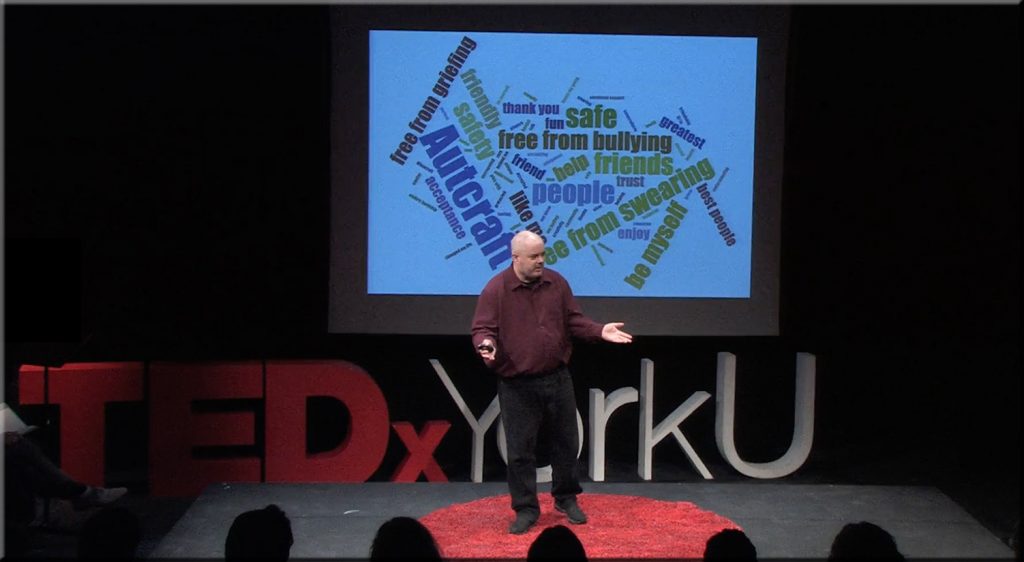
Stuart Duncan speaking at TEDX York U

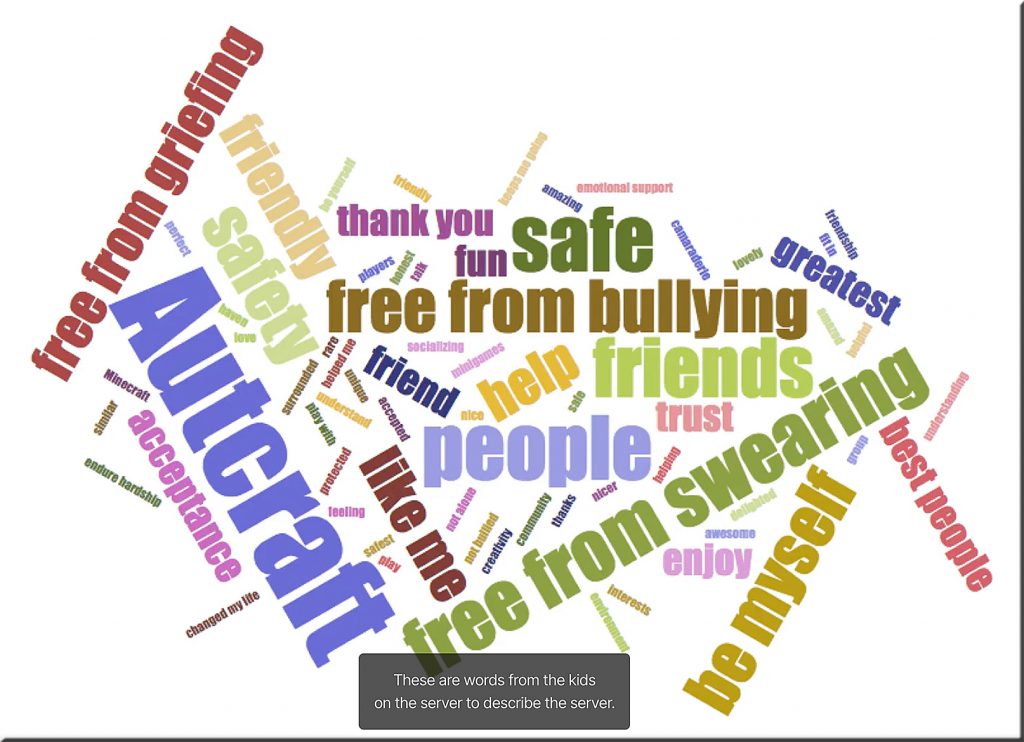
These are the words autistic students used to describe their experience with Stuart's Minecraft server


5 Tips for Online Tutoring Based on New Research — from techlearning.com by Erik Ofgang
Matthew Kraft, a professor at Brown University, shares some best practices for implementing online tutoring programs based on his recent research.

Excerpt:

While in-person high-dosage tutoring has been shown to improve student learning in multiple studies, the extent that this translates to online tutoring is not as well researched. However, a recent pilot study of online tutoring in which college students volunteered as tutors and were paired with middle school students in Illinois found consistently positive effects of online tutoring on student achievement, though these effects were smaller than had been seen for in-person tutoring.


Exploring Virtual Reality [VR] learning experiences in the classroom — from blog.neolms.com by Rachelle Dene Poth

Excerpt:

With the start of a new year, it is always a great time to explore new ideas or try some new methods that may be a bit different from what we have traditionally done. I always think it is a great opportunity to stretch ourselves professionally, especially after a break or during the spring months.

Finding ways to boost student engagement is important, and what I have found is that by using tools like Augmented Reality (AR) and Virtual Reality (VR), we can immerse students in unique and personalized learning experiences. The use of augmented and virtual reality has increased in K-12 and Higher Ed, especially during the past two years, as educators have sought new ways to facilitate learning and give students the chance to connect more with the content. The use of these technologies is increasing in the workplace, as well.

With all of these technologies, we now have endless opportunities to take learning beyond what has been a confined classroom “space” and access the entire world with the right devices.


Higher ed groups call for stricter oversight of accreditors — from highereddive.com by Jeremy Bauer-Wolf

Dive Brief:

  • Sixteen experts and advocacy organizations in higher education are calling for stricter U.S. Department of Education oversight of accreditors, particularly in how they handle colleges with poor student outcomes.
  • The groups and individuals wrote to the Education Department late last month recommending ways to make the evaluation process for accreditors more transparent and asking agency officials to more closely scrutinize several major accreditors up for review in February 2023.
  • Among their suggestions were that the Education Department should make certain documents public early in the process of accreditors seeking department approval, that it should spend more time reviewing accreditors that control access to federal financial aid funds than to those that do not, and that it should develop new regulations to make sure accreditors consider how institutions are serving disadvantaged students.
 

AI Foundation Models for the Rest of Us — from future.a16z.com by Elliot Turner

Excerpt:

While 2012’s state-of-the-art systems could be trained on a $700 video game card, today’s state-of-the-art systems – often referred to as foundation models – likely require tens of millions of dollars in computation to train.

The emergence of these massive-scale, high-cost foundation models brings opportunities, risks, and limitations for startups and others that want to innovate in artificial intelligence and machine learning.


Ecclesiastes 11:1-2 and 6 Invest in Many Ventures; as written by King Solomon

11 Ship your grain across the sea;
    after many days you may receive a return.
Invest in seven ventures, yes, in eight;
    you do not know what disaster may come upon the land.

Sow your seed in the morning,
    and at evening let your hands not be idle,
for you do not know which will succeed,
    whether this or that,
    or whether both will do equally well.


From DSC:
Perhaps Solomon should get more credit as one of the first wise investment advisors. If he lived today, he would likely support diversification and support the concepts behind using index funds! 


Wages and Salaries Up 5% for Private Industry Workers in 2021, Less Than Inflation
— from shrm.org by Stephen Miller
Labor costs increased at the highest rate in two decades

Excerpt (emphasis DSC):

However, when adjusted for inflation, “constant dollar” private wages and salaries fell 1.9 percent for the 12 months ending December 2021. 

Consumer prices rose 7 percent year-over-year in December 2021, the largest 12-month increase in nearly 40 years, the BLS reported on Jan. 12, adding pressure on employers to raise wages going into 2022.

From DSC:
Real wages not keeping up with the rate of inflation here in the United States…this doesn’t look good for the higher education industry here. This could be yet another component of the perfect storm within higher education.


1 Corinthians 13:1-8 — from biblegateway.com

13 If I speak in the tongues[a] of men or of angels, but do not have love, I am only a resounding gong or a clanging cymbal. If I have the gift of prophecy and can fathom all mysteries and all knowledge, and if I have a faith that can move mountains, but do not have love, I am nothing. If I give all I possess to the poor and give over my body to hardship that I may boast,[b] but do not have love, I gain nothing.

Love is patient, love is kind. It does not envy, it does not boast, it is not proud. It does not dishonor others, it is not self-seeking, it is not easily angered, it keeps no record of wrongs. Love does not delight in evil but rejoices with the truth. It always protects, always trusts, always hopes, always perseveres.

Love never fails. 


L&D Go Beyond Podcast: Writing Better Multiple-Choice Questions to Assess Learning — from upsidelearning.com by Amit Garg and Patti Shank

Excerpt:

In this episode of the L&D Go Beyond podcast, Amit Garg interacts with Patti Shank, President Learning Peaks LLC. They talk about a very interesting topic – Writing Better Multiple-Choice Questions (MCQs) to Assess Learning.


RTO [Return To Office] – Will That Drive Partners (yes, partners) to Parachute Into Virtual Firms? — from lawandmore.typepad.com

There are options. One is joining a virtual firm. Another is launching one. To that startup, they can take both fellow partners as well as associates.


From DSC:
Along the lines of change within the legal realm, also see:

Those differences can be broadly grouped into three main areas: dumping the billable hour; more use and better use of technology when possible; and operating with far lower overheads.


Higher Ed Dive’s 2022 Outlooks — from highereddive.com by Higher Ed Dive Staff
Here are the trends and questions facing higher education that we’re watching, from enrollment pressures to key court cases and for-profit colleges’ future.

Excerpt:

In the first few weeks of the new year, we looked ahead at important trends to watch and questions to ask for college administrators — and any other leaders who care deeply about the higher education sector.

These 2022 outlooks offer a chance to step back and take stock of issues that will be with us through the year. We gathered them here for you in once place.


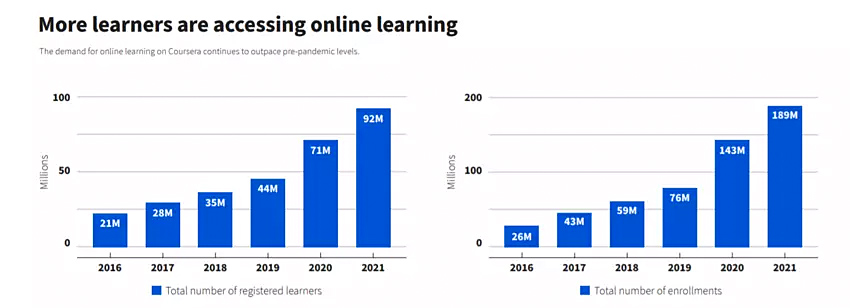
These 3 charts show the global growth in online learning — from weforum.org by Johnny Wood; with thanks to Ray Schroeder out on LinkedIn

Example chart:

Also relevant/see:

The company has launched 13 new degrees with colleges since 2021, bringing the total number of bachelor’s, master’s and postgraduate degrees up to 38, according to Maggioncalda.

2U saw $152.4 million from its degree segment in 2021’s fourth quarter, about 11 times the revenue Coursera brought in from its degree business over the same period. 

 
© 2025 | Daniel Christian