Google wants 20,000 Americans to have higher-paying jobs — from protocol.com by Amber Burton
Google’s Career Certificate Fund is aimed at creating a sustainable model of support for American job seekers.

Excerpt:

The program is designed for students to pay zero upfront costs for the three to six-month courses, but Google certificate students are expected to repay program costs if they land a job that pays at least $40,000 annually. While the exact amount of the monthly payments was not shared in the announcement, Google said it will be low no-interest payments for Social Finance to reinvest in the program for additional participants.

Our new $100 million Google Career Certificates Fund — from blog.google by Sundar Pichai

It’s another promising example of how the entire ecosystem — from private companies to nonprofits — can work together to help more Americans access economic opportunities.

Addendum on 3/2/22:


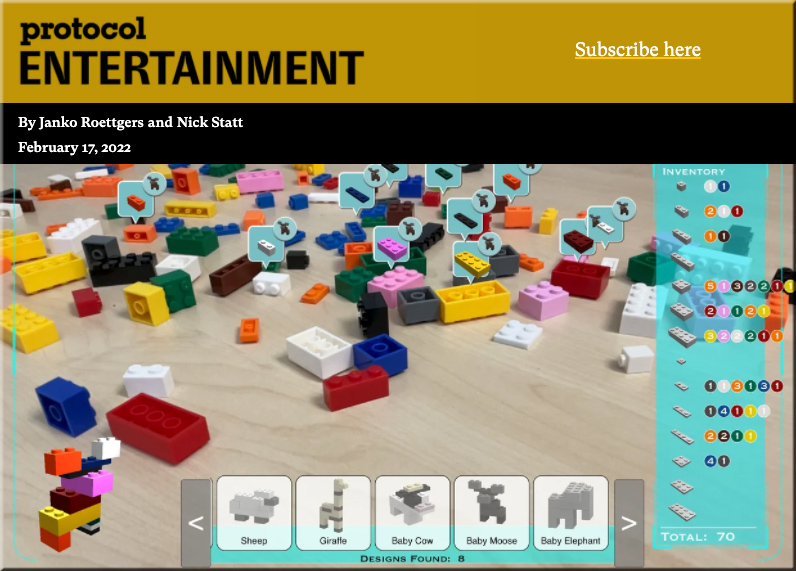
The Perceptus Platform / app began to identify individual bricks, counting and cataloging them by shape and color, and then suggesting different animals he could build with those specific bricks.

AR object recognition can give you superpowers — from by Janko Roettgers and Nick Statt

Excerpt:

Making sense of AR, one Lego brick at a time
Singulos Research CEO and CTO Brad Quinton poured a bunch of Lego bricks onto his desk during a recent Zoom call. Then, he picked up an iPad, fired up a demo app and opened the app’s camera mode. Immediately, the app began to identify individual bricks, counting and cataloging them by shape and color, and then suggesting different animals he could build with those specific bricks.

The playful and fun demo was meant to show off the capabilities of the Perceptus Platform, an AR object-recognition technology Singulos has been building in stealth over the past three years. The platform could soon help developers build smarter AR apps and services. “It gives AR applications the visual context of what’s around them,” Quinton said, and that could be key to building AR glasses people will actually want to wear.

From DSC:
This is a great use of Augmented Reality (AR)! Very slick! It’s beneficial, practical, and likely an example of what is to come.


Forbes Blockchain 50 2022 — from forbes.com; edited by Michael del Castillo and Matt Schifrin; reported by Maria Abreu, Nina Bambysheva, Justin Birnbaum, Lauren Debter, Michael del Castillo, Steven Ehrlich, Chris Helman, Katie Jennings, Jeff Kauflin, Javier Paz, Jon Ponciano, Marie Schulte-Bockum
Cryptocurrencies hog the spotlight, but blockchain’s biggest innovations are below the surface, saving billions each year for the world’s largest companies.

Excerpt:

You’ve come a long way, blockchain! Since our inaugural roundup of the Blockchain 50, published in 2019, the billion-dollar companies (minimum, by sales or market value) on our annual list have moved beyond test projects and now rely on “distributed ledger” technology to do serious work. A lot of the action is in the back office, verifying insurance claims or facilitating real estate deals. It has also become vital to supply chains, whether checking the provenance of conflict minerals like cobalt or tracking auto parts for Renault. Nearly half of the Blockchain 50 are based outside the United States; 14% are Chinese. New this year: venture capital firms, which as a group invested more than $32 billion in the sector in 2021.


A Voice For Virtual Reality: The Advocate’s Role | Accessibility VR Meetup Recap — from equalentry.com by Heather Bucalos

Excerpt:

The discomfort she experienced during cancer treatment led her on a search for better relief of common cancer treatment side effects. The idea to use VR during her own treatment proved beneficial for her as she is now a fierce advocate of VR in healthcare. She has pivoted to consulting in the VR for healthcare space and is excited about the way virtual reality is changing lives one headset at a time.

Here are some of the highlights from this presentation:


ADHD and your homeschool: An overview — from raisinglifelonglearners.com by Colleen Kessler

Excerpt:

This series is all about homeschooling a child with ADHD. Today, we kick it off with an overview of ADHD, and how it impacts your child and your homeschool.


Utah’s Certified Advocates Partners Program Made Possible by Regulatory Sandbox — from iaals.du.edu by Maddie Hosack

Excerpt:

In Utah, victims of domestic violence and stalking no longer have to navigate the process of obtaining a protective order alone.

For individuals who cannot afford or otherwise don’t want to hire a lawyer, victim advocates are able to tell victims which protective order to apply for, how to correctly fill out forms, and what they should expect in court. This legal advice was solely the purview of lawyers before Utah’s regulatory sandbox opened, and fortunately, victim advocates are now permitted to provide this critical help.

Text-Message Reminders from Courts Could Become the Norm in Colorado — from legaltechmonitor.com by Maddie Hosack

Remote Work Helps Law Firms Recruit And Retain Talent — from abovethelaw.com by Jordan Rothman
Even attorneys who have worked in the legal profession for years or decades may not wish to apply for a job with strict in-person work expectations.

Why Practice Management Software Is Now Table Stakes For Law Firms — from abovethelaw.com
You, too, can be working less and making more. Here’s how.  In this episode, Jared Correia welcomes five guests to discuss case management software in the legal space: Joshua Lenon from Clio, Dr. Cain Elliott from FileVine, Matt Spiegel from Lawmatics, Tomas Suros from AbacusNext, and Karrtik Rao from Moxtra.

Excerpt:

The group discusses the most compelling feature-based arguments for adopting case management software (8:09). Then, they talk about how law practice management better connects lawyers and staff (19:38). They also cover how law practice management software can implement lead management features (27:31), before finishing up by reviewing how case management software can be used to leverage workflows (30:46).

The DOJ’s new crypto enforcement team has a boss — from protocol.com by Benjamin Pimentel
Veteran prosecutor Eun Young Choi will lead the National Cryptocurrency Enforcement Team


Is there a skills gap in learning design? — from neilmosley.com by Neil Mosley

Excerpt:

Another deficiency in higher education has also been the dearth of support there is for learning design. Roles such as Learning Designer or Instructional Designer have been relatively niche in UK higher education, they have tended to exist only in online or distance education settings.

This seems to be changing a little and there’s been more of these roles created over the past two years. Hopefully, as a result of growing recognition of the design and planning work that’s needed in higher education as the teaching and study experience grows in complexity.

Whilst broadly positive, this has thrown up another problem – the inconsistency and variability of skills amongst those that might refer to themselves as a Learning or Instructional Designer.

From DSC:
Though this is from the UK, these perspectives and the issues Neil raises are also very much present here in the United States. Neil raises some important questions, such as:

  • Aare the Learning Designers and/or Instructional Designers getting the training that they need?
  • What’s expected of them?
  • Are they utilized properly?
  • How do you scale their work?
  • How do you get professors and teachers to think of *designing* their learning experiences?

Addendum on 2/19/22:

And if the last two years have taught us anything, it’s that this collective movement toward learning experience design will be essential to help striving students go on better, more productive, and personally meaningful educational journeys. Indeed, we must help spread the word that education is more than a collection of classes. It may include classes, but it is so much more. At its best, it is a carefully and thoughtfully crafted and curated family of experiences that can help striving students change their lives!  


Watching A Lecture Twice At Double Speed Can Benefit Learning Better Than Watching It Once At Normal Speed — from digest.bps.org.uk by Emma Young ; with thanks to the Learning Now TV Newsletter – February 2022 for this resource

Excerpt (emphasis DSC):

So, a student could just watch videos at 2x speed and halve their time spent on lectures….Or, according to the results of other studies reported in the paper, they could watch a video at 2x normal speed twice, and do better on a test than if they’d watched it once at normal speed. The timing mattered, though: only those who’d watched the 2x video for a second time immediately before a test, rather than right after the first viewing, got this advantage.


5 Must-Have Microlearning Assets That’ll Make Your Online Training More Effective — from blog.commlabindia.com by Nikhil Bhogaraju
We often hear about the advantages of microlearning, but what about its applications in corporate training? This blog explores how we can deliver effective training to a learning workforce through microlearning assets. Do you have them in your eLibrary?


A whole new world: Education meets the metaverse — from brookings.edu by Kathy Hirsh-Pasek, Jennifer M. Zosh, Helen Shwe Hadani, Roberta Michnick Golinkoff, Kevin Clark, Chip Donohue, and Ellen Wartella

Excerpt:

The metaverse is upon us. Soon it will be as omnipresent as TikTok, Instagram, and Facebook (now Meta). As technology advances to bring us new immersive and imaginary worlds, how we educate children and prepare teachers must also advance to meet these new opportunities. When education lags the digital leaps, the technology rather than educators defines what counts as educational opportunity. This is largely what happened with the introduction of “educational” apps designed to be used on smartphones and tablets meant for adults. Today, as the metaverse infrastructure is still under construction, researchers, educators, policymakers, and digital designers have a chance to lead the way rather than get caught in the undertow. To leverage the potential of the metaverse as a 3D, global, interconnected, immersive, and real-time online space, we need new ways to connect the physical world with augmented and virtual reality (VR) experiences.

In the end, we challenge those creating educational products for the metaverse to partner with educators and scientists to ensure that children experience real human social interaction as they navigate virtual spaces, children’s agency is supported as they explore these spaces, and there is a real eye to diversity in the representation and access to what is created.  

Also relevant/see:

The metaverse can provide a whole new opportunity for education. Here’s what to consider — from fastcompany.com by Stephen Fromkin
The cofounder of Talespin looks at an existing immersive learning program that delivers results and says our next priority should be getting it into the hands of as many learners as possible through the metaverse.


From DSC:
Hmmm…another interesting item:

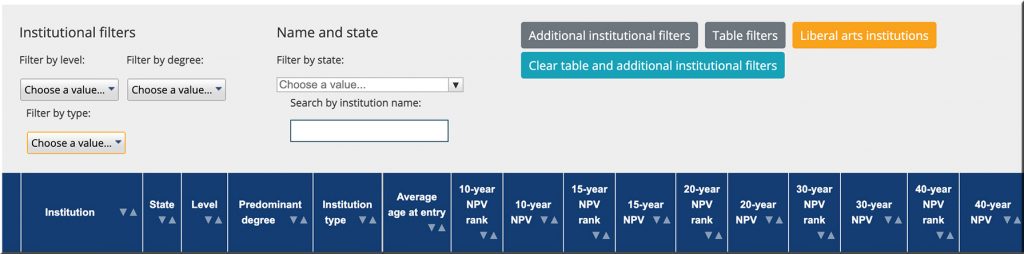
Ranking 4,500 Colleges by ROI (2022) — from cew.georgetown.edu

Excerpt:

Using new data from the College Scorecard, we ranked 4,500 colleges and universities by return on investment. The rankings follow the methodology of our 2019 report, A First Try at ROI: Ranking 4,500 Colleges.

The rankings include a new metric that measures the share of students at an institution whose earnings 10 years after enrollment are higher than those of workers with a high school diploma as their highest level of education. An average of 60 percent of college students across institutions earn more than a high school graduate after 10 years. However, at 1,233 postsecondary institutions (30 percent), more than half of their students 10 years after enrollment are earning less than a high school graduate. Our previous research indicates that these low earnings may relate to low graduation rates and disparities in earnings by gender and race and ethnicity.


The Lifecycle of a Breakthrough — from digitaltonto.com by  Greg Satell

Excerpt:

When we look back through history, we see a series of inventions. It seems obvious to us that things like the internal combustion engine and electricity would change the world. Still, as late as 1920, roughly 40 years after they were invented, most American’s lives remained unchanged. For practical purposes, the impact of those two breakthroughs were negligible.

What made the difference wasn’t so much the inventions themselves, but the ecosystems that form around them. For internal combustion engines it took a separate networks to supply oil, to build roads, manufacture cars and ships and so on. For electricity, entire industries based on secondary inventions, such as household appliances and radios, needed to form to fully realize the potential of the underlying technology.

From DSC:
I wonder what our learning ecosystems will look 5-10 years from now…?

#learningfromthelivingclassroom
#learningecosystems


From DSC:
Hmmm….interesting ideas here.

Has Your School District Considered Creating A “Parent University”? — from teachercast.net by Jeffrey Bradbury

Excerpt:

Over the course of the Pandemic, teachers and students have been coping with a brand-new teaching and learning style that has required them to do things they have not ever needed to do before. However, that is just two parts of the triangle in the learning process. For many parents, the thought of having to be a co-teacher in a digital classroom became a reality.

How do you support both teachers, students, and parents? The answer for many school districts is to create a Parent University, or a virtual program that helps teach parents and community members how to support their students.

In this blog post, we will look at what exactly a Parent University is and how it can be successfully created to support both parents as well as other members of your global community through the help of local professionals, teachers in the district and most importantly, your Instructional Coaching staff.

What Is A Parent University?
To put it very succinctly, a Parent University is an opportunity for a community to come together and provide a service to itself. Parent Universities come in a variety of shapes and sizes depending on the needs of the community, but the basic idea is for the school district to be a conduit for community learning.

From DSC:
I hadn’t thought of a community of practice in this regard, but maybe I should.


As bomb threats keep targeting HBCUs, 64 higher ed groups tell Congress to act — from highereddive.com by Laura Spitalniak

Excerpt (emphasis DSC):

More than a dozen HBCUs have been forced to clear campuses and cancel in-person classes following bomb threats this year. Fisk University, in Tennessee, issued a shelter-in-place order Monday after receiving a series of threats. The same day, Howard University, in Washington, D.C., received a bomb threat for the fourth time since the beginning of January and told students and employees to stay indoors.

All-clear notices have since been issued for both Fisk U and Howard U.

‘You’re Not Safe as a Black Person’: New Round of Bomb Threats Rattles HBCUs — from chronicle.com by Oyin Adedoyin

Excerpt:

The recent string of bomb threats across a handful of historically Black colleges and universities has sparked fear within higher education’s Black community. “This is probably one of the clearest examples of hate crimes based on race,” said Paulette Granberry Russell, the president of the National Association of Diversity Officers in Higher Education.

From DSC:
Some of the institutions I saw mentioned were:

  • Bowie State University, Howard University, Albany State University, Bethune-Cookman University, Southern University and A&M College, and Delaware State University

Can you imagine if this happened at Harvard, Yale, Northwestern, Stanford, and/or similar institutions? You and I both know that if students there kept having to put up with bomb threats and having their in-person classes canceled, there would be hell to pay! There would be a lot more heat in the kitchen. A lot more noise. A lot more overall societal concern. 

For me, the bottom line is that this situation is horribly wrong. It’s downright evil. I hope it gets resolved soon, though I have to say that I’m not as hopeful as I’d like to be in this 21st century of ours here in the United States…where I continue to be amazed at our lack of unity, respect, compassion, and caring for other people. The amount of racism and hate crimes in our country is just horribly wrong.

On somewhat related notes, see:

Where HBCU grads are thriving — from linkedin.com by McKenna Moore

Excerpt:

Promotion rates for graduates of historically Black colleges and universities (HBCUs) rose 4.94% in 2021 from the previous year, according to insights from LinkedIn’s data on over 600,000 HBCU alumni. The industries that outperform others in promoting HBCU grads include energy and mining, software and IT services, hardware and networking, finance and manufacturing. And the specific job functions that lead to the best chance of promotion for these alumni are program and project management, marketing, human resources, business development and accounting.

Black talent on the fast track: these 10 paths stand out for HBCU graduates — from linkedin.com by George Anders

Excerpt:

All told, more than 600,000 graduates of HBCUs such as Spelman have profiles on LinkedIn. That makes it possible for LinkedIn’s Economic Graph team to analyze the career paths that these alumni have chosen – and to extract insights about promotion rates by job types, gender and in comparison to non-HBCU graduates.

The overall picture that emerges from this data includes a wide list of career paths where HBCU alumni are thriving, as well as signs that overall gaps between HBCU graduates’ promotion rates and non-HBCU trends haven’t yet closed.

Giving to Community Colleges and HBCUs Soared Last Year — from philanthropy.com by Dan Parks

Addendum on 2/19/22:


What can institutions do to get ahead of a fast-changing higher ed market? — from highereddive.com by Laura Spitalniak

Excerpts:

  • Universities must prepare for a future where students could demand degrees, low-cost options or asynchronous learning. Otherwise, institutions risk becoming obsolete, according to a recent report from consulting firm EY.
  • Four key recommendations to education leaders are highlighted: Be clear about long-term purpose, consider possible future scenarios when making today’s choices, find leadership talent from other sectors that have already had to reinvent themselves, and invest across current and future time horizons.
 
© 2025 | Daniel Christian