Watching A Lecture Twice At Double Speed Can Benefit Learning Better Than Watching It Once At Normal Speed — from digest.bps.org.uk by Emma Young ; with thanks to the Learning Now TV Newsletter – February 2022 for this resource

Excerpt (emphasis DSC):

So, a student could just watch videos at 2x speed and halve their time spent on lectures….Or, according to the results of other studies reported in the paper, they could watch a video at 2x normal speed twice, and do better on a test than if they’d watched it once at normal speed. The timing mattered, though: only those who’d watched the 2x video for a second time immediately before a test, rather than right after the first viewing, got this advantage.


5 Must-Have Microlearning Assets That’ll Make Your Online Training More Effective — from blog.commlabindia.com by Nikhil Bhogaraju
We often hear about the advantages of microlearning, but what about its applications in corporate training? This blog explores how we can deliver effective training to a learning workforce through microlearning assets. Do you have them in your eLibrary?


A whole new world: Education meets the metaverse — from brookings.edu by Kathy Hirsh-Pasek, Jennifer M. Zosh, Helen Shwe Hadani, Roberta Michnick Golinkoff, Kevin Clark, Chip Donohue, and Ellen Wartella

Excerpt:

The metaverse is upon us. Soon it will be as omnipresent as TikTok, Instagram, and Facebook (now Meta). As technology advances to bring us new immersive and imaginary worlds, how we educate children and prepare teachers must also advance to meet these new opportunities. When education lags the digital leaps, the technology rather than educators defines what counts as educational opportunity. This is largely what happened with the introduction of “educational” apps designed to be used on smartphones and tablets meant for adults. Today, as the metaverse infrastructure is still under construction, researchers, educators, policymakers, and digital designers have a chance to lead the way rather than get caught in the undertow. To leverage the potential of the metaverse as a 3D, global, interconnected, immersive, and real-time online space, we need new ways to connect the physical world with augmented and virtual reality (VR) experiences.

In the end, we challenge those creating educational products for the metaverse to partner with educators and scientists to ensure that children experience real human social interaction as they navigate virtual spaces, children’s agency is supported as they explore these spaces, and there is a real eye to diversity in the representation and access to what is created.  

Also relevant/see:

The metaverse can provide a whole new opportunity for education. Here’s what to consider — from fastcompany.com by Stephen Fromkin
The cofounder of Talespin looks at an existing immersive learning program that delivers results and says our next priority should be getting it into the hands of as many learners as possible through the metaverse.


From DSC:
Hmmm…another interesting item:

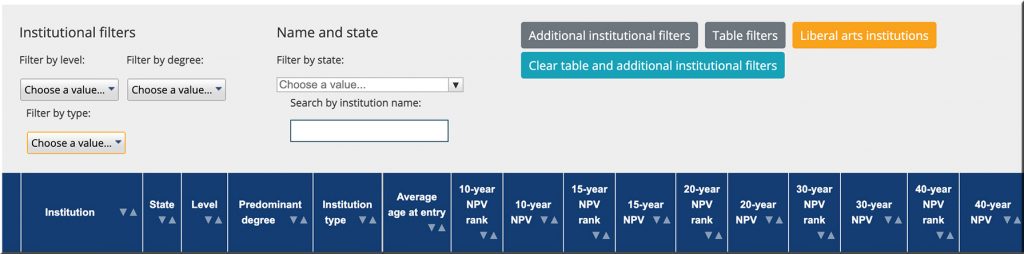
Ranking 4,500 Colleges by ROI (2022) — from cew.georgetown.edu

Excerpt:

Using new data from the College Scorecard, we ranked 4,500 colleges and universities by return on investment. The rankings follow the methodology of our 2019 report, A First Try at ROI: Ranking 4,500 Colleges.

The rankings include a new metric that measures the share of students at an institution whose earnings 10 years after enrollment are higher than those of workers with a high school diploma as their highest level of education. An average of 60 percent of college students across institutions earn more than a high school graduate after 10 years. However, at 1,233 postsecondary institutions (30 percent), more than half of their students 10 years after enrollment are earning less than a high school graduate. Our previous research indicates that these low earnings may relate to low graduation rates and disparities in earnings by gender and race and ethnicity.


The Lifecycle of a Breakthrough — from digitaltonto.com by  Greg Satell

Excerpt:

When we look back through history, we see a series of inventions. It seems obvious to us that things like the internal combustion engine and electricity would change the world. Still, as late as 1920, roughly 40 years after they were invented, most American’s lives remained unchanged. For practical purposes, the impact of those two breakthroughs were negligible.

What made the difference wasn’t so much the inventions themselves, but the ecosystems that form around them. For internal combustion engines it took a separate networks to supply oil, to build roads, manufacture cars and ships and so on. For electricity, entire industries based on secondary inventions, such as household appliances and radios, needed to form to fully realize the potential of the underlying technology.

From DSC:
I wonder what our learning ecosystems will look 5-10 years from now…?

#learningfromthelivingclassroom
#learningecosystems


From DSC:
Hmmm….interesting ideas here.

Has Your School District Considered Creating A “Parent University”? — from teachercast.net by Jeffrey Bradbury

Excerpt:

Over the course of the Pandemic, teachers and students have been coping with a brand-new teaching and learning style that has required them to do things they have not ever needed to do before. However, that is just two parts of the triangle in the learning process. For many parents, the thought of having to be a co-teacher in a digital classroom became a reality.

How do you support both teachers, students, and parents? The answer for many school districts is to create a Parent University, or a virtual program that helps teach parents and community members how to support their students.

In this blog post, we will look at what exactly a Parent University is and how it can be successfully created to support both parents as well as other members of your global community through the help of local professionals, teachers in the district and most importantly, your Instructional Coaching staff.

What Is A Parent University?
To put it very succinctly, a Parent University is an opportunity for a community to come together and provide a service to itself. Parent Universities come in a variety of shapes and sizes depending on the needs of the community, but the basic idea is for the school district to be a conduit for community learning.

From DSC:
I hadn’t thought of a community of practice in this regard, but maybe I should.


As bomb threats keep targeting HBCUs, 64 higher ed groups tell Congress to act — from highereddive.com by Laura Spitalniak

Excerpt (emphasis DSC):

More than a dozen HBCUs have been forced to clear campuses and cancel in-person classes following bomb threats this year. Fisk University, in Tennessee, issued a shelter-in-place order Monday after receiving a series of threats. The same day, Howard University, in Washington, D.C., received a bomb threat for the fourth time since the beginning of January and told students and employees to stay indoors.

All-clear notices have since been issued for both Fisk U and Howard U.

‘You’re Not Safe as a Black Person’: New Round of Bomb Threats Rattles HBCUs — from chronicle.com by Oyin Adedoyin

Excerpt:

The recent string of bomb threats across a handful of historically Black colleges and universities has sparked fear within higher education’s Black community. “This is probably one of the clearest examples of hate crimes based on race,” said Paulette Granberry Russell, the president of the National Association of Diversity Officers in Higher Education.

From DSC:
Some of the institutions I saw mentioned were:

  • Bowie State University, Howard University, Albany State University, Bethune-Cookman University, Southern University and A&M College, and Delaware State University

Can you imagine if this happened at Harvard, Yale, Northwestern, Stanford, and/or similar institutions? You and I both know that if students there kept having to put up with bomb threats and having their in-person classes canceled, there would be hell to pay! There would be a lot more heat in the kitchen. A lot more noise. A lot more overall societal concern. 

For me, the bottom line is that this situation is horribly wrong. It’s downright evil. I hope it gets resolved soon, though I have to say that I’m not as hopeful as I’d like to be in this 21st century of ours here in the United States…where I continue to be amazed at our lack of unity, respect, compassion, and caring for other people. The amount of racism and hate crimes in our country is just horribly wrong.

On somewhat related notes, see:

Where HBCU grads are thriving — from linkedin.com by McKenna Moore

Excerpt:

Promotion rates for graduates of historically Black colleges and universities (HBCUs) rose 4.94% in 2021 from the previous year, according to insights from LinkedIn’s data on over 600,000 HBCU alumni. The industries that outperform others in promoting HBCU grads include energy and mining, software and IT services, hardware and networking, finance and manufacturing. And the specific job functions that lead to the best chance of promotion for these alumni are program and project management, marketing, human resources, business development and accounting.

Black talent on the fast track: these 10 paths stand out for HBCU graduates — from linkedin.com by George Anders

Excerpt:

All told, more than 600,000 graduates of HBCUs such as Spelman have profiles on LinkedIn. That makes it possible for LinkedIn’s Economic Graph team to analyze the career paths that these alumni have chosen – and to extract insights about promotion rates by job types, gender and in comparison to non-HBCU graduates.

The overall picture that emerges from this data includes a wide list of career paths where HBCU alumni are thriving, as well as signs that overall gaps between HBCU graduates’ promotion rates and non-HBCU trends haven’t yet closed.

Giving to Community Colleges and HBCUs Soared Last Year — from philanthropy.com by Dan Parks

Addendum on 2/19/22:


What can institutions do to get ahead of a fast-changing higher ed market? — from highereddive.com by Laura Spitalniak

Excerpts:

  • Universities must prepare for a future where students could demand degrees, low-cost options or asynchronous learning. Otherwise, institutions risk becoming obsolete, according to a recent report from consulting firm EY.
  • Four key recommendations to education leaders are highlighted: Be clear about long-term purpose, consider possible future scenarios when making today’s choices, find leadership talent from other sectors that have already had to reinvent themselves, and invest across current and future time horizons.
 

Holograms? Check! Now what? — from blog.webex.com by Elizabeth Bieniek

Excerpt (emphasis DSC):

Two years ago, I wrote about the Future of Meetings in 2030 and hinted at an effort my team was building to make this a reality. Now, we have publicly unveiled Webex Hologram and brought the reality of a real-time, end-to-end holographic meeting solution to life.

With Webex Hologram, you can feel co-located with a colleague who is thousands of miles away. You can share real objects in incredible multi-dimensional detail and collaborate on 3D content to show perspective, share, and approve design changes in real-time, all from the comfort of your home workspace.

As the hype dies down, the focus on entirely virtual experiences in fanciful environments will abate and a resurgence in focus on augmented experiences—interjecting virtual content into the physical world around you for an enhanced experience that blends the best of physical and virtual—will emerge.

The ability to have curated information at one’s fingertips, still holds an incredible value prop that has yet to be realized. Applying AI to predict, find, and present this type of augmented information in both 2D and 3D formats will become incredibly useful. 

From DSC:
As I think of some of the categories that this posting about establishing a new kind of co-presence relates to, there are many relevant ones:

  • 21st century
  • 24x7x365
  • 3D
  • Audio/Visual (A/V)
  • Artificial Intelligence (AI)
  • Cloud-based
  • Collaboration/web-based collaboration
  • Intelligent tutoring
  • Law schools, legal, government
  • Learning, learning agents, learning ecosystems, Learning from the Living [Class] Room, learning spaces/hubs/pods
  • Libraries/librarians
  • K-12, higher education, corporate training
  • Metaverse
  • Online learning
  • Telelegal, telemedicine
  • Videoconferencing
  • Virtual courts, virtual tutoring, virtual field trips
  • Web3
 

Best Video Editing Software for Mac — from futurism.com by the editorial team at Recurrent Media, Futurism’s owner
Must-have software for creators in the age of YouTube.

Excerpt:

— Best Overall: Apple Final Cut Pro
— Best for Professionals: Adobe Premiere Pro 2022
— Best Budget: iMovie
— Best for Speed: Adobe Premiere Rush 2022
— Best Mid-Priced: Adobe Premiere Elements 2022

From DSC:
I appreciated the Specs, Pros, and Cons sections for each of the tools that made their cut. I also appreciated that they covered tools that could address a variety of audiences and budgets.

Also relevant/see:

WeVideo Classroom is the education spin-off of the famous video editing platform that is specifically aimed at teachers and students.

WeVideo is a very simple to use yet powerful [cloud-based] video editor which can be used by teachers to help students learn the art of video editing. Until this latest release, that meant using external tools or in-classroom teaching to get projects set and marked.

The idea behind WeVideo Classroom is to integrate all the tools into the editor itself so that teachers can set project assessments, monitor them, comment and ultimately mark them for student feedback.


How I use Minecraft to help kids with autism — from ted.com by Stuart Duncan; with thanks to Dr. Kate Christian for this resource

Description:

The internet can be an ugly place, but you won’t find bullies or trolls on Stuart Duncan’s Minecraft server, AutCraft. Designed for children with autism and their families, AutCraft creates a safe online environment for play and self-expression for kids who sometimes behave a bit differently than their peers (and who might be singled out elsewhere). Learn more about one of the best places on the internet with this heartwarming talk.


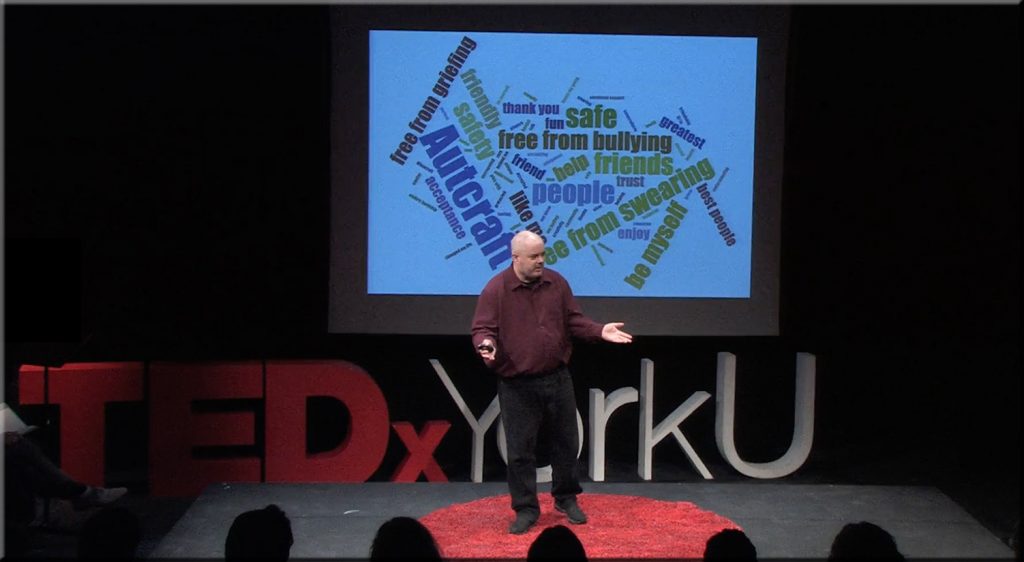
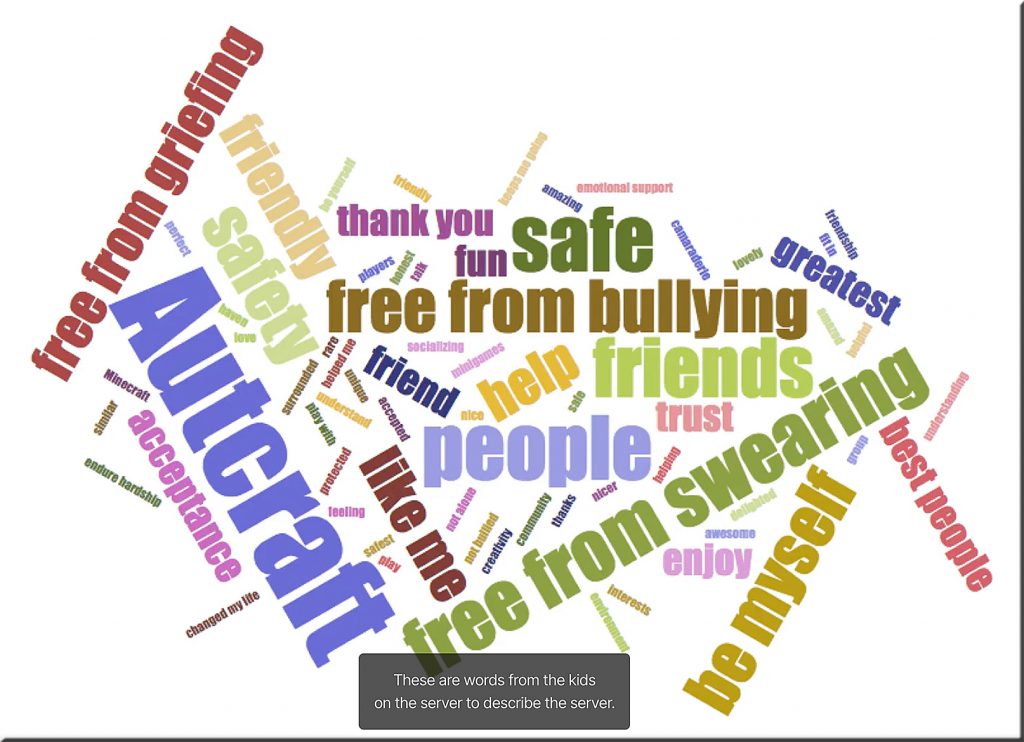
Below are two excerpted snapshots from Stuart’s presentation:

Stuart Duncan speaking at TEDX York U

These are the words autistic students used to describe their experience with Stuart's Minecraft server


5 Tips for Online Tutoring Based on New Research — from techlearning.com by Erik Ofgang
Matthew Kraft, a professor at Brown University, shares some best practices for implementing online tutoring programs based on his recent research.

Excerpt:

While in-person high-dosage tutoring has been shown to improve student learning in multiple studies, the extent that this translates to online tutoring is not as well researched. However, a recent pilot study of online tutoring in which college students volunteered as tutors and were paired with middle school students in Illinois found consistently positive effects of online tutoring on student achievement, though these effects were smaller than had been seen for in-person tutoring.


Exploring Virtual Reality [VR] learning experiences in the classroom — from blog.neolms.com by Rachelle Dene Poth

Excerpt:

With the start of a new year, it is always a great time to explore new ideas or try some new methods that may be a bit different from what we have traditionally done. I always think it is a great opportunity to stretch ourselves professionally, especially after a break or during the spring months.

Finding ways to boost student engagement is important, and what I have found is that by using tools like Augmented Reality (AR) and Virtual Reality (VR), we can immerse students in unique and personalized learning experiences. The use of augmented and virtual reality has increased in K-12 and Higher Ed, especially during the past two years, as educators have sought new ways to facilitate learning and give students the chance to connect more with the content. The use of these technologies is increasing in the workplace, as well.

With all of these technologies, we now have endless opportunities to take learning beyond what has been a confined classroom “space” and access the entire world with the right devices.


Higher ed groups call for stricter oversight of accreditors — from highereddive.com by Jeremy Bauer-Wolf

Dive Brief:

  • Sixteen experts and advocacy organizations in higher education are calling for stricter U.S. Department of Education oversight of accreditors, particularly in how they handle colleges with poor student outcomes.
  • The groups and individuals wrote to the Education Department late last month recommending ways to make the evaluation process for accreditors more transparent and asking agency officials to more closely scrutinize several major accreditors up for review in February 2023.
  • Among their suggestions were that the Education Department should make certain documents public early in the process of accreditors seeking department approval, that it should spend more time reviewing accreditors that control access to federal financial aid funds than to those that do not, and that it should develop new regulations to make sure accreditors consider how institutions are serving disadvantaged students.
 

AI Foundation Models for the Rest of Us — from future.a16z.com by Elliot Turner

Excerpt:

While 2012’s state-of-the-art systems could be trained on a $700 video game card, today’s state-of-the-art systems – often referred to as foundation models – likely require tens of millions of dollars in computation to train.

The emergence of these massive-scale, high-cost foundation models brings opportunities, risks, and limitations for startups and others that want to innovate in artificial intelligence and machine learning.

 
© 2025 | Daniel Christian