Groups call for college trustees to learn more about accreditation — from highereddive.com by Rick Seltzer
“Board members lack a solid understanding of what accreditation is,” says a report issued by AGB and CHEA in the face of stress on the system.

Excerpts:

Much has changed since 2009, the report says, as colleges now face heightened problems stemming from declining enrollment, constrained state funding and sometimes shaky finances.

Institutions also face challenges that don’t show up on balance sheets: pandemic-related stresses, remote instruction, public skepticism, threats to freedom of speech, tensions over diversity, equity and inclusion — and external influences.

Many of the people who sit on colleges’ governing boards are not from the academy and might not be familiar with processes like accreditation, said Cynthia Jackson-Hammond, CHEA’s president.

“It’s about trust,” Stoever said. “What accreditation is intended to do, it’s not only around academic quality and financial integrity, but trust — public trust that these institutions of higher education are trustworthy.”

From DSC:
But maybe that’s part of the problem institutions of higher education face today. They’ve lost the trust of the public. When faculty teach what they want to teach — and presidents, deans, faculty councils, trustees, boards, etc. allow that to occur — then students graduate without the skills and knowledge that the workplace is hiring for. By the way, I realize that’s too general and not true in many cases. I still believe that the liberal arts are very important — and the communications skills and the ability to reason, think critically, etc. will likely always be important and beneficial (regardless of the job). 

But when you are a student who has gone to school for 4-6+ years, you finally graduate, and then you find out that you don’t have the skills or knowledge that the employers are hiring for, that will likely impact one’s trust level in one’s alma mater as well as in higher education in general. When you graduate with a gorilla of debt on your back, that may also impact your trust levels (though it may not in some cases).

 

A Conversation with Ken Robinson’s Daughter about Their New Book on Transforming Education — from betterhumans.pub by Eva Keiffenheim
Kate Robinson and Co-Author of Imagine if — Creating a Future for us All

Excerpt:

In writing the book, we highlighted ten “Manifesto Statements” that really summarize the key points the book is making.

The main themes of them are:

  • we are all born with immense creative capacities
  • our incredible powers of imagination are what separates us from the rest of life on Earth
  • Education systems are based on conformity
  • real life thrives on diversity
  • we are in the midst of two climate crises: the crisis of the Earth’s natural resources, and the crisis of our human resources
  • and no matter who you are, you are the system — if you change your behavior, you have changed the system, and when enough people commit to changing the system, we have a revolution that will change the world

According to Imagine if…, the future will be grim unless we take action to change the course where we’re heading. What actions need to be taken and what needs to be done and how? Where do we start?

The first and most important step is to embrace a richer conception of human intelligence. Like any ecosystem, our cultural ecosystems depend on a wide variety of talents, interests, and capabilities to thrive. Therefore, we must actively encourage each person to connect with and make the most of their own abilities and passions.


Gamifying Workplace Learning the Right Way, with Karl Kapp -- by Amit Garg

Gamifying Workplace Learning the Right Way, with Karl Kapp — from upsidelearning.com by Amit Garg
In this podcast, Amit Garg, a business leader focused on building impactful workplace learning solutions, speaks with L&D experts from across the globe. Together, they explore topics aimed at enabling L&D professionals to stay ahead and go beyond the ordinary. If you are constantly intrigued by how workplace learning can be leveraged to help people develop in an organization, this podcast is for you.


Bitcoin’s proof-of-work mechanism is a climate disaster. Environmental groups have a fix. — from protocol.com by Sarah Roach
Ending proof of work would cut bitcoin’s carbon footprint by an estimated 99%.

Excerpt:

If bitcoin could just cool it with the whole “using copious amounts of energy to mine magic internet money” thing, that’d be great. That’s the message some environmental groups are putting out there as part of a new campaign pressuring the bitcoin community to clean up its act with a code change.

Greenpeace USA, Environmental Working Group and other organizations began a campaign called #ChangeTheCode this week in an attempt to turn up the heat on bitcoin investors. The cryptocurrency currently relies on a proof-of-work process that puts miners in competition with each other. That mechanism is used by miners to confirm and record crypto transactions, providing a greater level of security, but it also takes a heavy climate toll due to the amount of energy used and the associated carbon emissions. There are other options, including proof of stake, that use vastly less energy.


L&D is going through an identity crisis — here’s why that’s a good thing — from chieflearningofficer.com by Linda Cai
We’re in a new situation, and we need to do something different. Our employees are hungry for growth and purpose amidst the Great Reshuffle, and companies need to respond and act or risk watching their talent walk out the door.

Excerpt:

That’s why organizations need our expertise more than ever. The demand for L&D specialists increased by 94 percent between July and September of 2021 compared to the previous three month period, according to our just-released 2022 Workplace Learning Report.

At the same time, our research also revealed that we have work to do. The report reveals L&D professionals spent 35 percent less time learning than their HR colleagues in 2021. It is not surprising, since a lot of them are overwhelmed by workload, and well-being has decreased. But the L&D function is going through what might be its most consequential transformation to date, and our success depends on whether we can learn the skills that this new world of work requires of us. Are we prepared to take on this increasingly strategic role for years to come?

It will not be easy. But we can start this important work by doing two things: loosening up how we think about ourselves, and going back to why many of us got into this business — to help people do their best work and be their best selves.

Here’s a relevant quote from the 2022 Workplace Learning Report:

“We really need to change and think about more productive and sustainable ways to help connect talent to opportunity, and our view is that that’s going to be done through a skills-based approach.”

Ryan Roslansky
CEO, LinkedIn


Ontario Bar Association backs proposed guidelines for remote court hearings — from lawtimesnews.com by Katrina Eñano

Excerpt:

According to the OBA, resorting to remote hearings can promote efficiency and cost-effectiveness and ensure the appropriate allocation of judicial resources.

In addition, the OBA provided a list of matters that should presumptively proceed remotely. These matters include:

    • Procedural matters, chambers appointments, and scheduling appearances;
    • Pre-trials;
    • Short motions or applications;
    • Motions that do not require witness attendance and are comprised of argument by counsel only;
    • Summary trials.

Also relevant/see:

Lawyers increasingly concerned about interplay between virtual and in-person court operations — from lawtimesnews.com by Annabel Oromoni

Excerpt:

As civil proceedings prepare to return to in-person hearings for discoveries, mandatory mediations, and trials, litigation lawyer Eric Sherkin says lawyers are wondering about the interplay of online and in-person arguments.

Certain hearings like pre-trials and case conferences will remain remote but how it works in practice beyond that is still unknown, Sherkin says.

All parties can agree to a virtual hearing, but “how often will all counsel say, ‘let’s agree to do this on Zoom,’ or will there be fights where five lawyers want to proceed on Zoom, and one insists on doing it in person?”


A Skills-First Blueprint to Better Job Outcomes — from linkedin.com by Karin Kimbrough
As Chief Economist at LinkedIn, I lead a team of economists and data scientists that unearth the most interesting insights from over 800M global members. Every month I’ll share a snapshot of key trends to help shed light on where the world of work is headed. This month, we’re looking at new findings around the shift to a skills-first talent ecosystem. 

An excerpt from that last link/posting which is entitled “A Skills-First Blueprint for Better Job Outcomes”:

A few key findings:

  • Skills are Changing
  • The Pandemic Pulled the Future Forward
  • Skills-First Hiring Can Work for Both Job Seekers and Hiring Managers
  • Identifying Similar Skills Helps Workers Pivot to New Roles
  • Amidst the Great Reshuffle, Investing in Skills is a Key to Retention
 

I Analyzed 13 TED Talks on Improving Your Memory — Here’s the Quintessence — from learntrepreneurs.com by Eva Keiffenheim
How you can make the most out of your brain.

Excerpt:

In her talk, brain researcher and professor Lara Boyds explains what science currently knows about neuroplasticity. In essence, your brain can change in three ways.

Change 1 — Increase chemical signalling
Your brain works by sending chemicals signals from cell to cell, so-called neurons. This transfer triggers actions and reactions. To support learning your brain can increase the concentration of these signals between your neurons. Chemical signalling is related to your short-term memory.

Change 2 — Alter the physical structure
During learning, the connections between neurons change. In the first change, your brain’s structure stays the same. Here, your brain’s physical structure changes — which takes more time. That’s why altering the physical structure influences your long-term memory.

For example, research shows that London taxi cab drivers who actually have to memorize a map of London to get their taxicab license have larger brain regions devoted to spatial or mapping memories.

Change 3 — Alter brain function
This one is crucial (and will also be mentioned in the following talks). When you use a brain region, it becomes more and more accessible. Whenever you access a specific memory, it becomes easier and easier to use again.

But Boyd’s talk doesn’t stop here. She further explores what limits or facilitates neuroplasticity. She researches how people can recover from brain damages such as a stroke and developed therapies that prime or prepare the brain to learn — including simulation, exercise and robotics.

Her research is also helpful for healthy brains — here are the two most important lessons:

The primary driver of change in your brain is your behaviour.

There is no one size fits all approach to learning.


From DSC:
This is so important. It’s the underlying cognitive science/psychology involved in the posting I recently created that was entitled, “What are the ramifications of having cognitive “highways in our minds?” It occurs to me that patience, grace, forgiveness, work, new habits, and more are required here.


Learning Disorders and Law School: Strategies and Resources — from onlinemasteroflegalstudies.com with thanks to Allegra Balmadier for these resources

Excerpt:

Law schools across the country with all kinds of students and faculty could fairly be described by a single word: rigor. Juris Doctor (J.D.) degree programs are traditionally known for copious amounts of required reading and semester-end exams that count for a student’s whole grade. A legal education is an intensive course of study that would challenge any student.

A student with a learning disorder or disability (LD) may struggle for a particular reason—not for lack of effort but because of the conventional structure of class, assignments and tests. LDs can cause difficulty with processing information, a problem that is exacerbated when universities and colleges fail to offer support.

However, with appropriate strategies, students with LDs can succeed in law school and in the legal profession. Learn more about learning disorders and find resources below.


Homeschool math doesn’t have to be intimidating! — from raisinglifelonglearners.com by Colleen Kessler

Excerpt:

Finding The Right Math Program For Your Child
There are so many choices on the market. Some with manipulatives, some with thick workbooks, some on online learning platforms.

While it may seem overwhelming, its actually good news! You don’t have to worry about all of them – you only have to find the one that works for you!

That’s exactly what’s happened for my family this year with CTCMath.

CTCMath is an online program developed by a father of ten children, with twenty years teaching experience. It is a subscription math service that provides learning from Kindergarten all the way through Calculus. CTCMath specializes in providing online video tutorials that take a multi-sensory approach to learning.


The number one thing we’ve loved most about CTCMath this year is that it teaches math in short, bite sized amounts.

I LOVE the shorter lessons approach. Not only is it the best way to teach children with attention issues, but it also makes it easy for parents who struggle with math themselves!

Colleen Kessler


45 Next Generation Learning Tools That Kids Will Love — from ireviews.com with thanks to Alex Ward for this resource

Excerpts:

There’s a wide range of tools designed to support curriculum and help teachers and students achieve their goals. These are our top picks for school students of every age, due to their impressive functionality and simple integration into the classroom.


From DSC:
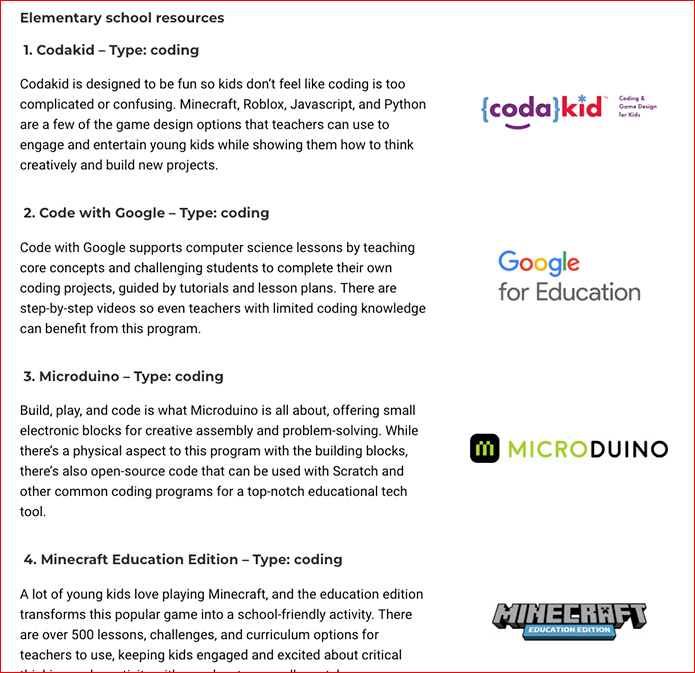
Below is a sample screenshot from the Elementary school resources section. They also have resources for middle schoolers and high schoolers.


45 Next Generation Learning Tools That Kids Will Love


Beyond the Ban — from edtrust.org; with thanks to Goldie Blumenstyk, a senior writer at The Chronicle, for this resource

Excerpt:

Each toolkit analyzes state policy to answer eight equity questions:

  • Does the state offer state financial aid to currently and formerly incarcerated students?
  • Does the state provide sentence reduction credit for incarcerated students enrolled in higher education courses?
  • Does the state provide incentives and resources to colleges that enroll and support currently and formerly incarcerated students?
  • Does the state have a streamlined process for currently incarcerated students to access documents to retrieve their state identification?
  • Does the state allow formerly incarcerated students to access federal support for basic needs like food, housing, and health care?
  • Does the state ban higher education institutions from asking about criminal history on admissions applications?
  • Does the state ban employers from asking about criminal history on job applications?
  • Do currently and formerly incarcerated individuals have the right to vote in the state?


Osso VR nets $66 million for surgical training — from axios.com by Sarah Pringle

Excerpt:

Why it matters: Surgical training hasn’t evolved in 30-plus years, but Osso VR is looking to change that by empowering health care professionals with virtual reality.

  • Training and assessing surgeons more efficiently can drive up the adoption of modern and hard-to-learn medtech, and democratize surgical education.
  • “The innovation from the medical device industry is providing us an incredible opportunity to treat patients much more consistently and with optimized outcomes,” said Justin Barad, Osso’s co-founder and a practicing pediatric orthopedic surgeon.

From DSC:
Not that this is exactly related, but the above item made me think of it:

  • The Healing Power of Learning — from chronicle.com by James M. Lang
    After a health crisis, an academic finds that learning is not just joyful but restorative.
 

The Future of ID in an AI World — from learningsolutionsmag.com by Markus Bernhardt and Clark Quinn

Excerpt:

Recent advances in artificial intelligence (AI) are promising great things for learning. The potential here is impressive, but there also exist many questions and insecurities around deploying AI technology for learning: What can AI do? Where is it best utilized? What are the limits? And particularly: What does that leave for the instructional designer and other human roles in learning, such as coaching and training?

We want to suggest that these developments are for the benefit of everyone—from organizational development strategy devised in the C-suite, via content creation/curation by instructional designers, right through to the learners, as well as coaches and trainers who work with the learners.


© 2025 | Daniel Christian