All the Software Google Announced at I/O 2022 — from wired.com
From Android to translation to visual web search, here are all the enhancements coming to your phone, tablet, and desktop this year. 

Excerpt:

Last month, Google rolled out a feature called Multisearch. It lets you combine elements in a single search query, like using a photo and text at the same time. Soon, Multisearch will get a new tweak. Called Near Me, the feature lets you factor in your location while Multisearching, helping to sniff out local restaurants or shops based on photos and text. Multisearch Near Me will be available globally later this year, though it only works with English input for now.

Another interesting item from wired:


Five steps to getting higher ROI on your learning content — from chieflearningofficer.com by Anindita Gupta

Excerpt:

Both scenarios point toward the fact that organizations are investing a disproportionate amount of time and money on their star content while the supporting content assets are left languishing.  In the long run, this skewed handling makes it extremely difficult for L&D teams to manage and maintain not just their content but also their budget. They could do better, be leaner, get more out of their investments, and experience smarter if they did just one thing differently.
.

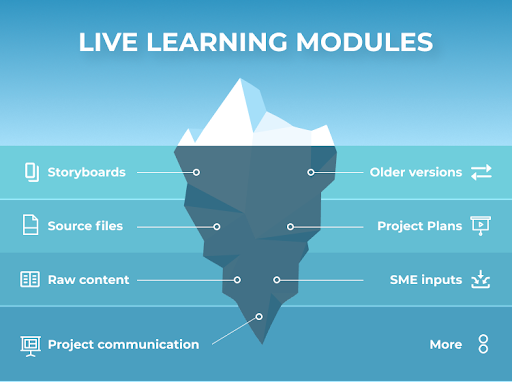
Live learning modules are only the tip of the iceberg of what is involved in creating them


Also relevant/see:

Addendum on 5/16/22:


Why Improving Student Learning is So Hard — from opencontent.org by David Wiley

Excerpt:

2. Student behavior will normally change only in response to changes in faculty behavior – specifically, the assignments faculty give and the support faculty provide.

For many students, the things-they-do-to-learn are all located within the relatively small universe of things their faculty assign them to do – read chapters, complete homework assignments, etc. For a variety of reasons, and many of them perfectly good reasons, “students don’t do optional” – they only do what they’re going to be graded on.

Therefore, students will likely engage in more effective learning behaviors ONLY IF their faculty assign them more effective learning activities. Faculty can further increase the likelihood of students engaging in more effective learning activities if they support them appropriately throughout the process.

From DSC:
I can put an “Amen” to the above excerpt. For years I managed a Teaching & Learning Digital Studio. Most of the students didn’t come into the Studio for help, because most of the faculty members assigned the normal kinds of things (papers, quizzes, and such). Had there been more digitally-created means of showing what students knew, there would have been more usage of the T&L Digital Studio. 

Also, if we want to foster more creativity and innovation — as well as give our learners more choice and more control over their learning — we should occasionally get away from the traditional papers.

Another comment here is that it’s hard to change what faculty members do, when Instructional Designers can’t even get in the car to help faculty members navigate. We need more team-based efforts in designing our learning experiences.


The Future of Work Is Flexible. Will Higher Ed Stay Stuck in the Past? — from edsurge.com by Kevin R. McClure (Columnist)

Excerpt (emphasis DSC):

We know that institutions are capable of making big changes. We pivoted in March 2020, then again in fall 2020, then again in fall 2021. Institutions have achieved things in the last two years that some considered unimaginable. Faculty and staff want to see that type of willpower and creativity directed at working conditions and cultures. They want the type of “reimagining” the Future of Work@Iowa report promised but didn’t deliver.

In a city full of adjunct faculty members, many struggle to get by — from washingtonpost.com by Lauren Lumpkin; with thanks to Ray Schroeder for this resource
Adjuncts across the region are protesting what they say are unfair working condition

7 Ways the Pandemic Changed Faculty Development — from er.educause.edu by Amy Kuntz, Sara Davis and Erica Fleming
Pandemic lessons about faculty development should be understood and factored into future offerings.

Excerpt (emphasis DSC):

Regarding this perspective shift, conference session participant Lindsay Wood, manager of instructional design at Penn State Abington, stated, “When reflecting on the impact of pandemic teaching, those of us working in faculty development and learning design know that there has never been and likely will never be another opportunity to upskill faculty and improve teaching and learning so broadly. It’s important … to really take a deep dive into how we meet the moment and ensure the positive changes are lasting. It would be a shame to squander a once-in-a-lifetime opportunity to adopt innovative practices because we didn’t adequately identify the lessons learned and apply them to the future.” This seemed to resonate with many participants; they want to see the positive changes from the past two years integrated at an institutional level.

Is Hybrid Learning Here to Stay in Higher Ed? — from edsurge.com by  Daniel Lempres

State of Continuing Education 2022 — from resources.moderncampus.com; with thanks to Amrit Ahluwalia for this resource

Universities Share Lessons Learned from Ransomware Attacks — from edtechmagazine.com by Chris Hayhurst
Universities that faced security breaches share advice from their experiences.


24 ideas for creating a discussion-rich classroom — from ditchthattextbook.com by Matt Miller
Discussion can engage students and help them to see different perspectives. Here are strategies you can use to create a discussion-rich classroom.

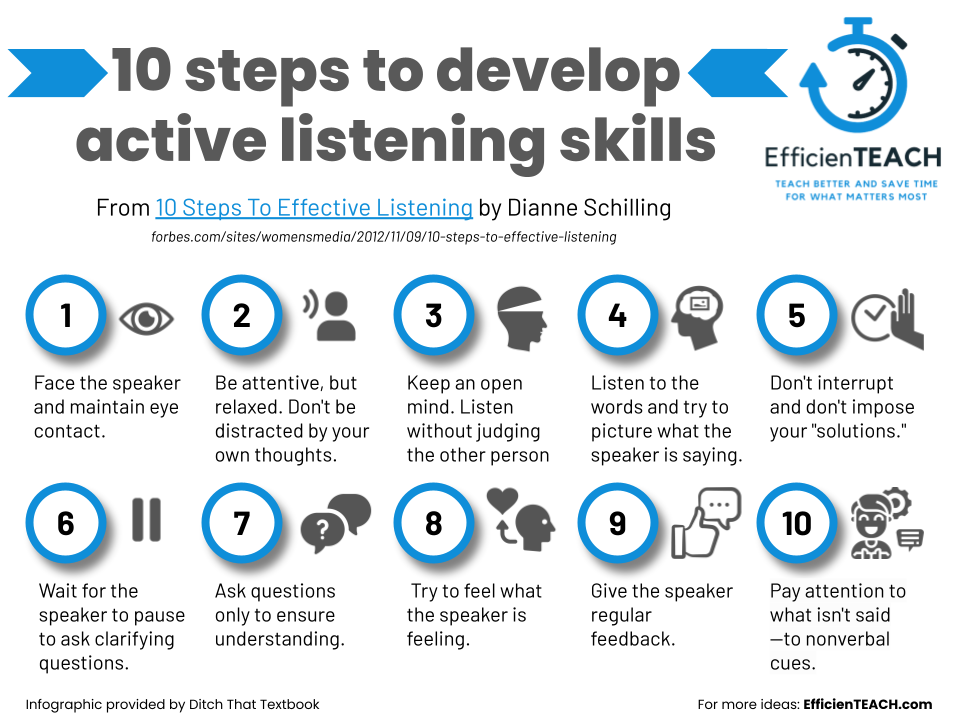
10 ways to teach active listening in the classroom

Also relevant/see:


From DSC:
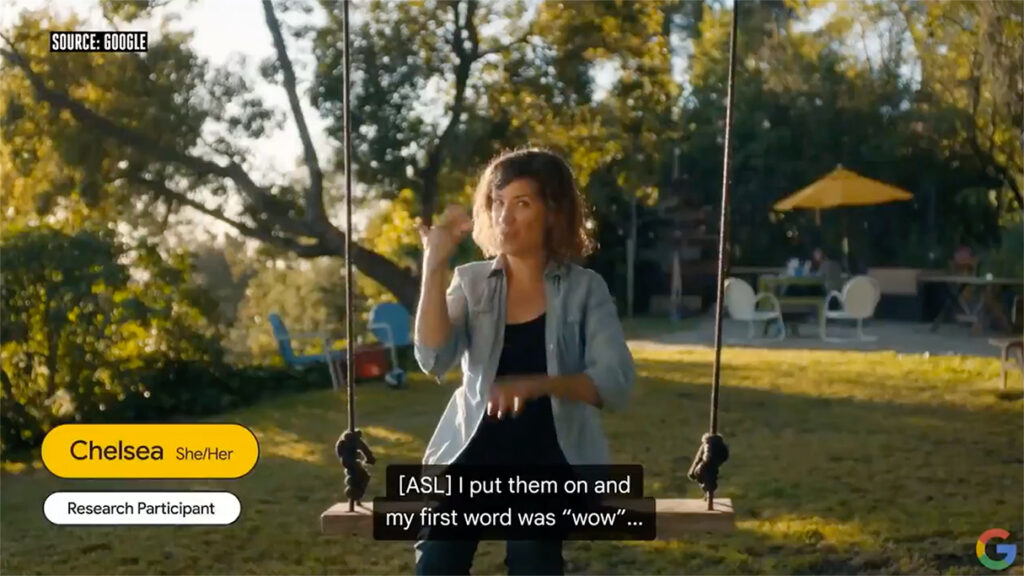
I love the parts about seeing instant language translations — including sign language! Very cool indeed!
(With thanks to Ori Inbar out on Twitter for this resource.)

Realtime American Sign Language translation via potential set of AR glasses from Google

Also see:


Psalm 150 — from biblegateway.com

Praise the Lord.[a]

Praise God in his sanctuary;
    praise him in his mighty heavens.
Praise him for his acts of power;
    praise him for his surpassing greatness.
Praise him with the sounding of the trumpet,
    praise him with the harp and lyre,
praise him with timbrel and dancing,
    praise him with the strings and pipe,
praise him with the clash of cymbals,
    praise him with resounding cymbals.

Let everything that has breath praise the Lord.

Praise the Lord.

***

Praise be to the God and Father of our Lord Jesus Christ! In his great mercy he has given us new birth into a living hope through the resurrection of Jesus Christ from the dead…


From DSC:
I’m on a journey to learn more about why “hope” made the big three — from 1 Corinthians 13:13 And now these three remain: faith, hope and love. But the greatest of these is love. — and what does it practically mean to have hope. Why do we need hope?

I read the other day that going to college is an act of hope. That made me think that following Christ is also an act of hope. Some men in my Bible study said that hope leads us to faith and salvation.

Teach me LORD. My learning continues…


Inside Microsoft’s new Inclusive Tech Lab — from engadget.com by C. Low; with thanks to Nick Floro on Twitter for some of these resources
“An embassy for people with disabilities.”

Increasing our Focus on Inclusive Technology — from mblogs.microsoft.com by Dave Dame

Excerpt:

In recent years, tied to Microsoft’s mission of empowering every person and organization on the planet to achieve more, teams from across Microsoft have launched several products and features to make technology more inclusive and accessible. [On May 10, 2022], as part of the 12th annual Microsoft Ability Summit, we celebrate a new and expanded Inclusive Tech Lab, powerful new software features, and are unveiling Microsoft adaptive accessories designed to give people with disabilities greater access to technology.

Microsoft’s Latest Hardware Is More Accessible and Customizable — from wired.com by Brenda Stolyar
The wireless system—a mouse, a button, and a hub—is designed to increase productivity for those with limited mobility.

Excerpt:

Microsoft if expanding its lineup of accessibility hardware. During its annual Ability Summit—an event dedicated to disability inclusion and accessibility—the company showed attendees some new PC hardware it has developed for users with limited mobility. Available later this year, the wireless system will consist of an adaptive mouse, a programmable button, and a hub to handle the connection to a Windows PC. Users set up the devices to trigger various keystrokes, shortcuts, and sequences. These new input devices can be used with existing accessories, and they can be further customized with 3D-printed add-ons. There are no price details yet.

Along these lines, also see:

  • 14 Equity Considerations for Ed Tech — from campustechnology.com by Reed Dickson
    Is the education technology in your online course equitable and inclusive of all learners? Here are key equity questions to ask when considering the pedagogical experience of an e-learning tool.
 

AI research is a dumpster fire and Google’s holding the matches — from thenextweb.com by Tristan Greene
Scientific endeavor is no match for corporate greed

Excerpts:

The world of AI research is in shambles. From the academics prioritizing easy-to-monetize schemes over breaking novel ground, to the Silicon Valley elite using the threat of job loss to encourage corporate-friendly hypotheses, the system is a broken mess.

And Google deserves a lion’s share of the blame.

Google, more than any other company, bears responsibility for the modern AI paradigm. That means we need to give big G full marks for bringing natural language processing and image recognition to the masses.

It also means we can credit Google with creating the researcher-eat-researcher environment that has some college students and their big-tech-partnered professors treating research papers as little more than bait for venture capitalists and corporate headhunters.

But the system’s set up to encourage the monetization of algorithms first, and to further the field second. In order for this to change, big tech and academia both need to commit to wholesale reform in how research is presented and reviewed.

Also relevant/see:

Every month Essentials publish an Industry Trend Report on AI in general and the following related topics:

  • AI Research
  • AI Applied Use Cases
  • AI Ethics
  • AI Robotics
  • AI Marketing
  • AI Cybersecurity
  • AI Healthcare

It’s never too early to get your AI ethics right — from protocol.com by Veronica Irwin
The Ethical AI Governance Group wants to give startups a framework for avoiding scandals and blunders while deploying new technology.

Excerpt:

To solve this problem, a group of consultants, venture capitalists and executives in AI created the Ethical AI Governance Group last September. In March, it went public, and published a survey-style “continuum” for investors to use in advising the startups in their portfolio.

The continuum conveys clear guidance for startups at various growth stages, recommending that startups have people in charge of AI governance and data privacy strategy, for example. EAIGG leadership argues that using the continuum will protect VC portfolios from value-destroying scandals.


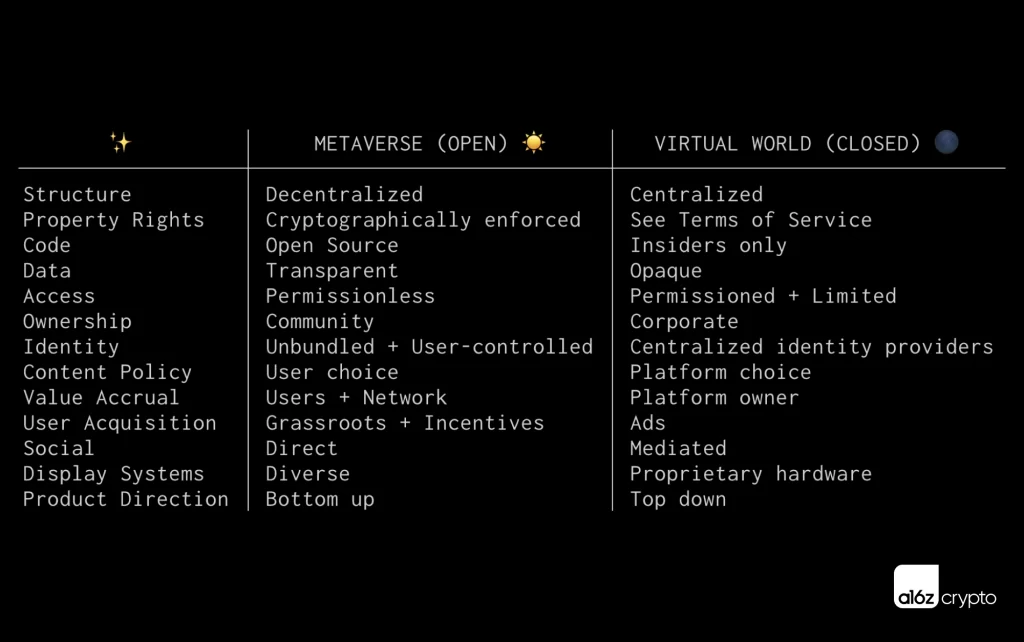
7 Essential Ingredients of a Metaverse — from future.a16z.com by Liz Harkavy, Eddy Lazzarin, Arianna Simpson

Excerpt:

There has been a lot of buzz about “the metaverse” since its coinage in the ‘90s, but especially during the pandemic (given the surge in online activity), and even more so after Facebook changed its name to Meta.

Is this just a bit of opaque marketing-speak? What is a metaverse exactly? How does one define the term, and where does one draw a line between a metaverse and, say, just another virtual world? These are common questions that people ask about the metaverse, so we thought we’d outline how we see it and how the metaverse intersects with web3.

Also relevant/see:


Is the virtual courtroom the future of the justice system? — from deseret.com by Zakary Sonntag
Video proceedings have increased court access but raised questions of rights amid case backlog

Excerpt:

The justice system in Utah is straining under the weight of an immense backlog of criminal cases, especially serious felony cases, leaving many defendants to languish in custody as additional filings continue to accumulate.

The buildup began in 2020 after the Utah Supreme Court ordered the shutdown of in-person proceedings in response to the coronavirus, which left attorneys and judges to hash out settlements through a remote, Webex court process.

The pandemic’s impact on the legal sector and what emerging lawyers need to know — from timesofindia.indiatimes.com by Roma Priya

Excerpt:

For aspiring lawyers and law school graduates who have commenced practice recently, one of the best ways to stay relevant is to upskill yourself. Apart from the legal industry-related skills as a lawyer, such as in-depth knowledge about clients, the law, and other subjects, communication skills, problem solving and analytical skills, and tech skills are crucial. 

Today, digitally-savvy lawyers are in high demand as technology continues to evolve and progress. And as the Indian Judiciary System gradually acquaints itself with cutting-edge technologies, emerging lawyers must do the same.

About one-fifth of lawyers and staffers considered suicide at some point in their careers, new survey says — from abajournal.com by Debra Cassens Weiss

A new survey of lawyers and staff members hailing mostly from BigLaw has found that anxiety, depression and isolation remain at concerning levels, despite a slight decrease in the percentages since the survey last year.

When is a legal department ready to transform? — from advisory.kpmg.us by Eric Gorman, Kimberly Majure, and Jeff Ikejiri
Explore the catalysts for change

…legal departments that identify and agree on a motive to change, and then are alert for opportunities to act, are legal departments that are ready to transform.


From DSC:
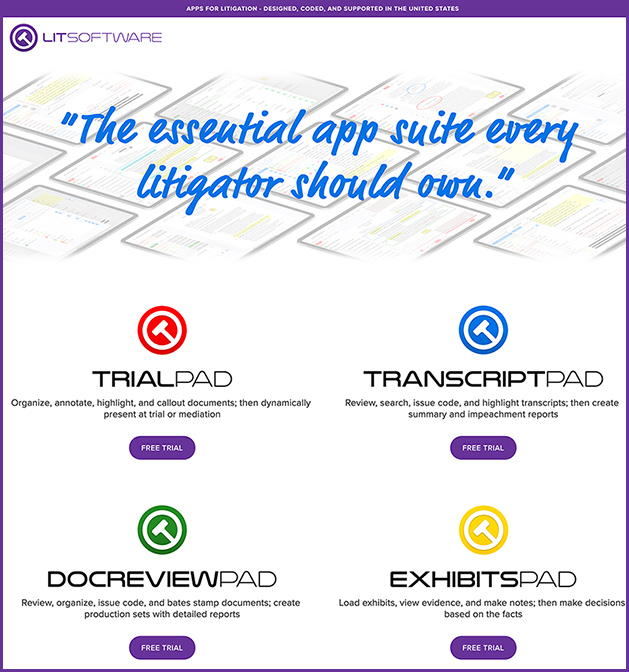
I saw the link to LitSoftware at the posting entitled, Three Lessons In Persuasive Trial Technology (from legaltechmonitor.com by Stephen Embry)..  I thought it offered some interesting software:


The Top 3 Legal Technology Trends of 2022 — from lexology.com by Sean Heck

Excerpts:

  1. Web-Based Contract Management Tools for Remote Legal Operations
  2. Online, Web-Based Document Editing
  3. Contract AI With Machine Learning for Intelligent CLM

Litera legal survey shows that technology is driving change in all aspects of M&A practice — from canadianlawyermag.com by Annabel Oromoni

Excerpt:

The global pandemic and the increasing reliance on technology to facilitate remote legal work and collaboration have accelerated the legal profession’s interest in technology-based solutions. A recent survey by Litera, a legal tech company, revealed that technology significantly impacts M&A practices in law firms.

Litera’s survey included insights from over 200 lawyers whose practices focus on M&A in the United States, the United Kingdom, and Canada.

David Curle, legal content and research lead at Litera, says the legal profession is fragmented, and Litera sought to receive responses about technology use, adoption, and spending from M&A lawyers specifically.

6 Types of Software for Your In-House Legal Team Needs — from jdsupra.com

Excerpt:

Most legal teams rely heavily on documents and communication for their work, and handling all the related operations may not be as simple as you would like it to be. Unless you change your approach to document management and start exploring tech solutions that improve team efficiency.

Automation software has helped many businesses and departments streamline all or most of their operations and improve their efficiency. The same can be done for a legal team.

In this article, let’s focus on the types of automation software for in-house counsel along with some of the top examples.


Addendum later on 5/11/22:

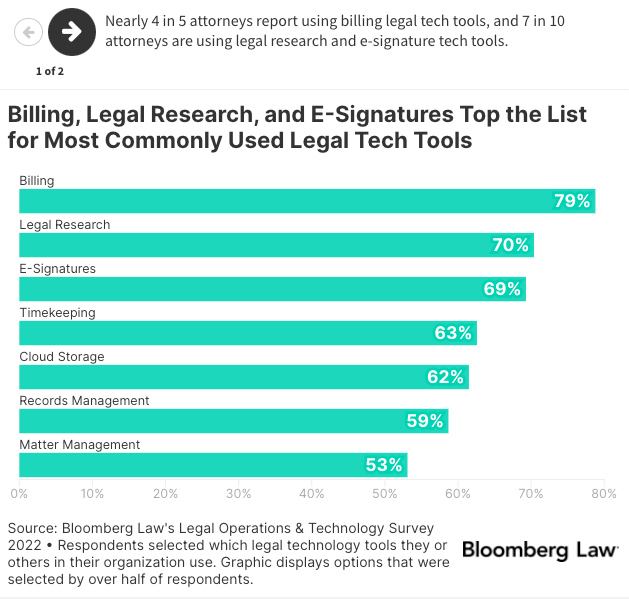
ANALYSIS: Lawyers’ Top Legal Tech Tools—And Biggest Blind Spots — from news.bloomberglaw.com by Racheal Pikulski, Princess Onyiri, and Lida Ouyang

Addendum later on 5/11/22:


Digital Classroom Newsletters: Tips for Engaging Students and Their Grownups — from blog.edmentum.com by Troy Minton

Excerpt:

Newsletters can be a very effective tool for getting quick and engaging information to students and their families, whether you teach online or in the physical classroom. Class newsletters can also be a quick and visually pleasing way for parents and guardians to stay informed on class activities and keep student supporters in the loop about grade level expectations, all the while building the essential communication lines. It allows supporters to ask specific questions about events happening in their child’s classroom more so than a simple question like “how was class?” would.

There are several free tools or versions that are available to educators that provide me a quick and effective method of getting information to students in an engaging and visually pleasing format. Let’s take a look at why a digital newsletter can be handy, and a few ways you can make sure to get the most out of yours.

 
© 2025 | Daniel Christian