The Science of Learning: Research Meets Practice — from the-learning-agency-lab.com by Alisa Cook and Ulrich Boser; with thanks to Learning Now TV for this resource
Six Research-Based Teaching Practices Are Put Into Practice

Excerpt:

For the nation’s education system, though, the bigger question is: How do we best educate our children so that they learn better, and learn how to learn, in addition to learning what to learn? Additionally, and arguably just as challenging, is: How do we translate this body of research into classroom practice effectively?

Enter the “Science of Learning: Research Meets Practice.” The goal of the project is to get the science of learning into the hands of teaching professionals as well as to parents, school leaders, and students.


What The Future Of Technology In The Workplace Means For Office Design And Operations — from workdesign.com by Mara Hauser

Excerpt:

Advances in technology continue to influence the workplace as corporate entities and coworking operators are confronted with modern challenges surrounding productivity and collaboration. We lead teams to execute intentional designs that reflect brand vision and produce lively, productive workspaces. With the growing demand from employees for workplace flexibility, these technological advancements must be reflected in both office design and business practices in order to add value and ultimately achieve operational excellence.

.

Podcasting studio at FUSE Workspace in Houston, TX.


‘Stackable credentials’ could be future of higher education in Colorado — from thedenverchannel.com by Nicole Brady; with thanks to Ray Schroeder for this resource out on LinkedIn
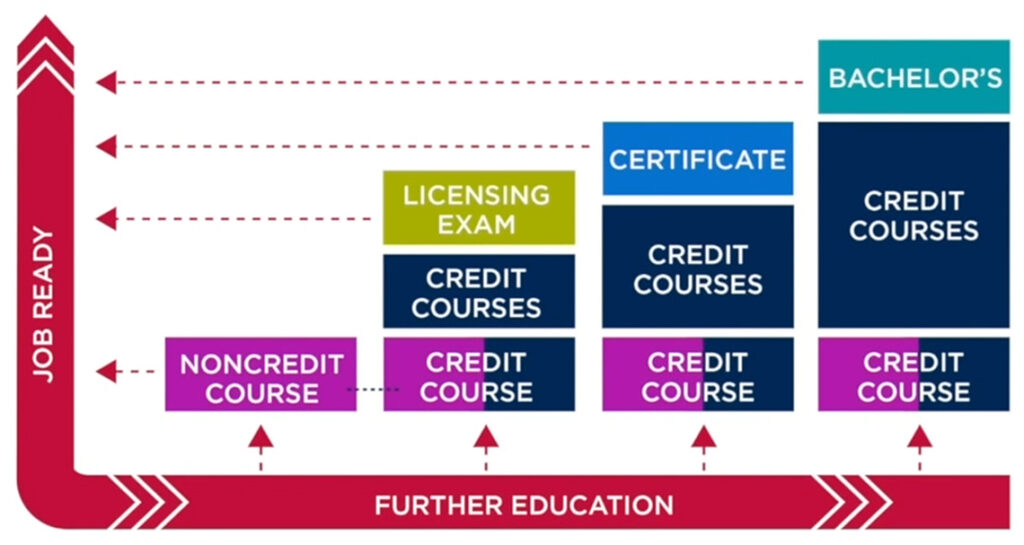
Stackable credentials could be future of higher education in Colorado

Excerpt (emphasis DSC):

DENVER — Metropolitan State University of Denver is one of Colorado’s largest four-year institutions, but some students are spending just months there — not years — before joining the workforce.

They’re doing it by “stacking” credentials.

“Stackable credentials are really a convergence of individuals wanting to learn in smaller chunks and industries being willing to accept those chunks,” said Terry Bower, associate vice president of Innovative and Lifelong Learning at MSU Denver.

The career launchpad lays out exactly what steps are needed to work in those industries and how much money a person can earn with different credentials.

For students who decide they want to add more credentials or work toward a degree, they can return to MSU with no credits lost.

From DSC:
That part that says “The career launchpad lays out exactly what steps are needed to work in those industries and how much money a person can earn with different credentials” will likely be a part of a next-generation learning platform. Here are the skills in demand. Here are the folks offering you the ability to learn/develop those skills and here’s what you can expect to earn at different levels of this type of job. The platform will be able to offer this type of information and these types of opportunities throughout your lifetime.

Cloud-based learner profiles will be part of this new setup — along with recommendation engine-based results based upon one’s learning preferences (not learning styles — which don’t exist — but upon one’s learning preferences).
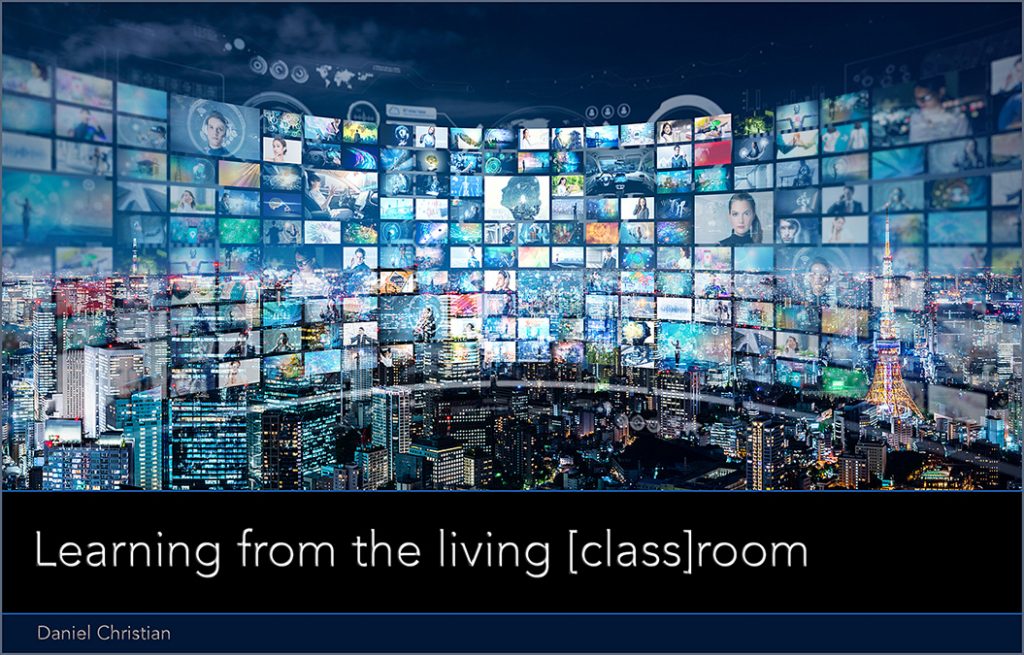
Learning from the living class room


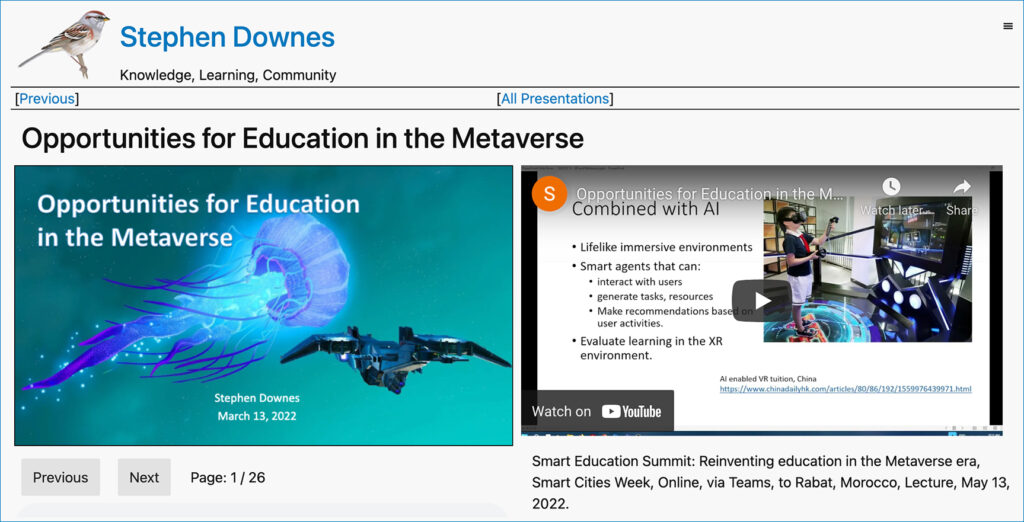
Opportunities for Education in the Metaverse -- from downes.ca by Stephen Downes

Opportunities for Education in the Metaverse — from downes.ca by Stephen Downes

Excerpt:

This short presentation introduces major elements of the metaverse, outlines some applications for education, discusses how it may be combined with other technologies for advanced applications, and outlines some issues and concerns.

Also relevant/see:

What Should Higher Ed in the Metaverse Look like? – from linkedin.com by Joe Schaefer

Excerpt:

The Metaverse is coming whether we like it or not, and it is time for educators to think critically about how it can benefit students. As higher education continues to evolve, I believe every learning product and platform working with or within the Metaverse should, at least, have these functionalities:


Addendum on 5/23/22:


Michigan Learning Channel: A Free Tool for Summer Learning — from michiganvirtual.org

Excerpt:

In this course, you will:

  • Recognize the what, why, and how of Michigan Learning Channel (MLC) resources.
  • Identify opportunities for family engagement that align with literacy, math, and science learning goals.
  • Consider ways to share these fun and free activities with students and families.

Also relevant/see:

FUTURE OF ME — from michiganlearning.org
Explore STEM careers by meeting women who work in those fields.

AGE RANGE: 6th – 12th Grade
SUBJECT: Career Exploration, Math, Science

TV Schedule — from michiganlearning.org


10 Best Web Highlighters for Desktop in 2022 — from hongkiat.com by Kei Watanabe

Excerpt:

Have you used any web highlighters? It helps us improve our productivity by copying and pasting important texts you’ve found online automatically, saving good articles in your directory, and highlighting important sentences on articles so that you can remember them when looking back.

In this article, I’ll introduce you to 10 useful web highlighters for the desktop. All these tools offer different features and you can read about each tool in detail in the following.


Gensler warns as crypto crashes: ‘The public is not protected’ — from protocol.com by Benjamin Pimentel
The SEC chair had sounded alarms about crypto’s risks, and now those risks are in plain sight.

Excerpt:

SEC Chair Gary Gensler warned Congress Wednesday that consumers and investors are vulnerable in an increasingly volatile crypto market now reeling from a sharp downturn.

Citing the recent collapse in the crypto market’s value, Gensler said, “This is a field that is now worth $1.2 trillion. Two weeks ago it was supposedly worth $2 trillion.”

“The public is not protected,” he testified at a House Appropriations Committee hearing on the proposed budget for the SEC and the FTC. “They don’t have the disclosures from these entrepreneurs.”

From DSC:
A topic for personal finance courses? Economics courses?


Google Maps to add “immersive view” — from futuretimeline.net
Google Maps, the world’s most-downloaded travel app, will soon become more immersive and intuitive thanks to a major upgrade.


Excerpts:

A new “immersive view” will generate far more detailed graphics than are available currently. This will provide sweeping views of cities in full 3D, complete with simulated cars, real-time weather, realistic day/night cycles, shadow effects, water reflections, and even animations like birds flying through the sky.

The company also announced an update for Live View. First launched in 2019, this provides augmented reality (AR) walking routes in the form of arrows, directions, and distance markers.

These improvements are possible thanks to advances in computer vision and AI that allow billions of aerial, street view, and other images to combine and create a rich, seamless, digital model of the world.


Addendums on 5/23/22:

Google Wants To Deliver World-Scale AR Using Google Maps — from vrscout.com by Bobby Carlton

Somewhat relevant/see:

Earth // Around The World From The Air 4K from Kien Lam on Vimeo.


The Pandemic’s Lasting Lessons for Colleges, From Academic Innovation Leaders — from edsurge.com by Nadia Tamez-Robledo, Rebecca Koenig, and Jeffrey R. Young

Excerpts:

“Universities are in the business of knowledge, but universities do a very poor job of managing their own knowledge and strategy,” says Brian Fleming, associate vice chancellor of learning ecosystem development at Northeastern University. “You may have faculty members who study organizational development, but none of that gets applied to the university.”

University leaders should learn to think more like futurists, he argues, working to imagine scenarios that might need planning for but are beyond the usual one-year or five-year planning cycles.

The pandemic prompted more faculty to ask the question, “What do we actually want to use class time for?” says Tyler Roeger, director of the center for the enhancement of teaching and learning at Elgin Community College. And the answer many of them are landing on, he adds, is: “Actual face-to-face time can be dedicated to problem-working, and working in groups together.”


4 Online Tactics to Improve Blended Learning — from campustechnology.com by Megan Burke, CPA, Ph.D.
An accounting professor shares how best practices from online pedagogy have helped her create a blended learning environment that supports student success.

Excerpts:

Now that students are back in the classroom, I have been combining these tactics with in-person instruction to create a blended learning environment that gives my students the best of both worlds.

The right activities, on the other hand, can make a significant difference. For example:

  • Breakout rooms (for think/pair/share);
  • Polls and quizzes that are low-stakes and anonymous to encourage full engagement;
  • Using the whiteboard option; and
  • Having reviews of material at the end of class.

I also encourage faculty (and myself!) to get out and meet with employers and ask what we can do to better prepare students, so that we can get a better feel for what first-year staff really need to know — and ensure that we present that knowledge and information in the classroom.


Teacher Moves That Cultivate Learner Agency — from edutopia.org by Paul Emerich France
Helping students become independent, questioning thinkers begins with stepping back and guiding them to take the lead in their learning.

Excerpt:

Cultivating learner agency is an endless journey. It not only entails knowing our students as human beings but also requires identifying and unlearning patterns in our teaching that unknowingly engender dependence in learners.

The term agency comes from the Latin agere, meaning “to set in motion.” It is precisely what agency should do in our classrooms: empower learners so that their minds and hearts become the engines that drive learning in our classrooms. This isn’t as simple as some might believe. Providing too much voice and choice without proper scaffolds can be counterproductive, resulting in chaos in the classroom.

Consider the following moves that cultivate learner agency—and choose one to try in your classroom.

 
© 2025 | Daniel Christian