The original article by @andylocal in the @nytimes when we first filed our challenge:

They Need Legal Advice on Debts. Should It Have to Come From Lawyers? — from nytimes.com
A nonprofit has filed a lawsuit in New York, hoping to clear the way for volunteers to help people defend themselves against debt collection suits.

Thalia Juarez for The New York Times.

Excerpt:

The Rev. John Udo-Okon, a Pentecostal minister in the Bronx, has a lot of congregants who are sued by debt collectors and don’t know what to do.

Like most of the millions of Americans sued over consumer debt each year, Pastor Udo-Okon’s congregants typically cannot retain a lawyer. When they fail to respond to the suit, they lose the case by default.


Also relevant/see:

Law Firms Branch Out Beyond Lawyers in Bid to Beat Out Rival Advisers — from wsj.com
Facing competitive pressure from consulting firms and others, old law firms try to pick up new tricks

“Clients increasingly were coming to us with a problem that they needed to solve and they really didn’t much care how we solved it,” Mr. Portnoy said. “Very often they were looking for something that was beyond the traditional tool kit.”


From DSC:
The items below reminded me that things aren’t looking good for higher education these days. Having a son a quarter of the way through college makes this even more relevant/personal for our family.


The Big Quit | Even tenure-line professors are leaving academe. — from chronicle.com by Joshua Doležal

Excerpts:

We have become accustomed to the exodus of graduate students, postdocs, and adjuncts, but before Covid it was still possible to see tenured and tenure-track faculty members as relatively immune from the stresses of working in higher ed. No more. A 2020 study by The Chronicle and Fidelity Investments found that more than half of all faculty members surveyed were seriously weighing options outside of higher education: either changing careers entirely or retiring early.
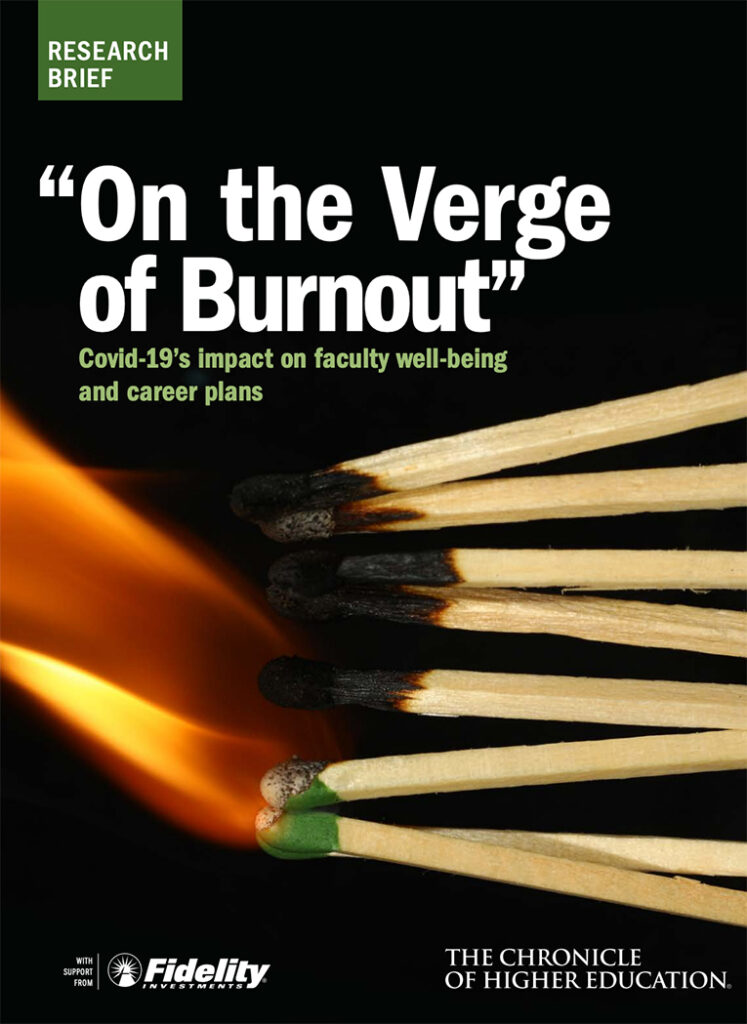
“If a return to normal simply means restoring the burnout conditions that the pandemic inflamed, then the rumble of faculty members leaving may build to a roar that no amount of magical thinking can explain away.”

Here’s a relevant quote from a weekly newsletter — Teaching — from The Chronicle of Higher Education (by Becky Supiano)

The bottom line? “You don’t get student success,” McClure says, “unless you have invested in faculty well-being.”

The quote is from Kevin McClure, who is “trying to get the challenges front-line faculty and staff face on the radar of more college leaders.” As primarily a former staff member, I appreciate that he’s including staff members here. Staff are important members of the academe as well.


Drop in Spring-2022 Enrollment Is Worse Than Expected — from chronicle.com byAudrey Williams June

Excerpt:

New data from the National Student Clearinghouse Research Center provide a final tally on enrollment for the spring of 2022 — and reveal a persistent trend: College attendance continues to decline.

Undergraduate enrollment fell 4.7 percent from a year earlier, a shortfall of more than 662,000 students. Since the pandemic began, the undergraduate student body has dropped by almost 1.4 million students.

But also in play, he said, are students who increasingly question the value of college, are wary about taking out student loans to pay for it, and who have options to join the labor market instead.


Michigan colleges experience nation’s worst spring enrollment dive, new report shows — from mlive.com by Samuel Dodge

Excerpt:

College enrollment across Michigan plummeted 15% during the spring semester this year, dragged down by a 20% hit to four-year public universities, a new report shows. Spring enrollment across all sectors dropped to 360,220 students, a decrease of more than 62,000 from 2021 to this year, according to data released Thursday, May 26, by the National Student Clearinghouse.


[Cost of Inequity]  The Student Loan Crisis — from businessinsidre.com by various
How the student loan industry put a $1.7 trillion price tag on the American dream and the proposed reforms that could pay the bill.


A somewhat-related item:

The Future of Higher Education Is the Hybrid Campus — from campustechnology.com by Dr. Jeffrey R. Docking
Blending the best of face-to-face instruction with the flexibility of online learning can enhance the higher ed experience for all types of learners, lower the cost of a degree and better prepare students for the workforce.

Excerpts (emphasis DSC):

What Students Want
Students and families are increasingly rethinking whether a traditional college education is worth the investment, leaving higher ed leaders searching for innovative ways to showcase their school’s value and entice students. When we think about what students really want, they want more than a degree — they want skills training that will ensure a well-paying, rewarding career. In fact, 62% of college students say they would be more likely to re-enroll if their institution offered “new programs and certificates tailored to the new economy” with high-demand majors and education that connects them to employability. This makes sense since employers are continuing to find value in students developing a “broad skill base that can be applied across a range of contexts.”

But over the last several years, and after seeing the success of it at Adrian College, I’ve become convinced that the future of residential colleges is not face-to-face or online, but an intelligent blend of both modalities.


A somewhat-related item:

Navigating career turbulence — from ted.com by Adam Grant; with thanks to Deirdre Honner for this resource

Description:

Everyone’s career will hit some turbulence at some point. Instead of pushing harder against the headwinds, we’re sometimes better off tilting our rudder and charting a new course. In this episode, host Adam Grant speaks with people who have taken unusual steps to battle uncertainty, rethought their approach to finding and landing a job and reached out for help in unexpected places — as well as an expert on recessions who forecasts the future by looking to the past. Listen and subscribe to WorkLife with Adam Grant and more podcasts from the TED Audio Collective wherever you’re listening to this.


From DSC:
The report below contains some great examples of a few of the elements in a learning ecosystem! Though there are many other elements in a learning ecosystem, tools and technologies are certainly two key components of one.

Some of the topics in this report at:

  • Knowledge bases and knowledge management technology
  • Microlearning
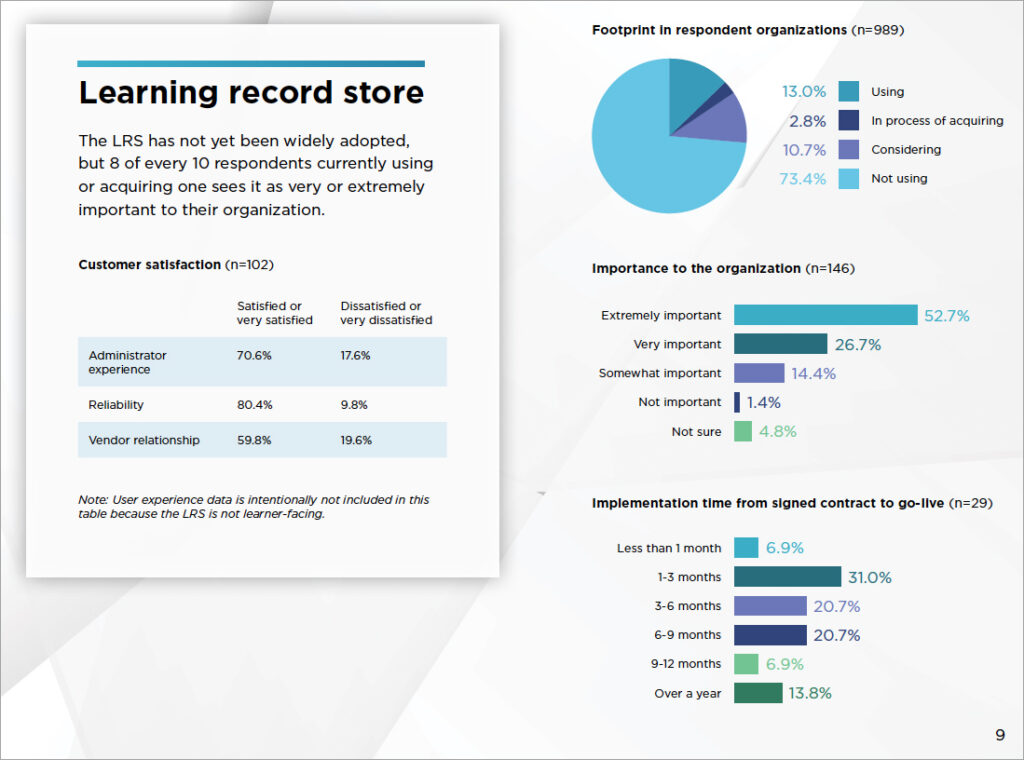
  • Learning record store
  • Learning Experience Platform (LXP)
  • Augmented reality / Virtual reality (AR/VR)
  • Adaptive learning / Intelligent tutor
  • Technology stack

2022 Trends in Learning Technology — from learningguild.com by Steve Foreman

Excerpt:

In this research report, Steve Foreman analyzes recent survey findings to examine eight learning technologies and explore how they impact the L&D space, organizations, customer satisfaction, and more.

This image contains some information regarding the learning record store


SXSW EDU Launch Winner Our Worlds Bringing Native American Culture to Life Through Mobile-Based Immersive Reality — from the74million.org by Tim Newcomb

Excerpt:

Take a stroll along the La Jolla Shores Beach in San Diego, and you might find sand between your toes. But users of the new Our Worlds app, winner of the 2022 SXSW EDU Launch Competition, might also find much more. Through augmented reality, they can look at that same stretch of beach and see handmade tule boats from the local Kumeyaay tribe.

Our Worlds launched to highlight Native American history via modern-day technology, putting what founder and CEO Kilma Lattin calls “code to culture” and pushing Native American civilization forward. Lattin says Our Worlds offers a full suite of technology — virtual reality, augmented reality, artificial intelligence — to capture all the components that make a culture.


Apple’s first AR/VR headset inches closer to launch — from protocol.com by Nat Rubio-Licht
The company reportedly showed off the device to board members as it makes progress on the headset’s operating system.

Camp K12 Launches Hatch Kids, a Metaverse & AR/VR Creation Platform for Kids — from edtechreview.in by Stephen Soulunii

….


Above video from Steve Kerr’s statement on school shooting in Texas

From DSC:
Steve Kerr has it right. Powerful. Critically important. 

“Enough!”  “We can’t get numb to this!”


Four items re: law schools

Embrace the Change—Law School vs. Undergrad — from abaforlawstudents.com by Andrew Kryder

Excerpt:

Learn what to expect before law school to soften the blow. The following points are some of the major differences between undergrad and law school and advice on navigating these new challenges.

‘Law Students Need to Hear from People on the Ground’ – Alice Armitage, LexLab — from artificiallawyer.com by

Excerpt:

How do you help law students to really get to grips with legal tech and the changing profession? One solution is to host your own accelerator along with providing associated courses on legal technology, which is exactly what Alice Armitage, Chief Executive Professor at LexLab, at the University of California Hastings College of Law, is doing.

Armitage told Artificial Lawyer: ‘My belief is that law students need to hear from people on the ground about technology. With LexLab we have been able to get so many people to guest speak, on legal ops and legal informatics, and more. It’s been amazingly successful.’

ABA Legal Ed council seeks comment on proposed revision to law school admissions test requirement — from abajournal.com by Stephanie Francis Ward

Excerpt:

A suggested revision to remove the requirement for law school entrance exams will be going out for notice and comment, following a Friday vote by the council of the ABA Section of Legal Education and Admissions to the Bar.

No LSAT Required? Law School Admissions Tests Could Be Optional Under New Proposal — from wsj.com by Deanna Paul
American Bar Association floats proposal to allow law-school applications without LSAT or GRE scores


What technology trends will—and should—lead business agendas in 2022? — from mckinsey.com

Excerpt:

Metaverse. Web3. Crypto. 5G.

These are just a few of the technologies grabbing headlines at the start of 2022. But what technology trends truly sit atop business agendas this year? Which might be under executives’ radars but should be surfaced? And what should business leaders keep in mind as they consider these trends?

We asked some members of the McKinsey Technology Council, a group of global experts convened to assess, track, and debate real emerging trends in business and technology, for their perspectives on these questions. Specifically, we asked the following:

  • What technology trend do you predict will headline business agendas for the remainder of 2022 and why?
  • What technology trend do you think is under businesses’ radars but merits more of executives’ attention?
  • What’s one piece of advice you would give to business leaders as they consider incorporating new technologies into their business?

Also relevant/see:

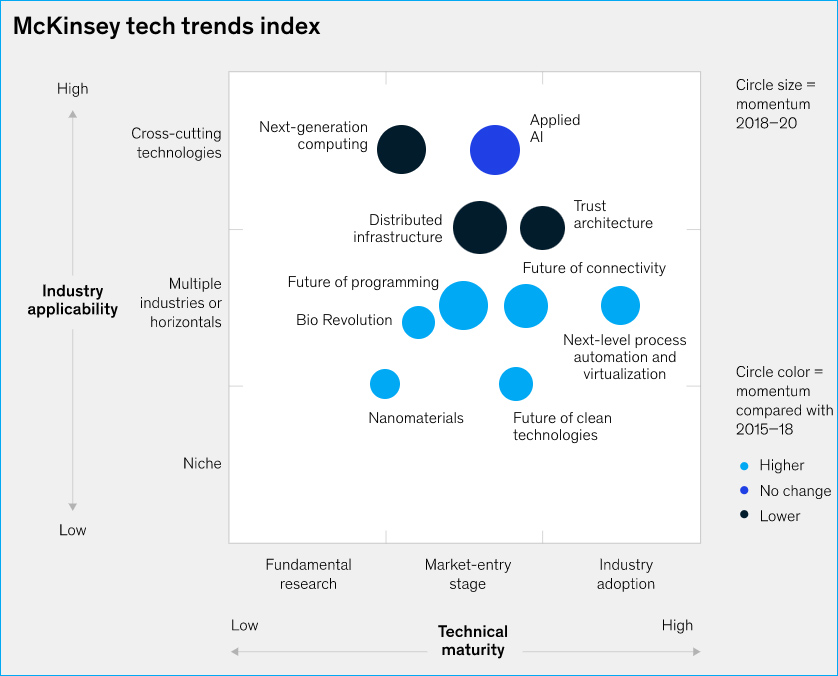
The top trends in tech — from mckinsey.com
Which technologies have the most momentum in an accelerating world? We identified the trends that matter most.

McKinsey tech trends index

Marketing in the metaverse: An opportunity for innovation and experimentation — from mckinsey.com
Although widespread adoption of the metaverse may take some time, leading brands are already rewriting the rules of marketing.

Marketers would be remiss if they didn’t start exploring what the metaverse can offer. Now is the right time to adopt a test-and-learn mindset, to be open to experiments, and to move on quickly from failure and capitalize on success.

From DSC:
And not just marketers. How about teachers, professors, trainers, and instructional designers?

#Metaverse #learningfromthelivingclassroom #learningecosystems #learning #training #education #K12 #highereducation #vocations #careers #corporatetraining #learninganddevelopment


From DSC:
The items below made me reflect on the need to practice some serious design thinking to rethink/redesign the cradle-to-grave learning ecosystems out there.


Real World Learning in Action — from gettingsmart.com by Shawnee Caruthers

Key Points

  • The Real World Learning initiative was created to address a simple, but equally complex challenge: How do you prepare students for life after high school?
  • The traditional, go to classes, earn some credits, participate in some activities and earn a diploma wasn’t working, at least not equitably.

Creating a new high school experience starts with innovative thinking and advocates willing to say yes. As a result of collaborations, visiting best practice sites and numerous convenings, the Kansas City region is now a hub for pathways, wall-to-wall academies, microschools, innovation academies, student-run businesses, strong client-connected project examples and more. Educational stakeholders can now go across state lines to see future-forward thinking for students.

Also relevant/see:

Framing and Designing the HOW — from gettingsmart.com by Rebecca Midles

Key Points (emphasis DSC):

  • The referenced circle graphic is intended to guide how we talk about our work as a system, internal and externally.
  • It also is about understanding our why on a personal level.
  • Learning systems are specifically designed to get the results they have, and to change results, we have to redesign the system.

Also relevant/see:

Fewer People Are Getting Teacher Degrees. Prep Programs Sound the Alarm — from edweek.org by Madeline Wil

Excerpt (emphasis DSC):

As teacher dissatisfaction rates rise and concerns about teacher shortages intensify, colleges of education are sounding the alarm: Enrollment has been steadily declining for the past decade, and the pandemic has likely made things worse.

Smaller and Restructured: How the Pandemic Is Changing the Higher Education IT Workforce — from educause.edu by Jenay Robert

Excerpt:

Several prominent themes emerged from the analysis of these responses and are supported by other recent EDUCAUSE research:

  • Though most respondents reported a reduction in force, some were able to justify adding new positions to their units in 2021, primarily to meet new institutional needs.
  • Budget cuts were the main cause of reductions in force.
  • Work factors such as flexible, remote work options and competitive salaries are playing a central role in attrition and recruitment.
  • Increased workloads and personal stressors related to the pandemic have resulted in widespread burnout among staff.
  • IT units have plans to reorganize in 2022 to become more agile and efficient and to respond to the evolving needs of their organizations.

Allan: With $175G Grants, Accelerate ED Looks to Better Link K-12, College & Work — from the74million.org by Sara Allan

Excerpt:

Today, most states require high school students to complete a set of defined courses, assessments and experiences in order to graduate on a career-ready pathway. However, the number of schools that fully embrace coherent programs of study that connect K-12, higher education and employment remains frustratingly small.

.


What if every high school student had the chance to take an additional year of courses related to their interests and earn enough credits to complete their associate degree one year after high school while gaining valuable experience and career preparation—at little to no cost?

— from Seamless Pathways to Degrees and Careers

From DSC:
The above quote is the type of “What if…” question/thinking that we need to redesign our cradle-to-grave/lifelong learning ecosystems.


A relevant addendum on 6/1/22:


27 Fun Ways to Celebrate the End of the School Year — from commonsense.org by Erin Wilkey O.

Excerpt:

This year, things are closer to “normal,” but we can still be creative in recognizing and celebrating students’ accomplishments. Use this list of ideas to help you plan some fun end-of-year activities — we’ve included a special section at the end for celebrating the class of 2022. Many of the ideas here play out in the digital world, but we’ve mixed in some offline options as well.

We hope these activities bring you and your students some much-deserved joy as we close out the 2021–2022 school year.


Private colleges’ net tuition revenue from first-year students declined in 2021-22, study finds — from highereddive.com by Rick Seltzer
The revenue drop comes as tuition discount rates for first-year undergraduates rose to 54.5%, NACUBO found. Selective colleges discounted less than others.

Dive Brief (emphasis DSC):

  • Tuition discount rates for full-time first-year students attending private nonprofit colleges rose 2.1 percentage points to average 54.5% in 2021-22, a new record high, according to the National Association of College and University Business Officers.
  • Average tuition discount rates also climbed for all undergraduates attending private nonprofits, increasing by 1.4 percentage points to 49%, an annual NACUBO study released Thursday found. That measure hit its highest recorded mark as well.
  • Net tuition revenue from first-time undergraduates fell for just the second time in 10 years, with colleges that aren’t selective in admissions struggling most.

Also relevant/see:

Smaller and Restructured: How the Pandemic Is Changing the Higher Education IT Workforce — from educause.edu by Jenay Robert


Google accelerates audiobook production exponentially — from provideocoalition.com by Allan Tépper

Excerpt:

In March 2022, I published Google’s Aloud auto-dubs your English video in Castilian or Portuguese, free. Now, Google is doing a similar quantum leap for audiobook production. In fact, I already converted and published one of my own books as an audiobook successfully using Google’s semi-automatic voices. Ahead, I’ll explain how Google’s process can convert the manuscript into a presentable audiobook in a few hours instead of over a month of work, using one of Google’s automated voices which are available for different languages and regions.


U.S. issues charges in first criminal cryptocurrency sanctions case — from washingtonpost.com by Spencer S. Hsu
Federal judge finds U.S. sanctions laws apply to $10 million in Bitcoin sent by American citizen to a country blacklisted by Washington

Excerpt:

The Justice Department has launched its first criminal prosecution involving the alleged use of cryptocurrency to evade U.S. economic sanctions, a federal judge disclosed Friday.


Best colouring and painting apps for kids — from educatorstechnology.com

Excerpt:

Below is a collection of some of great painting and colouring apps to help your kids unleash their expressive creativity and develop fine motor skills. These apps, mostly colouring games, provide kids access to a wide variety of colouring pages featuring images covering different topics from animals and mandalas to horoscopes and flowers to colour. Using game-based activities and interactive lessons, these apps offer kids a learning friendly space where they can exercise their painting, and drawing skills, improve their hand-eye coordination, and expand their imagination and creativity.

 
© 2025 | Daniel Christian