Animated Series: What’s Up with the Metaverse — from joetechnologist.com by Joseph Raczynski with creative by Elise Harmening, Esq.

Video description (emphasis DSC):

What’s Up with the Metaverse, published on June 2, 2022, was written by Joseph Raczynski of Thomas Reuters, a member of the Governing Council for the Center for Innovation, and created by Elise Harmening, Esq., Project Specialist Manager at the Center for Innovation. Innovation and You is a production by The American Bar Association’s Center for Innovation to help lawyers and our members think about innovative legal technology and practices as the legal landscape continues to change. Join the conversation on Twitter @ABAInnovation.


Also see:

Animated Series: What is an API? — from joetechnologist.com by Joseph Raczynski with creative by Elise Harmening, Esq.


Second Chance Pell helps deliver degrees to over 9,000 incarcerated students — from highereddive.com by Laura Spitalniak

Excerpts:

“Some programs may start as a real passion of an individual faculty member,” she said. “But in order for them to be sustainable, programs need cross-college support. Students need things like academic advising and access to library services. We’re seeing more and more of that, which is terrific.”

The existence and funding of such programs benefits people both in and out of the prison system. Inmates who participate in correctional education programs are 28% less likely to return to prison after their release than those who don’t, according to a 2018 meta-analysis of research. And research suggests that offering postsecondary programs could reduce levels of violence in prison.


Majority Want Online Courts To Keep Going – Survey — from artificiallawyer.com

Excerpt:

A major survey by the Social Market Foundation (SMF) of 1,000 individuals, plus 1,000 businesses, has found that a majority want to keep the online court system going, despite the end of the worst of the pandemic in the UK.

The results were:

  • three-quarters of the British public are content with online hearings and other remote access arrangements. Just 27% of the public object to such innovations.
  • 64% of businesses support remote access to the civil courts…..although, that means that up to 36%, a notable minority, of companies are not that happy with remote court hearings.

And here’s a related item from here in the United States:


Research reveals the benefits of online tutoring — from adigaskell.org by Adi Gaskell

Excerpt:

The Covid pandemic resulted in considerable disruption to the education of pupils around the world, with many parents resorting to online tutoring in a bid to ensure their children didn’t fall behind. Research from the University of California San Diego highlights the effectiveness of such tutoring.

While there have long been suspicions around the effectiveness of such schemes, concerns have existed about both the high costs associated with them and the limited availability of tutors.

“Our program explores the possibilities of a low-cost model with volunteer tutors which has the potential to reach more students in need,” the researchers explain.


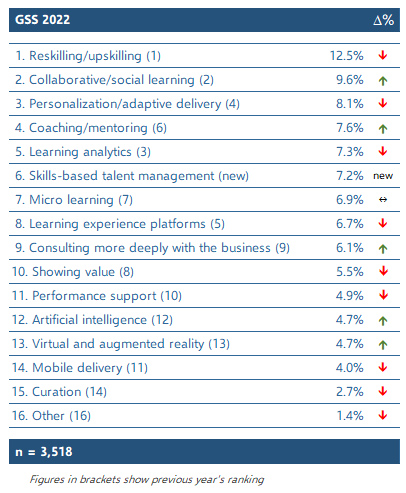
The 2022 L&D Global Sentiment Survey — from donaldtaylor.co.uk by Donald Taylor

Excerpt:

This year’s L&D Global Sentiment Survey, the ninth, shows L&D at a turning point, as the result of two forces. One is the demands of organisations, as they emerge from the pandemic, for more training delivery, very often with unchanged or reduced resources for L&D. The other is the need to deal with the emergency measures put in place in 2020 to deal with the immediate impact of COVID-19.

This sense of practitioners being under pressure is amply illustrated by responses to the free text question ‘What is your biggest L&D challenge in 2022?’ 40% of respondents answered, with the answers painting a picture of practitioners being asked to do more, in difficult circumstances, to support the learning of overworked employees and uninterested employers.

It is tempting to see this as a return to business-as-usual for L&D. Hasn‘t it always been the case that the department needed to fight for the attention of both executives and employees? Behind this undeniable reality, however, there are definite signs of longer-term trends emerging.


Facebook Seems to Be Adding Video-Course Features. For Edtech, That Raises Old Fears. — from edsurge.com by Daniel Mollenkamp

Excerpts:

The tech giant Meta, widely known under its previous name Facebook, seems to be eyeing a way to allow users to offer video classes.

Since at least last year, Meta has experimented with Facebook Classes, a program designed to make online instruction through its platform smoother. A consultant recently noticed a company announcement about the features in the U.K. version of the platform and shared a screenshot on Twitter.

The company did not respond to questions about the program. But recent reports have speculated that the company could “bootstrap an online course ecosystem.”

Meta’s learning offering could be most trouble for other tech behemoths like Google Classroom and Microsoft Teams, according to some speculations.

Either way, Meta’s possible entrance into the market plays into a long-standing fear of big tech in the edtech industry.


Demarginalizing Design: 3 powerful ways to get started — from ditchthattextbook.com by Dee Lanier

Excerpt:

Get proximate to the pain

  • Gather the people that are most affected by the problem.
  • Listen for pain. Emotions such as outrage and frustration are insights into the source of the problem.
  • Design with them, not for them. Your job is to facilitate the discussion that allows them to come up with their own solutions that affect their community.

From DSC:
You will notice some more postings regarding “Design Thinking” on this Learning Ecosystems blog from time to time. I’m continuing to do this because as we move more toward a reality of lifelong learning, we should probably rethink the entire cradle-to-grave design of our learning ecosystems.


The Restaurant of Mistaken Orders: A Tokyo Restaurant Where All the Servers Are People Living with Dementia — from openculture.com

Whole towns have already begun to structure their services around a growing number of citizens with dementia. But dementia itself remains “widely misunderstood,” says Restaurant of Mistaken Orders producer Shiro Oguni in the “concept movie” at the top of the post. “People believe you can’t do anything for yourself, and the condition will often mean isolation from society. We want to change society to become more easy-going so, dementia or no dementia, we can live together in harmony.”

Also see:

How Technology Can Improve Elder Care — from digitalsalutem.com by João Bocas

In this article, I talk about:

  1. The growth of the aging population
  2. The future of elder care is already here
  3. Smart homes, augmented and virtual reality, and wearables as potential solutions
  4. How these solutions can help providers deliver elder care
  5. The benefits of using these solutions

The world is changing. The way we live, the way we work, and the way we age are all being transformed by technology. In fact, some experts say that by 2030, more than half of the world’s population will be over 50 years old.

This is a new phenomenon for humanity. With this shift comes a need for new approaches to healthcare that are better suited to an aging population with increasingly complex needs.


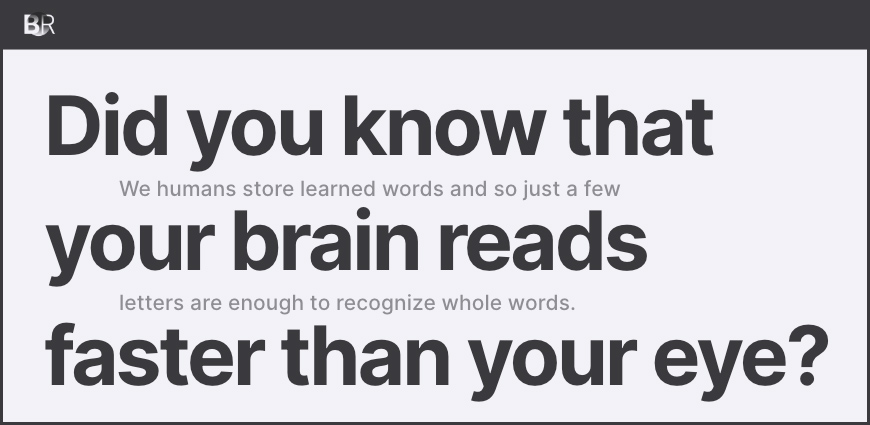
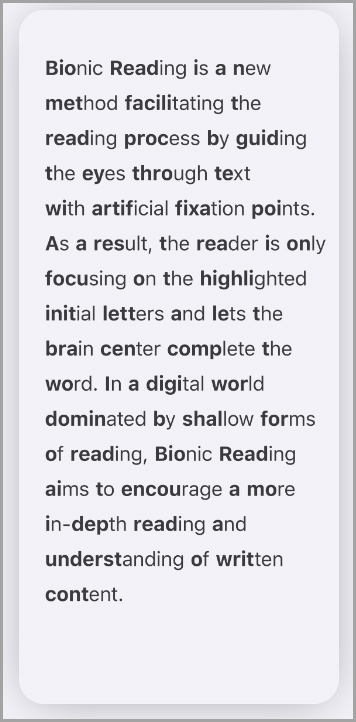
Bionic Reading

Bionic Reading


From DSC:
Thanks to my good friend Chris for this resource. By the way, this Chrome Extension, Converter, and API remind me a bit of Microsoft’s Immersive Reader.

Also related, see:


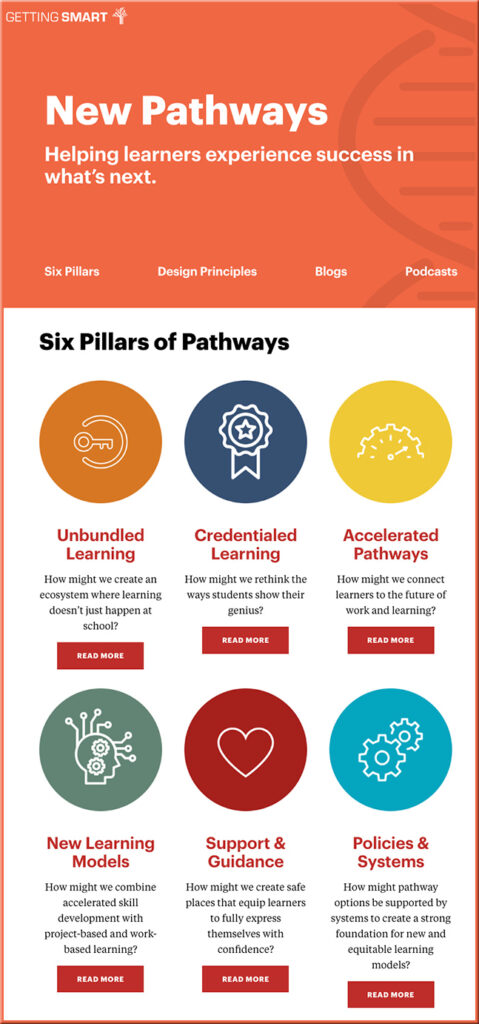
New Pathways: Experiencing Success In What’s Next — from Getting Smart

Excerpt:

Some of you were able to attend our official kick-off event yesterday (on 6/21/22), but for those who weren’t able to make it we wanted to let you know that our new campaign, New Pathways, has officially begun!. Over the next few years, and in partnership with ASA, the Bill & Melinda Gates Foundation, Stand Together and the Walton Foundation, we will be dedicated to tracking innovations in the following six pillars:

  1. Unbundled Learning
  2. Credentialed Learning
  3. Accelerated Pathways
  4. New Learning Models
  5. Support & Guidance
  6. Policies & Systems
We believe that when combined, these pillars enable learners to find success in what’s next in their professional lives, their personal lives and in their communities.


From DSC:
Inflation way up. Real wages way down. Not a good mix for higher education. And faculty members aren’t the only ones impacted here. These developments may cause the rise of additional alternatives to institutions of traditional higher education out there. 


One of the resources mentioned in Isha Trivedi’s article out at The Chronicle of Higher Education that’s entitled “Faculty-Pay Survey Records the Largest One-Year Drop Ever” was this one:

The Annual Report on the Economic Status of the Profession, 2021-22 — from the American Association of University Professors (AAUP)

Key Findings (emphasis DSC):
Provisional results were released in early April 2022, including summary tables and institution-level datasets. Key findings include:

  • From 2020–21 to 2021–22, average salaries for full-time faculty members increased 2.0 percent, consistent with the flat wage growth observed since the Great Recession of the late 2000s.
  • Real wages for full-time faculty fell below Great Recession levels in 2021, with average salary falling to 2.3 percent below the 2008 average salary, after adjusting for inflation.
  • Real wages for full-time faculty members decreased 5.0 percent after adjusting for inflation, the largest one-year decrease on record since the AAUP began tracking this measure in 1972.
  • In 2021–22, 97.2 percent of full-time faculty members were covered by retirement plans, a 2.8 percentage point increase from 2020–21.
  • Institutions reported full-time faculty salaries for women that are 81.9 percent of those for men in 2021–22, on average. The gender pay gap is greatest at the full professor rank.
  • From 2019–20 to 2021–22, the number of full-time women faculty members increased 1.6 percent, compared with a 2.5 percent decrease for men.
  • In 2020–21, average pay for adjunct faculty members to teach a course section ranged from $2,979 in public associate’s institutions without ranks to $5,557 in public doctoral institutions.
  • In fall 2020, about three in five (61.5 percent) faculty members were on contingent appointments.

Also relevant, see:


Some learning-related tips from Eva Keiffenheim’s Learn Letter


Excerpts from Eva’s 6/15/22 letter re: learning a language — with Mathias Barra, who “has studied about 20 languages and is fluent in six”

2) The best way to mastery is by making language learning part of your life
There’s no single best way to study languages. Mathias approached every language differently.

The most important thing is to find some activities that you actually enjoy in the language. For example, you can:

  • watch a Netflix series with double subtitles with the free Language Reactor extension
  • reading a book in the language you’re learning, for example with easy readers?
  • go to radio.garden and listen to the language you’re learning
  • switch your phone settings to another language
  • write your diary in the language you’re learning

“The best way to study languages is not to limit it to study time, but to make it part of your life, for example, through exposure.”

Some tools and resources Mathias recommends:

  • iTalki offers 1-on-1 lessons in more than 150 languages
  • Journaly allows you to type a text that natives correct
  • Slowly connects you with a language tandem for writing letters
  • HiNative gets you answers from native speakers
  • Speechling helps you work on listening comprehension

See the full interview here.

And from Eva’s 6/22/22 Learn Letter:

According to this concept, there’s an optimal arousal level for task performance. The Yerkes-Dodson Law says there is an empirical relationship between stress and performance. Yerkes and Dodson discovered that the optimal arousal level depends on the complexity and difficulty of the task.

From DSC:
Reading a bit about the Yerkes-Dodson Law, I was reminded of a bad learning experience from years ago. I recall sitting in a conference room at Baxter Healthcare and I was trying to learn more about programming.  I had just been switched into a new group and my new supervisor was trying to teach me some basic items (basic to him, anyway). He was getting increasingly frustrated at me for not understanding some things. The more frustrated he got, the less I could even concentrate on what he was saying and trying to teach me. 

Along these lines, I also remember a relative trying to teach another relative some new things. Again, the more upset the “teacher” got, the less able the “learner” was able to concentrate. It didn’t end well. 

Oh…what’s that?! I’m hearing a loud “Amen!!!” coming from countless music teachers and students out there too. 

For these kinds of reasons, I want to learn more about the place of emotion in our learning ecosystems.


Coursera’s Global Skills Report

Excerpt from the Executive Summary:

Here are some of our top findings:

  • Digital skills are the shared language of the modern economy.
  • Women’s participation continued to rise.
  • The developing world had the highest rate of learner growth.
  • Lower levels of internet access mean lower levels of skills proficiency.
  • Courses in human skills had more learners from developed countries, while those in digital skills had more from developing ones.
  • The U.S. held steady in its overall skills proficiency ranking—yet it lost meaningful ground in core technology and data science skills.
  • Europe leads the world in skills proficiency.
  • Proficiency in technology and data science skills varies widely across the Asia-Pacific region.
  • Learners used Coursera to understand the pandemic.
 

How parents can set up a productive home learning space for students — from blog.neolms.com by Charlie Fletcher

Excerpt:

Most schools have now reopened, and students across the nation and the world are back to learning in person. But, that doesn’t mean that remote learning is over. Plenty of schools still follow a hybrid model, and some students who fared better in remote learning conditions have stuck with virtual classrooms. This means that parents must know how to set up a productive learning space, both for remote learning and as a great study area.

Fortunately, there are plenty of resources to help parents and guardians who want to create a home learning space. This means that whatever your budget, every student can have their own space to study for exams and complete homework.


© 2025 | Daniel Christian