New approaches to legal service delivery are propelling us into the future. Don’t get left behind! AI and automations are making alternative service delivery easier and more efficient than ever. Dennis & Tom welcome Mathew Kerbis to learn more about his expertise in subscription-based legal services.
What a strong business case includes A credible business case has three core elements: a clear problem statement, a defined solution, and a robust analysis of expected impact. It should also demonstrate that legal has done its homework and thought beyond implementation.
From DSC: This one is for the youth out there. Learn these lessons NOW, before you go too much further in your journey here on Earth. If you do, you will reap the benefits of this learning for the rest of your days.
As I mentioned to our own kids when I forwarded this article to them:
My dad passed along a bit of wisdom to me when he told me what *his* dad (my Grandpa Christian) had told him:
“If a job is worth doing, it’s worth doing well.”
I’ve always remembered that and I *try* to do quality work.
The following article is worth your time. It touches upon a similar idea: .
I pass it along to help us *try* to do quality things and work…but NOT to load up unrealistic expectations on ourselves or create a harried, perfectionistic lifestyle.
Excerpt:
An old carpenter told his boss that he planned to retire. The boss was sad to lose the carpenter, but understood.
He asked if he’d stick around for one last job—to build one final house.
The carpenter reluctantly agreed, figuring he could get it done quickly. He cut corners, used cheap materials, and rushed through the work.
When the house was done, his boss arrived for the final inspection. But instead of walking the house, he reached into his pocket, and handed the carpenter the keys.
“This is your house,” his boss smiled, “My retirement gift to you.”
The carpenter was stunned. If he’d known he was building his own house, he would have done it differently. Now he’d have to live in a house he had built none too well.
The lesson: You’re always building your own house.
Tech Layoffs 2025: Why AI is Behind the Rising Job Cuts — from finalroundai.com by Kaustubh Saini, Jaya Muvania, and Kaivan Dave; via George Siemens 507 tech workers lose their jobs to AI every day in 2025. Complete breakdown of 94,000 job losses across Microsoft, Tesla, IBM, and Meta – plus which positions are next. .
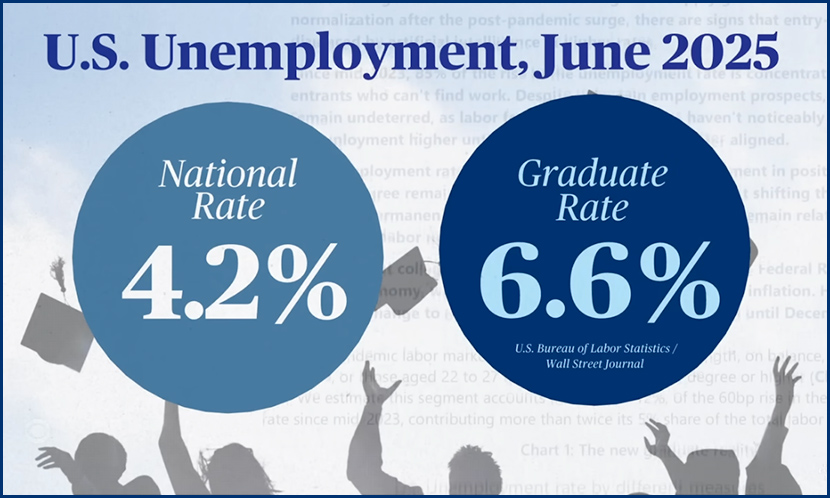
Amid all the talk about the state of our economy, little noticed and even less discussed was June’s employment data. It showed that the unemployment rate for recent college graduates stood at 5.8%, topping the national level for the first and only time in its 45-year historical record.
It’s an alarming number that needs to be considered in the context of a recent warning from Dario Amodei, CEO of AI juggernaut Anthropic, who predicted artificial intelligence could wipe out half of all entry-level, white-collar-jobs and spike unemployment to 10-20% in the next one to five years.
The upshot: our college graduates’ woes could be just the tip of the spear.
But as I thought about it, it just didn’t feel right. Replying to people sharing real gratitude with a copy-paste message seemed like a terribly inauthentic thing to do. I realized that when you optimize the most human parts of your business, you risk removing the very reason people connect with you in the first place.
For today’s chief learning officer, the days of just rolling out compliance training are long gone. In 2025, learning and development leaders are architects of innovation, crafting ecosystems that are agile, automated and AI-infused. This quarter’s Tech Check invites us to pause, assess and get strategic about where tech is taking us. Because the goal isn’t more tools—it’s smarter, more human learning systems that scale with the business.
Sections include:
The state of AI in L&D: Hype vs. reality
AI in design: From static content to dynamic experiences
AI in development: Redefining production workflows
NEW YORK – The AFT, alongside the United Federation of Teachers and lead partner Microsoft Corp., founding partner OpenAI, and Anthropic, announced the launch of the National Academy for AI Instruction today. The groundbreaking $23 million education initiative will provide access to free AI training and curriculum for all 1.8 million members of the AFT, starting with K-12 educators. It will be based at a state-of-the-art bricks-and-mortar Manhattan facility designed to transform how artificial intelligence is taught and integrated into classrooms across the United States.
The academy will help address the gap in structured, accessible AI training and provide a national model for AI-integrated curriculum and teaching that puts educators in the driver’s seat.
In an era when the college-going rate of high school graduates has dropped from an all-time high of 70 percent in 2016 to roughly 62 percent now, AI seems to be heightening the anxieties about the value of college.
According to the survey, two-thirds of parents say AI is impacting their view of the value of college. Thirty-seven percent of parents indicate they are now scrutinizing college’s “career-placement outcomes”; 36 percent say they are looking at a college’s “AI-skills curriculum,” while 35 percent respond that a “human-skills emphasis” is important to them.
This echoes what I increasingly hear from college leadership: Parents and students demand to see a difference between what they are getting from a college and what they could be “learning from AI.”
Culture matters here. Organizations that foster psychological safety—where experimentation is welcomed and mistakes are treated as learning—are making the most progress. When leaders model curiosity, share what they’re trying, and invite open dialogue, teams follow suit. Small tests become shared wins. Shared wins build momentum.
Career development must be part of this equation. As roles evolve, people will need pathways forward. Some will shift into new specialties. Others may leave familiar roles for entirely new ones. Making space for that evolution—through upskilling, mobility, and mentorship—shows your people that you’re not just investing in AI, you’re investing in them.
And above all, people need transparency. Teams don’t expect perfection. But they do need clarity. They need to understand what’s changing, why it matters, and how they’ll be supported through it. That kind of trust-building communication is the foundation for any successful change.
These shifts may play out differently across sectors—but the core leadership questions will likely be similar.
AI marks a turning point—not just for technology, but for how we prepare our people to lead through disruption and shape the future of learning.
If you’re anything like me, the answer is an iPad AND a drawing display. I heavily rely on both my desktop apps and Procreate, so limiting myself to only one device doesn’t cut it for my creative workflow.
However, it all comes down to personal preference and understanding which apps you rely on, whether portability is essential, how vital ergonomics are, and ultimately what you can afford. Once you answer those questions, everything falls into place.
Budget hawks have fretted for decades about America’s deficits and debt, repeatedly advising our government to embrace greater fiscal austerity. And for just as long, budget doves — myself included — fought this narrative, repeatedly arguing that austerity often does more harm to our economy than good.
No longer. I, like many other longtime doves, am joining the hawks, because our nation’s budget math just got a lot more dangerous.
At least 85% of students with disabilities can learn and achieve on grade level.
14% of all U.S. students have a disability.
No belief is more damaging in education than the misperception that children with disabilities cannot really succeed and shouldn’t be challenged to reach the same high standards as all children.
Arne Duncan, former U.S. Secretary of Education
From DSC: One of our kids — actually, who is no longer a kid anymore — was born with Mosaic Down Syndrome. Looking back on her K-12 years, first through fifth grade went very well — which my wife and I were very grateful for. (We didn’t know what each year would bring and whether she would be able to move on to the next grade.)
But sixth and seventh grades were very rough. At the end of seventh grade, we decided to homeschool our daughter. The system she was in — like so many school systems across the nation — was meant to address the 80% of students who are neither gifted nor have special needs. The quickly-moving trains leave at such and such a time and then stop at such and such a time. One better keep up. This traditional system is a one-size-fits-all approach, and it’s something we do for administrative purposes — it’s not for the benefit of the kids within K-12 schools.
After a few years of both homeschooling and Christian education, it turned out that our daughter was able to learn almost all of the subjects in high school. But she needed to learn ON HER TIMELINE…AT HER OWN PACE of learning.
We’re proud of her. She has had a couple of jobs already and is doing quite well overall. Her motivation has been very low at times, which made homeschooling very tough. But, overall, I would agree with Karla Phillips-Krivicka’s key point that at least 85% of students with disabilities can learn and achieve at grade level. That’s been true for our daughter who has some special needs.
Is graduate employability a core university priority? — from timeshighereducation.com by Katherine Emms and Andrea Laczik Universities, once judged primarily on the quality of their academic outcomes, are now also expected to prepare students for the workplace. Here’s how higher education is adapting to changing pressures
A clear, deliberate shift in priorities is under way. Embedding employability is central to an Edge Foundation report, carried out in collaboration with UCL’s Institute of Education, looking at how English universities are responding. In placing employability at the centre of their strategies – not just for professional courses but across all disciplines – the two universities that were analysed in this research show how they aim to prepare students for the labour market overall. Although the employability strategy is initialled by the universities’ senior leaders, the research showed that realising this employability strategy must be understood and executed by staff at all levels across departments. The complexity of offering insights into industry pathways and building relevant skills involves curricula development, student-centred teaching, careers support, partnership work and employer engagement.
Every student can benefit from an entrepreneurial mindset — from timeshighereducation.com by Nicolas Klotz To develop the next generation of entrepreneurs, universities need to nurture the right mindset in students of all disciplines. Follow these tips to embed entrepreneurial education
This shift demands a radical rethink of how we approach entrepreneurial mindset in higher education. Not as a specialism for a niche group of business students but as a core competency that every student, in every discipline, can benefit from.
At my university, we’ve spent the past several years re-engineering how we embed entrepreneurship into daily student life and learning.
What we’ve learned could help other institutions, especially smaller or resource-constrained ones, adapt to this new landscape.
The first step is recognising that entrepreneurship is not only about launching start-ups for profit. It’s about nurturing a mindset that values initiative, problem-solving, resilience and creative risk-taking. Employers increasingly want these traits, whether the student is applying for a traditional job or proposing their own venture.
Build foundations for university-industry partnerships in 90 days— from timeshighereducation.com by Raul Villamarin Rodriguez and Hemachandran K Graduate employability could be transformed through systematic integration of industry partnerships. This practical guide offers a framework for change in Indian universities
The most effective transformation strategy for Indian universities lies in systematic industry integration that moves beyond superficial partnerships and towards deep curriculum collaboration. Rather than hoping market alignment will occur naturally, institutions must reverse-engineer academic programmes from verified industry needs.
Our six-month implementation at Woxsen University demonstrates this framework’s practical effectiveness, achieving more than 130 industry partnerships, 100 per cent faculty participation in transformation training, and 75 per cent of students receiving industry-validated credentials with significantly improved employment outcomes.
How Do You Teach Computer Science in the A.I. Era? — from nytimes.com by Steve Lohr; with thanks to Ryan Craig for this resource Universities across the country are scrambling to understand the implications of generative A.I.’s transformation of technology.
The future of computer science education, Dr. Maher said, is likely to focus less on coding and more on computational thinking and A.I. literacy. Computational thinking involves breaking down problems into smaller tasks, developing step-by-step solutions and using data to reach evidence-based conclusions.
A.I. literacy is an understanding — at varying depths for students at different levels — of how A.I. works, how to use it responsibly and how it is affecting society. Nurturing informed skepticism, she said, should be a goal.
At Carnegie Mellon, as faculty members prepare for their gathering, Dr. Cortina said his own view was that the coursework should include instruction in the traditional basics of computing and A.I. principles, followed by plenty of hands-on experience designing software using the new tools.
“We think that’s where it’s going,” he said. “But do we need a more profound change in the curriculum?”
Doxology
33 Oh, the depth of the riches of the wisdom and knowledge of God!
How unsearchable his judgments,
and his paths beyond tracing out!
34 “Who has known the mind of the Lord?
Or who has been his counselor?”
35 “Who has ever given to God,
that God should repay them?”
36 For from him and through him and for him are all things.
To him be the glory forever! Amen.
Adulting and Career Exploration — from the-job.beehiiv.com by Paul Fain Junior Achievement helps high school grads learn life skills and gain work experience while figuring out what comes next.
Bridging the Gap Between School and Careers Junior Achievement has stepped into the blur space between high school and what comes next. The nonprofit’s 5th Year program gives young adults a structured year to live on a college campus and explore careers, gain work experience, and build life skills.
An initial cohort of 24 students graduated this May from a trial run of the program based in Toledo, Ohio. Each participant held two internships—one in the fall and one in the spring. They also visited 60 employers across the metro area. Represented industries included law, engineering, construction, accounting, healthcare, higher education, and nonprofit organizations.
The program is focused on helping students find a clear path forward, by guiding them to match their interests and abilities with in-demand careers and local job opportunities.
“We’re giving them the space to just pause,” he says. “To discover, to explore, to grow personally, to grow socially.”
The microschooling sector’s robust diversity of educational approaches is often described by the families who choose it as among its most appealing attributes. The wide range of approaches offered, and the many ways different approaches are combined within different microschooling models, offer families options usually not currently available in the communities they live.
And while many of these approaches, like project-based learning, are popular across all of American education, within the smaller, more personalized and responsive context of a microschool, educators are able to take advantage of their flexibility to delve more deeply into the possibilities of each than they were in the more rigid structures of most traditional schools.
According to 2025 research published by the National Microschooling Center, microschool leaders reported that project-based learning is the most popular educational approach used (72 percent). Respondents were asked to indicate all that apply, so microschools typically indicated incorporating multiple approaches.
Thanks for dropping by my Learning Ecosystems blog!
My name is Daniel Christian and this blog seeks to cover the teaching and learning environments within the K-12 (including homeschooling, learning pods/micro-schools), collegiate, and corporate training spaces -- whether those environments be face-to-face, blended, hyflex, or 100% online.
Just as the organizations that we work for have their own learning ecosystems, each of us has our own learning ecosystem. We need to be very intentional about enhancing those learning ecosystems -- as we all need to be lifelong learners in order to remain marketable and employed. It's no longer about running sprints (i.e., getting a 4-year degree or going to a vocational school and then calling it quits), but rather, we are all running marathons now (i.e., we are into lifelong learning these days).