2022 Report: The State Of eLearning — from elearningindustry.com by My Learning HUB
What does the future of L&D look like? My Learning Hub surveyed 291 L&D professionals to get their perspectives on the state of eLearning.

Key chapters

  • There’s Been A Rapid Digital Transformation – What Has This Meant For L&D?
  • The L&D Landscape Has Changed, But So Have Attitudes
  • We Know What We Want From L&D, But Can We Achieve It?
  • eLearning Isn’t Going Anywhere, But It Is Changing
  • Summary Of Our Findings
 

Forget the Jetsons. Transportation of the future will look more like ‘Westworld’ — from fastcompany.com
Futuristic public transportation projects are already in the works.

Excerpt:

THE NEXT GENERATION
The way we commute has already started to change. With next generation transportation projects, public transportation is becoming more efficient by employing self-driving buses and trains and installing automatic card-ticketing systems.

From DSC:
But we need to look out here. As we’ve seen before, not everything is so rosy with emerging technologies. See this next item for example:

Cruise’s Robot Car Outages Are Jamming Up San Francisco— from wired.com by Aarian Marshall
In a series of incidents, the GM subsidiary lost contact with its autonomous vehicles, leaving them frozen in traffic and trapping human drivers.

“A letter sent anonymously by a Cruise employee to the California Public Utilities Commission that month alleged that the company loses contact with its driverless vehicles ‘with regularity,’ blocking traffic and potentially hindering emergency vehicles.”


From DSC:
Below are several observations re: our learning ecosystems — and some ideas on how we can continue to improve them.


It takes years to build up the knowledge and skills in order to be a solid teacher, faculty member, instructional designer, and/or trainer. It takes a lot of studying to effectively research how the brain works and how we learn. Then we retire…and the knowledge is often lost or not passed along. And the wheel gets reinvented all over again. And again. And again.

Along these lines — and though we’re making progress in this area — too often we separate the research from the practical application of that research. So we have folks working primarily in learning science, neuroscience, cognitive psychology, and related fields. But their research doesn’t always get practically applied within our learning spaces. We have researchers…and then we have practitioners. So I greatly appreciate the likes of Pooja Agarwal and Patrice Bain out at RetrievalPractice.org, Daniel Willingham, Eva Keiffenheim, The Learning Scientists, James Lang, and several others who bridge this gap.
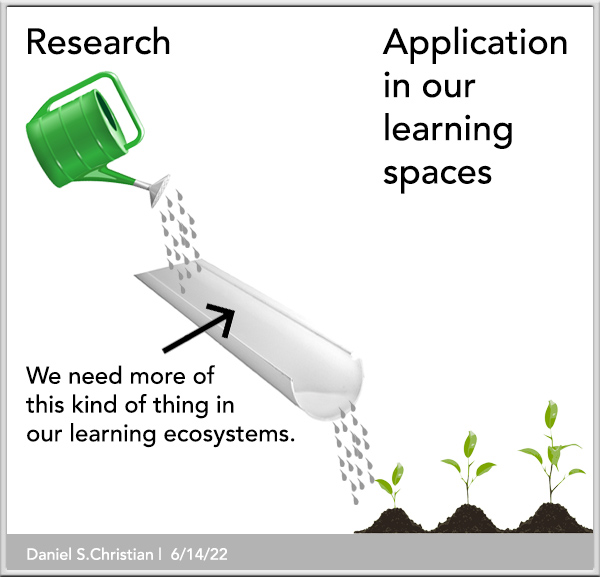
We need to take more of the research from learning science and apply it in our learning spaces.

Perhaps more researchers, faculty members, teachers, trainers, instructional designers, principals, provosts, etc. could blog or be active out on social media.

***

Along these lines, we need to spend more time helping people know how best to study and to learn.
If that type of thing is ever to be learned, it seems like it’s often learned or discussed in the mid- to later years of one’s life…often after one’s primary and secondary days are long gone.

Instead, we should consider putting these easy-to-understand posters from the Learning Scientists in every K-12 school, college, and university in the nation — or something like them.

***

To provide the most effective engaging learning experiences, we should consider using more team-based approaches. As appropriate, that could include the students themselves.

***

We put way too much emphasis on grades — which produces gameplayers who seek only to do the minimum amount of work necessary to get the A’s.  Doing so creates systems whereby learning is not the goal — getting a 4.0+ is.

***
As we are now required to be lifelong learners, our quality of life as a whole goes waaaay up if we actually enjoy learning.  Many people discover later in life that they like to learn…they just didn’t like school. Perhaps we could place greater emphasis within K-16 on whether students enjoyed their learning experiences or not. And if not, what might have made that topic more enjoyable to them? Or what other topics would they like to dive into (that weren’t’ on the original learning menu)?

This could also apply in the corporate training/L&D space as well. Such efforts could go a long way in helping establish stronger learning cultures.

***

We don’t provide enough choice to our students. We need to do a better job of turning over more control to them in their learning journey. We turn students off to learning because we try to cram information that they don’t care about down their throats. So then we have to use the currency of grades to force them into doing the work that they could care less about doing. Their experience with learning/school can easily get soured.
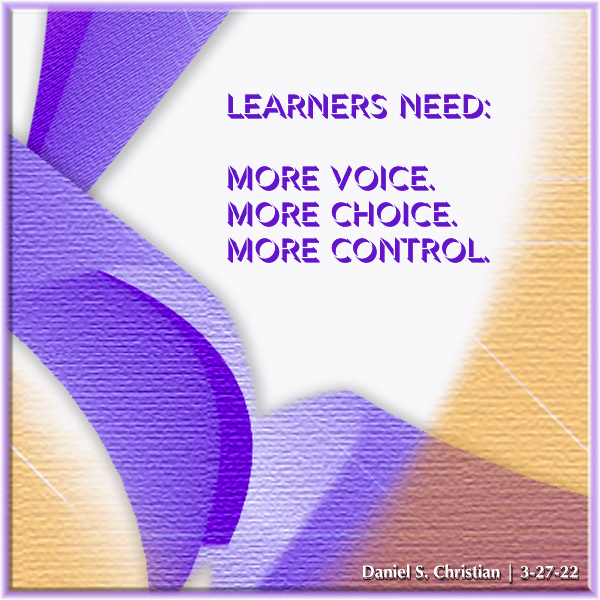
Learners need: More voice. More choice. More control. -- this image was created by Daniel Christian

We need to be more responsive with our curricula. And we need to explain how the information we’re trying to relay is relevant in the real world and will be relevant in their futures.

***

So those are some ideas that I wanted to relay. Thanks for your time and for your shared interests here!


GAO: Accommodations pose challenges to testing companies, test-takers — from k12dive.com by Kara Arundel
The pandemic made it more difficult to provide accommodations for higher ed admission tests, educational testing companies told the government agency.

Excerpt:

Individuals with disabilities and testing companies that administer assessments for higher education admission report challenges regarding testing accommodations, ranging from problems in providing documentation to concerns about maintaining test integrity, according to research by the Government Accountability Office.

Some individuals had difficulty providing adequate documentation to justify their accommodations, according to representatives from six disability advocacy organizations. Officials from five testing companies described hardships in reviewing and granting accommodation requests.


Reinvent Career Services to Create Pathways to Employability — from insidehighered.com by Kerry Fulcher; with thanks to Ryan Craig for this resource
To help students develop career readiness skills and prepare for work, related content should be embedded in coursework, writes Provost Kerry Fulcher.

Excerpt (emphasis DSC):

On the organization front, for practical and symbolic reasons, we created a structure in which the career services function moved out of student life and into academics, now reporting up to me as provost. If equity in student access to career services functions is one of our commitments, there couldn’t be a clearer way of conveying this to all concerned than by housing it in academics.

This shift displays that career services isn’t an afterthought or part of a laundry list of optional add-on student experiences. Rather, by embedding it in academics, it becomes an essential part of what we do, having ramifications for the role of our faculty—and to mine as provost.


The Cardboard Sculptures of Artist Warren King Are an Homage to His Chinese Heritage — from thisiscolossal.com by


Photos Of The Day For June 2022 — from outdoorphotographer.com

A Rare Sighting -- beautiful picture of a bird by Dennis Seeger

Photos of the day for May 2022— from outdoorphotographer.com

Artist Spotlight: Jarid del Deo — from booooooom.com


Addendums on 7/14/22:

Vivid Contours Conjure Hope and Resilience in Yulia Brodskaya’s Quilled Paper Compositions — from thisiscolossal.com

3D Relief Painting — from theawesomer.com


Psalm 34:18

18 The Lord is close to the brokenhearted
    and saves those who are crushed in spirit.


The Post-Covid New Normal is Looking Bipolar — from philonedtech.com by Phil Hill

Excerpt:

I think it is important to deal with evidence on enrollment trends on their own terms and not just in the context of Covid recovery, and not just based on pre-Covid trends. The data we’re seeing recently have some big implications for the health of institutions, for online and hybrid education, and for alternative educational programs (and even alternative scheduling of programs).

The observation that higher education fortunes differ between elites and more open access institutions is not new, but what is becoming clear is that increasing separation cannot be explained away by Covid.


Also relevant/see:

Supporting Students and Faculty in the New Normal — from campustechnology.com by Thomas Hoover, Richard Shrubb, Donna Johnson
As classrooms evolve to accommodate the flexibility and innovation of new learning models, it’s important to provide ample training and resources for all constituents. Here are three key areas to consider.


Education Week -- The Top 7

Excerpt:

The struggle to keep classrooms fully staffed is getting increasingly desperate and it shows in this week’s top stories. A dozen states are amending—or considering amending—their teacher certification rules to expand their teacher pipelines. Districts are using 4-day school weeks as a carrot to draw job applicants. And then there’s emergency certification. In some states, the last-resort practice is becoming business as usual. Some educators wonder if that’s a good idea.

Across the country, policymakers are taking steps to relax their states’ certification requirements to get more teachers in the classroom and circumvent shortages.

Reviews by Education Week and the Education Commission of the States found about a dozen states that have recently amended—or are considering amending—teacher certification rules. Some are changing the criteria for licensure, others are expanding the qualifying score on state licensing tests, and some are dropping licensure tests altogether.

Those changes reflect a teacher pipeline in flux.

Source


Also relevant/see:

  • Principals Are on the Brink of a Breakdown — from edsurge.com by Emily Tate Sullivan
    A recent survey found 85 percent of school principals are experiencing job-related stress and 48 percent are dealing with burnout. What can be done to keep them in their roles?


Adapting L&D programs for the past, present and future — from chieflearningofficer.com by Calvin Coffee

Excerpt (emphasis DSC):

According to LinkedIn’s 2022 Workplace Learning Report, employees ranked learning and growth opportunities as the number one driver of thriving work culture — an increase from ninth in 2019. As demand for learning and development specialists nearly doubled over the last year, the need for successful L&D in organizations is as significant as ever, with new work environments and a massive skills gap looming.

With a massive reshuffling of talent and the increased role of hybrid work due to the pandemic, pools of learners and their skills may be entirely different for learning leaders to understand. “People are signaling satisfaction with their workplace with their feet. Having poor retention is a business problem,” says Laura Roberts, senior director, corporate leadership at Jobs for the Future. One of the best ways to increase employee retention is by simply investing in employees to foster an organizational culture built on growth and training opportunities. 


Public colleges’ operating revenue rose 3.1% in 2021 despite lower net tuition — from highereddive.com by Rick Seltzer

Excerpt:

“This strong performance is unlikely to continue as universities continue to grapple with student affordability issues and enrollment losses, along with inflation affecting labor and other operating costs,” the report said.


Radar Trends to Watch: July 2022 — from oreilly.com
Developments in AI, Metaverse, Programming, and More

Excerpt (emphasis DSC):

The most important issue facing technology might now be the protection of privacy. While that’s not a new concern, it’s a concern that most computer users have been willing to ignore, and that most technology companies have been willing to let them ignore. New state laws that criminalize having abortions out of state and the stockpiling of location information by antiabortion groups have made privacy an issue that can’t be ignored.

Also relevant/see:

 
© 2025 | Daniel Christian