Encourage Learning Over the Summer with Buncee & PebbleGo Create — from rdene915.com by Rachelle Dene Poth

Excerpts:

In each of these, there are opportunities for students to take a close look at the world around them and become curious about learning. Students can connect with things that are happening in the real world.

Another item from Rachelle:

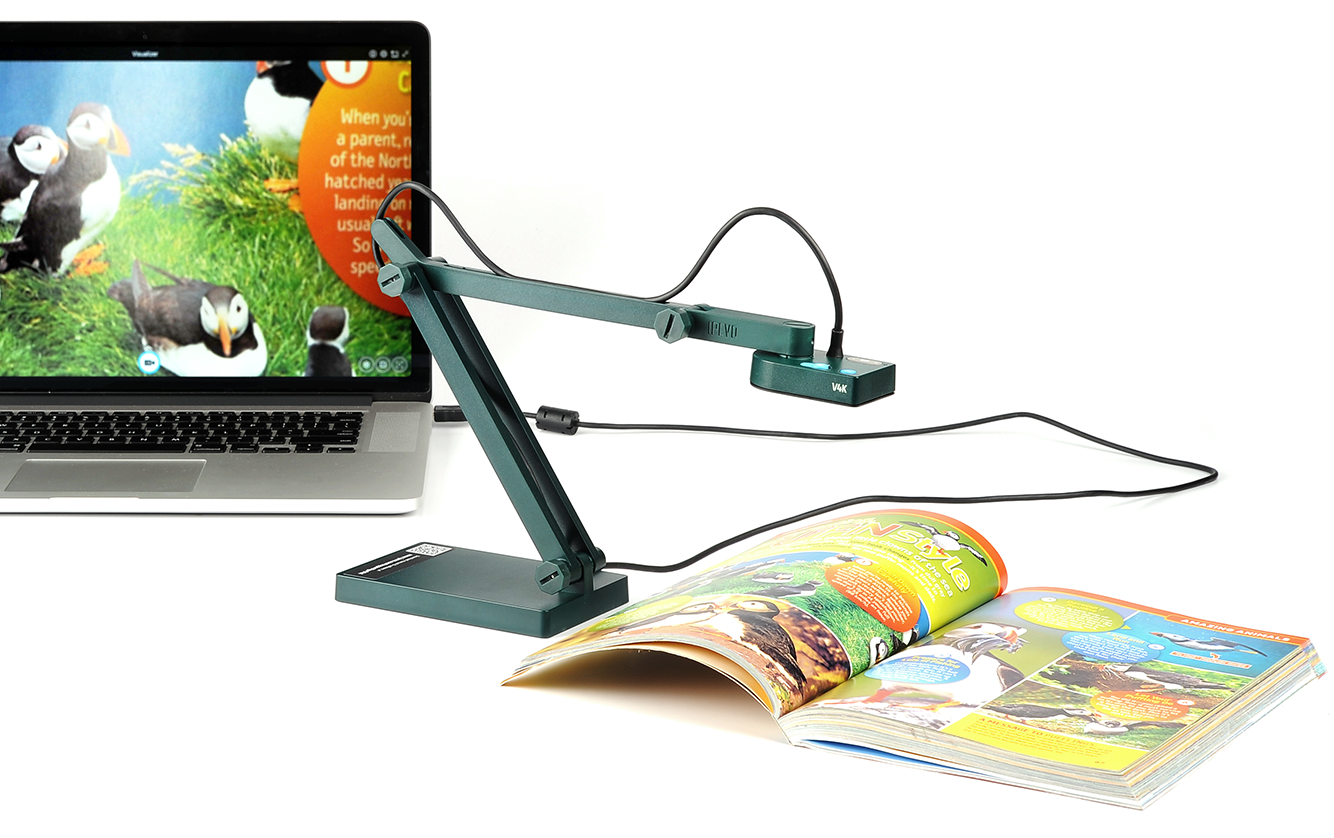
Enhanced Learning with IPEVO!

From DSC:
In my last position, we used IPEVO devices as well. I purchased one for my sister last year as well. They do the job quite well — at a very decent price.


7 Surprising Ways ADHD Shows Up in the Classroom — from additudemag.com by Mark Bertin, M.D., Beverley Holden Johns, Kathy Kuhl
ADHD in the classroom is easy to mistake for carelessness, defiance, laziness, or a learning difference. Here are the 7 ADD symptoms that educators seldom recognize at school — and solutions for each.

Excerpt:

ADHD sometimes manifests in obvious ways — like when a second grader blurts out an answer (again) or when a high school student forgets her completed assignment at home (again). Just as often, though, signs of ADHD in the classroom are more subtle and easily overlooked because they don’t align with stereotypes. Here are seven less-recognized ways ADHD symptoms show up at school, and productive ways to address each one.


Also relevant/see:


How Alternative Credentials Can Help You Find Employees — from shrm.org by Kathryn Tyler
Focus on skills, not degrees, to increase your talent pool.

Excerpts:

“Alternative credentials,” such as the ones Brown attained, are increasingly available in the form of micro-credentials, digital badges and industry-recognized certificates. They’re less expensive than a college degree and designed to help prepare workers for better jobs.

IBM is ahead of the game in many respects. Six years ago, the tech giant began revising its job descriptions to focus on skills and not just educational attainment. On average, 50 percent of the company’s posted positions in the U.S. don’t require a bachelor’s degree.

“We call these ‘new-collar jobs,’ and they’re aligned to careers that require the right set of skills and a commitment to lifelong learning,” says Tommy Wenzlau, talent leader for new-collar initiatives at IBM, which employs more than 250,000 workers globally. “New-collar roles are in some of technology’s fastest-growing fields, including data science, cloud computing, application development, cybersecurity and digital design.”


James 1:19

James 1:19

Listening and Doing

19 My dear brothers and sisters, take note of this: Everyone should
be quick to listen, slow to speak and slow to become angry…


Quiet People in Meetings Are Incredible — from medium.com by Tim Denning
Knowing when not to talk is an art.

Excerpts:

But it’s not all bad. Meetings have taught me one valuable lesson: watch the quiet people.

Job titles make people do stupid things. One of those misdemeanors is talking too much. You can have a title today and have it gone tomorrow.

What ruins business is people that don’t listen. They think they know the market but actually they don’t know anything at all.

The brightest spark in the room says nothing at all. They are there taking notes and paying attention to what is going on. They watch the duel of egos and see no room to interrupt.


From DSC:
The following two items make me wonder how Extended Reality (XR)-related techs will impact theatre, gaming, opera, & other forms of entertainment.


AR Opera Glasses Could Change Broadway Forever — from vrscout.com by Kyle Melnick

Excerpt:

Immersive technology brings the stage to life like never before.

Students from the South Korean Hongik University have developed a pair of reimagined 19th-century opera glasses that utilize AR technology to immerse spectators in Broadway shows in a variety of unique and imaginative ways. The device is compatible with popular shows such as Wicked, Aladdin, Cats, Mamma Mia, and Frozen.

Reddot_Rene from ???/??????? on Vimeo.


What ‘Shakespeare Karaoke’ Teaches About the Virtual Reality Future — from edsurge.com by Rebecca Koenig
Does technology work better as a solo encounter or a group experience?

Excerpt:

To immerse, or not to immerse?

For professors designing virtual reality versions of Shakespeare’s plays, that is the question. The answer(s) may have implications for designing new edtech tools—and VR technology intended to be used beyond the classroom, too.

The Bard’s masterpieces, plays written in the late 1500s and early 1600s, have received all kinds of digital makeovers in the 21st century. Two current efforts designed by academics for use in teaching draw on extended reality tools that invite users to actively participate in scenes from works like “Romeo and Juliet.”

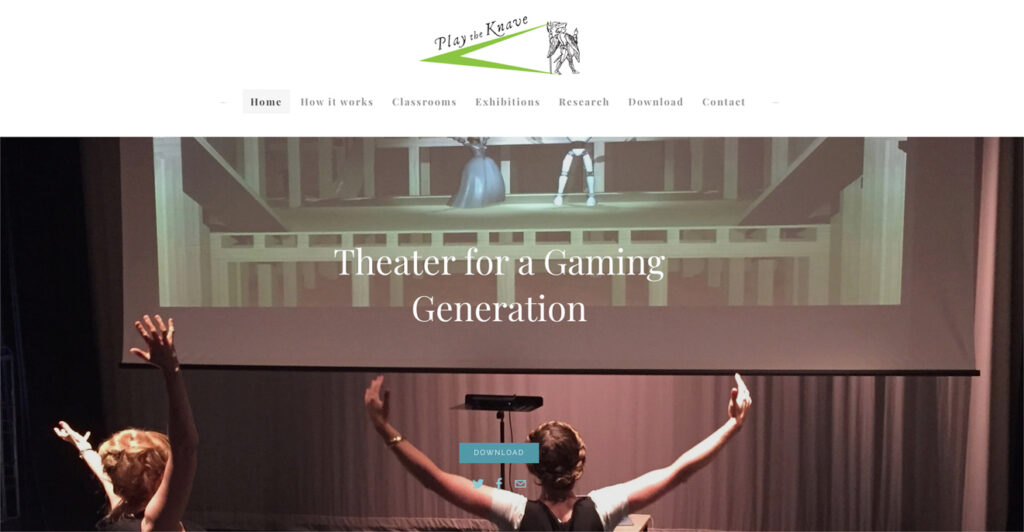
Play the Knave is a video game that helps users design actor-avatars they can direct with their bodies around virtual theater spaces. Shakespeare-VR is a project-in-development that will enable users to don a VR headset, step on to a virtual Elizabethan stage and perform alongside avatars voiced by professional actors.

Play the Knave* is a mixed reality video game that enables virtual design and performance of dramatic scenes from Shakespeare--or any text you choose


Dead Malls and Future Campuses — from insidehighered.com by Joshua Kim
Thoughts on Meet Me by the Fountain: An Inside History of the Mall.

Excerpt:

Can we learn anything about the future of the university from the history of the shopping mall?

If any lessons connecting malls to colleges are to be found, the starting place is Meet Me by the Fountain. It is hard to imagine a more complete social, architectural, cultural, economic or cross-national comparison of shopping malls than this book provides.

For some, all the detail, theorizing and analysis of the mall’s history, relevancy and meaning might be a bit too much. For those looking for clues about how the university might evolve post-pandemic, the deep dive into malls that Meet Me by the Fountain provides is helpful.


Survey Shows Teachers See Play and Choice in Learning Methods As Key to Student Engagement — from thejournal.com by Kristal Kuykendall

Excerpt:

A recent survey of teachers by Kahoot reveals that educators see playful learning and student choice in learning methods as vital to helping boost student engagement and outcomes, according to a new report from the ed tech company.

Kahoot’s May survey of over 8,000 K–16 educators nationwide found that teachers are still concerned about drops in student engagement during the pandemic, and they consider more student-centered approaches as the path forward.


Inside a radical new project to democratize AI — from technologyreview.com by Melissa Heikkilä
A group of over 1,000 AI researchers has created a multilingual large language model bigger than GPT-3—and they’re giving it out for free.

Excerpt:

PARIS — This is as close as you can get to a rock concert in AI research. Inside the supercomputing center of the French National Center for Scientific Research, on the outskirts of Paris, rows and rows of what look like black fridges hum at a deafening 100 decibels.

They form part of a supercomputer that has spent 117 days gestating a new large language model (LLM) called BLOOM that its creators hope represents a radical departure from the way AI is usually developed.

Unlike other, more famous large language models such as OpenAI’s GPT-3 and Google’s LaMDA, BLOOM (which stands for BigScience Large Open-science Open-access Multilingual Language Model) is designed to be as transparent as possible, with researchers sharing details about the data it was trained on, the challenges in its development, and the way they evaluated its performance. OpenAI and Google have not shared their code or made their models available to the public, and external researchers have very little understanding of how these models are trained.

Another item re: AI:

Not my job: AI researchers building surveillance tech and deepfakes resist ethical concerns — from protocol.com by Kate Kaye
The computer vision research community is behind on AI ethics, but it’s not just a research problem. Practitioners say the ethics disconnect persists as young computer vision scientists make their way into the ranks of corporate AI.

For the first time, the Computer Vision and Pattern Recognition Conference — a global event that attracted companies including Amazon, Google, Microsoft and Tesla to recruit new AI talent this year — “strongly encouraged”researchers whose papers were accepted to the conference to include a discussion about potential negative societal impacts of their research in their submission forms.


Hypercompetition Is Harming Higher Ed — from chronicle.com by Julie A. Reuben
Colleges should ease off the branding and remember their shared values.

Excerpt:

Competition has long been viewed as a key to the greatness of the American college. But developments over the last half century have knocked the balance between competition and cooperation out of whack. These changes include rising tuition; the use of merit aid and other discounts to drive enrollment; the increased importance of rankings; soaring student debt; a surge in revenue-seeking activities, such as patenting and corporate partnerships; increases in revenue-containment strategies, such as the use of contingent faculty; and uneven or declining support at the state and federal levels. Researchers have used terms such “privatization,” “market-oriented,” or “neoliberal” to characterize this larger transformation. The pursuit of institutional advantage at the expense of the health of the larger sector is both a consequence and a driver of these changes.

The excessive competition may be bringing the whole system down. As that happens, even the institutions with the strongest brands will suffer.

Leaders are more interested in defining the distinctive qualities of their institutions than in debating what higher education writ large should be.

From DSC:
I like what Julie’s saying, and I agree with much of it. That said, I’m very skeptical that we can achieve this. From the earliest ages, we introduce a great deal of competition to our youth. How fast can you run the 50 or 100 yard dash? What violin chair are you in the school orchestra? What’s your GPA? Where are you on the Bell Curve?

Capitalism — our basic economic system here in the U.S. — further compounds these dynamics.

We focus more on ourselves as individuals than we focus on our communities.

So while I hope we can achieve what Julie’s saying, I’m not optimistic here.


Somewhat related items:


Along the lines of competition, the following item was added on 7/16/22:


17 Best Video Converter Software in 2022 (Free and Paid) — from videoproc.com by Cecilia Hwung

Excerpt:

Looking for the best video converter software? We may need a free or paid video converter for various reasons. For instance,

  • Change videos into different formats for playing on iPhone, TVs, PS4, Xbox, Mac…
  • Convert videos recorded by GoPro, DJI, iPhone, DSLR cameras, or screen captures to editing-friendly format
  • Transcode videos for sending on Discord, Pinterest, Twitter, and other social media without quality loss
  • Share the same video on different platforms with different formats for getting the best outcomes on each platform
  • Convert DVDs (including the new and 99-title DVDs) with favored chapters, subtitles, and languages

Given the fact that hundreds of paid and free video converters out there claim themselves to be powerful, fast, and easy-to-learn while giving no compromise to quality, choosing the best video converter software becomes one of the most frustrating roadblocks you may encounter.

Lucky you are here. We have carefully selected and assembled a list of the best video converter software you can get right now. Most of them are open-source and cross-platform, meaning they are completely free video file converter programs for Windows 11/10/8/7, macOS, Linux, and web.


Optimizing Your Website for Screen Readers and Other Accessibility Tools — from hongkiat.com by Jori Hamilton

Excerpt:

But what is web accessibility, and how, exactly, can you prioritize this on your website?

In this article, we’ll take a closer look at what web accessibility means and tips for how to design a website that is more accessible to all users.


The new labor market: No bachelor’s required? — from hechingerreport.org by Lawrence Lanahan
More workers without degrees are landing jobs they’d have been shut out of before. Will it last?

Excerpt:

Thanks to a tight labor market, more good jobs are opening up to workers who lack a bachelor’s degree. A month after Maryland’s announcement, Colorado Gov. Jared Polis directed government agencies in his state to embrace hiring workers for skills, not degrees. Private sector employers have been rolling back B.A. requirements too.


12 Learning Myths Exposed — from ivypanda.com by IvyPanda; with thanks to Irene Fenswick for this resource

Excerpt:

Many people come to us searching for the answer to the question, “What’s the right way to learn?” First of all, we want to clarify: there is no right or wrong way to study. Still, we can list quite a few misconceptions regarding how the human brain works and what methods can help you memorize material. These are so widespread that it takes time and effort to recognize how unjustified and misguided they are.

That’s exactly how this article will help you.

On this page, we’ve busted all the myths surrounding your learning abilities. Our team has collected all the popular misconceptions about studying and explored why they are inaccurate. Besides, we’ve provided some practical (and time-tested) study tips for you to try out.


Best Sites and Apps for Digital Storytelling — from techlearning.com by Diana Restifo
Digital storytelling can help boost communication and presentation skills

Excerpt:

…storytelling is a great way for kids to learn to love reading and writing. But almost any school subject can be considered through a dramatic frame, from history to geography to science. Even math can be taught through narrative (word problems, anyone?). Most importantly, storytelling gives kids the opportunity to be inventive with language, graphics, and design, and to share their creations with others.

The following sites and apps for storytelling range from basic to advanced. Many are designed for educators or include guides for use in education. And while most are paid products, the prices are generally reasonable and nearly every platform offers a free trial or free basic account.

6 best classroom noise meters for teachers — from educatorstechnology.com by Med Kharbach

Excerpt:

One of the effective ways to monitor and reduce noise levels in classrooms is by making noise visible. Enabling students to visualize their noise raises awareness to their sound levels and makes them noise conscious. There are several noise meter tools and apps to use in your classroom to bring down students noise and therefore help in creating optimal learning experiences. Below is a collection of some of the best noise meters for classroom use.  They are simple, easy to use, and cost-effective.

Digital age classroom projects — from thetechedvocate.org by Matthew Lynch

Excerpt:

Classroom learning today has left the era of flipping through textbooks trying to be on the same page with the teacher, though not for every class lesson. Educators today are seizing the opportunities of digital devices and media to expand learning opportunities beyond pencil and paper homework. Also, assessment is not just a multiple-choice test.

Consider trying one of these projects:

The Education of Incarcerated Youth with Disabilities Ep.14 — from edcircuit.com

Excerpt:

The School Justice Project (SJP) champions an extremely vulnerable population: incarcerated youth with disabilities. The SJP’s mission is to ensure every learner, in or out of prison facilities, receives the education they were promised and deserve. Their current class action lawsuit against the DC prison system underscores the impact of their efforts. Featured guest, Claire Blumenson, pulls no punches as she forces us to look, and not to look away, in this pivotal moment.

We are educators, parents, siblings, and friends who aren’t satisfied with the quality of the content our students are exposed to. We know they deserve better, and are committed to bringing authentic, engaging, diverse and accessible content to all learners.
Business Leaders Say Computer Science Needs to Be A Core Subject — from edsurge.com by Daniel Mollenkamp

Excerpt:

[On July 12], a collection of more than 500 prominent business, education and nonprofit leaders called on states to update their K-12 curriculum to make computer science a core subject.

In a letter sent to governors from all fifty states, they write, “computer science provides an essential foundation—not only for careers in technology, but for every career in today’s world,” and call upon state leaders to update curriculum to ensure that all students have an opportunity to learn computer science in school.

What is Microsoft Sway and How Can it Be Used to Teach? Tips & Tricks — from techlearning.com by Luke Edwards
Microsoft Sway is a presentation tool that works really well for teaching

Excerpt:

Microsoft Sway is the company’s alternative to PowerPoint as a presentation tool that embraces collaborative working. As such, this is a powerful system for teachers and students to use in the classroom and beyond.

The idea behind Sway is to offer a super simple setup that allows anybody to create presentation slideshows. This makes it good for both younger students and teachers for in-class or online-based presenting.


For a somewhat related item, see:

Exploring some different instructional strategies and discovering how to incorporate them into the classroom process can rekindle a love affair with teaching. Finding the right instructional strategy to fit your classroom can make a world of difference to your students by allowing them to make meaningful connections with what they are learning. Take a look at a few different strategies, and see which one might suit your students this academic year.


© 2025 | Daniel Christian