24 Tips for Dorm Living — from custom-writing.org; with thanks to Julia Reed for this resource

Excerpt:

Dorms become like a second home to many students during their university experience. And while dorm life can mean making new friends and having exciting adventures, adjusting to new routines is not always easy. Since most students who come to the dorms have no prior experience living outside their parents’ homes, the reality of taking care of themselves and sharing space with strangers can be overwhelming.

Nevertheless, that doesn’t mean that dorm life has to be a total culture shock. This list of excellent tips compiled by Custom-Writing.org will help you settle in and make the most out of your student life.


Addendum on 8/13/22:

Lisa L. Lewis on the Sleep-Deprived Teen — from gettingsmart.com

Key Points

  • Middle and high school should start no earlier than 8:30 a.m. This is just one factor in the life of the sleep deprived teen, but it is a policy issue.
  • California will become the first state with a start school later policy.


States Crack Open the Door to Teachers Without College Degrees — from edweek.org by Madeline Will

Excerpt:

As states brace for the potential for starting the school year with thousands of unfilled teacher vacancies, several are easing certification requirements. But Arizona and Florida have gone one step further by lifting the requirement that teachers hold bachelor’s degrees in certain instances.

From DSC:
You can probably guess where I’m going to go with my comments here…and you’re right.

Teaching is extremely hard. To do it well, one has to have a lot of knowledge and practice. I, for one, would not want to be thrown into the deep end of teaching without a fair amount of background knowledge and experience. 

Even highly experienced teachers can’t do it all. Even they can’t provide a personalized, customized education for 25-30 students at a time — each and every day. Even they can’t address a spectrum of abilities and paces of learning. They are operating within a system whereby the train leaves at specific times and travels at a specific pace and then stops at specific times.

K-12 education in America is a like a quickly moving train that stops for no one.

I hope the experiment works and that it can diversity the profession — and be open to trying different things in different ways — as proponents assert. But I must admit that I’m a bit skeptical here.

I’d rather see the system change than try to make the existing system work with different people. I do like what Tonya Strozier said:

“If we want something different, we’ve got to do something different,” Strozier said.

Which reminds me of what Kelly Niccolls said out this piece from GettingSmart.com:

I’m hopeful for the rebuilding of what can be and for the doors that open for folks with skill sets that otherwise have been ignored or devalued. These skills are what we need now for these new times.

Kelly Niccolls


Also relevant/see:


Anxiety and learning: What you need to know — from raisinglifelonglearners.com by Colleen Kessler

Excerpt:

An anxious kid is an anxious kid and that anxiety permeates every part of their lives. It goes through and touches everything. This means it’s not easy to separate the stress, anxiety, and perfectionism from the situation.

Specifically, when it comes to learning, we are going to focus less on what’s causing the anxiety and focus instead on how we can address it in educational settings.

Today, I share my own best tips and resources for helping your child. This episode includes things you can begin today, to help your anxious child.


The future of learning: Co-creating skills development strategies with employee preferences — from chieflearningofficer.com by Stacey Young Rivers
The limitations of developing just-in-time learning strategies perpetuate a paradigm where learning and development can appear ineffective for teams that have to move quickly and fail fast.

Excerpt:

I believe the future of learning will be a system where employees and learning teams co-create experiences. No longer will skills development programs be created in silos for employees to consume. Gone will be the days of conducting exhaustive needs analysis that can add layers of complexity for program delivery.

The limitations of developing just-in-time learning strategies perpetuate a paradigm where learning and development can appear ineffective for teams that have to move quickly and fail fast. Thinking about how to overcome these challenges conjures a solution similar to a metaverse, a persistent virtual world that is always open. One value proposition of a metaverse is that everyone can create their own adventure in an ecosystem supporting curiosity and experimentation, two areas undergirding skills development.

With this lens, understanding employee preferences for learning is the beginning of co-creating experiences, and one approach for how L&D leaders can begin to structure skills development programs. While conducting a study to engage employees in training, we uncovered new insights into where corporate L&D is headed in the future.

Also relevant here, see:

Workplace Learning: Still a Mess — from eliterate.us by Michael Feldstein

Excerpt:

There’s a mantra these days that higher education needs to get better at listening to industry so they can better prepare students for work. And while there is definitely some truth to that, it assumes that “industry” knows what it needs its workers to know. Former HP CEO Lew Platt once famously said, “If only Hewlett Packard knew what Hewlett Packard knows, we’d be three times more productive.”

In other words, a lot of vital know-how is locked up in pockets within the organization. It doesn’t reach either the training folks or the HR folks. So how are either universities or EdTech professional development companies supposed to serve an invisible need?

It’s not that they don’t know how to learn or they don’t like to learn online. It’s because their experience tells them that their valuable time spent “learning” might not equate to actual skills development.


Addendum on 8/15/22:


Radar Trends to Watch: August 2022 — from oreilly.com by Mike Loukides
Developments in Security, Quantum Computing, Energy, and More

Excerpt:

The large model train keeps rolling on. This month, we’ve seen the release of Bloom, an open, large language model developed by the BigScience collaboration, the first public access to DALL-E (along with a guide to prompt engineering), a Copilot-like model for generating regular expressions from English-language prompts, and Simon Willison’s experiments using GPT-3 to explain JavaScript code.

On other fronts, NIST has released the first proposed standard for post-quantum cryptography (i.e., cryptography that can’t be broken by quantum computers). CRISPR has been used in human trials to re-engineer a patient’s DNA to reduce cholesterol. And a surprising number of cities are paying high tech remote workers to move there.


The Metaverse Is Not a Place — from oreilly.com by Tim O’Reilly
It’s a communications medium.

Excerpt:

Foundations of the metaverse
You can continue this exercise by thinking about the metaverse as the combination of multiple technology trend vectors progressing at different speeds and coming from different directions, and pushing the overall vector forward (or backward) accordingly. No new technology is the product of a single vector.

So rather than settling on just “the metaverse is a communications medium,” think about the various technology vectors besides real-time communications that are coming together in the current moment. What news from the future might we be looking for?

  • Virtual Reality/Augmented Reality
  • Social media
  • Gaming
  • AI
  • Cryptocurrencies and “Web3”
  • Identity

#metaverse #AI #communications #gaming #socialmedia #cryptocurrencies #Web3 #identity #bots #XR #VR #emergingtechnologies


Women in Tech: A Complete Guide — from techguide.org by Vasilia Niles

Excerpt:

This guide is all about how to get more women in tech. First, we will examine why the gender gap in tech fields exists and what we can do about it. And then, we will take a look at the best way to find opportunities for women interested in science, technology, and engineering — including scholarships, internships, and employment opportunities all geared toward the most cutting edge fields.

Closing the gap in tech is important for many reasons. Firstly, women make up 40 percent of the US workforce. With the tech industry being the fastest growing sector and others rapidly shrinking, there will be a disparity between supply and demand for employees if this continues. This is already the case in some tech sectors like cybersecurity.

Secondly, women-led companies and companies with more female employees historically outperform by 3x ones that are male dominant. In fact, in companies where 50 percent or more of executives are women, there are reported higher job satisfaction, better work culture, equal and higher pay, and less female employee turnover. 


10 in-demand soft skills to supercharge your career — from fastcompany.com by Melissa Rosenthal
Your résumé and experience may get you through the door, but these soft skills could help you clinch the job.

Excerpt:

A LinkedIn Global Talent Trends report shows that 92% of talent professionals reported that soft skills are equally or more important to hire for than hard skills. The same study reveals that 89% surveyed said that when a new hire doesn’t work out, it’s because they lack much-needed soft skills.

The hard truth about hard skills is that they can have a short half-life. Constant innovation, technology updates, and new feature releases render many of these skills obsolete quickly. Meanwhile, soft skills never expire—they are relevant, transferable, and keep a person highly employable.


Online Learning, From the Margins to the Center — from insidehighered.com by Ray Schroeder
Online learning has evolved over the past 25 years from a niche position on the margins of higher ed to the leading driver of growth in enrollment and innovation.

Excerpt:

Online learning has grown from a marginal niche of higher ed to the largest provider of postsecondary learning in the world. We are now on the cusp of yet another technological evolution in the delivery of online learning. The advent of the metaverse in higher education is closer than many casual observers may think. By 2025, we will begin to see significant numbers of offerings using avatars and immersive technologies such as virtual reality, augmented reality and extended reality engaging learners at a distance.

Do you have developmental immersion laboratories for your faculty and staff to prepare for 2025? Who at your university is advocating for the integration of VR, AR and XR into online delivery? Are you already collaborating with industry and business in developing the most effective and relevant technology-enhanced online programs that will meet their needs? Those who lead in these ventures will set the standards and gain the recruiting advantage in higher education.


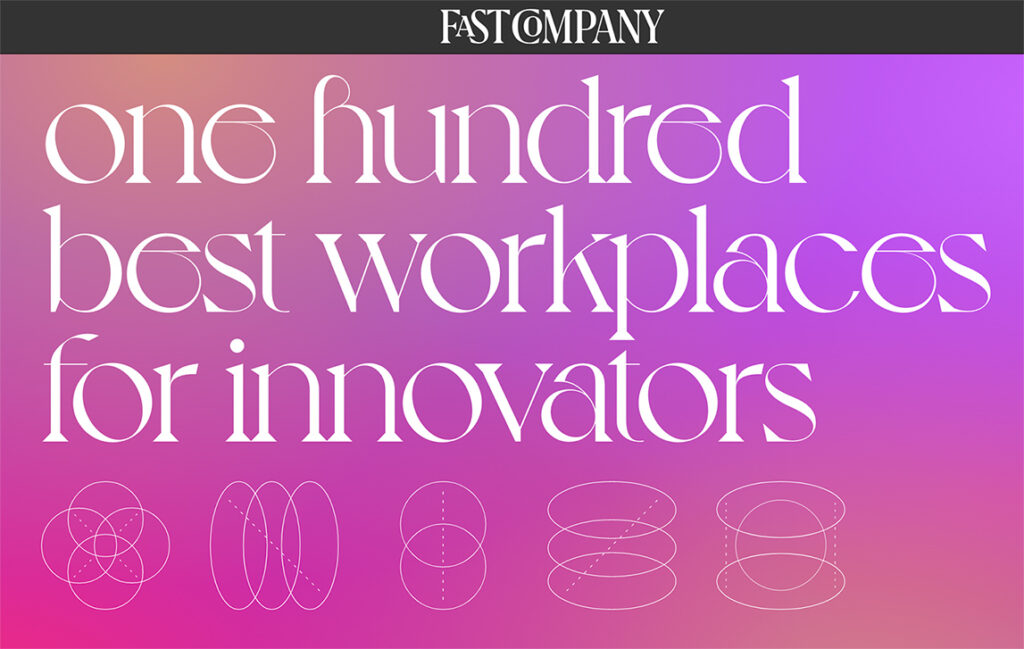
one hundred best workplaces for innovators -- from fastcompany dot com

one hundred best workplaces for innovators — from fastcompany.com

Excerpt:

In this era of distributed workforces and mass attrition (the so-called Great Resignation), our fourth annual Best Workplaces for Innovators list highlights more than 100 companies that energize employees by rewarding creativity wherever it arises. The venerable toy giant Mattel operates a “virtual garage platform” that allows workers at any level to pitch new concepts, while Maverick Quantum, a Texas-based artificial intelligence platform, goes one step further, soliciting ideas not only from employees but also from their family members. “These innovative organizations have cultures that offer meaningful employee engagement, and a chance to change the world,” says Paul Daugherty, group chief executive of Technology and CTO at Accenture, Fast Company’s research partner on Best Workplaces for Innovators.

One of the articles in this series is at:

Best Workplaces for Innovators 2022: Innovation Team of the Year — from fastcompany.com by Jay Woodruff
A group of Alaska Airlines employees take top honors.

Excerpt:

Whether focused on microscopic computer chips or cement trucks full of concrete, these six teams stood out to Fast Company judges for devising innovative solutions to global problems.


The edtech top 50 — emerging companies for higher education — from medium.com by Nic Newman (back from June 27, 2022)


Two Years After Promising a ‘Transformational’ Partnership, the U. of Arizona and Zovio Part Ways — from chronicle.com by  Dan Bauman

Excerpt:

The University of Arizona Global Campus announced on Monday it would take over management of its online education programs from Zovio Inc. — the same company that two years earlier transferred its for-profit college holdings to the University of Arizona in what was touted then as a “transformational” agreement.

The news marks a precipitous end for the original deal, Arizona acquired Zovio’s Ashford University in 2020 and created the University of Arizona Global Campus, a nonprofit organization affiliated with the traditional public university.

The article links to “An Open Letter from Paul Pastorek” (President of the University of Arizona Global Campus) — from uagc.edu

Excerpt:

As an institution, this new chapter reflects our belief that our mission demands that the governance and control of critical functions, in particular enrollment, marketing, student advising, and financial aid, rest exclusively with UAGC leadership. It is grounded in a conviction that outsourcing such functions is inherently at odds with our aspirations and desired outcomes. Placing all of our services under one roof, we believe, will increase efficiency, reduce costs, and is a necessary precondition to making good on our commitments to our students.


Impatient for workers, businesses help students take college shortcuts — from hechingerreport.org by Lilah Burke
Employers and states are adding faster-paced skills training for people who want to forgo college

Excerpt:

It’s part of an accelerating movement of noncredit, short-term training programs, not just in technology, but in many fields for which students are impatient for jobs and employers for workers who want to leapfrog their way to careers — and do it without necessarily spending the years and money it takes to earn a university degree.

These are among the ways “employers are creating the solutions they need in order to deal with their talent demands,” said Bridgette Gray, chief customer officer at Opportunity@Work, a nonprofit that encourages employers to hire more people without degrees.

Now some companies, motivated by a mix of corporate social responsibility and the need for talent, are edging toward a new model in which they create their own, or hire from other, training programs.


2U announces layoffs and new approach to tuition-share agreements — from highereddive.com by Natalie Schwartz
The online program manager expects the restructuring will lead to about $70 million in annual cost savings.

Excerpt:

2U announced across-the-board layoffs and changes to its business strategy on Thursday, as it reorients the company around edX, a prominent MOOC platform it acquired last year.

2U officials announced the company is updating this part of the business model, saying it will offer tuition-share agreements starting at 35% of a program’s revenue — with higher rates available to colleges that want more services.


25 Best Parks In The United States — from htownbest.com by Anna Smith; with thanks to Apple Smith for this resource

Excerpt:

There’s something about national parks that make you feel so in touch with nature. It’s also a fantastic place to bond and spend time with friends and family over fun activities like hiking, swimming, fishing, and biking.

In this article, we listed down the best parks you can find in the country along with helpful descriptions to help you find the best ones for your needs and preferences.

This guide is for couples looking for a grand adventure, families that are looking for a fun vacation, hikers in search of their next trail, and just anyone who’s curious and wants to know more about the top national parks you can find here in the United States.


Bryce Canyon National Park; Image from: Utah National Park Trips Image from: Utah National Park Trips

 
© 2025 | Daniel Christian