New Salary Survey to Showcase the Promise of Horticulture Careers | Industry Participation Needed!— from research.seedyourfuture.org; with thanks to Jazmin Albarran for this resource

Excerpt:

Alexandria, VA – September 1, 2022 – Seed Your Future (SYF) and the American Floral Endowment (AFE) are launching an in-depth survey that promises to shed light on the salary potential in horticulture jobs. The Industry Salary Survey for Horticulture Sectors is designed to expand the understanding of wages and benefits in horticultural sectors ranging from floriculture, public gardens, garden centers, and landscape to fruits and vegetables.

“As Seed Your Future continues to work to promote horticulture careers to students and their families, we often run into a roadblock — the perception that all horticulture and related sector jobs are low paying,” says Seed Your Future Executive Director, Jazmin Albarran. “While entry-level positions, can be low paying, there are many more horticulture and horticulture-related careers that have robust salaries. This survey will give us a better understanding of which positions are providing living wages and higher.”

Culinary school enrollment drops even as need soars at restaurants — from washingtonpost.com


What role do CFOs play in the Great Resignation? — from chieflearningofficer.com by Keith Keating

Excerpt:

People are unhappy with their jobs, opportunities and employers’ treatment. Many feel constricted and unable to advance their careers because their companies fail to provide efficient learning and development programs. According to a McKinsey report, 41 percent of employees said the lack of opportunity for professional progress was the principal reason they left.

Their workplaces had no room for personal or career growth, forcing them to look elsewhere. Moreover, 94 percent said they wouldn’t resign their jobs had their employers invested in learning and development.

That is a grave problem. Gallup’s 2021 report found that turnover costs one trillion dollars to U.S. businesses per year.

Would companies be able to prevent this issue if their chief financial officers took L&D programs more seriously?

From DSC:
That seems like a very solid question to me.


Also relevant/see:

Succession Planning Requires Continuous Learning Culture — from learningsolutionsmag.com by Pamela Hogle


An AI-generated artwork’s state fair victory fuels arguments over ‘what art is’ — from theverge.com by James Vincent; with thanks to Paul Czarapata for this resource on Twitter
I’m not going to apologize for it,’ said the man who submitted the piece
.

Excerpt:

A game designer has sparked controversy after submitting an image created by an AI text-to-image generator to a state art competition and taking home first prize.

Jason Allen entered the artwork titled “Theatre d’Opera Spatial” in the “Digital Arts / Digitally-Manipulated Photography” category of the Colorado State Fair fine arts competition but created the piece using a popular text-to-image AI generator named Midjourney.


ABA cleans up accreditation rules surrounding distance education for law schools — from highereddive.com by Lilah Burke

Dive Brief (emphasis DSC):

  • Recent amendments to American Bar Association accreditation standards addressed definitions of distance education, but Leo Martinez, immediate past chair of the ABA Council for the Section of Legal Education and Admissions to the Bar, says the resolution won’t change much for law schools without waivers allowing them to conduct extra distance education.
  • The changes, made at the ABA’s annual meeting in August, were meant to clarify language in accreditation standards.
  • The ABA, which serves as the accreditor for 199 law schools and programs, requires waivers for institutions that want to offer more than one-third of J.D. program credits online. But it remains interested in reviewing distance education.

From DSC:
For an industry in the 21st century whose main accreditation/governance body for law schools still won’t let more online learning occur without waivers…

…how can our nation expect future lawyers and law firms to be effective in an increasingly tech-enabled world?

Here’s the pace of change in the world today:

The exponential pace of change is like warp speed for the U.S.S. Enterprise (Star Trek) or the hyperdrive on the Millennium Falcon (Star Wars).

Yet here’s the pace that the American Bar Association (@ABAesq) has been taking — and continues to take — at least in the area of supporting online-based learning as well as in developing sandboxes/new methods of improving access to justice (#A2J):

.

It’s high time the ABA did their research re: online-based learning and majorly picked up their pace. Undergraduate online-based education started back in the late 1990’s for crying out loud! (And the number of students taking one or more of their courses completely online has been increasing ever since that time.)

Plus, many law school students are adults who have jobs as well as families. They often don’t have the time nor the money to travel to campuses in order to take part in something that they could have easily accomplished online.

It’s also appropriate to recognize here that the current learning ecosystems out there continue to move more towards hybrid/blended learning models as well as a hyflex model. 

The ABA is not serving law school students nor our citizenry well at all in this regard.


Learning by Scientific Design podcast, Ep. 4: Empowering educators & elevating the teaching profession — from by Deans for Impact

Description of podcast:
Learning by Scientific Design is a podcast series by Deans for Impact that explores how an understanding of cognitive science, or the science of how students learn, can lead to more rigorous, equitable and inclusive teaching.

How can the growing adoption of learning science in teacher preparation contribute to systemic change in U.S. education? In this episode, you’ll hear from:

  • Louise Vose, Adjunct Professor, School of Education, Endicott College
  • Peter Fishman, Vice President of Strategy, Deans for Impact
  • Leah Brown, Assistant Professor, School of Education, University of Alaska Fairbanks

From DSC:
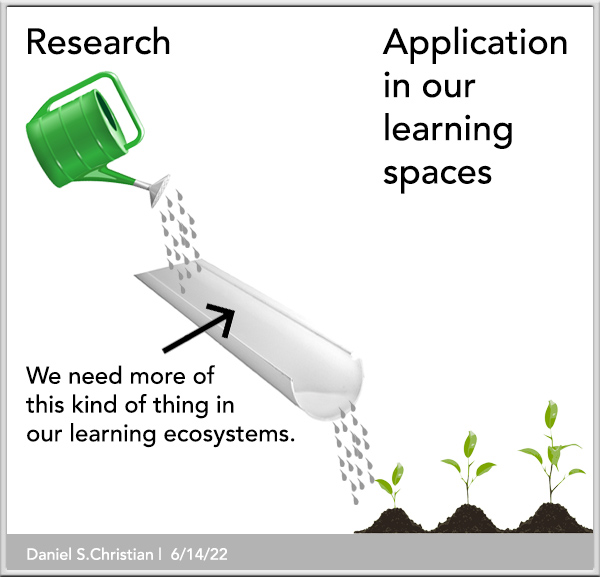
This podcast reminds me of the graphic (below) that I created not too long ago…

We need to take more of the research from learning science and apply it in our learning spaces.

.


Also see:

.


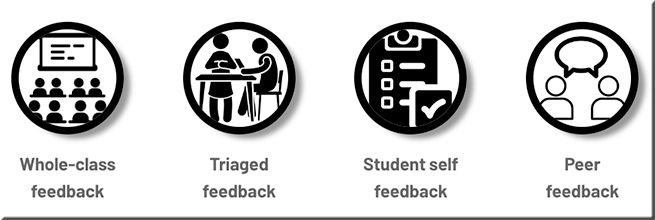
How do I give feedback to 100+ students? — from ditchthattextbook.com

Excerpt:

How do we modify our instructions to meet ALL of their needs? How do we make the most of our time and theirs?

That’s what we want to tackle with you.

As part of the EfficienTEACH project, we are looking at assessment and the feedback we can provide in the most manageable, effective and efficient way possible.
.

Table of Contents


Also see:


The Decomposition of School and Regeneration of Learning — from gettingsmart.com by  Maggie Favretti

Key points

  • Industrial schooling has been smelling funky for a while.
  • The fragmentation of time prevents deep learning.
  • Splitting school off from ‘real life’ undermines meaning and purpose.

5 Strategies for a Successful Start to the School Year — from gettingsmart.com by Abby Dorsey

Key Points:

  • AVID principles can be applied across grade levels and subjects to empower students to meet their goals.
  • The following five AVID strategies can help you ensure a successful start to the school year for students and educators on your campus.
 

No one in higher ed is fixing this overlooked crisis for instructors — from highereddive.com by Nina Huntemann
Adjunct faculty members are struggling. It’s time to treat them like the valuable contributors they are, writes Chegg’s chief academic officer.

Excerpt:

In higher ed, it is a much-discussed but little addressed fact that many higher-education faculty in the U.S. are paid below the poverty line. Approximately one-fourth of the instructors teaching at U.S. colleges and universities are earning less than $25,000 per year, though the median household income in our country is approximately $67,000, according to 2020 data from the U.S. Census Bureau.

Those outside the higher ed space often assume most faculty members in the U.S. are tenured or on a tenure track, with “jobs for life” and a comfortable income; however, this is far from reality. The fact is that contingent faculty, those who hold non-tenure-track positions and often work on annual or semester-by-semester contracts, comprise 75% of all faculty positions, according to the American Federation of Teachers.


A New Initiative to Tackle Education’s Big Problems — from the74millioin.org by Andrew J. Rotherham
Rotherham: For all the rhetoric around ‘reimagining’ and ‘reinventing’ schooling, there’s precious little to show for it. There’s another way

Excerpt:

Instead, experts operate in silos to find solutions, reform and pandemic fatigue abound, and dysfunctional reactionary politics define various debates.

Beta by Bellwether, [which launched on 8/31/22], is a new initiative bringing viewpoint- and background-diverse experts together to tackle big problems and develop blueprints, strategies and tools that can help communities address structural educational problems. We’re building on our 12 years of work at Bellwether bridging policy and practice with a perspective that should be mundane but in this climate seems radical: the belief that the best ideas often lie between different perspectives and are strengthened through serious debate. No faction owns solutions, good ideas or virtue.
Bellwether Beta -- A New Initiative to Tackle Education’s Big Problems

Bellwether.org 

From DSC:
This is something to keep on your K-12 learning ecosystems radar.
Bellwether dot org -- something to keep on your K-12 learning ecosystems radar


Also see:

National Microschooling Center launches, proving ‘modern one-room schoolhouse’ is no flash-in-the-pandemic phenomenon — from reimaginedonline.org by Tom Jackson

Excerpt:

Writing for the Manhattan Institute, researcher Michael McShane lays out the framework and the appeal of microschools:

Neither homeschooling nor traditional schooling, [microschools] exist in a hard-to-classify space between formal and informal learning environments. They rose in popularity during the pandemic as families sought alternative educational options that could meet social-distancing recommendations.

But what they offer in terms of personalization, community building, schedules, calendars, and the delivery of instruction will have appeal long after Covid recedes.

Long-time education choice advocate Don Soifer concurs.

“For whatever reason, families are just rethinking the public education system,” he says. “The research is telling us now that microschooling serves 2-1/2 to 3-1/2 million learners as their primary form of education.”


Also see:


Learning Pods Are Here, Are You In? — from schoolchoiceweek.com by National School Choice Week Team

Excerpt:

If you’ve stumbled into an education conversation or joined a parent discussion group recently, you’ve surely heard of pods or micro-schools. As families grapple with a changing education environment, some hope to find the flexibility, safety, and community they desire in small, local learning arrangements called learning pods. Whether you have your heart set on joining a pod or just want to better understand education choices for your child, we’ve broken down all types of pandemic pods here.


Fresh Resources for Web Designers and Developers (August 2022) — from hongkiat.com by Thoriq Firdaus

Excerpt:

The front-end development is fast changing, with new things to explore every month. There’s always a new methodology, approach, and framework introduced in the web development world that you need to update yourself with.

In this edition of the series, we’ll feature some frameworks and resources for web designers, testing tools, and a lot more. If you are a front-end developer or designer, I’m pretty sure you’ll love what we have on the list. Let’s take a look.


The Multidisciplinary Approach to Thinking — from fs.blog by Peter Kaufman; with thanks to Robert Ferraro for this resource

Excerpt:

Peter Kaufman is one of the most successful businessmen of our time, and yet few people have ever heard of him. He’s the CEO of Glenair, an aerospace company based in California, and the editor of Poor Charlie’s Almanack, a book about Charlie Munger.

This speech was to the California Polytechnic State University Pomona Economics Club. The transcript and audio are reproduced here with the permission of Peter Kaufman.

As with many “conversational” talks given without notes, it’s better to listen to the audio to pick up on subtleties that won’t come across in the lightly edited transcript.

There is a simple takeaway. Using a true multidisciplinary understanding of things, Peter identifies two often overlooked, parabolic “Big Ideas”: 1) Mirrored Reciprocation (go positive and go first) and 2) Compound Interest (being constant). A great “Life Hack” is to simply combine these two into one basic approach to living your life: “Go positive and go first, and be constant in doing it.”


How to Use Edtech to Engage Introverted Learners — from edsurge.com by Stacey Roshan

Excerpts:

But we can leverage technology to create more equitable and empowering forums for discussion—to shift from a culture that praises the first person to raise their hand, to one where every individual has a platform to make their ideas seen and heard. I’m talking about using simple web apps.

As an introverted perfectionist who needed time to process and formulate a response before I was ready to share, I began to confuse faster with smarter. Because I saw my peers answering more questions than I was in class—and getting praised for it—I struggled to feel like I measured up.

And so, as a math teacher, it has become my mission to find ways to spotlight all of the unique voices and personalities in my classroom, and to celebrate the diverse approaches students choose to share, rather than valuing one.


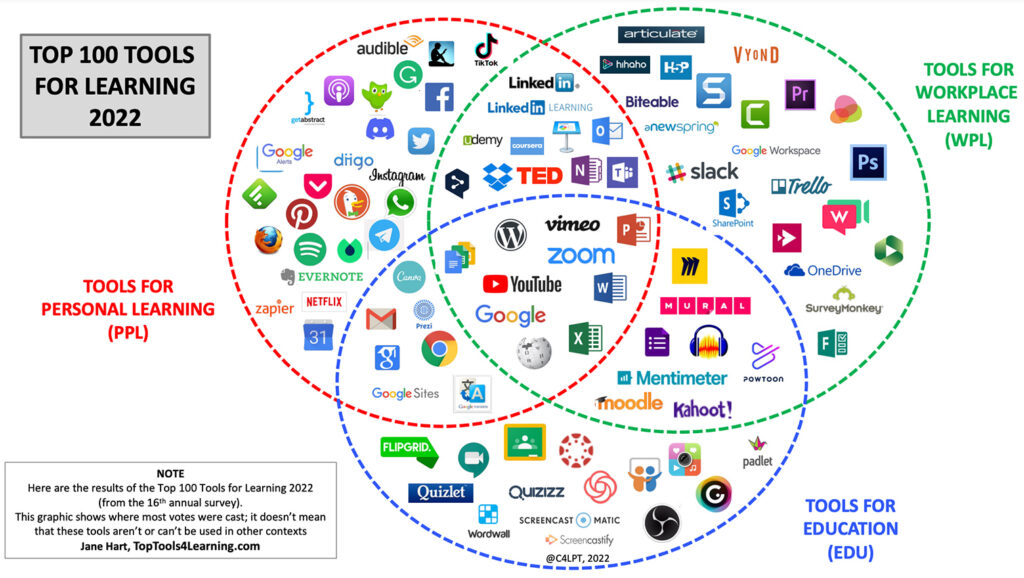
Top Tools for Learning 2022 [Jane Hart]

Top Tools for Learning 2022


Top tools for learning 2022 — from toptools4learning.com by Jane Hart

Excerpt:

In fact, it has become clear that whilst 2021 was the year of experimentation – with an explosion of tools being used as people tried out new things, 2022 has been the year of consolidation – with people reverting to their trusty old favourites. In fact, many of the tools that were knocked off their perches in 2021, have now recovered their lost ground this year.


Also somewhat relevant/see:


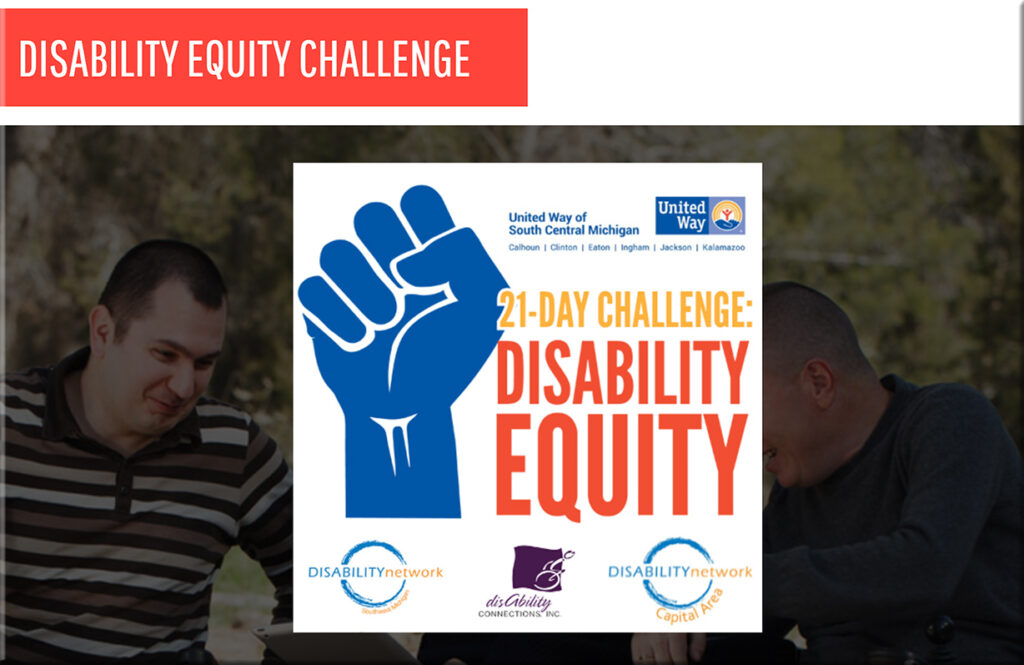
The 21-day challenge for disability equity -- offered by the United Way of South Central Michigan

To view previous content, click HERE.
Also see the following resources from this challenge.

Below are some local and general resources related to disability justice and advocacy that may be helpful. There is a Disability Network or Center for Independent Living serving all of the counties in the state of Michigan. You can find the office that covers your area by going to https://dnmichigan.org/

If you have questions about the information in this 21 Day Challenge, please contact Disability Network Southwest Michigan.


Michigan Resources


  • Find your local Disability Network or Center for Independent Living: https://dnmichigan.org/ 
  • Disability Rights Michigan is the independent, private, nonprofit, nonpartisan protection and advocacy organization authorized by Federal and State law to advocate and protect the legal rights of people with disabilities in Michigan: https://www.drmich.org/ 
  • Michigan Disability Rights Coalition cultivates disability pride and strengthens the disability movement by recognizing disability as a natural and beautiful part of human diversity while collaborating to dismantle all forms of oppression: https://mymdrc.org/
  • Self-Advocates of Michigan is an advocacy organization comprised of people with developmental disabilities and intellectual disabilities, working together to make a difference: https://selfadvocatesofmichigan.wordpress.com
  • The Arc promotes and protects the human rights of people with intellectual and developmental disabilities and actively supports full inclusion and participation in the community. https://arcmi.org/.

General Resources


  • Americans with Disabilities Act information and technical assistance: www.ada.gov
  • Disability is Natural is a source for new ways of thinking about disability and moving beyond the status quo: www.disabilityisnatural.com
  • Job Accommodation Network is a one-stop web page to get information regarding accommodations at work and advocating for disability rights in the workplace: www.askjan.org
  • Disability Scoop is the nation’s premier source for developmental disability news and information: www.disabilityscoop.com
  • Rooted in Rights tells authentic, accessible stories to challenge stigma and redefine narratives around disability: www.rootedinrights.org
  • Autistic Self Advocacy Network (ASAN) serves as a national grassroots disability rights organization for the autistic community, advocating for systems change and ensuring that the voices of autistic people are heard in policy debates and the halls of power: www.autisticadvocacy.org
  • Sins Invalid promotes leadership opportunities for people with disabilities within our communities and within the broader social justice movement: www.sinsinvalid.org
  • The Disability Visibility Project is an online community dedicated to creating, sharing, and amplifying disability media and culture: https://disabilityvisibilityproject.com/
  • The National Association of the Deaf is the nation’s premier civil rights organization of, by and for deaf and hard of hearing individuals in the United States of America: https://www.nad.org/
  • The National Council on Independent Living is the longest-running national cross-disability, grassroots organization run by and for people with disabilities: https://ncil.org
  • National Federation of the Blind is the oldest and largest nationwide organization of blind Americans. The National Federation of the Blind is continuously working toward securing full integration, equality, independence, acceptance, and respect for all blind Americans: https://nfb.org
  • Self Advocates Becoming Empowered (SABE) is the United States’ national self-advocacy organization: https://www.sabeusa.org
  • Crip Camp: A Disability Revolution is a feature-length documentary about the disability rights movement available on Netflix and YouTube: https://youtu.be/OFS8SpwioZ4
[Image description: photo of Mia Mingus on a colorful striped background with her quote, “Understanding disability and ableism is the work of every revolutionary, activist and organizer – of every human being.” Mia Mingus, writer and community organizer for transformative justice and disability justice.]

To view previous content, click HERE.


A somewhat relevant resource:


Learning 3.0: A data-fueled, equitable future for corporate learning — from chieflearningofficer.com by Marc Ramos and Marc Zao-Sanders
Learning pedagogy, technology and practice inevitably draw on (but tend to lag behind) the developments of the web, the world’s main stage for advancement and innovation.

Excerpts:

Tomorrow could be extraordinary. Many of the crowning jewels of Web 3.0 and web3 have been designed to be open source, user-friendly and ship with APIs, such as OpenAI’s GPT3, which generates natural language to an expert human level, seemingly at will. This means that the time between the launch of cutting-edge technology and it reaching corporate learning will decrease substantially. Learning might finally advance from the back seat to a board seat. There is already a growing list of GPT3 content creation tools that will impact creators, publishers, academic and corporate education materials as well as the design process.

We’re less than five years from this. The technology is here already. What’s missing is the data.


© 2025 | Daniel Christian