What 4 Atypical Shocks Are Coming in Education? — from techlearning.com by Susan Gentz
Preparing for a potential wild ride in education over the next few years

Excerpt:

What are the 4 Atypical Shocks on the Horizon?
None of these atypical shocks should come to a surprise to anyone who understands how the market works. The team at Edunomics Lab did an excellent job succinctly predicting what these shocks will be (the extent of each shock will be unknown for some time):

* Federal funding will end: Fiscal Cliff (September 2024)
* Enrollment is declining
* Inflation and labor
* Economic slowdown (recession)

Also relevant/see:

Attendance rates drop 4% in Michigan schools compared to pre-pandemic numbers — from mlive.com

Excerpt:

As Michigan schools continue to rectify the effects the COVID-19 pandemic had on students, the Michigan Department of Education (MDE) recently announced that attendance rates have also taken a hit when compared to pre-pandemic levels.

School attendance for Michigan’s approximately 1.4 million K-12 students dropped to under 89% in the 2021-22 school year, down from 93% in the 2019-20 school year when the pandemic began.

‘Wake-up Calls’: New Parent Survey Shows 9% Enrollment Drop in District Schools — from the74million.org by Linda Jacobson
Experts urge treating the results with caution, but several of the nation’s largest districts are already reporting huge losses

Excerpt:

“These are wakeup calls,” said Jenn Bell-Ellwanger, CEO of the Data Quality Campaign. “Is there something bigger happening here that we need to understand?”

The results, she said, should prompt district leaders to “interrogate” their own enrollment data, especially at key transition points like kindergarten and middle school. If families aren’t coming back, she said, officials should ask why.
 

Moving from program effectiveness to organizational implications — from chieflearningofficer.com by Rachel Walter

Excerpt:

To summarize, begin by ensuring that you are able to add business value. Do this by designing solutions specific to the known business problem to achieve relevance through adding value. Build credibility through these successes and expand your network and business acumen. Use the expanding business knowledge to begin gathering information about leading and lagging indicators of business success. Build some hypotheses and start determining where to find data related to your hypotheses.

More than looking at data points, look for trends across the data and communicate these trends to build upon them. It’s critical to talk about your findings and communicate what you are seeing. By continuing to drive business value, you can help others stop looking at data that does not truly matter in favor of data that directly affects the organization’s goals.

Also, from the corporate learning ecosystem:

Creating Better Video For Learning, Part 1 — from elearningindustry.com by Patti Shank

Summary: 

This is the first article in a series about what evidence (research) says about creating better video for learning. It discusses the attributes of media and technologies for digital or blended instruction, selecting content and social interactions, and the strengths and challenges of video.


Boosting High School Students’ Sense of Agency and Motivation — from edutopia.org by Mary Davenport
Providing students with greater voice and choice in the classroom can build their desire to learn and do well academically.

Excerpt:

This year, instead of repeating essay after essay, we included project-based, performative, and creative assessments. The variety allowed for every student to shine at some point in a way unique to themselves.

More than anything, creating opportunities for autonomy has necessitated a shift in my perspective. Our field likes to talk about everything standards-based, but there are dangers to that: When the standard becomes more important than the student in front of us, we have lost the true meaning of education.

I offer students choice by giving them options regarding

    • learning content (which texts to read, videos to watch, podcasts to listen to);
    • communication and processing (written, verbal, or visual);
    • assessments (choosing topics, choosing texts, choosing supports, choosing structures); and
    • work time (independent, collaborative, location).

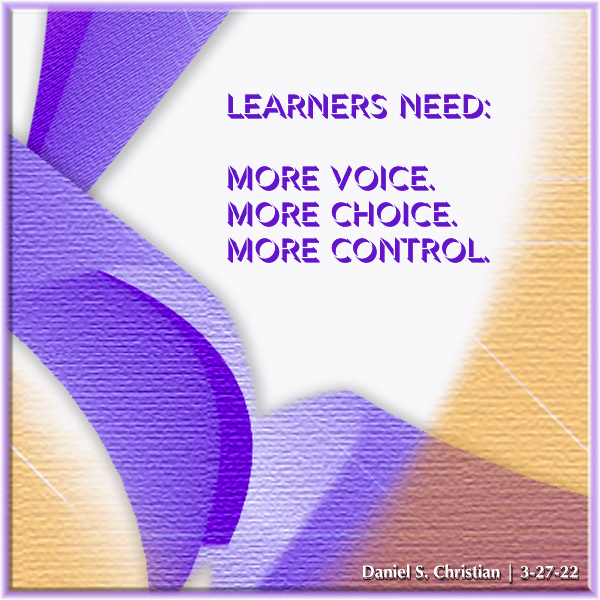
Learners need: More voice. More choice. More control. -- this image was created by Daniel Christian


Microschools: What Are They, What Do They Cost and Who’s Interested? — from edchoice.org by Ed Tarnowski

Excerpt:

Microschools are gaining steam.

Microschools, sometimes referred to as learning pods, is the reimagining of the one-room schoolhouse, where class sizes are usually fewer than 15 students of varying ages, and the schedule and curriculum is tailored to fit the needs of each class. This model of schooling can operate in either public, private or charter schools or separately on its own. Many describe microschools as a “mid-point” between traditional schooling and homeschooling. Most microschools are independently parent-led, but some are affiliated with a formal microschool network offering paid, in-person instructors. Lessons are taught in a range of approachable environments, such as homes, libraries and other community centers.


Course Awareness in HyFlex: Managing unequal participation numbers — from hyflexlearning.org by Candice Freeman

Excerpt:

How do you teach a HyFlex course when the number of students in various participation modes is very unequal? How do you teach one student in a mode – often in the classroom? Conversely, you could ask how do you teach 50 asynchronous students with very few in the synchronous mode(s)? Answers will vary greatly depending from teacher to teacher. This article suggests a strategy called Course Awareness, a mindfulness technique designed to help teachers envision each learner as being in the instructor’s presence and engaged in the instruction regardless of participation (or attendance) mode choice.

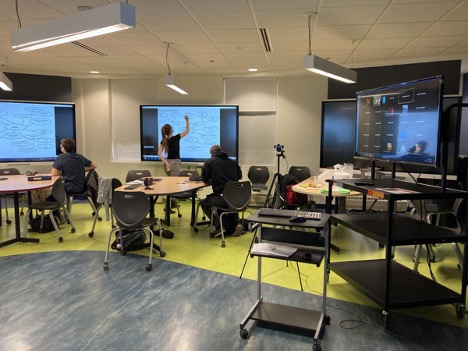
Teaching HyFlex in an active learning classroom

From DSC:
I had understood the hyflex teaching model as addressing both online-based (i.e., virtual/not on-site) and on-site/physically-present students at the same time — and that each student could choose the manner in which they wanted to attend that day’s class. For example, on one day, a student could take the course in room 123 of Anderson Hall. The next time the class meets, that same student could attend from their dorm room.

But this article introduces — at least to me — the idea that we have a third method of participating in the hyflex model — asynchronously (i.e., not at the same time). So rather than making their way to Anderson Hall or attending from their dorm, that same student does not attend at the same time as other students (either virtually or physically). That student will likely check in with a variety of tools to catch up with — and contribute to — the discussions. As the article mentions:

Strategically, you need to employ web-based resources designed to gather real-time information over a specified period of time, capturing all students and not just students engaging live. For example, Mentimeter, PollEverywhere, and Sli.do allow the instructor to pose engaging, interactive questions without limiting engagement time to the instance the question is initially posed. These tools are designed to support both synchronous and asynchronous participation. 

So it will be interesting to see how our learning ecosystems morph in this area. Will there be other new affordances, pedagogies, and tools that take into consideration that the faculty members are addressing synchronous and asynchronous students as well as online and physically present students? Hmmm…more experimentation is needed here, as well as more:

  • Research
  • Instructional design
  • Design thinking
  • Feedback from students and faculty members

Will this type of model work best in the higher education learning ecosystem but not the K-12 learning ecosystem? Will it thrive with employees within the corporate realm? Hmmm…again, time will tell.


And to add another layer to the teaching and learning onion, now let’s talk about multimodal learning. This article, How to support multimodal learningby Monica Burns, mentions that:

Multimodal learning is a teaching concept where using different senses simultaneously helps students interact with content at a deeper level. In the same way we learn through multiple types of media in our own journey as lifelong learners, students can benefit from this type of learning experience.

The only comment I have here is that if you think that throwing a warm body into a K12 classroom fixes the problem of teachers leaving the field, you haven’t a clue how complex this teaching and learning onion is. Good luck to all of those people who are being thrown into the deep end — and essentially being told to sink or swim.


Why Some Teachers Don’t Want to Go ‘Back to Normal’ — from edsurge.com by Daniel Lempres

Excerpts:

“My school did not drive me out of education. My students did not drive me out of education,” Aion says. Instead, he says he left because the lack of support and the deep systemic flaws in education had finally become too much. Aion says he was tired of pretending things were back to their pre-pandemic “normal,” and tired of pretending that “normal” had been working for students in the first place.

For educators like Aion and Bowyer, the expectation that public education would “return to normal” is one of the factors that pushed them out of the profession.

Her students were excited for her, and enthusiastically asked about what she would do instead of teaching them math. “I started crying in the middle of class,” Bowyer says. “And I said, ‘I don’t know, I don’t actually want to leave, I want to be here and I want to do this. But I don’t think I can anymore.’”


Paying for Outcomes [fs.blog]

Paying for Outcomes — from fs.blog; with thanks to Roberto Ferraro for this resource

Excerpt:

A lot of clients like to buy process. It’s like they think they are not getting their money’s worth because I solved it too fast.

[…]

How can it be that you talk to someone and it’s done in a second? But it IS done in a second — it’s done in a second and 34 years. It’s done in a second and every experience, and every movie, and everything in my life that’s in my head.


3D Scanner Lets You Capture The Real World In VR — from vrscout.com by Kyle Melnick

Excerpt:

VR is about to get a whole lot more real.

Imagine having the power to capture your real-world environment as a hyper-realistic 3D model from the palm of your hand. Well, wonder no more, as peel 3d, a developer of professional-grade 3D scanners, today announced the launch of peel 3 and peel 3.CAD, two new easy-to-use 3D scanners capable of generating high-quality 3D scans for a wide variety of digital mediums, including VR and augmented reality (AR).


NASA & Google Partner To Create An AR Solar System — from vrscout.com by Kyle Melnick

Excerpt:

[On 9/14/22], Google Arts & Culture announced that is has partnered with NASA to further extend its virtual offerings with a new online exhibit featuring a collection of new-and-improved 3D models of our universe brought to life using AR technology.

These 3D models are for more than just entertainment, however. The virtual solar system exhibit features historical annotations that, when selected, display valuable information. Earth’s moon, for example, features landing sites for Apollo 11 and China’s Chang’e-4.


‘Spaces Matter’ — from insidehighered.com by Colleen Flaherty
Limited access to active learning spaces may disproportionately hurt historically excluded groups, and institutions should build more of these spaces in the name of equity, according to a new study. Where does higher ed stand on next-generation learning spaces?

An interactive lecture hall at Rutgers University at New Brunswick, surrounded by active learning spaces across the U.S.

Excerpt (emphasis DSC):

A new study is therefore concerning—it found that limited access to active learning classrooms forced students to self-sort based on their social networks or their attitudes toward learning. The authors warn that limited access to active learning spaces may create a marginalizing force that pushes women, in particular, out of the sciences.

The solution? Invest in active learning spaces.

From DSC:
The groups I worked in over the last 15 years created several active learning spaces, but the number of rooms was definitely limited due to the expenses involved. Students liked these spaces and the feedback from faculty members was positive as well. Some students often staked their claims in these rooms so that they could study together (this was especially true for those majoring in Engineering).


Virtual Internships matches students with top companies around the world — from techcrunch.com by Catherine Shu

Excerpts:

Remote work struck down barriers for many employees, and now Virtual Internships is doing the same for university students around the world by partnering with over 12,000 companies from 100 countries.

Virtual Internships uses AI to match students at scale with internships at companies ranging from startups to blue chips and guarantees a match within one month.


Future of Learning Council on Statewide Grassroots Strategies & Pathways — from gettingsmart.com

Description of podcast:

On this episode of the Getting Smart Podcast Shawnee Caruthers is joined by Dr. Dave Richards, the Executive Learning Strategist for Michigan Virtual and a key part of Future of Learning Council, a partner that we’ve loved working alongside over the last year.

We are also joined by two superintendents who are a part of this project – Dr. Christopher Timmis, Superintendent of Dexter Community Schools and Dr. John VanWagoner of Traverse City Area Public Schools.


3 Pitfalls to Avoid in Shift to Skills-Based Hiring, Training — from by Lynne McNamee

Excerpts:

Since the pandemic many organizations have explored a shift in hiring and people development, moving from emphasizing candidates’ formal degrees to focusing on specific skills development and certifications.

With the dramatic increase in the average cost of a college degree in the USA—average per-student annual cost is now above $35,000—it is clear that meeting staffing needs while also supporting DEI efforts requires that organizations consider an alternative to the traditional option of requiring a degree for most positions.

While it’s easy to become enthusiastic about the potential benefits of focusing on specific, needed skills, it’s also prudent to be aware of potential pitfalls—and explore intentional processes and checks that can help learning leaders avoid these three common unintended consequences.

Speaking of skills, also see:

State of Global Skills 2022: Investing in Skills Development — from coursera.org

Watch the webinar on-demand to learn:  

  • How skills development has changed during the pandemic — and which changes are expected to last
  • How countries around the world have enacted policies that develop a more skilled workforce
  • Which are the most in-demand skills, and how to use regional and global skills data to drive strategic planning


What’s next for online education? — from educationalist.substack.com by Alexandra Mihai

Excerpt:

An ecosystem not a dichotomy
As you’re hopefully already getting from my thoughts so far, I personally see our options for quality education in the future more like an ecosystem and not a series of mutually exclusive paths. It’s time to discard- or at least question-the “online vs. in person” dichotomy, almost always unfavourable to online education. It’s time to think in a more nuanced way about this. And, yes, you’ve guessed, more nuanced is always more difficult. Seeing the shades of grey requires a critical lens that we don’t need to see black and white.

The extent to which online education will be used in the future does not depend only on people (micro level), it depends on institutions (meso level) and policies (macro level).

The learning ecosystem, in my view:

  • includes various modalities used in a complementary way and as a continuum;
  • serves a multitude of audiences, at different stages of learning, with different aims and degrees of engagement;
  • requires comprehensive and interconnected support structures at institutional level, for students and faculty.
 

Scams in College and How to Avoid Them — from ivypanda.com and Yvonne McQuarrie

A young college student looking shocked at her phone.

Excerpt:

These days scams are on the rise. Employing all sorts of schemes, con artists target different society layers, from children to the elderly. College students are no exception.

Our team has prepared the infographic below to describe various scams directed at college students. We’ve also explored the ways to prevent being scammed.


The Artificial Lawyer Guide to Legal Tech – Autumn 2022 — from artificiallawyer.com

Excerpt:

It’s been a wild ride the last couple of years, but what should we be looking out for as we move into the Autumn of 2022? Here are some thoughts from Artificial Lawyer.

 
© 2025 | Daniel Christian