New Lightcast Report: AI Skills Command 28% Salary Premium as Demand Shifts Beyond Tech Industry — from lightcast.io; via Paul Fain
First-of-its-kind analysis reveals specific AI skills employers need most, enabling targeted workforce training strategies across all career areas

July 23, 2025 – Lightcast, the global leader in labor market intelligence, today released “Beyond the Buzz: Developing the AI Skills Employers Actually Need,” a comprehensive analysis revealing that artificial intelligence has fundamentally transformed hiring patterns across the world of work. The report, based on analysis of over 1.3 billion job postings, shows that job postings including AI skills offer 28% higher salaries—nearly $18,000 more per year—than those without such capabilities.

More importantly, the research analyzes specific skills based on their growth across job postings, their importance in the workforce, and their exposure to AI. This shows exactly which AI skills create value in which contexts, solving the critical challenge facing educators and workforce development leaders: moving beyond vague “AI literacy” to precise, targeted training that delivers measurable results.


Also via Paul Fain:


Despite growing awareness, however, participation in skill development is limited. In 2024, less than half of U.S. employees (45%) participated in training or education to build new skills for their current job. About one in three employees (32%) who are hoping to move into a new role within the next year strongly agree that they have the skills needed to be exceptional in that role.


 

The Magi Visit the Messiah — from biblegateway.com

After Jesus was born in Bethlehem in Judea, during the time of King Herod, Magi[a] from the east came to Jerusalem and asked, “Where is the one who has been born king of the Jews? We saw his star when it rose and have come to worship him.”

When King Herod heard this he was disturbed, and all Jerusalem with him. When he had called together all the people’s chief priests and teachers of the law, he asked them where the Messiah was to be born. “In Bethlehem in Judea,” they replied, “for this is what the prophet has written:

“‘But you, Bethlehem, in the land of Judah,
    are by no means least among the rulers of Judah;
for out of you will come a ruler
    who will shepherd my people Israel.’[b]

Then Herod called the Magi secretly and found out from them the exact time the star had appeared. He sent them to Bethlehem and said, “Go and search carefully for the child. As soon as you find him, report to me, so that I too may go and worship him.”

After they had heard the king, they went on their way, and the star they had seen when it rose went ahead of them until it stopped over the place where the child was. 10 When they saw the star, they were overjoyed. 11 On coming to the house, they saw the child with his mother Mary, and they bowed down and worshiped him. Then they opened their treasures and presented him with gifts of gold, frankincense and myrrh. 12 And having been warned in a dream not to go back to Herod, they returned to their country by another route.

The Escape to Egypt

13 When they had gone, an angel of the Lord appeared to Joseph in a dream. “Get up,” he said, “take the child and his mother and escape to Egypt. Stay there until I tell you, for Herod is going to search for the child to kill him.”

14 So he got up, took the child and his mother during the night and left for Egypt, 15 where he stayed until the death of Herod. And so was fulfilled what the Lord had said through the prophet: “Out of Egypt I called my son.”[c]

16 When Herod realized that he had been outwitted by the Magi, he was furious, and he gave orders to kill all the boys in Bethlehem and its vicinity who were two years old and under, in accordance with the time he had learned from the Magi. 17 Then what was said through the prophet Jeremiah was fulfilled:

18 “A voice is heard in Ramah,
    weeping and great mourning,
Rachel weeping for her children
    and refusing to be comforted,
    because they are no more.”


From DSC:
Herod gave the order to kill all the boys in Bethlehem and its vicinity who were two years old and under.

So, as you can see from this excerpt from the Bible, kings can do whatever the hell they want to do. As such, we don’t want a king here in America. That will NOT make America great again…no way. Especially with someone like Donald Trump, who should be in jail…not in the presidency.


Aeneas transforms how historians connect the past — from deepmind.google
Introducing the first model for contextualizing ancient inscriptions, designed to help historians better interpret, attribute and restore fragmentary texts.

Today, we’re publishing a paper in Nature introducing Aeneas, the first artificial intelligence (AI) model for contextualizing ancient inscriptions.

When working with ancient inscriptions, historians traditionally rely on their expertise and specialized resources to identify “parallels” — which are texts that share similarities in wording, syntax, standardized formulas or provenance.

Aeneas greatly accelerates this complex and time-consuming work. It reasons across thousands of Latin inscriptions, retrieving textual and contextual parallels in seconds that allow historians to interpret and build upon the model’s findings.


The US AI Action Plan, Explained — from theneurondaily.com by Grant Harvey
Sam’s 3 AI nightmares, Google hits 2B users, and Trump bans “woke” AI…

Meanwhile, at the Fed’s banking conference on Wednesday, Altman revealed his three nightmare AI scenarios. The first two were predictable: bad actors getting superintelligence first, and the classic “I’m afraid I can’t do that, Dave” situation.

But the third? AI accidentally steering us off course while we just…go along with it.

His example hit home: young people who can’t make decisions without ChatGPT (according to Sam, this is literally a thing). See, even when AI gives great advice, collectively handing over all decision-making feels “bad and dangerous” (even to Sam, who MADE this thing).

So yeah, Sam’s not really worried about the AI rebelling. He’s worried about AI becoming so good that we stop thinking for ourselves—and that might be scarier.

Also from The Neuron re: the environmental impacts of producing/offering AI:


$50 a week for 40 weeks: How no-strings cash changed the lives of teens — from hechingerreport.org by Neal Morton
A cash transfer program for high schoolers resulted in better attendance and more financial literacy, but no improvement in grades

“The $50 study,” as it’s known, began at Rooted School, a local charter school, as an experiment to increase attendance. The study has since grown to eight other high schools in the city, as well as Rooted’s sister campus in Indianapolis, with students randomly selected to receive $50 every week for 40 weeks, or $2,000 total. By comparing their spending and savings habits to a larger control group, researchers wanted to figure out whether the money improved a teen’s financial capability and perception of themselves. They also wanted to know: Could the cash boost their grade-point averages and reading scores?

From DSC:
An interesting experiment.


Building a learning ecosystem that drives business results — from chieflearningofficer.com by Nick Romanowski
How SAX combined adaptive e-learning and experiential workshops to accelerate capability development and impact the bottom line.

At SAX, we know that to succeed in today’s market, we need professionals who can learn quickly, apply that learning effectively and continuously adapt as client needs evolve.

Yet traditional training methods were no longer enough. Our firm faced familiar challenges: helping staff meet continuing professional education requirements efficiently, uncovering knowledge gaps to guide development and building a more capable, more client-ready workforce.

We found our solution in a flipped learning model that blends adaptive e-learning with live, experiential workshops. The results were transformative. We accelerated CPE credit completion by more than 50 percent, reclaimed 173 billable hours and equipped our people with deeper capabilities.

Here’s how we did it, and what we learned along the way.

Blend technology and human touch: Adaptive e-learning addresses individual knowledge gaps efficiently. Live workshops enable skill development through practice and feedback. Together, they drive both learning efficiency and behavior change.


I Teach Creative Writing. This Is What A.I. Is Doing to Students. — from nytimes.com by Meghan O’Rourke; this is a gifted article.

We need a coherent approach grounded in understanding how the technology works, where it is going and what it will be used for.

From DSC:
I almost feel like Meghan should right the words “this week” or “this month” after the above sentence. Whew! Things are moving fast.

For example, we’re now starting to see more agents hitting the scene — software that can DO things. But that can open up a can of worms too. 

Students know the ground has shifted — and that the world outside the university expects them to shift with it. A.I. will be part of their lives regardless of whether we approve. Few issues expose the campus cultural gap as starkly as this one.ce 

From DSC:
Universities and colleges have little choice but to integrate AI into their programs and offerings. There’s enough pressure on institutions of traditional higher education to prove their worth/value. Students and their families want solid ROI’s. Students know that they are going to need AI-related skills (see the link immediately below for example), or they are going to be left out of the competitive job search process.

A relevant resource here:


Firefly adds new video capabilities, industry leading AI models, and Generate Sound Effects feature — from blog.adobe.com

Today, we’re introducing powerful enhancements to our Firefly Video Model, including improved motion fidelity and advanced video controls that will accelerate your workflows and provide the precision and style you need to elevate your storytelling. We are also adding new generative AI partner models within Generate Video on Firefly, giving you the power to choose which model works best for your creative needs across image, video and sound.

Plus, our new workflow tools put you in control of your video’s composition and style. You can now layer in custom-generated sound effects right inside the Firefly web app — and start experimenting with AI-powered avatar-led videos.

Generate Sound Effects (beta)
Sound is a powerful storytelling tool that adds emotion and depth to your videos. Generate Sound Effects (beta) makes it easy to create custom sounds, like a lion’s roar or ambient nature sounds, that enhance your visuals. And like our other Firefly generative AI models, Generate Sound Effects (beta) is commercially safe, so you can create with confidence.

Just type a simple text prompt to generate the sound effect you need. Want even more control? Use your voice to guide the timing and intensity of the sound. Firefly listens to the energy and rhythm of your voice to place sound effects precisely where they belong — matching the action in your video with cinematic timing.


From DSC:
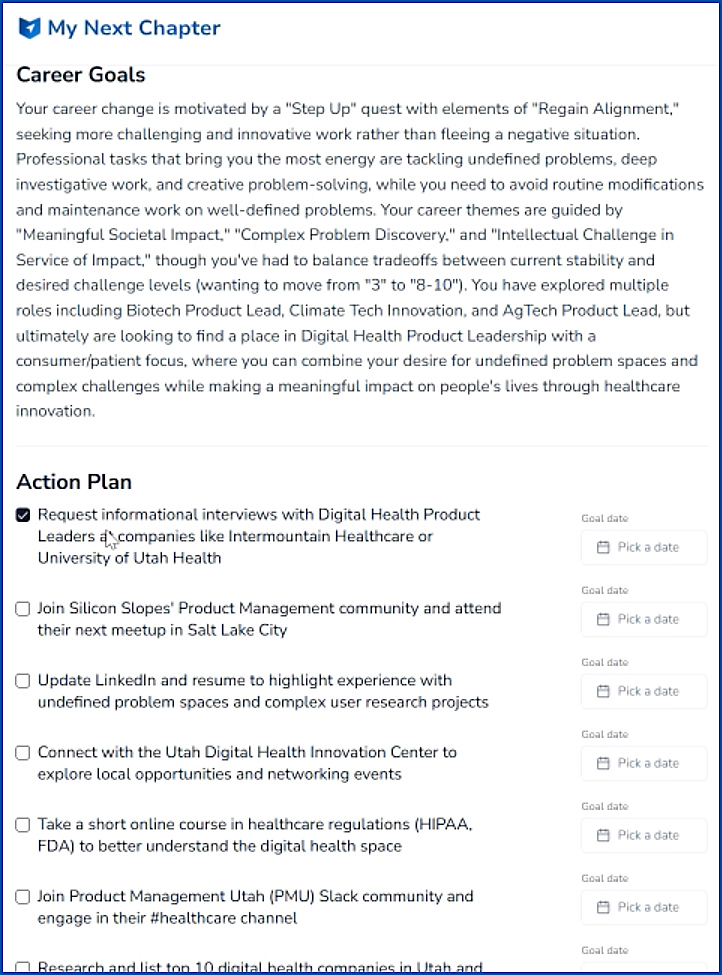
In looking at
 
MyNextChapter.ai — THIS TYPE OF FUNCTIONALITY of an AI-based chatbot talking to you re: good fits for a future job — is the kind of thing that could work well in this type of vision/learning platform. The AI asks you relevant career-oriented questions, comes up with some potential job fits, and then gives you resources about how to gain those skills, who to talk with, organizations to join, next steps to get your foot in the door somewhere, etc.

The next gen learning platform would provide links to online-based courses, blogs, peoples’ names on LinkedIn, courses from L&D organizations or from institutions of higher education or from other entities/places to obtain those skills (similar to the ” Action Plan” below from MyNextChapter.ai).


Dennis Lehtonen Documents a Pair of Immense Icebergs Paying a Visit to a Small Greenland Village — from thisiscolossal.com by Dennis Lehtonen and Kate Mothes


Trump officials accused of defying 1 in 3 judges who ruled against him — from washingtonpost.com by Justin Jouvenal
A comprehensive analysis of hundreds of lawsuits against Trump policies shows dozens of examples of defiance, delay and dishonesty, which experts say pose an unprecedented threat to the U.S. legal system.

President Donald Trump and his appointees have been accused of flouting courts in a third of the more than 160 lawsuits against the administration in which a judge has issued a substantive ruling, a Washington Post analysis has found, suggesting widespread noncompliance with America’s legal system.

Plaintiffs say Justice Department lawyers and the agencies they represent are snubbing rulings, providing false information, failing to turn over evidence, quietly working around court orders and inventing pretexts to carry out actions that have been blocked.

.

The Post examined 337 lawsuits filed against the administration since Trump returned to the White House and began a rapid-fire effort to reshape government programs and policy. As of mid-July, courts had ruled against the administration in 165 of the lawsuits. The Post found that the administration is accused of defying or frustrating court oversight in 57 of those cases — almost 35 percent.


DC: How is making a mockery of the justice system making America great again? I don’t think any one of us would benefit from living in a land with no laws. It would be absolute chaos.


Philippians 2:9-11

9 Therefore God exalted him to the highest place
and gave him the name that is above every name,
10 that at the name of Jesus every knee should bow,
in heaven and on earth and under the earth,
11 and every tongue acknowledge that Jesus Christ is Lord,
to the glory of God the Father.

Psalm 25:4-6

4 Show me your ways, Lord,
teach me your paths.
5 Guide me in your truth and teach me,
for you are God my Savior,
and my hope is in you all day long.
6 Remember, Lord, your great mercy and love,
for they are from of old.

Psalm 25:11-12

11 For the sake of your name, Lord,
forgive my iniquity, though it is great.
12 Who, then, are those who fear the Lord?
He will instruct them in the ways they should choose.[a]


From DSC:
Read through the article below. It’s an excellent example of a learning ecosystem, one that has been developed and practiced by Tiago Forte.

My 4-Stage System for Learning Anything New — from fortelabs.com by Tiago Forte

  • Stage 1: Immersion – Get Maximum Exposure
  • Stage 2: Building – Make Something Real
  • Stage 3: Structured Learning – Find Your Mentors
  • Stage 4: Connection – Build Real Relationships
  • The Secret Ingredient: Cultivating Play in Learning
 

Introducing ChatGPT agent: bridging research and action — from openai.com
ChatGPT now thinks and acts, proactively choosing from a toolbox of agentic skills to complete tasks for you using its own computer.

ChatGPT can now do work for you using its own computer, handling complex tasks from start to finish.

You can now ask ChatGPT to handle requests like “look at my calendar and brief me on upcoming client meetings based on recent news,” “plan and buy ingredients to make Japanese breakfast for four,” and “analyze three competitors and create a slide deck.” ChatGPT will intelligently navigate websites, filter results, prompt you to log in securely when needed, run code, conduct analysis, and even deliver editable slideshows and spreadsheets that summarize its findings.


Teach business students to write like executives — from timeshighereducation.com by José Ignacio Sordo Galarza
Many business students struggle to communicate with impact. Teach them to pitch ideas on a single page to build clarity, confidence and work-ready communication skills

Many undergraduate business students transition into the workforce equipped with communication habits that, while effective in academic settings, prove ineffective in professional environments. At university, students are trained to write for professors, not executives. This becomes problematic in the workplace where lengthy reports and academic jargon often obscure rather than clarify intent. Employers seek ideas they can absorb in seconds. This is where the one-pager – a single-page, high-impact document that helps students develop clarity of thought, concise expression and strategic communication – proves effective.


Also from Times Higher Education, see:


Is the dissertation dead? If so, what are the alternatives? — from timeshighereducation.com by Rushana Khusainova, Sarah Sholl, & Patrick Harte
Dissertation alternatives, such as capstone projects and applied group-based projects, could better prepare graduates for their future careers. Discover what these might look like

The traditional dissertation, a longstanding pillar of higher education, is facing increasing scrutiny. Concerns about its relevance to contemporary career paths, limitations in fostering practical skills and the changing nature of knowledge production in the GenAI age have fuelled discussions about its continued efficacy. So, is the dissertation dead?

The dissertation is facing a number of challenges. It can be perceived as having little relevance to career aspirations in increasingly competitive job markets. According to The Future of Jobs Report 2025 by the World Economic Forum, employers demand and indeed prioritise skills such as collaborative problem-solving in diverse and complex contexts, which a dissertation might not demonstrate.


© 2025 | Daniel Christian