Hidden toll: Thousands of schools fail to count homeless students — from by Amy DiPierro and Corey Mitchell
Federal law promises homeless children an equal shot at education. Many fall through the cracks

Excerpt:

A Center for Public Integrity analysis of district-level federal education data suggests roughly 300,000 students entitled to essential rights reserved for homeless students have slipped through the cracks, unidentified by the school districts mandated to help them.

Some 2,400 districts — from regions synonymous with economic hardship to big cities and prosperous suburbs — did not report having even one homeless student despite levels of financial need that make those figures improbable.

And many more districts are likely undercounting the number of homeless students they do identify. In nearly half of states, tallies of student homelessness bear no relationship with poverty, a sign of just how inconsistent the identification of kids with unstable housing can be.


Can a Group of MIT Professors Turn a White Paper Into a New Kind of College? — from edsurge.com by Jeffrey R. Young

Excerpt:

A group of professors at Massachusetts Institute of Technology dropped a provocative white paper in September that proposed a new kind of college that would address some of the growing public skepticism of higher education. This week, they took the next step toward bringing their vision from idea to reality.

That next step was holding a virtual forum that brought together a who’s who of college innovation leaders, including presidents of experimental colleges, professors known for novel teaching practices and critical observers of the higher education space.

The MIT professors who authored the white paper tried to make clear that even though they’re from an elite university, they do not have all the answers. Their white paper takes pains to describe itself as a draft framework and to invite input from players across the education ecosystem so they can revise and improve the plan.

IDEAS FOR DESIGNING An Affordable New Educational Institution

IDEAS FOR DESIGNING An Affordable New Educational Institution

The goal of this document is simply to propose some principles and ideas that we hope will lay the groundwork for the future, for an education that will be both more affordable and more effective.

Promotions and titles will be much more closely tied to educational performance—quality, commitment, outcomes, and innovation—than to research outcomes. 


10 Ways to Give a Better Lecture — from cultofpedagogy.com by Jennifer Gonzalez

Excerpt:

It would be an understatement to say that lecturing is frowned upon in modern teaching. At this point it’s almost become a cliché: Don’t be the sage on the stage; be the guide on the side. Ideally, we should stick to supporting students through inquiry learning, cooperative learning, project-based learning, and so on. I have personally advocated for ALL of these approaches, over and over again. And I do believe that students need to be active in their learning.

But does that mean we dump lectures altogether? At a time when TED Talks and online courses are incredibly popular, when our students get at least some portion of their instruction through video-based, blended learning platforms, and when most people reading this have probably learned something useful or interesting in the last month from YouTube, aren’t we all learning from lectures all the time?

I’d argue that two factors have given lectures a bad name: overuse and poor execution. Let’s look at these issues one at a time.


In elementary classrooms, demand grows for play-based learning — from hechingerreport.org by Ariel Gilreath
Play supporters point to improved literacy, fewer achievement gaps, and better motor skills for students

Excerpt:

It can be difficult to explain what play-based learning looks like, said Mara Krechevsky, senior researcher at Project Zero, an education research group in Harvard’s Graduate School of Education. Over the past seven years, Krechevsky and her research team have been working on a project called the Pedagogy of Play, studying play-based learning at schools in Boston, Denmark, South Africa and Colombia.

Through their research, Krechevsky’s group came up with three basic tenets for playful learning: students should be able to help lead their own learning, explore the unknown, and find joy. Under this framework, play time doesn’t have to be the reward for completing work and learning. Play can actually be the work, Krechevsky said.

Addendums on 11/20/22:


NVIDIA Teams With Microsoft to Build Massive Cloud AI Computer — from nvidianews.nvidia.com
Tens of Thousands of NVIDIA GPUs, NVIDIA Quantum-2 InfiniBand and Full Stack of NVIDIA AI Software Coming to Azure; NVIDIA, Microsoft and Global Enterprises to Use Platform for Rapid, Cost-Effective AI Development and Deployment

Excerpt:

NVIDIA announced [on 11/16/22] a multi-year collaboration with Microsoft to build one of the most powerful AI supercomputers in the world, powered by Microsoft Azure’s advanced supercomputing infrastructure combined with NVIDIA GPUs, networking and full stack of AI software to help enterprises train, deploy and scale AI, including large, state-of-the-art models.

Addendum on 11/20/22:


The Status of the Teaching Profession Is at a 50-Year Low. What Can We Do About It? — from edweek.org by Caitlynn Peetz

Excerpt:

The status of the teaching profession is at its lowest in five decades, new research suggests, which its authors say is “cause for national concern.”

In a new paper published Tuesday, researchers at Brown University and the University at Albany compiled and analyzed decades’ worth of national data from more than a dozen sources about factors like teachers’ morale, the perceived prestige of the profession, and interest in entering the field, to create an annual profile of the profession between 1970 and 2022.

What they found is sobering. It suggests that the pandemic has only added fuel to a job that’s steadily declined in prestige and attractiveness for more than a decade.

“When you look at the data that we have, it’s hard to see us in a spot anywhere else other than a really critical tipping point in public education,” said Matthew Kraft, an associate professor of education and economics at Brown and co-author of the report.

Reversing “the trend of top-down control over teachers” and creating meaningful career pathways, including professional development and peer observation opportunities, could help restore morale, Kraft and Lyon wrote in their paper, though they did not recommend specific approaches.


Yale and Harvard’s Law Schools Are Ditching the ‘U.S. News’ Rankings. Will Others Follow? — from chronicle.com by Francie Diep

Excerpt:

Yale Law School — long ranked No. 1 by U.S. News & World Report — is quitting the magazine’s rankings, it announced Wednesday. Hours after that announcement, which was first reported by The Wall Street Journal, Harvard Law School said it would do the same.

“U.S. News stands in the way of progress for legal education and the profession,” said Heather Gerken, Yale Law School’s dean. “It’s made it harder for law schools to admit and support low-income students, and it’s undermining efforts to launch a generation to serve. Now is the time to take a step.”

Also related/see:

Some other legal-related items include:

IAALS Releases New Allied Legal Professionals Landscape Report and Resource Center in an Effort to Increase Legal Options for the Public — iaals.du.edu

Excerpt:

IAALS, the Institute for the Advancement of the American Legal System at the University of Denver, announced today that it released its new Allied Legal Professionals landscape report, along with an accompanying online Knowledge Center. With generous support from the Sturm Family Foundation, this project seeks to help standardize a new tier of legal professionals nationally, with the goal of increasing the options for accessible and affordable legal help for the public.

“Today, the majority of Americans are faced with a very serious access to justice problem—not only low-income populations, as many people believe. And the pandemic has only made matters worse in recent years,” says Jim Sandman, chair of IAALS’ board of advisors and President Emeritus of the Legal Services Corporation. “For example, studies show that around 40–60% of the middle class have legal needs that remain unmet. Simply put: people want legal help, and they are not getting the help they need.”

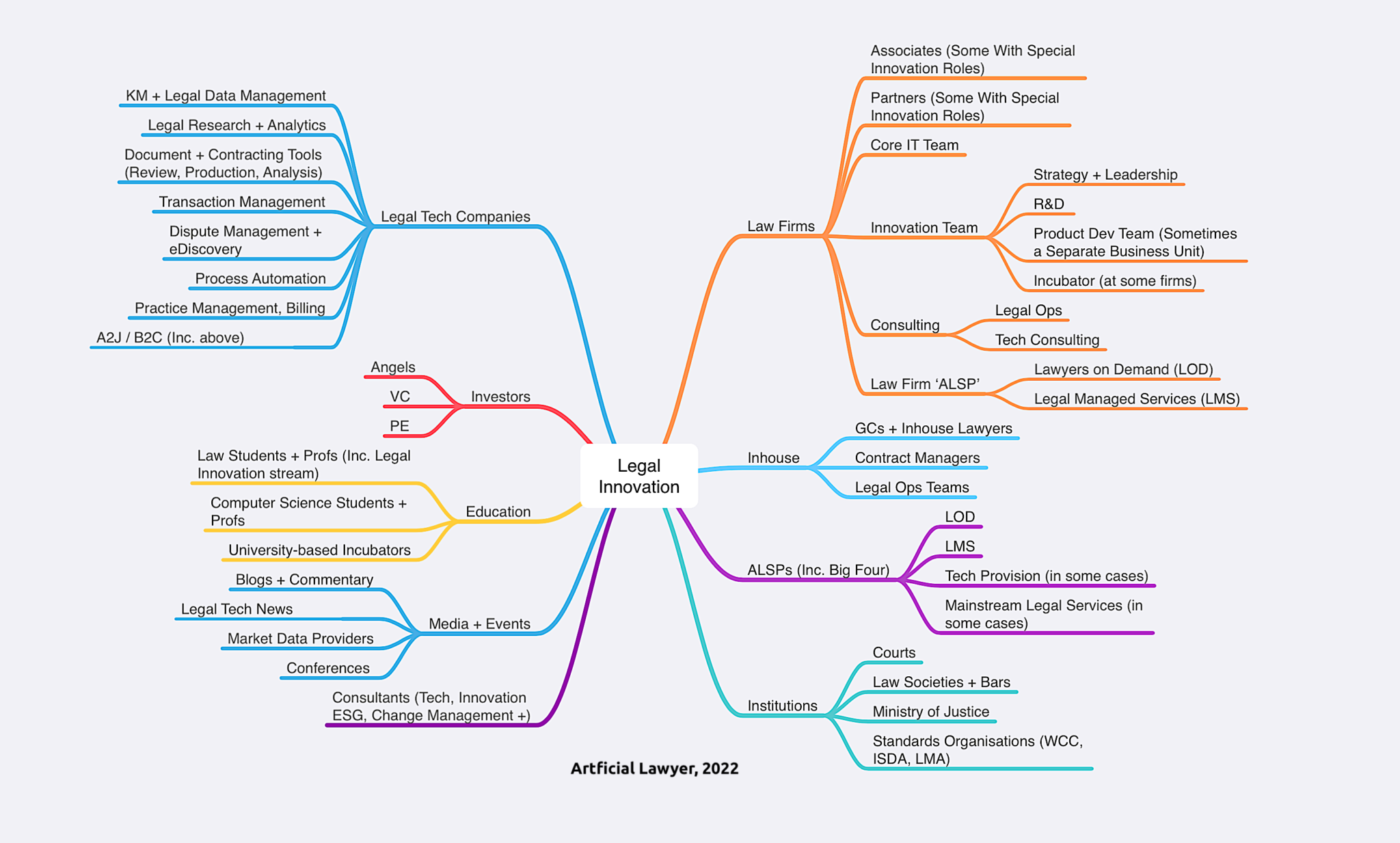
Legal Innovators: An Ecosystem of Change Agents! — from artificiallawyer.com

The expanding role of technology in the law firm business model (338) — from legalevolution.org by Kenneth Jones
Legal technology is slowly becoming core to the legal business. It’s time to commit to a cross-functional team approach.

Excerpt:

The premise of this post is that individual capabilities and excellence (either legal or technical) standing alone are not enough to ensure long-term, sustainable success.  No superstar technologist or lawyer is equipped to do it all, as there are too many specialties and functional roles which need to be filled.  Rather, a better approach is to construct team-based, cross-functional units that offer greater operational efficiency while building in layers of redundancy that reduce the potential for surprises, errors, or disruption.  Cf Post 323 (Patrick McKenna’s “rules of engagement” for high-performing legal teams).


The Impact of Storytelling on Learning — from campustechnology.com by Ruth Reynard
The benefits of storytelling in teaching and learning are well established — and digital tools can help make stories more interactive, boost engagement, and convey ideas more effectively. Here’s how to make the most of technology and sidestep common mistakes in the use of storytelling for learning.

Excerpts:

Research.com provides a lot of helpful information on digital storytelling, including a breakdown of the tools and media used to tell stories or present ideas: audio capture devices (e.g. microphones and voice recorders), image capture devices (such as digital cameras and scanners), computers (with multimedia capabilities and ample storage), and digital media software (for creating and editing image, video, and audio).

While digital tools evolve rapidly, there are several useful tools listed for teachers and students by Med Kharbach (2022). These include:

    • StoryboardThat – this storyboard design tool helps to support good design and planning for effective storytelling.
    • Canva – this provides already developed templates to use in any story design and development.
    • Adobe Spark – useful if you are already familiar with Adobe products.
 

Californians approve big funding boost for arts education — from apnews.com by Julie Watson; with thanks to Goldie Blumenstyk for this resource

Excerpt:

SAN DIEGO (AP) — California voters on Tuesday approved a ballot measure backed by a celebrity lineup that included Barbra Streisand and Los Angeles-born rappers will.i.am and Dr. Dre that could pump as much as $1 billion a year from the state’s general fund into arts education.

Supporters said it would benefit public school programs that go beyond the traditional art, theater, dance and music classes to include graphic design, computer coding, animation, music composition and script writing.

Also from Goldie Blumenstyk:


David Hockney exhibition to launch Lightroom immersive arts space— from inavateonthenet.net

Excerpt:

A David Hockney exhibition will mark the launch of Lightroom, a four-storey-high space in London that uses wraparound projection and audio to immerse visitors.


When Colleges Close, Students Aren’t Likely to Re-Enroll — from insidehighered.com by Johanna Alonso
Data from the National Student Clearinghouse show that fewer than half of students attending an institution that closes transfer to another institution.

Excerpt:

The study, produced by the National Student Clearinghouse and the State Higher Education Executive Officers Association, followed 143,215 students who were enrolled in 467 institutions that closed between July 1, 2004, and June 30, 2020. Those that closed generally enrolled larger populations of students of color than institutions that remained open—55 percent versus 46.4 percent—and more Pell Grant recipients as well.

Just under half the students whose institutions closed—47.1 percent—re-enrolled at another college or university. Of those who re-enrolled, only 36.8 percent went on to earn a credential; 52.9 percent dropped out, and 10.4 percent were still enrolled as of February 2022. Students of color, male students and non-traditional-aged students were the least likely to re-enroll and complete a credential.

“Once it becomes likely an institution will close, states need to ensure teach-out agreements are in place to provide all students with a pathway for completing their credentials,” the study reads. “Additionally, states need to thoroughly vet the teach-out institutions to ensure they are capable of completing the terms of the teach-out agreement and are financially viable.”

When Campuses Close, Most of Their Students Are Stuck Without the Credentials They Wanted — from chronicle.com by Katherine Mangan

Excerpt:

Nearly three-quarters of the students whose colleges closed between 2004 and 2020 were stranded without adequate warning or plans to help them finish their degrees, and fewer than half of those students ended up re-enrolling in any postsecondary programs, according to a report released Tuesday.

Hardest hit were Black and Hispanic students enrolled in for-profit institutions. “Their schools’ closing effectively closed the doors on the students’ educational dreams,” Doug Shapiro, executive director of the National Student Clearinghouse Research Center, said in a briefing with reporters.

The research center worked with the State Higher Education Executive Officers Association, also known as SHEEO, on a series of three reports that will examine the impact of college closures on students and how states can better protect those whose education plans are disrupted.

‘Universities must engage in lifelong learning’ – UNESCO — from thepienews.com by Helen Packer
The future of universities depends on their ability to provide ‘lifelong learning’ that equips non-traditional students with in-demand skills, UNESCO warned last week. 

Excerpt:

David Atchoarena, director of the UNESCO Institute for Lifelong Learning, called on universities to engage with continuing and adult education at the first Global Lifelong Learning Summit held in Singapore in November.

“As we face salient changes in citizenship, climate change, health and wellbeing, among others, more countries are seeing the increasing importance of lifelong learning and are putting measures and strategies to make it a reality,” said Atchoarena, later adding that universities should “really define their mission so that they play their role”.

New Study Details Challenges Facing Native Students, and How to Address Them — from the74million.org by Angelique Albert
Albert: From funding for tuition to housing, food aid and financial literacy training, what schools can do to make education truly affordable

Excerpt:

A newly released National Study on College Affordability for Indigenous Students brings much-needed visibility to this disparity, which has long been ignored in the public dialogue about educational access. The report provides comprehensive data and a fresh set of powerful personal testimonies that illuminate how Native students experience the many facets of funding their college education. It offers recommendations for making higher education more financially accessible to Native students, such as providing aid for non-tuition expenses.

New Report on Re-Enrolling Adult Learners — from insidehighered.com by Sara Weissman

Excerpt:

A new report offers guidance to community college leaders seeking to re-enroll adult learners who earned academic credits but left college without a degree or credential.

The report, released today, was produced by InsideTrack, a nonprofit organization that helps institutions enroll students and improve academic outcomes through coaching. The report notes that community colleges lost almost 830,000 students nationally since spring 2020, according to National Student Clearinghouse Research Center data. Meanwhile, there are currently 39 million Americans who attended some college but never graduated.


Accelerated Learning — Schools’ Answer for ‘Learning Loss’ — Hits Some Speed Bumps — from edsurge.com by Nadia Tamez-Robledo

The main finding? Accelerated learning simply requires more. More staff, more resources, more energy, more buy-in from teachers.

As district leaders talked about their day-to-day realities, they shared how those things were all tough to come by when everyone in the system was already stretched thin.

Not necessarily related to the above item, but I wanted to pass this one along to you as well:

QAA Report on Badging and Micro-Credentialing: How Education and Employment Can Benefit from Using Skills Profiles  — from gettingsmart.com by Rupert Ward

Key Points

  • Skills profiles make it easier for educators and employers to understand how skills gained in learning can be transferred to those required in earning.
  • This QAA Collaborative Enhancement Project Report demonstrates both how badges and microcredentials can be incorporated into a range of higher education courses and, through doing this, how we can ultimately personalise learning and earning.
 

Hybrid learning is becoming the norm and not the exception — from benefitspro.com by Joel Kranc
“[Corporate] Learning and development needs to happen where work takes place and learning leaders must place a greater focus on creating blended learning experiences that mirror hybrid work models,” says Jeanne Meister, Executive Vice President, Executive Networks.

Excerpt:

A new survey by Executive Networks and NovoEd highlights the new model as 6 in 10 of the 515 learning leaders at large corporations say hybrid learning is becoming a major part of the learning landscape, and is not just a fad or temporary trend. “Learning leaders are preparing for profound changes as they redesign corporate learning with new delivery methods and rethink how to meet the needs of new audiences,” says Christina Yu, CMO, NovoEd. “The pivot to online learning and the availability of a greater range of technology and tools that can be integrated into learning initiatives, such as social and collaborative learning platforms, make it easier for real-time interaction between cohorts, experts, and mentors.”


ASCD and ISTE to Merge in Partnership Aimed at Reducing Education Silos — from edsurge.com by Jeffrey R. Young

Excerpt:

[Yesterday], after a key vote, it’s official: Two giants in the education space will join forces, creating a professional development powerhouse for their educator members.

The International Society for Technology in Education (ISTE) and the Association for Supervision and Curriculum Development (ASCD) will merge, beginning in January, a move that leaders hope will help to speed up the pace and smooth the process of innovation in education.

“I think it is a reaction to the reality that edtech has become an infused part of all learning,” argued Culatta, nodding to the fact that many schools and districts got where they are by necessity, when the COVID-19 pandemic began almost three years ago.

 
© 2025 | Daniel Christian