


Police are rolling out new tech without knowing their effects on people — from The Algorithm by Melissa Heikkilä
Excerpt:
I got lucky—my encounter was with a drone in virtual reality as part of an experiment by a team from University College London and the London School of Economics. They’re studying how people react when meeting police drones, and whether they come away feeling more or less trusting of the police.
It seems obvious that encounters with police drones might not be pleasant. But police departments are adopting these sorts of technologies without even trying to find out.
“Nobody is even asking the question: Is this technology going to do more harm than good?” says Aziz Huq, a law professor at the University of Chicago, who is not involved in the research.
Michigan flags 112 low-performing schools for intensive intervention — from mlive.com by Matthew Miller
Excerpt:
“These are the urban high minority districts, right? So they were the ones that had the highest death rates, the highest case rates, the highest income and economic hits because of the pandemic,” she said. “We know that all of this goes into what we label as school quality even though it’s about so much more than the school or the district.”
From DSC:
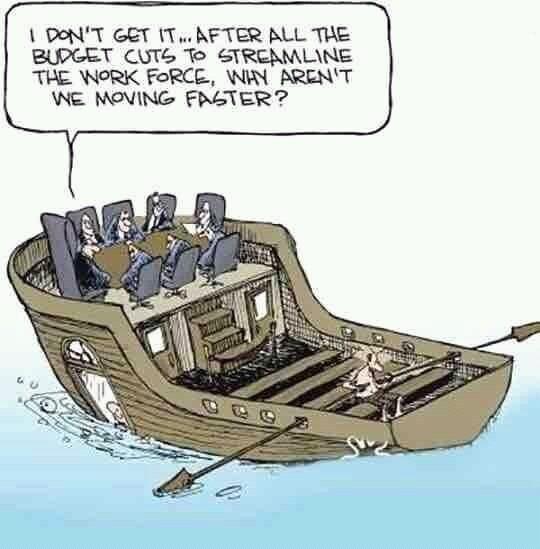
I surely hope that what’s going on in the image below isn’t what’s going on within the state of Michigan (as well as other states) — but I have my fears/concerns in that regard. Though admittedly, my focus here isn’t so much about the financial pictures, but rather it has to do with the straight-jacketing of the teachers and students by legislators in Lansing (and other state capitals). If I were to redraw this image, I would have legislators in (far-away) Lansing seated in comfortable chairs and offices while frazzled/overworked educators are straight-jacketed in the classrooms.
We have too many standardized tests and too many one-size-fits-all methods of “doing school” that aren’t coming from the people on the front lines. Those same people, given the right environment, could unleash a far greater amount of joy, wonder, relevance, creativity, and counsel — for themselves as well as for their students.
.
.
The ‘Digital Equity’ Students Need to Learn May Not Come Without Community Outreach — from edsurge.com by Daniel Mollenkamp
Excerpt:
And that means, more than ever, getting an education requires access to fast, reliable internet. But while the infrastructure to make sure that everyone can use the internet has improved in the last couple of years, the process isn’t complete.
If we want to keep the digital divide from growing, experts say, it’ll mean districts thinking about themselves as just one part of the larger community composed of families, nonprofits, businesses—all of them potential partners in expanding internet access for students.
.
Missing an Opportunity: Ed Dept. Criticized by GAO for Teacher Shortage Strategy — from the74million.org by Marianna McMurdock
In recent report, GAO finds key recruitment, retention challenges impacting the profession, and why current federal strategy lacks teeth to succeed
Excerpt:
The challenge of cost of entry into the profession and concerns of return on investment, the GAO report found, is also significantly straining the country’s supply of teachers. Compounding the financial reality, many candidates fear being overworked and mistreated.
“The COVID-19 pandemic laid bare teachers’ discontent with aspects of their jobs, including a lack of support for their safety and value as professionals and an increasingly disrespectful and demanding workplace culture—and exacerbated teacher shortages nationwide,” the GAO stated, pulling data from focus groups held throughout the pandemic.
Addendum on 12/10/22:
- What is Snopes and How Can It Be Used to Teach? Tips & Tricks — from techlearning.com by Luke Edwards
Snopes is a fact-checking website that can help students in education to better navigate online media
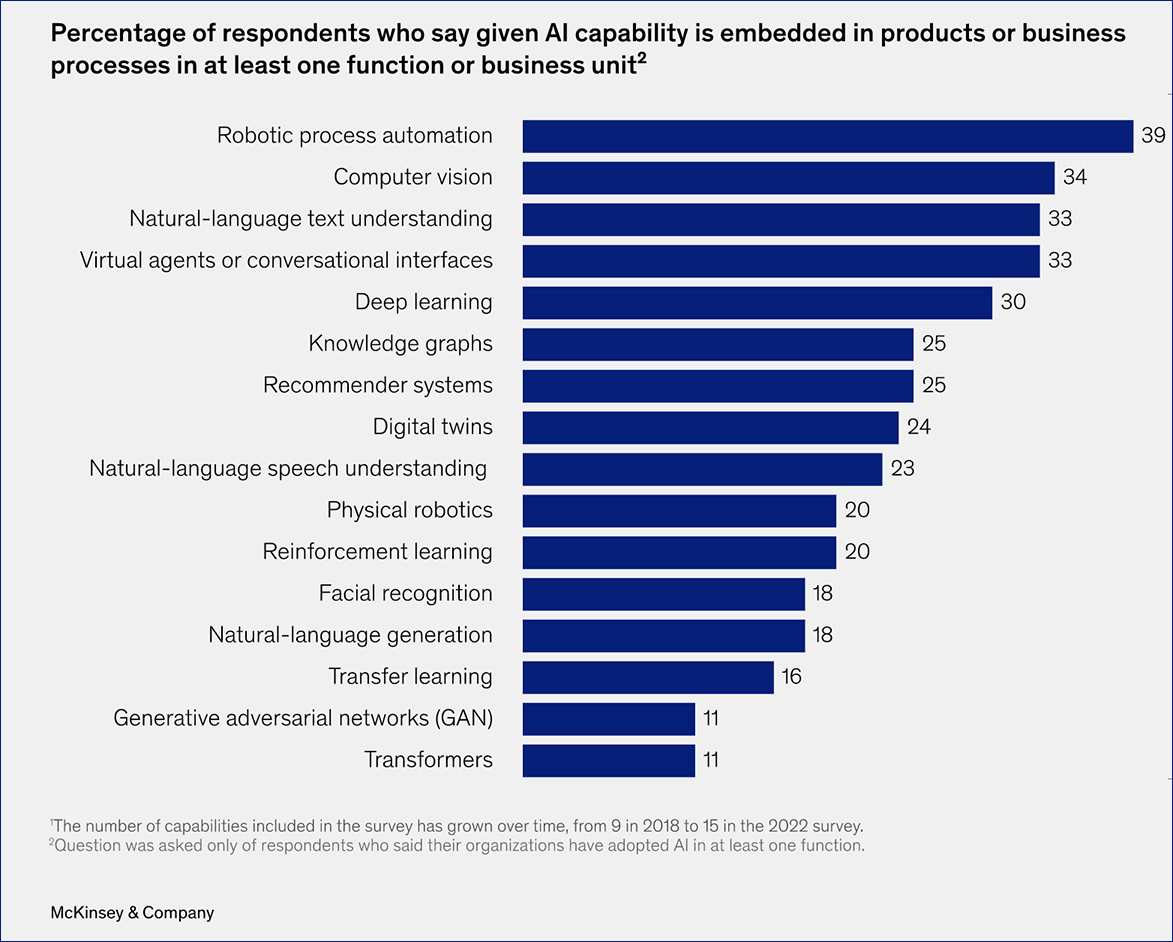
The state of AI in 2022—and a half decade in review — from mckinsey.com
The results of this year’s McKinsey Global Survey on AI show the expansion of the technology’s use since we began tracking it five years ago, but with a nuanced picture underneath.
Example graphic:
AI is finally good at stuff, and that’s a problem — from vox.com by Rebecca Heilweil
Here’s why you’ve been hearing so much about ChatGPT.
Excerpt (emphasis DSC):
A few weeks ago, Wharton professor Ethan Mollick told his MBA students to play around with GPT, an artificial intelligence model, and see if the technology could write an essay based on one of the topics discussed in his course. The assignment was, admittedly, mostly a gimmick meant to illustrate the power of the technology. Still, the algorithmically generated essays — although not perfect and a tad over-reliant on the passive voice — were at least reasonable, Mollick recalled. They also passed another critical test: a screening by Turnitin, a popular anti-plagiarism software. AI, it seems, had suddenly gotten pretty good.
It certainly feels that way right now. Over the past week or so, screenshots of conversations with ChatGPT, the newest iteration of the AI model developed by the research firm OpenAI, have gone viral on social media.
1 Timothy 1:12-17 — from biblegateway.com
The Lord’s Grace to Paul
12 I thank Christ Jesus our Lord, who has given me strength, that he considered me trustworthy, appointing me to his service. 13 Even though I was once a blasphemer and a persecutor and a violent man, I was shown mercy because I acted in ignorance and unbelief. 14 The grace of our Lord was poured out on me abundantly, along with the faith and love that are in Christ Jesus.
15 Here is a trustworthy saying that deserves full acceptance: Christ Jesus came into the world to save sinners—of whom I am the worst. 16 But for that very reason I was shown mercy so that in me, the worst of sinners, Christ Jesus might display his immense patience as an example for those who would believe in him and receive eternal life. 17 Now to the King eternal, immortal, invisible, the only God, be honor and glory for ever and ever. Amen.
From DSC:
I was watching a sermon the other day, and I’m always amazed when the pastor doesn’t need to read their notes (or hardly ever refers to them). And they can still do this in a much longer sermon too. Not me man.
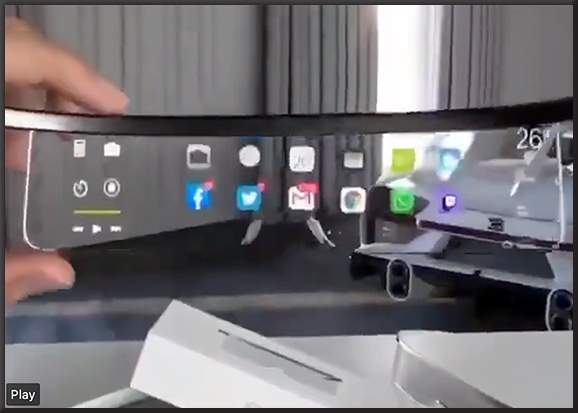
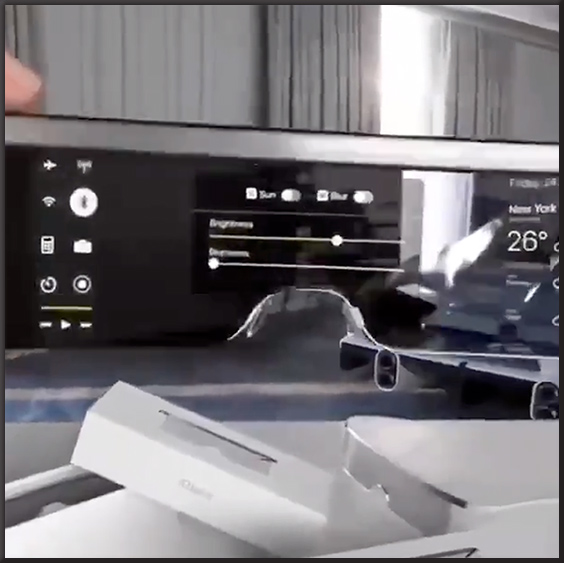
It got me wondering about the idea of having a teleprompter on our future Augmented Reality (AR) glasses and/or on our Virtual Reality (VR) headsets. Or perhaps such functionality will be provided on our mobile devices as well (i.e., our smartphones, tablets, laptops, other) via cloud-based applications.
One could see one’s presentation, sermon, main points for the meeting, what charges are being brought against the defendant, etc. and the system would know to scroll down as you said the words (via Natural Language Processing (NLP)). If you went off script, the system would stop scrolling and you might need to scroll down manually or just begin where you left off.
For that matter, I suppose a faculty member could turn on and off a feed for an AI-based stream of content on where a topic is in the textbook. Or a CEO or University President could get prompted to refer to a particular section of the Strategic Plan. Hmmm…I don’t know…it might be too much cognitive load/overload…I’d have to try it out.
And/or perhaps this is a feature in our future videoconferencing applications.
But I just wanted to throw these ideas out there in case someone wanted to run with one or more of them.
Along these lines, see:
Tell me you’re not going to want a pair of #AR glasses ?
? @TechAmazing #AugmentedReality #Wearables #5G #CES2023 #FutureOfWork #AI #cloud
pic.twitter.com/He5d1bSnQK— Glen Gilmore | ?? #CES2023 (@GlenGilmore) December 3, 2022
.
After playing with in for the past 24 hours, I believe #ChatGPT is going to change the world, including the world of law and legal education. Ignore it at your peril. #AI #innovation #legaltech
— Gabe Teninbaum (@GTeninbaum) December 3, 2022
More interesting results from #ChatGPT. I entered the same prompt about a bicycle accident twice — once bracketed by clear messaging that I was looking for legal advice, once without that messaging. Check out the differences. pic.twitter.com/BJJiGjAvs6
— Jordan Furlong (@jordan_law21) December 6, 2022

Example resources:
- Trends in legal technology post-pandemic — by Caroline Boudreau Sweeney
- Trends in Legal technology — by CIOReview
Also see:
In this episode we discuss:
- Some background on our guest Gabe Teninbaum, and why he’s passionate about spaced repetition
- The theory behind spaced repetition and how it works in practice
- Using spaced repetition to memorize material as a law student
- How early in your study should you start using the spaced repetition technique?
- Does learning with spaced repetition as a law student help lay the foundation for bar study?
- How you can use the spacedrepetition.com website for your law school and bar exam studies
One of the best decisions I’ve ever made as a prof is to start building my classes to start with 1 week of onboarding followed by just 12 weeks of content. Last 2 weeks are just catchup and reassessment. Course is basically over at Thanksgiving.
— Robert Talbert (@RobertTalbert) November 28, 2022
From DSC:
With a shout out to Beth McMurtrie’s Teaching Newsletter for pointing this Tweet out from Robert Talbert. Nice work Robert and Beth!
Global Education Market to reach $10 Trillion by 2030 — from holoniq.com
Excerpt:
The global education market is set to reach at least $10T by 2030 as population growth in developing markets fuels a massive expansion and technology drives unprecedented re-skilling and up-skilling in developed economies. The next decade will see an additional 350 million post secondary graduates and nearly 800 million more K12 graduates than today. Asia and Africa are the driving force behind the expansion. The world needs to add 1.5 million teachers per year on average, approaching 100 million in total in order to keep pace with the unprecedented changes ahead in education around the world.

2023 Higher Education Trend Watch — from educause.edu
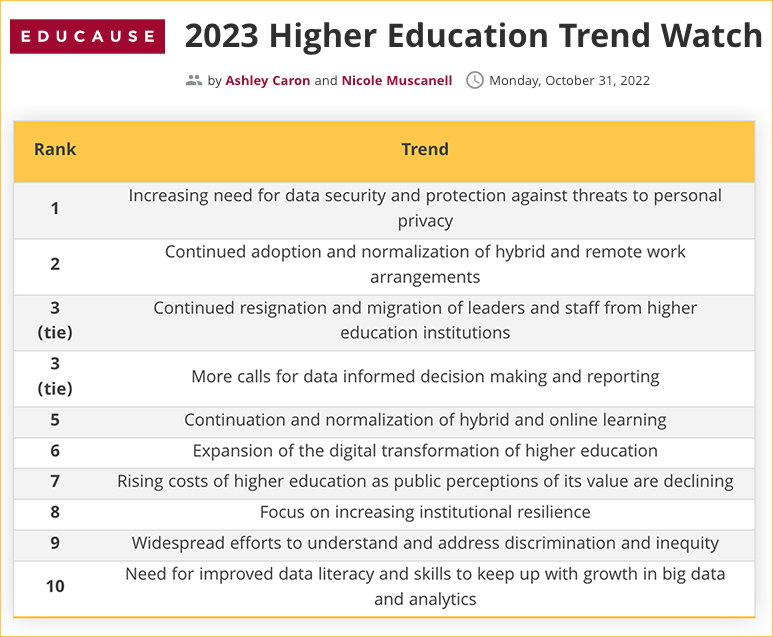
Also see:
2023 Strategic Trends Glossary — from educause.edu
Excerpts:
- Closer alignment of higher education with workforce needs and skills-based learning
- Continuation and normalization of hybrid and online learning
- Continued adoption and normalization of hybrid and remote work arrangements
- Continued resignation and migration of leaders and staff from higher education institutions
- Declining public funding for higher education
- …and more
Higher Ed Is a Land of Dead-End Jobs — from chronicle.com by Kevin R. McClure
Colleges have done a spectacularly bad job of managing talent.
Excerpt:
It’s hard to conclude anything other than that higher education has done a spectacularly bad job of managing talent. Campuses have evolved over centuries and dedicated resources to perfect the art and science of human development, while largely outsourcing or ignoring the professional growth and learning of their employees. Rather than draw upon their own experts to develop and retain workers, institutions let employees burn out, and then replace them.
When I floated the idea of dead-end jobs in higher education on Twitter, I was floored by the volume and breadth of responses.
From DSC:
Having worked half of my career in the corporate world and the other half within higher education, I would agree with the main points of this article. There are very few job pathways within the world of higher education.
Looking at the one pathway that I’ve seen…it surprises me to think that faculty members who have taught in the classroom and/or served as department chairs or deans for X years are then put into the Provost position and expected to know how to do that job. There is little — if any — training on project management, how to think more strategically and with greater vision, change management, managing budgets, and managing/motivating people.
Mind-blowing structure relocation projects
by @gigadgets_#AI #ArtificialIntelligence #MI #Robotics #MachineLearning #FutureOfWork #Engineering #Innovationcc: @terenceleungsf @jamesmarland @wil_bielert @ronald_vanloon pic.twitter.com/N1ydzba6TZ
— Ronald van Loon (@Ronald_vanLoon) December 4, 2022
This is how the Panama Canal works
pic.twitter.com/jo35rWZJE9— Tech Burrito (@TechAmazing) December 4, 2022
A cardboard escalator
pic.twitter.com/XkXV0GPlRx— Tech Burrito (@TechAmazing) December 7, 2022
Alexandr Hrustevich playing Vivaldi.. ? pic.twitter.com/bBcJruMVVu
— Buitengebieden (@buitengebieden) December 4, 2022
Also see Alexander Hrustevich’s bio.