Top List: The Best Mobile Learning Content Development Companies (2023) — from elearningindustry.com by Christopher Pappas

Summary: 

Working remotely has brought a major shift to corporate training, making mobile learning more important than ever. Your top assets, and frankly your whole staff, will need to adjust to this new reality. To help you out, we decided to gather the best content providers for mobile learning in one place. Explore our top list and find the right partner to start your mobile learning project or even develop your own mobile app. Are you ready?


2022 European edtech report: Smaller rounds and fewer deals, but more angel activity — from techcrunch.com by Rhys Spence

Excerpt:

Against this background, we formed our annual review of European edtech activity for 2022. For the first time since 2014, venture capital funding to European edtech startups saw a decline year-over-year, with startups raking in $1.8 billion in 2022 compared to $2.5 billion a year earlier.

The global ecosystem has been on an upward trajectory, albeit less consistently, but the declines in new investment in 2022 were steep: globally funding declined to $9.1 billion last year from $20.1 billion in 2021. This is in line with macro trends in the public markets as well as other tech sectors (both trends were highlighted in our October report with Dealroom).


Unbundled: Designing Personalized Pathways for Every Learner — from gettingsmart.com by Nate McClennen “with contributions from the Getting Smart team and numerous friends and partners in the field”

Excerpts:

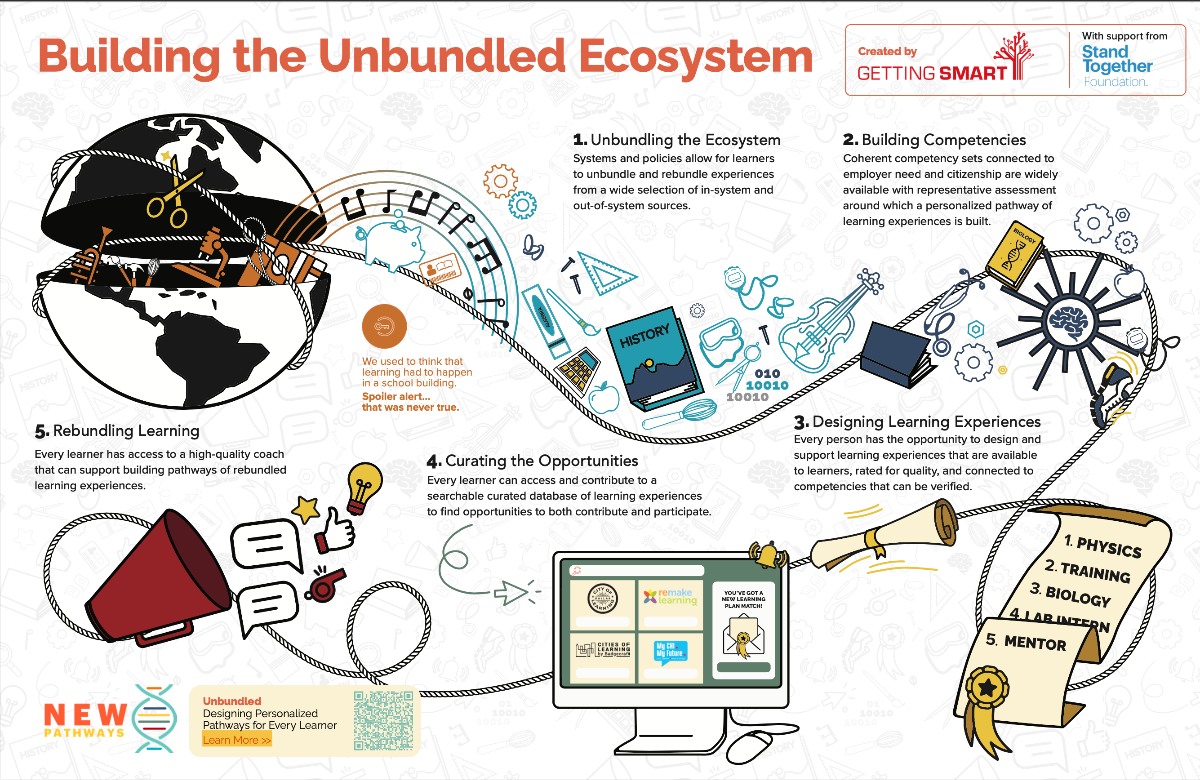
In this publication, we articulate the critical steps needed to unbundle the learning ecosystem, build core competencies, design learning experiences, curate new opportunities, and rebundle these experiences into coherent pathways.
.

Building the Unbundled Ecosystem

Vision

Every learner deserves an unlimited number of unbundled opportunities to explore, engage, and define experiences that advance their progress along a co-designed educational pathway. Each pathway provides equitable and personalized access to stacked learning experiences leading to post-secondary credentials and secure family-sustaining employment. Throughout the journey, supportive coaches focus on helping learners build skills to navigate with agency. In parallel, learners develop foundational skills (literacy, math), technical skills, and durable skills and connect these to challenging co-designed experiences. The breadth and depth of experiences increase over time, and, in partnership, learners and coaches map progress towards reaching community-defined goals. This vision is only enabled by an unbundled learning ecosystem.

Recommendations

Solutions already exist in the ecosystem and need to be combined and scaled. Funding models (like My Tech High), badging/credentialing at the competency level (like VLACS), coaching models (like Big Thought), and open ecosystems (like NH Learn Everywhere) provide an excellent foundation. Thus, building unbundled systems has already begun but needs systemic changes to become widely available and accepted.

      1. Build a robust competency-based system.
      2. Create a two-way marketplace for unbundled learning.
      3. Implement policy to support credit for out-of-system experiences.
      4. Invest in technology infrastructure for Learning and Employment Records.
      5. Design interoperable badging systems that connect to credentials.
 

Take Your Words From Lecture to Page — from chronicle.com by Rachel Toor
What compelling lecturers do, and how their techniques can translate to good writing.

Excerpts:

Thing is, many of the moves that the best lecturers make on the stage can translate to the page and help you draw in readers. That is especially important in writing textbooks and other work for general readers. If you can bring the parts of yourself that work in the classroom to the prose, you will delight readers as much as you do your students.

Narrative can be key. Data and research aren’t enough in either the classroom or on the page. People like to be told stories. If you want to be persuasive in both realms, use narrative to make arguments. Don’t forget that much scholarly work is really a quest. What journey can you take a reader on?

It’s a performance on the page, too. A great lecture is a performance. So is great writing.

Raise real questions the reader will want answers to. 


What is college for? Gov. Shapiro raises the question. Higher ed leaders are listening. — from The Philadelphia Inquirer by Will Bunch; with thanks to Ray Schroeder out on LinkedIn for the resource
Pa.’s new governor Josh Shapiro’s first move was to question the need of a college diploma as a job credential. U.S. universities, pay attention.

Excerpt:

NEW HAVEN, Conn. — What is college actually for?

No one expected this to be the initial question raised by Pennsylvania’s new governor, Josh Shapiro, in his first full day on the job. While he may not have stated it explicitly, this was the essence of the Democrat’s very first executive order, which opened up some 92% of job listings in state government — about 65,000 in all — to applicants who don’t have a four-year college degree.

In branding degree requirements for many jobs as “arbitrary” and declaring “there are many different pathways to success,” the Keystone State’s new chief executive was tugging at the shaky Jenga block that has undergirded the appalling rise of a $1.75 trillion student debt bomb in the U.S. and led, arguably, to a college/non-college divide driving our nation’s bitter politics. The notion is this: You can’t make it in 21st-century America without that most expensive piece of sheepskin: the college diploma.

So the $64,000 question (OK, $80,000 … for one year on some elite private campuses) is this: If you don’t need the credential, do you actually need college?

Something is clearly gained by giving America’s young people more career options that won’t contribute to that $1.75 trillion college debt bomb. But are we talking enough about what could be lost in a new system that not only devalues the university but also seems to ratify a dubious idea — that higher education is almost solely about careerism, and not the wider knowledge and critical-thinking skills that come from liberal arts learning?

From DSC:
To me — and to many other parents and families — it all boils down to the price tag of obtaining a liberal arts education. It’s one thing to get a liberal arts education at $5K per year. It’s another thing when the pricetag runs at $40K and above (per year)! Most people ARE FORCED to question the ROI of a liberal arts education. They simply have to.

On a relevant tangent here…many inside the academy have traditionally looked with disdain at the corporate world. The thinking went something like this:

Business! Ha! We are not a business! Students are not customers. Don’t ever compare us to the corporate world.

Having spent half of my career in the corporate world, I do not subscribe to that perspective. In fact, I’d like to ask those who still hold this point of view:
  • Where else can you pay tens of thousands of dollars for something and not be treated as a customer?! Don’t you typically expect value on your own purchases and positive returns on your investments?
  • How will you collaborate with the corporate world if you look upon them with disdain?!

But now that colleges and universities enrollments are not doing so well, perhaps there will be more openness to change and towards developing more impactful collaborations.


Virtual Exam Case Primes Privacy Fight Over College Room Scans — from news.bloomberglaw.com by Skye Witley

  • Cleveland State case centers on remote proctoring software
  • Fourth Amendment protections in question before Sixth Circuit

Excerpt:

A legal dispute over a university’s use of exam proctoring software that allegedly scanned students’ rooms is set to shape the scope of Fourth Amendment and privacy protections for online college tests.

Cleveland State University last week asked a federal appeals court in Cincinnati to review a district court finding that the “room scans” were unconstitutional searches. The case could influence how other students litigate their privacy rights and change how universities virtually monitor their students during exams, attorneys said.


Colleges consider overhauling grading system for freshmen to ease transition to higher learning — from mercurynews.com by Kate Hull
Supporters say ‘ungrading’ could result in less stress and a more level playing field for students from less rigorous high schools  

Excerpt:

Dubbed “weed-out” or “gatekeeper” classes, they can be dream-crushing for many students — especially those hoping to enter the science, technology, engineering and math (STEM) fields. And a growing body of research says the courses can be particularly discriminatory toward historically excluded groups such as Latinos and Black and Indigenous people.

One possible remedy, some educators say, is “ungrading,” a style of teaching and assessment that seeks to evaluate students in other ways besides A-F letter grades — usually just in their freshman year.

“You’re trying to move the focus from a score to the learning,” said Robin Dunkin, who teaches biology and is the assistant faculty director at UCSC’s Center for Innovations in Teaching and Learning.  “For that reason, it’s immensely powerful.”


Also relevant see the #Ungrading hashtag on Twitter, from which the below item was taken:

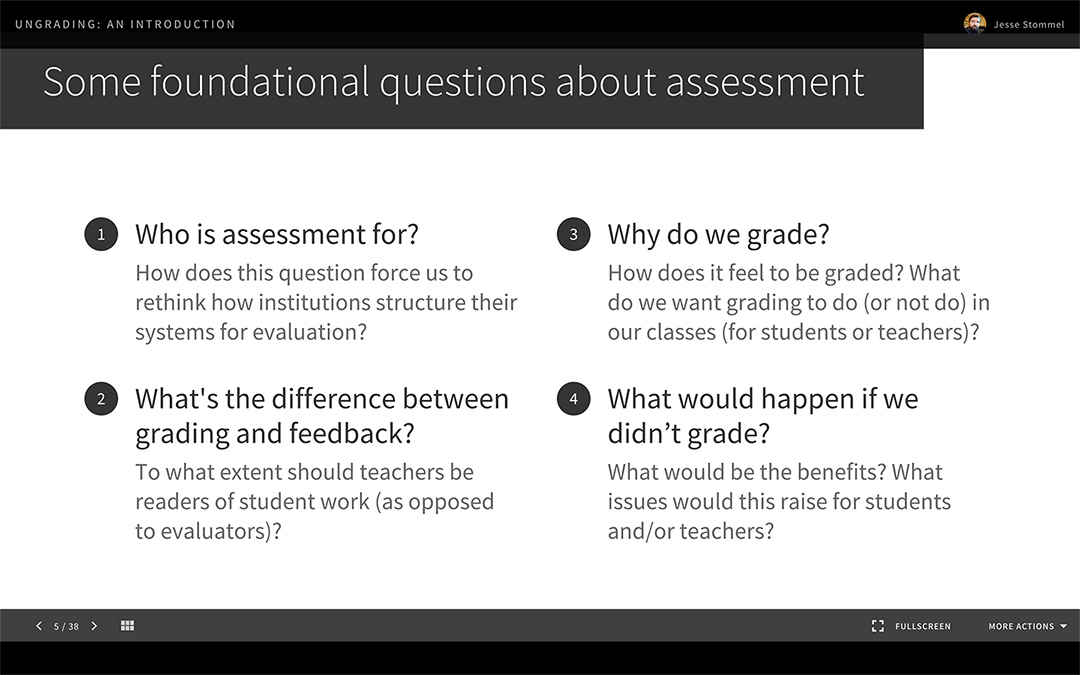
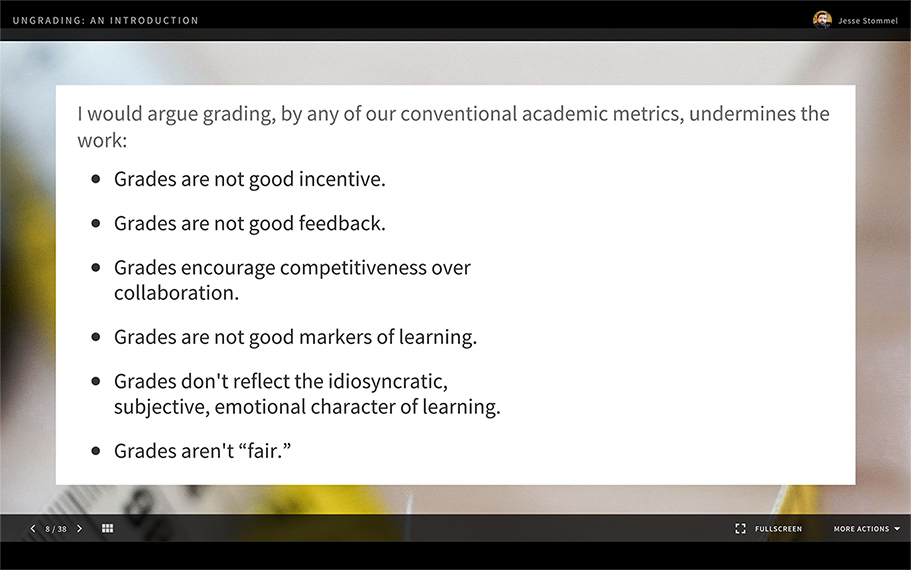
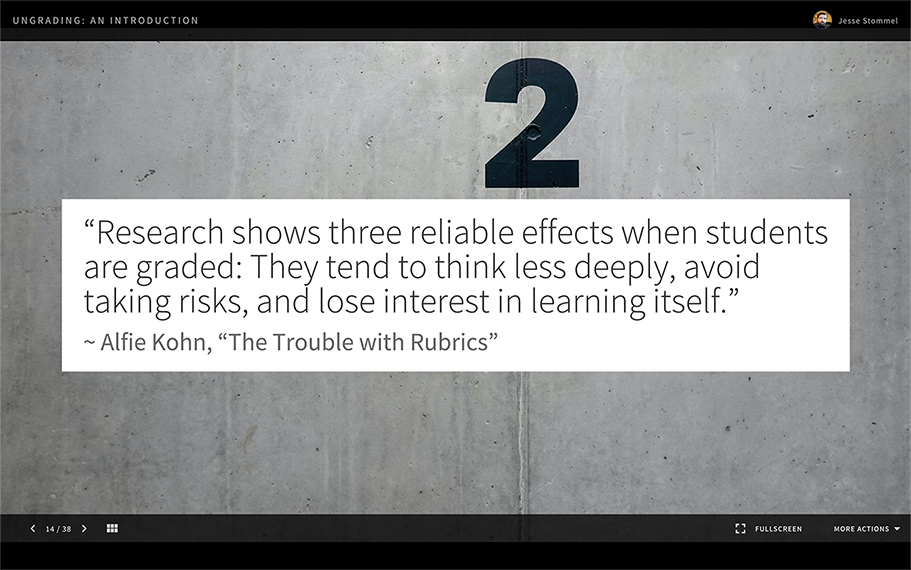
Excerpts from Jesse Stommel’s Ungrading: an Introduction presentation:

An excerpt from Ungrading - an Introduction by Jesse Stommel

An excerpt from Ungrading - an Introduction by Jesse Stommel

An excerpt from Ungrading - an Introduction by Jesse Stommel


Also relevant/see Robert Talbert’s Grading for Growth.


The practical guide to using AI to do stuff — from oneusefulthing.substack.com by Ethan Mollick; with thanks to Sam DeBrule for this resource. Ethan Mollick is a professor at the Wharton School of the University of Pennsylvania where he studies entrepreneurship & innovation, as well as how we can better learn and teach.
A resource for students in my classes (and other interested people).

Excerpts:

My classes now require AI (and if I didn’t require AI use, it wouldn’t matter, everyone is using AI anyway). But how can students use AI well? Here is a basic tutorial and guide I am providing my classes. It covers some of the many ways to use AI to be more productive, creative, and successful, using the technology available in early 2023, as well as some of the risks.

Come up with ideas 
Open Source Option: Nothing very good
Best free (for now) option: ChatGPT (registration may require a phone number)
Best option if ChatGPT is down: OpenAI Playground
.


Also relevant/see:

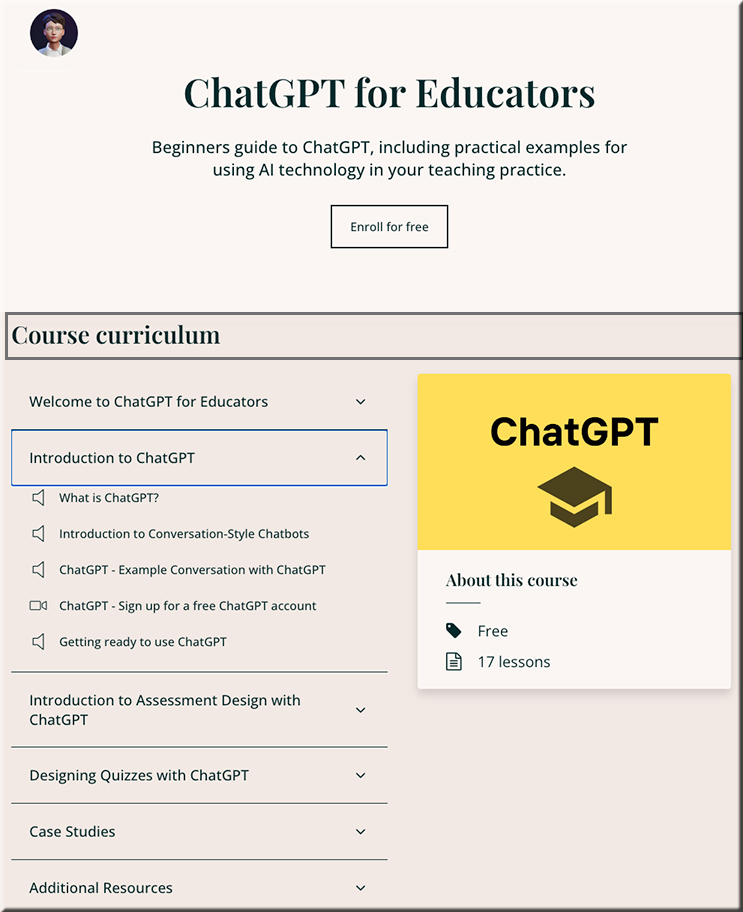
ChatGPT for educators -- a free 17 lesson course


On a relevant note:

Gen Z says school is not equipping them with the skills they need to survive in a digital world — from fastcompany.com by Shalene Gupta; with thanks to Robert Gibson for this resource
According to a study from Dell Technologies, Gen Z-ers in 15 different countries feel their government could do better.

Excerpt:

They see an education and skills gap: Forty-four percent said that school only taught them very basic computing skills, while 37% said that school education (for children under age 16) didn’t prepare them with the technology skills they needed for their planned careers. Forty percent consider learning new digital skills essential to future career options.

It’s clear that Gen Z see technology as pivotal for their future prosperity. It is now up to us—leading technology providers, governments, and the public sector—to work together and set them up for success by improving the quality and access to digital learning. Forty-four percent of Gen Z feel educators and businesses should work together to bridge the digital skills gap, and with the speed at which technology continues to evolve, this will require constant collaboration.

Aongus Hegarty, president of international markets at Dell Technologies


Psalms 16:1-2 — from bible.com

Keep me safe, my God, for in you I take refuge. I say to the LORD, “You are my Lord; apart from you I have no good thing.”


Revolutionising Criminal Law with AI — from seotraininglondon.org by Danny Richman
This case study outlines how I helped a law firm use Artificial Intelligence (AI) to streamline new client enquiries, resulting in significant savings of time and money.

Excerpt:

However, this process took up a lot of time and resources, meaning that highly qualified, well-paid individuals had to dedicate their time and energy to processing email enquiries instead of working on client cases.

That’s why I developed an app for Stuart Miller built on OpenAI’s GPT-3 technology. This app receives the content of the client’s email and makes the same determination as the human team of lawyers. It then immediately alerts the relevant lawyer to any enquiries flagged as high-priority, high-value cases. The entire process is automated requiring no human interaction.

From DSC:
Hmmm…something to keep on the radar.


Also relevant/see:

Here’s Why Lawyers Are Paying Attention to ChatGPT — from legallydisrupted.com by Zach Abramowitz
AI Will Continue to Be a Talking Point Throughout the Year

Excerpts:

Ready to get disrupted? Me neither, but let’s take the plunge.

ChatGPT is all anyone in legal wants to talk about right now, and for good reason.

Smash cut to yesterday, and this webinar focusing on ChatGPT is sold out and the sheer number of questions from the audience (which ranged from law students to in-house counsel and law firm partners) was more than 10x a normal webinar.

The point is that I’m not in a bubble this time. Everyone in legal is paying attention to ChatGPT, not just the legaltech nerds. This @#$% is going mainstream.


ChatGPT can’t be credited as an author, says world’s largest academic publisher — from theverge.com by James Vincent; with thanks to Robert Gibson on LinkedIn for the resource
But Springer Nature, which publishes thousands of scientific journals, says it has no problem with AI being used to help write research — as long as its use is properly disclosed.

Excerpt:

Springer Nature, the world’s largest academic publisher, has clarified its policies on the use of AI writing tools in scientific papers. The company announced this week that software like ChatGPT can’t be credited as an author in papers published in its thousands of journals. However, Springer says it has no problem with scientists using AI to help write or generate ideas for research, as long as this contribution is properly disclosed by the authors.


On somewhat-related notes:

Uplevel your prompt craft in ChatGPT with the CREATE framework — from edte.ch by Tom Barrett

Excerpt:

The acronym “CREATE” is a helpful guide for crafting high-quality prompts for AI tools. Each letter represents an important step in the process.

The first four CREA are all part of prompt writing, where TE, the final two are a cycle of reviewing and editing your prompts.

Let’s look at each in more detail, with some examples from ChatGPT to help.

BuzzFeed to Use ChatGPT Creator OpenAI to Help Create Quizzes and Other Content — from wsj.com by Alexandra Bruell (behind paywall)
CEO Jonah Peretti intends for artificial intelligence to play a larger role in the company this year


Retrieval Practice, Scaffolding, and the Socratic Method — from scholarlyteacher.com by Todd Zakrajsek
Revisit the Socratic method by using it to enact retrieval practice and scaffolding in courses and refresh thinking about applying recommendations from the Scholarship of Teaching and Learning (SOTL)

Excerpt:

When students think they know course material because they have collected reams and reams of information, retrieval practice, much like Socratic questioning, forces students to stop, think, reflect, and reconsider. It meets students where they are (e.g., overwhelmed with information), encourages effortful struggle associated with learning (e.g., presents a desirable difficulty), and offers the discipline of practice (or, perhaps, the practice of discipline). The goal of retrieval practice, getting information out, reflects the goal of so many of Socrates’s questions, to make his interlocutors give an account of and become more aware of their thinking.

When faculty chunk up material, assist students as they move through Bloom’s taxonomy, model approaches to help students get started and maintain momentum, make the student an active participant in developing and reflecting on knowledge, they are incorporating key elements of some of the most important recommendations from the Scholarship of Teaching and Learning. All these techniques help students build or generate knowledge.


Phoenix Goes Nonprofit? — from read.letterhead.email by Paul Fain

Excerpt:

“We’re seeing dramatically increased competitive intensity,” he said. “Being online is no longer a differentiator.”

Also from Paul Fain:

A true alternative to a four-year college? — from workshift.opencampusmedia.org
The Marcy Lab School in New York City aims to offer a traditional college experience in just one year. We talked with co-founder Reuben Ogbonna about experimentation, growth, and student choice in higher ed.

Times Square in New York City -- Photo by Paulo Silva via Unsplash

Excerpts (emphasis DSC):

In our current landscape, jobs for young people that fall into this category are incredibly slim, but we see this as our opportunity to systematically remove the barriers, such as degree requirements, that shut out students like ours. Together with our partners, we are actively reframing what early talent success can look like.

Partners that “get it” are energized by the ability to co-create innovative new programs like apprenticeships with us directly. They are incredibly student-centric, and firmly believe in the power of growth for our students in professional environments that are fun, challenging, rewarding, and safe.

The success of our innovative model has been through intentional experimentation and thoughtful listening to what is working and not working, and then iterating on it. 


Tired of the Same Old Professional Development? Let Students Lead. — from edsurge.com by Matt Homrich-Knieling

Excerpts (emphasis DSC):

Despite my love for learning, I strongly disliked most professional development sessions. The way sessions were facilitated often contradicted research-based teaching strategies. It is also frustrating when pre-packaged PD sessions are disconnected from your specific school context and student population.

To most teachers, this critique isn’t surprising. PD has a bad reputation in education circles, and it isn’t because teachers are resistant to professional learning. On the contrary, teachers want professional learning that is practical, engaging and relevant.

A group of students from the club met with the principal and explained their idea for leading a PD on building classroom community and supporting student self-confidence.

“Think about times when you lacked community or self-confidence in class. What did the teacher do/not do that led you to that experience? On the other hand, think about times when you felt a great sense of community or self-confidence in class. What did the teacher do/not do that led you to that experience?”

From DSC:
“On the contrary, teachers want professional learning that is practical, engaging and relevant.

Hmmm…sounds like what students want as well.

 
© 2025 | Daniel Christian