Psalms 36:5-7 NIV — from bible.com

Your love, LORD, reaches to the heavens, your faithfulness to the skies. Your righteousness is like the highest mountains, your justice like the great deep. You, LORD, preserve both people and animals. How priceless is your unfailing love, O God! People take refuge in the shadow of your wings.


Luke 5:31-32 — from bible.com

“Jesus answered them, “It is not the healthy who need a doctor, but the sick. I have not come to call the righteous, but sinners to repentance.””
Luke 5:31-32 NIV

From DSC:
LORD, thank you for your grace, patience, and love.


A Spotify model of personalised higher education — from timeshighereducation.com by Michael Rosemann and Martin Betts
With technology offering greater potential for a personalised approach to higher education, Michael Rosemann and Martin Betts look at what universities can learn from the ubiquitous music platform Spotify

Excerpts (emphasis DSC):

Selection, or the P(upil)-route as educationalist Dan Buckley calls it, means personalisation driven by the learner. This is the fastest-moving form of personalised learning. Not only do students benefit from true omnichannel education – choosing between face to face and online – they also independently navigate the internet’s resources and online databases in search of the knowledge that will help them to achieve their learning targets.

Automation,  or the A-route, is the new enabler of personalised learning. As with personalised medicine, finance or entertainment, education is starting to use digital technologies to unlock new models of tailored engagement. While for most universities, AI-driven, personalised education is not an option as the required capabilities are missing and significant investments would be necessary, there is a range of alternative forms of automated personalised learning. For this, we look to providers outside the sector for inspiration.

Here are Spotify-inspired ideas that universities ambitious enough to provide personalised learning could explore.

From DSC:
Rosemann & Betts use the term “omnichannel education” — I like that term. Very nice.


Law has a magic wand now — from jordanfurlong.substack.com by Jordan Furlong
Some people think Large Language Models will transform the practice of law. I think it’s bigger than that.

Excerpts:

ChatGPT4 can also do things that only lawyers (used to be able to) do. It can look up and summarize a court decisionanalyze and apply sections of copyright law, and generate a statement of claim for breach of contract.

What happens when you introduce a magic wand into the legal market? On the buyer side, you reduce by a staggering degree the volume of tasks that you need to pay lawyers (whether in-house or outside counsel) to perform. It won’t happen overnight: Developing, testing, revising, approving, and installing these sorts of systems in corporations will take time. But once that’s done, the beauty of LLMs like ChatGPT4 is that they are not expert systems. Anyone can use them. Anyone will.

But I can’t shake the feeling that someday, we’ll divide the history of legal services into “Before GPT4” and “After GPT4.” I think it’s that big.


From DSC:
Jordan mentions: “Some people think Large Language Models will transform the practice of law. I think it’s bigger than that.”

I agree with Jordan. It most assuredly IS bigger than that. AI will profoundly impact many industries/disciplines. The legal sector is but one of them. Education is another. People’s expectations are now changing — and the “ramification wheels” are now in motion.

I take the position that many others have as well (at least as of this point in time) that take the position that AI will supplement humans’ capabilities and activities. But those who know AI-driven apps will outcompete those who don’t know about such apps. 


We Can’t Keep ChatGPT Out of the Classroom, so Let’s Address the ‘Why’ Behind Our Fears — from edsurge.com by Alice Domínguez

Excerpt:

ChatGPT offers us an opportunity to address our fears, release our fixation on preventing cheating and focus our attention on more worthy priorities: providing students with compelling reasons to write, inviting them to wrestle with important questions and crafting a piece of writing that cannot be mistaken for a robot’s work.


As Schools Embrace Mastery Learning, and Confront Challenges of GPAs and College Admissions, Consortium Creates New ‘Bridge’ Transcript — from the74million.org by Patrick O’Donnell; via Ryan Craig
The Mastery Transcript Consortium is now piloting a ‘Learning Record’ that lets a broader view of students accompany standard grades in applications.

Excerpt:

Creators of a grading system that ditches traditional A-F grades for a new “mastery” transcript know that’s too big a leap for some schools to make, so they’ve created a “bridge” that can ease students, parents and college admissions officers into the shift.

“The single biggest barrier to adoption of the mastery transcript is that it’s perceived as risky, and kind of unfamiliar,” said Mike Flanagan, CEO of the Mastery Transcript Consortium, a national group that wants students to learn at their own pace and be rated continually on their progress, not just by snapshots when the calendar says a grading period ends.


The Ultimate Compilation of 101 GPT-4 L&D Prompts — from innovationlounge.notion.site

Examples:

  1. Design a personalized learning plan for a new employee joining a software development team, including onboarding, skill assessment, and ongoing development.
  2. Describe a strategy for implementing a mentorship program within an organization to improve employee development and retention.
  3. Suggest a framework for evaluating the effectiveness of a company’s existing learning and development programs.
  4. Propose a gamification strategy for engaging employees in a company-wide training program on diversity and inclusion.
  5. Identify potential barriers to effective remote learning and provide recommendations for overcoming them in a virtual training environment.
  6. Develop a plan for a “lunch-and-learn” series to encourage cross-functional collaboration and skill-sharing among employees.
  7. Recommend a variety of cost-effective resources (books, online courses, webinars, etc.) for training employees in project management skills.
  8. Design a three-month training program for a sales team to improve their negotiation and closing skills, including specific activities and milestones.
  9. Outline a strategy for integrating microlearning techniques into an organization’s existing training approach to boost knowledge retention and engagement.
  10. Suggest an approach for identifying and addressing skills gaps within a team or department, including assessment tools and targeted training resources.
 

60% of Higher Education Leaders Say Continuing Education is Not Well-Integrated into Institutional Portfolio Offerings — from finance.yahoo.com
Despite Belief that CE Programming Positively Affects Enrollments in Traditional Programming, CE Units Remain Under-Resourced

Excerpt:

TORONTO, March 22, 2023 /PRNewswire-PRWeb/ — While 71% of senior leaders within higher education institutions support scale and growth of continuing education (CE), more than half (57%) feel that their CE units are understaffed to execute on institutional goals. This is according to the 2023 State of Continuing Education report. Published by higher education engagement platform leader Modern Campus, in partnership with the Canadian Association for University Continuing Education (CAUCE), The EvoLLLution, and the University Professional and Continuing Education Association (UPCEA), the study explores professional, continuing, and online (PCO) unit program offerings, institutional support and capabilities, perceptions of the competitive landscape, and continuing education collaboration and integration within the larger institution.

“The future higher education institution is rooted in CE, but delivering on that promise requires both strategic and operational support from the institution,” said Amrit Ahluwalia, senior director of content and strategic insights at Modern Campus and editor-in-chief of The EvoLLLution. “It is our sincere belief that the findings of this study will enable CE professionals to advocate for greater resources and allow them to be seen for the critical functions that their portfolio plays for institutions and learners alike.”


Nvidia will bring AI to every industry, says CEO Jensen Huang in GTC keynote: ‘We are at the iPhone moment of AI’ — from venturebeat.com by Sharon Goldman

Excerpt:

As Nvidia’s annual GTC conference gets underway, founder and CEO Jensen Huang, in his characteristic leather jacket and standing in front of a vertical green wall at Nvidia headquarters in Santa Clara, California, delivered a highly-anticipated keynote that focused almost entirely on AI. His presentation announced partnerships with Google, Microsoft and Oracle, among others, to bring new AI, simulation and collaboration capabilities to “every industry.”

Introducing Mozilla.ai: Investing in trustworthy AI — from blog.mozilla.org by Mark Surman
We’re committing $30M to build Mozilla.ai: A startup — and a community — building a trustworthy, independent, and open-source AI ecosystem.

Excerpt (emphasis DSC):

We’re only three months into 2023, and it’s already clear what one of the biggest stories of the year is: AI. AI has seized the public’s attention like Netscape did in 1994, and the iPhone did in 2007.

New tools like Stable Diffusion and the just-released GPT-4 are reshaping not just how we think about the internet, but also communication and creativity and society at large. Meanwhile, relatively older AI tools like the recommendation engines that power YouTube, TikTok and other social apps are growing even more powerful — and continuing to influence billions of lives.

This new wave of AI has generated excitement, but also significant apprehension. We aren’t just wondering What’s possible? and How can people benefit? We’re also wondering What could go wrong? and How can we address it? Two decades of social media, smartphones and their consequences have made us leery.    

ChatGPT plugins — from openai.com

Excerpt:

Users have been asking for plugins since we launched ChatGPT (and many developers are experimenting with similar ideas) because they unlock a vast range of possible use cases. We’re starting with a small set of users and are planning to gradually roll out larger-scale access as we learn more (for plugin developers, ChatGPT users, and after an alpha period, API users who would like to integrate plugins into their products). We’re excited to build a community shaping the future of the human–AI interaction paradigm.


Bots like ChatGPT aren’t sentient. Why do we insist on making them seem like they are? — from cbc.ca by Matt Meuse
‘There’s no secret homunculus inside the system that’s understanding what you’re talking about’

Excerpt:

LLMs like ChatGPT are trained on massive troves of text, which they use to assemble responses to questions by analyzing and predicting what words could most plausibly come next based on the context of other words. One way to think of it, as Marcus has memorably described it, is “auto-complete on steroids.”

Marcus says it’s important to understand that even though the results sound human, these systems don’t “understand” the words or the concepts behind them in any meaningful way. But because the results are so convincing, that can be easy to forget.

“We’re doing a kind of anthropomorphization … where we’re attributing some kind of animacy and life and intelligence there that isn’t really,” he said.


10 gifts we unboxed at Canva Create — from canva.com
Earlier this week we dropped 10 unopened gifts onto the Canva homepage of 125 million people across the globe. Today, we unwrapped them on the stage at Canva Create.


Google Bard Plagiarized Our Article, Then Apologized When Caught — from tomshardware.com by Avram Piltch
The chatbot implied that it had conducted its own CPU tests.


Using AI to Help Organize Lesson Plans — from edutopia.org by Jorge Valenzuela
Artificial intelligence tools like ChatGPT can help educators find activities that are set up to teach designated skills.

Excerpt:

  1. My middle school students have to write a personal narrative about their experience with leadership and service. Which two or three specific Common Core State Standards are relevant to this task?
  2. Now rewrite those standards into three to four “I can” statements. Although the chatbot can give you a great starting point, you may need to reword these into learning goals better suited for your students.
  3. What formative assessments (formal and informal) can I use to check my students’ understanding of these standards?
  4. Given your “I can” statements, what lessons can I teach to help my students write their best personal narratives?
  5. Which high-yielding strategies can I use to teach these lessons? I aim to engage all my learners in tandem with increasing academic achievement.
  6. You mentioned using “differentiated instruction.” What methods can I use to support my English language learners to improve their narratives?
  7. Please provide the sources you used for your responses with websites.

10 Powerful Ways to End Your Lessons — from edutopia.org by Andrew Boryga
Instead of cleaning up or going over homework assignments, try these creative activities that can help students make sense of new material—and have fun in the process.

Excerpts:

4. Create News “Headlines” or “Six-word Summaries”: Pair students off and tell them to imagine they’re writing news headlines that summarize what they’ve learned. Challenge each pair to write at least two headlines, then come back together to review the headlines. Alternatively, you can do this as an entire class activity, writing the headlines suggested by students on your whiteboard.

5. Traffic Light: …Before students leave the room, they take sticky notes and write one thing they learned in the lesson and place it on the green light, one thing they’re still mulling over and place it on yellow light, and one thing they’re struggling to understand and place it on the red light.

2 Ways to Encourage Better Note-Taking — from edutopia.org by Marianna Ruggerio
Do your high school students think that taking notes during class means writing down everything you say? You can teach them effective note-taking skills that increase their engagement.

Distance Learning Strategies to Bring Back to the Classroom — from edutopia.org by Sarah Cooper
When schools closed, teachers were forced to get creative—and they’ve learned things they can use when they’re back at school.


DC: Other potential curricula would involve instructional design and instructional technology (which now includes using AI).


How AI will revolutionize the practice of law — from brookings.edu by John Villasenor

Artificial intelligence (AI) is poised to fundamentally reshape the practice of law. 

Excerpt:

BROADENING ACCESS TO LEGAL SERVICES
AI also has the potential to dramatically broaden access to legal services, which are prohibitively expensive for many individuals and small businesses. As the Center for American Progress has written, “[p]romoting equal, meaningful access to legal representation in the U.S. justice system is critical to ending poverty, combating discrimination, and creating opportunity.”

AI will make it much less costly to initiate and pursue litigation. For instance, it is now possible with one click to automatically generate a 1000-word lawsuit against robocallers. More generally, drafting a well-written complaint will require more than a single click, but in some scenarios, not much more. These changes will make it much easier for law firms to expand services to lower-income clients.


Houses of worship to move streaming from social media to dedicated platforms — from inavateonthenet.net

Houses of worship to move streaming from social media to dedicated platforms

Excerpt:

A report by Pushpay, with data from over 1,700 organisations has found that while 91% of churches currently livestream worship services on social media, only 47% plan to do the same in the upcoming year.

The report, entitled ‘State of Church Tech 2023 is available to download here.

The reason cited for this shift is organisations’ lack of control on social media platforms to maintain engagement, as users are bombarded with pop-up windows, notifications, status updates, and more.

This is driving a rise in custom video players, website embeds, mobile app streaming, and other platforms that are better suited to maintain engagement.


Begun, the AI lawsuits have — from bloomberg.com by Brad Stone

Excerpt:

A few intellectual property lawsuits have already been lobbed at the makers of these AI services. Getty sued Stability AI for building its image database by scraping millions of online images, many protected by copyright. In a similar suit, a San Francisco-based class action firm representing three artists sued Stability AI, DeviantArt and Midjourney for training their model with billions of copyrighted images. News publishers have also criticized OpenAI for using their articles to train its AI tools.

But the complaints focus on the creation and training of databases that feed these new AI engines — the inputs. It remains to be seen how rights holders will interpret the output — Yoda’s ramblings, for example — which have been coopted by Character.AI and its ilk without permission from Walt Disney Co.-owned Lucasfilm and other rights holders.


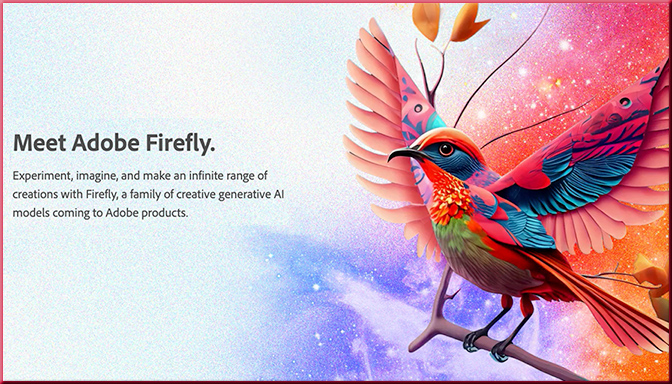
Meet Adobe Firefly. Experiment, imagine, and make an infinite range of creations with Firefly, a family of creative generative AI models coming to Adobe products.

Meet Adobe Firefly. — from adobe.com
Experiment, imagine, and make an infinite range of creations with Firefly, a family of creative generative AI models coming to Adobe products.

Generative AI made for creators.
With the beta version of the first Firefly model, you can use everyday language to generate extraordinary new content. Looking forward, Firefly has the potential to do much, much more.


Also relevant/see:

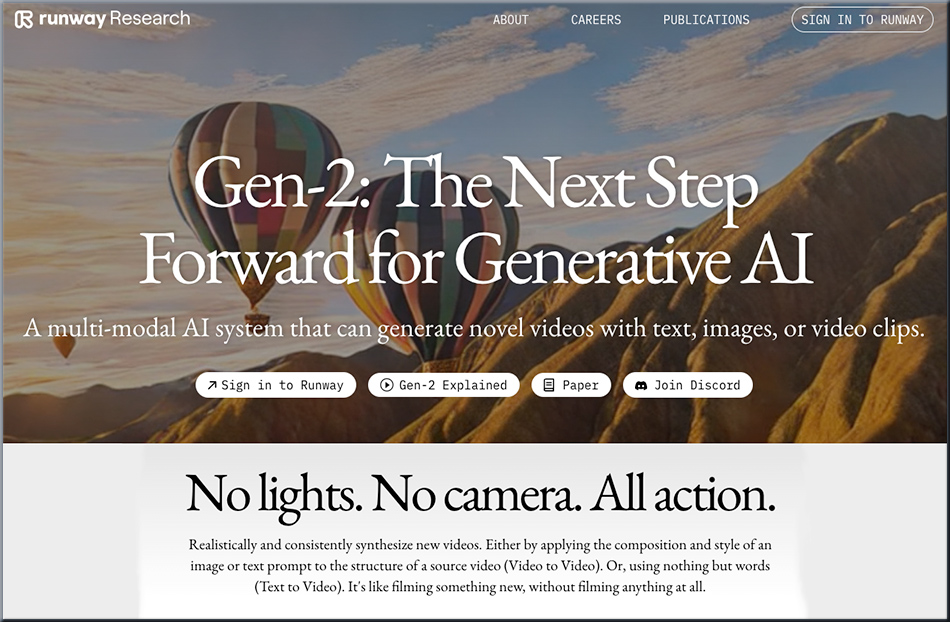
Gen-2 from runway Research -- the next step forward for generative AI

Gen-2: The Next Step Forward for Generative AI — from research.runwayml.com
A multi-modal AI system that can generate novel videos with text, images, or video clips.

Realistically and consistently synthesize new videos. Either by applying the composition and style of an image or text prompt to the structure of a source video (Video to Video). Or, using nothing but words (Text to Video). It’s like filming something new, without filming anything at all.


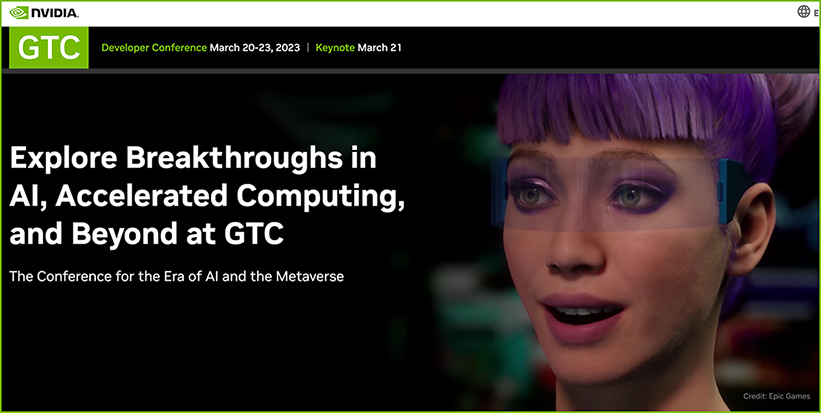
Explore Breakthroughs in AI, Accelerated Computing, and Beyond at NVIDIA's GTC -- keynote was held on March 21 2023

Explore Breakthroughs in AI, Accelerated Computing, and Beyond at GTC — from nvidia.com
The Conference for the Era of AI and the Metaverse


Addendums on 3/22/23:

Generative AI for Enterprises — from nvidia.com
Custom-built for a new era of innovation and automation.

Excerpt:

Impacting virtually every industry, generative AI unlocks a new frontier of opportunities—for knowledge and creative workers—to solve today’s most important challenges. NVIDIA is powering generative AI through an impressive suite of cloud services, pre-trained foundation models, as well as cutting-edge frameworks, optimized inference engines, and APIs to bring intelligence to your enterprise applications.

NVIDIA AI Foundations is a set of cloud services that advance enterprise-level generative AI and enable customization across use cases in areas such as text (NVIDIA NeMo™), visual content (NVIDIA Picasso), and biology (NVIDIA BioNeMo™). Unleash the full potential with NeMo, Picasso, and BioNeMo cloud services, powered by NVIDIA DGX™ Cloud—the AI supercomputer.

 
© 2025 | Daniel Christian