ChatGPT: Student insights are necessary to help universities plan for the future — from theconversation.com by Alpha Abebe and Fenella Amarasinghe

Excerpt:

In the race to get ahead of new technologies, are we forgetting about the perspectives of the most important stakeholders within our post-secondary institutions: the students?

Leaving students out of early discussions and decision-making processes is almost always a recipe for ill-fitting, ineffective and/or damaging approaches. The mantra “nothing for us without us” comes to mind here.


Evolving Zoom IQ, our smart companion, with new features and a collaboration with OpenAI — from blog.zoom.us

Excerpt:

Today we’re announcing that we’re evolving the capabilities of Zoom IQ to become a smart companion that empowers collaboration and unlocks people’s potential by summarizing chat threads, organizing ideas, drafting content for chats, emails, and whiteboard sessions, creating meeting agendas, and more.


Also from Julie Sobowale, see:

  • Law’s AI revolution is here — from nationalmagazine.ca
    At least this much we know. Firms need to develop a strategy around language models.

Also re: legaltech, see:

  • Pioneers and Pathfinders: Richard Susskind — from seyfarth.com by J. Stephen Poor
    In our conversation, Richard discusses the ways we should all be thinking about legal innovation, the challenges of training lawyers for the future, and the qualifications of those likely to develop breakthrough technologies in law, as well as his own journey and how he became interested in AI as an undergraduate student.

Also re: legaltech, see:

There is an elephant in the room that is rarely discussed. Who owns the IP of AI-generated content?


What’s Different Between the Life of a Classroom Teacher vs. Instructional Designer? — from tedcurran.net by Ted Curran

Excerpt:

How is the day-to-day life of an Instructional Designer different than that of a K12 classroom teacher?

Many classroom teachers are looking to make the switch into instructional design, and even though it’s all still teaching and learning, there are some big differences in the way you’ll work in an ID role.

This post attempts to outline the large changes you might find as you transition outside the classroom and into the world of ID.


You no longer need a college degree to work at these 7 companies — from businessinsider.com by Ethan Dodd

Key points:

  • College-degree requirements have locked out millions of Americans from good-paying jobs.
  • Persistent labor shortages are causing more and more companies to drop degree requirements.
  • These seven companies in tech, finance, and aviation are leading the charge.


To help new students adapt, some colleges are eliminating grades — from npr.org by Jon Marcus

Excerpt (emphasis DSC):

Experiences like these are among the reasons behind a growing movement to stop assigning conventional A through F letter grades to first-year college students and, sometimes, upperclassmen.

Called “un-grading,” the idea is meant to ease the transition to higher education — especially for freshmen who are the first in their families to go to college or who weren’t well prepared for college-level work in high school and need more time to master it.

But advocates say the most important reason to adopt un-grading is that students have become so preoccupied with grades, they aren’t actually learning.


Higher Learning Commission's 2023 Trends


Artist Spotlight: Minyoung Choi [booooooom.com]

Artist Spotlight: Minyoung Choi — from booooooom.com

Painting of a fish tank with colorful guppies in it


ChatGPT and AI Applications for In-house Lawyers — from docket.acc.com by Spiwe L. Jefferson

Excerpt:

The explosive emergence of ChatGPT as a consumer tool has catapulted Artificial Intelligence (AI) and its subfield, natural language processing (NLP), to the technology stage. As AI and NLP continue to evolve, the use of AI-powered tools, such as the Generative Pre-trained Transformer (GPT), in the legal industry has become increasingly prevalent. Many lawyers are experimenting with AI and grappling with its applications to streamline practices and improve efficiency.

While GPT and other AI-powered tools can potentially revolutionize aspects of the legal profession, it is important to consider the current limitations and potential pitfalls in implementing these technologies.

017 | Post-Event Learnings w/ AI Prompts |Brainyacts #17 — from thebrainyacts.beehiiv.com

Excerpt:

Earlier this week some of you were at Legalweek in New York. Others of you joined Terri Mottershead and the Centre for Legal Innovation to talk about what consultants think about ChatGPT/Generative AI.

Far too many of us attend these events and never take the time to invest in ourselves and our organizations by capturing our learnings and insights.

In fact, I will go a step further.

If your organization paid for you to go, there is an obligation to transfer your personal experience into one that benefits the organization. Sort of a return on investment for the $ and time away from the office.


Also relevant/see:

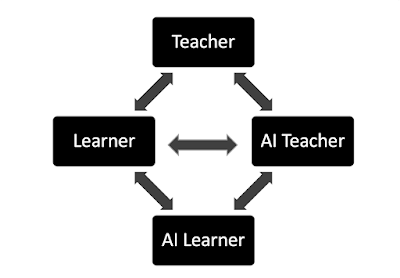
We have moved from Human Teachers and Human Learners, as a diad to AI Teachers and AI Learners as a tetrad.


How can we teach and assess with ChatGPT? — from timeshighereducation.com by Soumyadeb Chowdhury and Samuel Fosso Wamba
A guide to designing teaching and assessments that encourage students to learn with and about ChatGPT

Excerpts:

  1. Design activities that require reflection:
  2. Link essay-type assignments to novel case studies:
  3. Ask for more in essay assessments:
  4. Discuss openly the importance of human skills in their future careers:

Also relevant/see:

  • ChatGPT can generate, but can it create? — from ecampusnews.com Dr. Lee Ann Dickerson; with thanks to Ray Schroeder for posting this resource on LinkedIn
    The AI chatbot is taking many of us in education by surprise and startling more of us to attention

Also relevant/see:


Also relevant/see:

AI in the Classroom, Teachers as Learners, Denver-bound, and more — from ed3.beehiiv.com by Scott Meyer
The most exciting ideas in education, hand-picked for you


Duolingo is working on a music app — from techcrunch.com by Natasha Mascarenhas

Excerpt:

Duolingo, a language learning app with over 500 million users, is working on a music app, TechCrunch has learned.

The Pittsburgh-based tech company currently has a small team working on a music product and is hiring a learning scientist who is an “expert in music education who combines both theoretical knowledge of relevant learning science research and hands-on teaching experience,” according to a job posting listed on Duolingo’s career page.

In October 2022, the company announced Duolingo Math in its first subject expansion beyond its original roots of language learning and literacy. The math app is free and similar to language learning; both require methodical thinking and the ability to apply functions to get to answers.


From DSC:
While I continue to try and review/pulse-check the K12 learning ecosystem, it struck me that we need new, DIRECT communication channels between educators, support staff, administrators, and legislators — and possibly others.

That is:

  • How can teachers, support staff, and administrators talk directly to legislators?
  • How can legislators communicate with teachers, support staff, and administrators?
  • Should we require relevant legislators (i.e., those individuals sponsoring bills or major changes to our k12 learning ecosystem) to go through training on how students learn?
  • What communication vehicles are present? Can they be anonymous?
  • Should there be an idea 1-800 hotline or an idea “mailbox” (digital and/or analog based)?

And what about the students themselves and/or their parents/guardians? Should they be involved as well?

 
© 2025 | Daniel Christian