


Instant translation on the go #AI #MachineLearning #voice
RT @helene_wpli @BrianRoemmele @jblefevre60 @akwyz @DimitriHommel @alvinfoo @floriansemle @dinisguarda @YuHelenYu @kashthefuturist @MarshaCollier @CurtisSChin @Xbond49 @guzmand @kalydeoo @Ym78200 @ArnaultChatel pic.twitter.com/XcUiX9oNdz— Olivier Laborde ????? (@labordeolivier) February 13, 2019
On 02/12/2019,
in 21st century, 24x7x365 access, dangers of the status quo, Daniel S. Christian, law schools, legislatures / government / legal, pace of change, society, technology (general), the downsides of how people use tech, tools, trends,
by Daniel Christian
C-Level View | Feature:
Technology Change: Closing the Knowledge Gap — A Q&A with Mary Grush & Daniel Christian
Excerpts:
Technology changes quickly. People change slowly. The rate of technology change often outpaces our ability to understand it.
…
It has caused a gap between what’s possible and what’s legal. For example, facial recognition seems to be starting to show up all around us — that’s what’s possible. But what’s legal?
…
The overarching questions are: What do we really want from these technologies? What kind of future do we want to live in?
…
Those law schools that expand their understanding of emerging technologies and lead the field in the exploration of related legal issues will achieve greater national prominence.Daniel Christian
On 02/12/2019,
in 21st century, 24x7x365 access, A/V -- audio/visual, adult learning, career development, cloud-based computing / apps / other cloud-related, CMS/LMS, colleges, communities of practice, community colleges, consortiums, content development, aggregation, repositories, corporate / business world, corporate universities / corporate training, cost of getting a degree, credentialing, Daniel S. Christian, digital learning, disruption, distance education, education, education technology, elearning, emerging technologies, future, future of higher education, global / globalization, heutagogy, higher education, homeschooling/homeschoolers, human-computer interaction (HCI), ideas, innovation, instructional design, intelligent systems, intelligent tutoring, internet, K-12 related, law schools, learning, learning agents, learning ecosystem, Learning from the Living [Class] Room, learning hubs & pods & microschooling, learning preferences, learning spaces, library / librarians, lifelong learning, love of learning, MBA, media/film, microlearning, MOOCs -- Massive Open Online Courses, more voice more choice more control, multimedia, Natural Language Processing (NLP), online learning, online media, online tutoring, personalized/customized learning, platforms, professional development, smart classrooms, social learning / networks, society, staying relevant, streams of content, teaching & learning, technologies for your home, technology (general), television, tools, training / L&D, TVs, user experience (UX), user interface design, vendors, videoconferencing, virtual field trips, virtual K-12 schools, Virtual Reality (VR) / worlds / learning, virtual tutoring, vision/possibilities, web-based collaboration,
by Daniel Christian
From DSC:
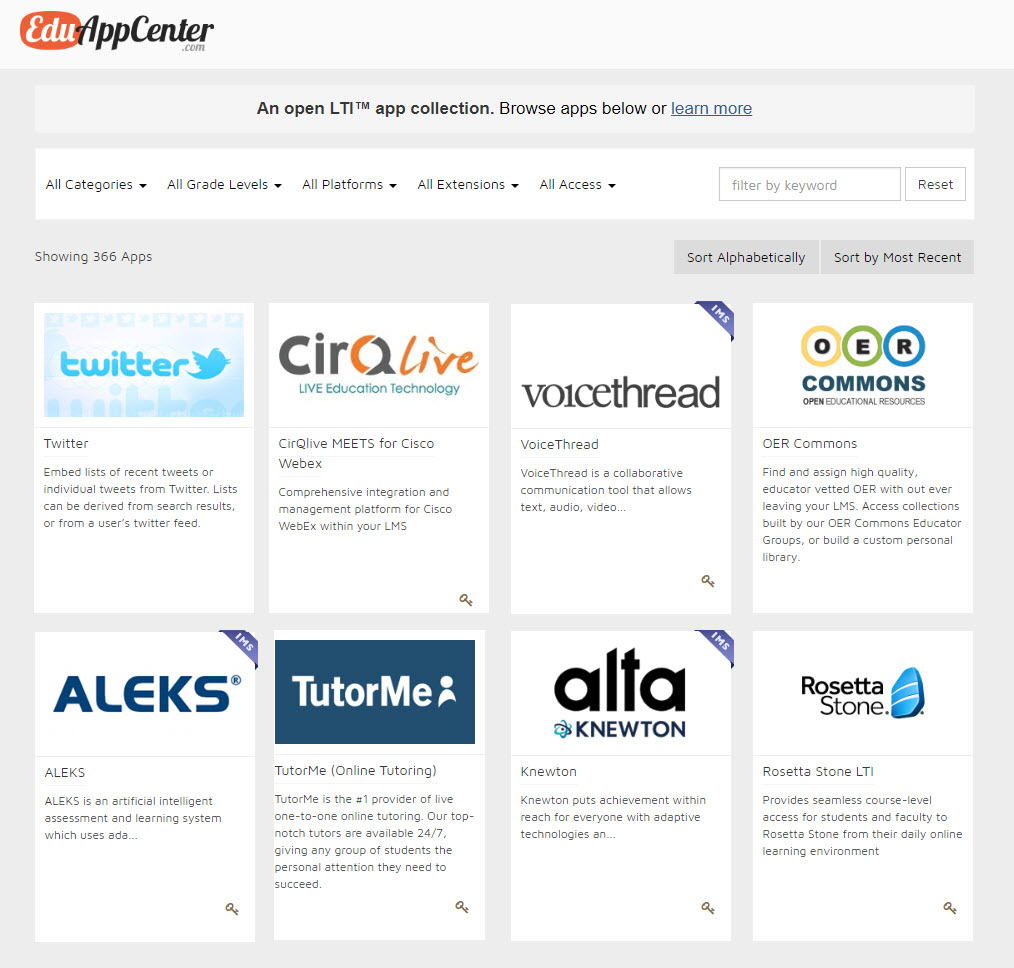
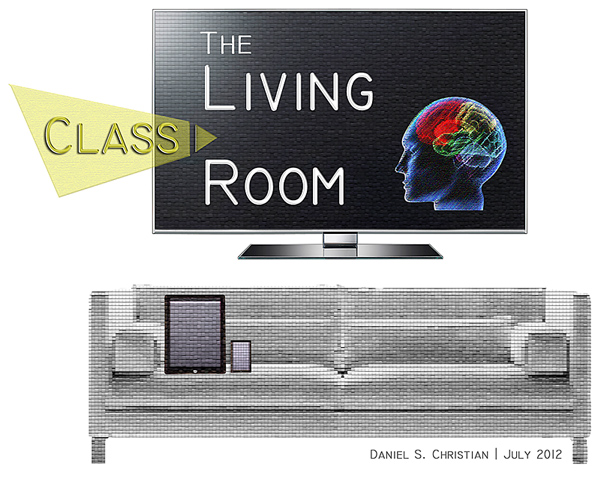
In a next generation learning system, it would be sharp/beneficial to have a Netflix-like interface to check out potential functionalities that you could turn on and off (at will) — as one component of your learning ecosystem that could feature a setup located in your living room or office.
For example, put a Netflix-like interface to the apps out at eduappcenter.com (i.e., using a rolling interface at first, then going to a static page/listing of apps…again…similar to Netflix).
On 02/11/2019,
in 21st century, career development, collaboration, communications, corporate / business world, corporate universities / corporate training, higher education, marketplaces, Microsoft, productivity / tips and tricks, professional development, strategy, student-related, tools, training / L&D, workplace, youth,
by Daniel Christian
This is how you’ll look for a job in 2019 — from linkedin.com by Lydia Dishman
Some brand new strategies and time-tested traditions dictate the way job seekers will conduct the hunt in 2019.
Excerpt:
In addition to making sure you list at least five skills, Guo suggests adding the field you work in since more than 300,000 people search by industry on LinkedIn each week. And don’t forget to update the city you work in since this can make you up to 23 times more likely to be found in search, according to LinkedIn’s data.
From DSC:
This next article is likely somewhat of an ad to take courses out at Lynda.com, but it’s still helpful I think:
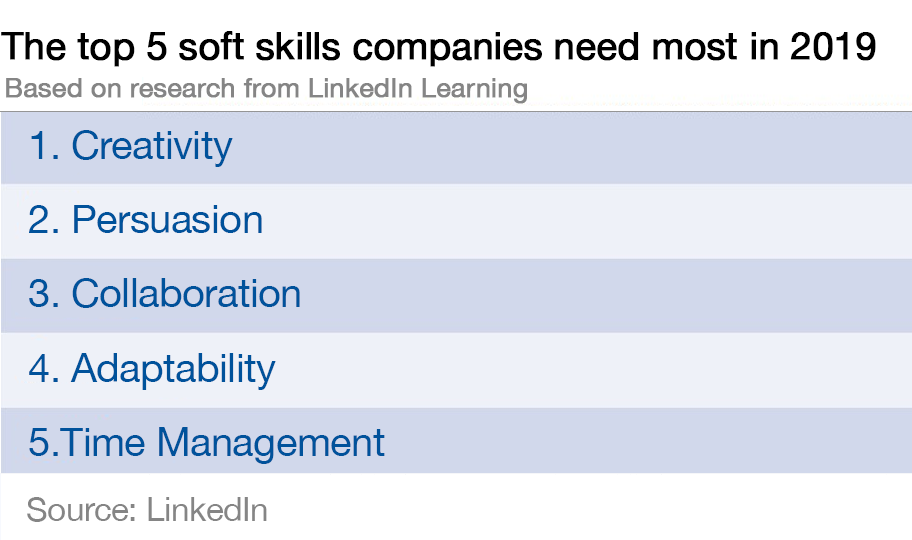
- The Skills Companies Need Most in 2019 – And How to Learn Them— from linkedin.com by Paul Petrone
Also see (emphasis DSC):
- These are the 10 most in-demand skills of 2019, according to LinkedIn — from weforum.org by Emma Charlton
Excerpt (emphasis DSC):
According to analysis from networking site LinkedIn, 2019’s employers are looking for a combination of both hard and soft skills, with creativity topping the list of desired attributes. The findings chime with the World Economic Forum’s Future of Jobs report, which concluded that “human” skills like originality, initiative and critical thinking are likely to increase in value as technology and automation advances. “Strengthening a soft skill is one of the best investments you can make in your career, as they never go out of style,” LinkedIn Learning Editor, Paul Petrone wrote in a blog. “Plus, the rise of AI is only making soft skills increasingly important, as they are precisely the type of skills robots can’t automate.”
On 02/09/2019,
in Canada, CMS/LMS, colleges, community colleges, education technology, higher education, IT in HE, teaching & learning, tools, United States, universities, vendors,
by Daniel Christian
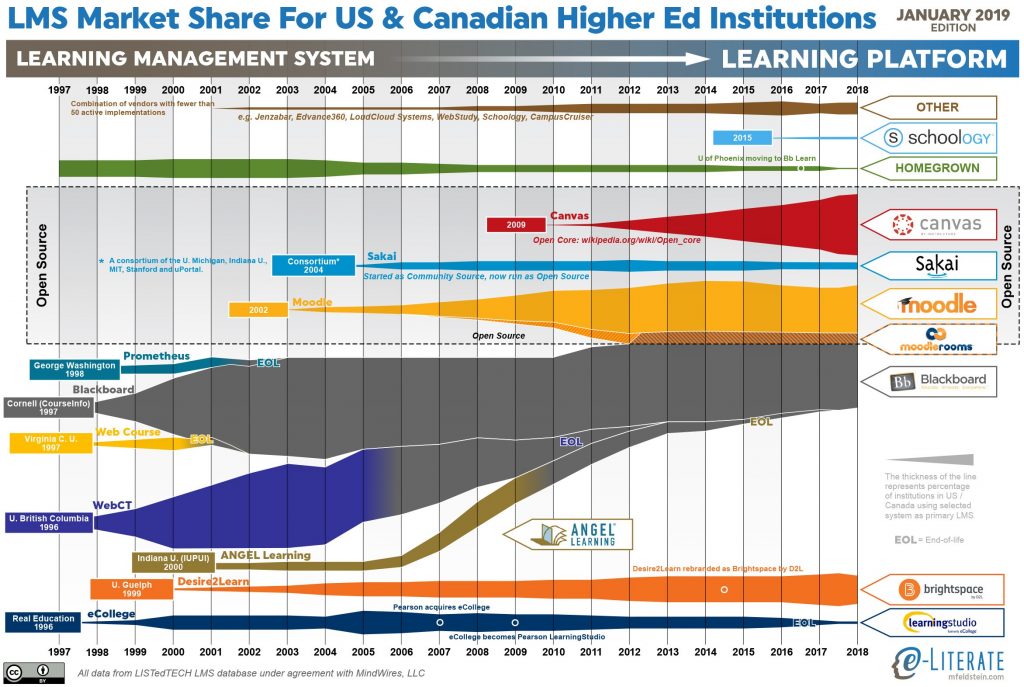
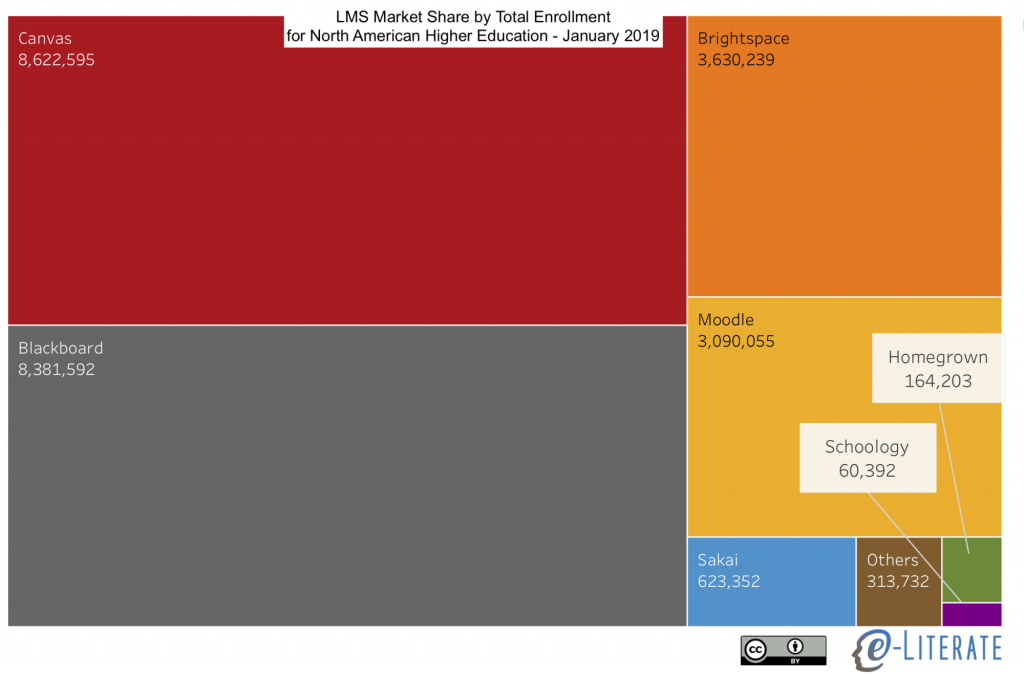
State of Higher Ed LMS Market for US and Canada: 2018 Year-End Edition — from mfeldstein.com by Phill Hill
Excerpts:
- The market continues to consolidate around the Big Four – Blackboard, Canvas, D2L Brightspace, and Moodle.
- The Homegrown option for LMS usage is going away, at least in a statistical sense. Only a handful of schools even consider this option.
On 01/30/2019,
in 21st century, analytics, Artificial Intelligence/Agents/LLMs/and Related, bots, business, career development, change, cloud-based computing / apps / other cloud-related, corporate / business world, disruption, emerging technologies, future, human-computer interaction (HCI), innovation, intelligent systems, IT in HE, marketing/social marketing, technology (general), tools, trends, United States, user experience (UX), workplace,
by Daniel Christian
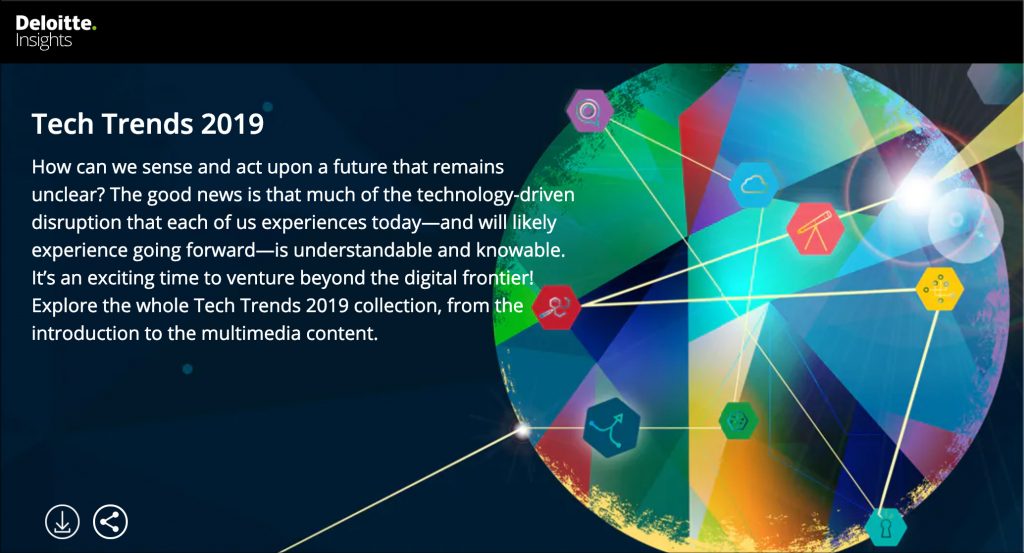
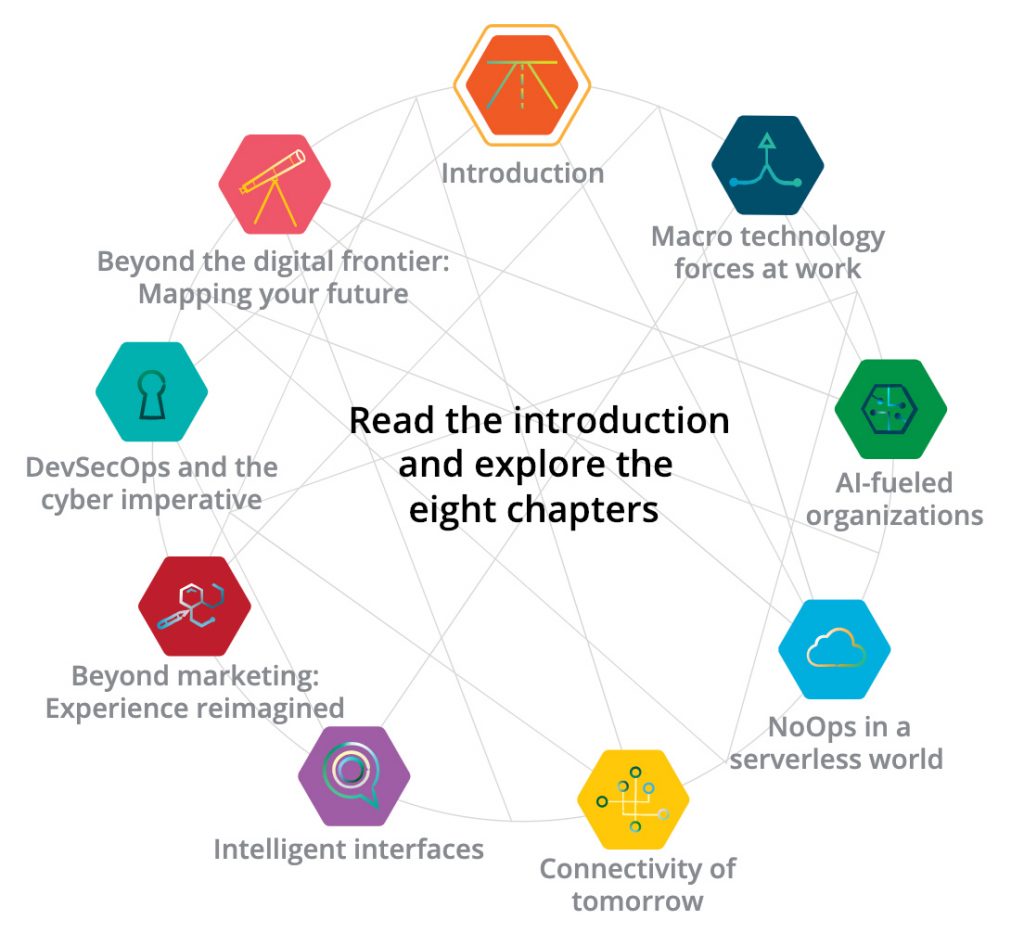
Emerging technology trends can seem both elusive and ephemeral, but some become integral to business and IT strategies—and form the backbone of tomorrow’s technology innovation. The eight chapters of Tech Trends 2019 look to guide CIOs through today’s most promising trends, with an eye toward innovation and growth and a spotlight on emerging trends that may well offer new avenues for pursuing strategic ambitions.
On 01/28/2019,
in 21st century, adult learning, Artificial Intelligence/Agents/LLMs/and Related, business, change, colleges, community colleges, computer science, corporate / business world, dangers of the status quo, Daniel S. Christian, emerging technologies, future, game-changing environment, global / globalization, higher education, ideas, intelligent systems, law schools, legislatures / government / legal, lifelong learning, Michigan, pace of change, platforms, reinvent, society, staying relevant, streams of content, student-related, surviving, technologies for your home, technology (general), the downsides of how people use tech, tools, training / L&D, trends, United States, universities,
by Daniel Christian
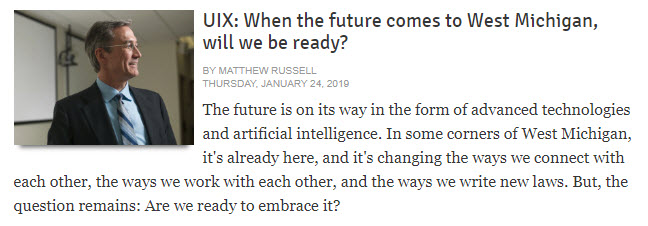
UIX: When the future comes to West Michigan, will we be ready? — from rapidgrowthmedia.com by Matthew Russell
Excerpts (emphasis DSC):
“Here in the United States, if we were to personify things a bit, it’s almost like society is anxiously calling out to an older sibling (i.e., emerging technologies), ‘Heh! Wait up!!!'” Christian says. “This trend has numerous ramifications.”
Out of those ramifications, Christian names three main points that society will have to address to fully understand, make use of, and make practical, future technologies.
- The need for the legal/legislative side of the world to close the gap between what’s possible and what’s legal
- The need for lifelong learning and to reinvent oneself
- The need to make pulse-checking/futurism an essential tool in the toolbox of every member of the workforce today and in the future

Photos by Adam Bird
From DSC:
The key thing that I was trying to relay in my contribution towards Matthew’s helpful article was that we are now on an exponential trajectory of technological change. This trend has ramifications for numerous societies around the globe, and it involves the legal realm as well. Hopefully, all of us in the workforce are coming to realize our need to be constantly pulse-checking the relevant landscapes around us. To help make that happen, each of us needs to be tapping into the appropriate “streams of content” that are relevant to our careers so that our knowledgebases are as up-to-date as possible. We’re all into lifelong learning now, right?
Along these lines, increasingly there is a need for futurism to hit the mainstream. That is, when the world is moving at 120+mph, the skills and methods that futurists follow must be better taught and understood, or many people will be broadsided by the changes brought about by emerging technologies. We need to better pulse-check the relevant landscapes, anticipate the oncoming changes, develop potential scenarios, and then design the strategies to respond to those potential scenarios.
On 01/23/2019,
in 21st century, 24x7x365 access, Amazon, Artificial Intelligence/Agents/LLMs/and Related, bots, business, career development, cloud-based computing / apps / other cloud-related, CMS/LMS, computer science, corporate / business world, corporate universities / corporate training, Daniel S. Christian, digital audio, digital learning, education technology, emerging technologies, experimentation, future, game-changing environment, global / globalization, homeschooling/homeschoolers, human-computer interaction (HCI), ideas, innovation, intelligent systems, intelligent tutoring, interactivity, internet, K-12 related, law schools, learning, learning agents, learning ecosystem, Learning from the Living [Class] Room, learning spaces, lifelong learning, microlearning, mobile learning, Natural Language Processing (NLP), Near Field Communication (NFC), personalized/customized learning, platforms, productivity / tips and tricks, smart classrooms, society, technologies for your home, tools, training / L&D, trends, TVs, United States, using teams, vendors, vision/possibilities, voice recognition / voice enabled interfaces, workplace,
by Daniel Christian
Amazon has 10,000 employees dedicated to Alexa — here are some of the areas they’re working on — from businessinsider.com by Avery Hartmans
Summary (emphasis DSC):
- Amazon’s vice president of Alexa, Steve Rabuchin, has confirmed that yes, there really are 10,000 Amazon employees working on Alexa and the Echo.
- Those employees are focused on things like machine learning and making Alexa more knowledgeable.
- Some employees are working on giving Alexa a personality, too.

From DSC:
How might this trend impact learning spaces? For example, I am interested in using voice to intuitively “drive” smart classroom control systems:
- “Alexa, turn on the projector”
- “Alexa, dim the lights by 50%”
- “Alexa, open Canvas and launch my Constitutional Law I class”
On 01/23/2019,
in colleges, community colleges, education, education technology, higher education, IT in HE, K-12 related, student-related, tools, United States, universities, vendors,
by Daniel Christian
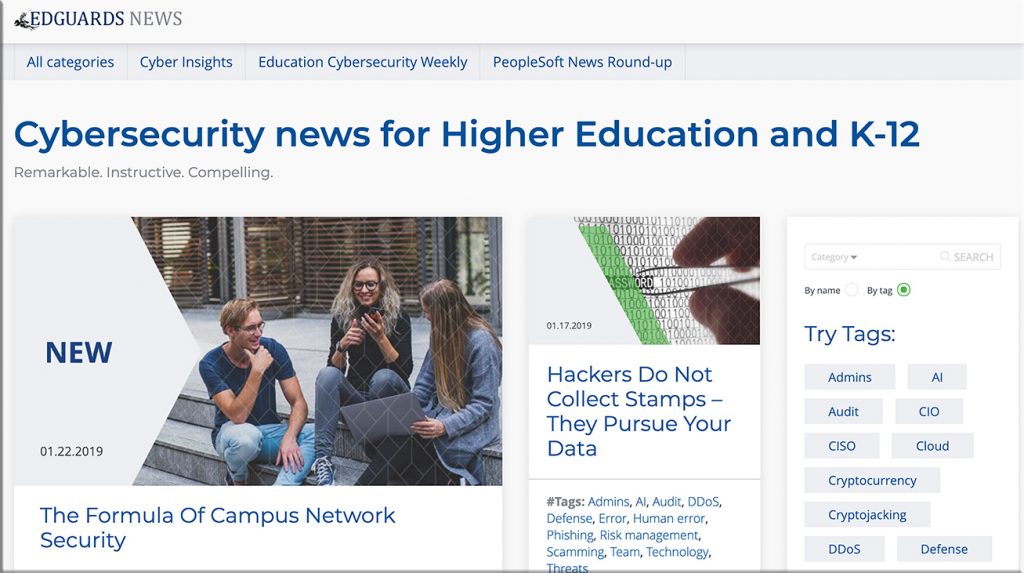
EdGuards News: A helpful news resource about education and technology with a shift towards cybersecurity; with thanks to Amy Lynn for this resource and the item below as well
NOTE:
- EdGuards provides security scanning solutions and services for PeopleSoft, Ellucian, and other systems.
Also see:
- Higher Education Cyber Attacks History — from edguards.com (from June 15, 2018)
This article covers the most notorious cyber attacks performed on educational institutions from 2002 to 2018.

On 01/23/2019,
in 21st century, Asia, Augmented Reality (AR), Australia, Canada, collaboration, communications, convergence, corporate / business world, corporate universities / corporate training, education technology, elearning, emerging technologies, Europe, future, human-computer interaction (HCI), ideas, India, innovation, intelligent systems, internet, IT in HE, Learning from the Living [Class] Room, machine-to-machine communications, Mixed Reality (MR), online learning, platforms, society, technologies for your home, technology (general), telecommunications, telepresence, tools, trends, UK, United States, user experience (UX), vendors, Virtual Reality (VR) / worlds / learning, web-based collaboration, XR - extended reality,
by Daniel Christian
What is 5G? Everything you need to know — from techradar.com by Mike Moore
The latest news, views and developments in the exciting world of 5G networks.
Excerpt:
What is 5G?
5G networks are the next generation of mobile internet connectivity, offering faster speeds and more reliable connections on smartphones and other devices than ever before.
Combining cutting-edge network technology and the very latest research, 5G should offer connections that are multitudes faster than current connections, with average download speeds of around 1GBps expected to soon be the norm.
The networks will help power a huge rise in Internet of Things technology, providing the infrastructure needed to carry huge amounts of data, allowing for a smarter and more connected world.
With development well underway, 5G networks are expected to launch across the world by 2020, working alongside existing 3G and 4G technology to provide speedier connections that stay online no matter where you are.
So with only a matter of months to go until 5G networks are set to go live, here’s our run-down of all the latest news and updates.
From DSC:
I wonder…
- What will Human Computer Interaction (HCI) look like when ~1GBps average download speeds are the norm?
- What will the Internet of Things (IoT) turn into (for better or for worse)?
- How will Machine-to-Machine (M2M) Communications be impacted?
- What will that kind of bandwidth mean for XR-related technologies (AR VR MR)?
On 01/22/2019,
in adjunct faculty, assessment, colleges, community colleges, corporate universities / corporate training, education, education reform, face-to-face, higher education, homeschooling/homeschoolers, ideas, instructional design, K-12 related, law schools, learning, learning ecosystem, learning theories, lifelong learning, memory, metacognition / metacognitive skills, online learning, parents/guardians, productivity / tips and tricks, research, STEAM-related, strategy, student teaching/teacher education, student-related, teachers, teaching & learning, tools, training / L&D, universities, youth,
by Daniel Christian
The Lesson You Never Got Taught in School: How to Learn! — from bigthink.com by Simon Oxenham (from 2/15/13)
Psychological Science in the Public Interest evaluated ten techniques for improving learning, ranging from mnemonics to highlighting and came to some surprising conclusions.
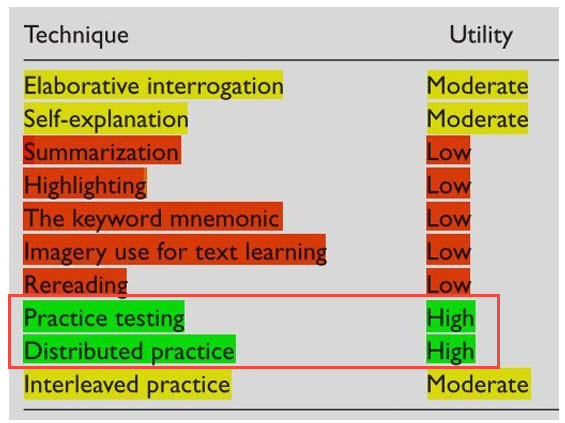
Excerpts:
Practice Testing (Rating = High)
This is where things get interesting; testing is often seen as a necessary evil of education. Traditionally, testing consists of rare but massively important ‘high stakes’ assessments. There is however, an extensive literature demonstrating the benefits of testing for learning – but importantly, it does not seem necessary that testing is in the format of ‘high stakes’ assessments. All testing including ‘low stakes’ practice testing seems to result in benefits. Unlike many of the other techniques mentioned, the benefits of practice testing are not modest – studies have found that a practice test can double free recall!
Distributed Practice (Rating = High)
Have you ever wondered whether it is best to do your studying in large chunks or divide your studying over a period of time? Research has found that the optimal level of distribution of sessions for learning is 10-20% of the length of time that something needs to be remembered. So if you want to remember something for a year you should study at least every month, if you want to remember something for five years you should space your learning every six to twelve months. If you want to remember something for a week you should space your learning 12-24 hours apart. It does seem however that the distributed-practice effect may work best when processing information deeply – so for best results you might want to try a distributed practice and self-testing combo.
Also see:
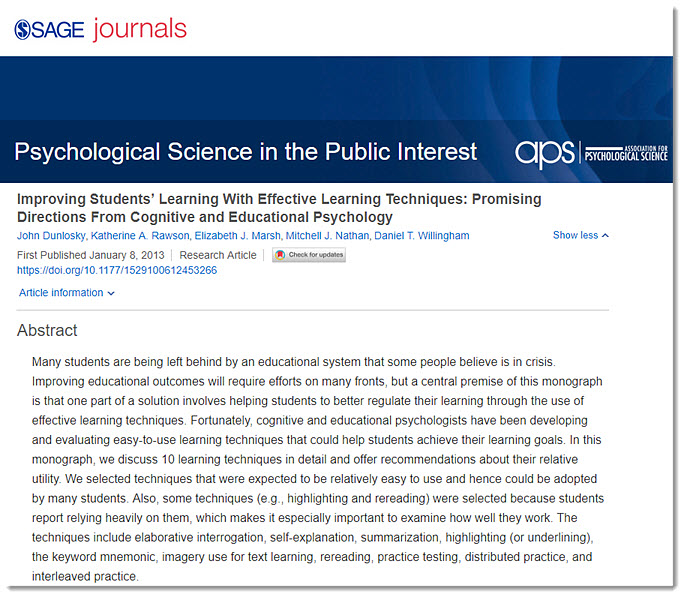
- Improving Students’ Learning With Effective Learning Techniques: Promising Directions From Cognitive and Educational Psychology
John Dunlosky, Katherine A. Rawson, Elizabeth J. Marsh, Mitchell J. Nathan, Daniel T. Willingham
First Published January 8, 2013 | Research Article
https://doi.org/10.1177/1529100612453266
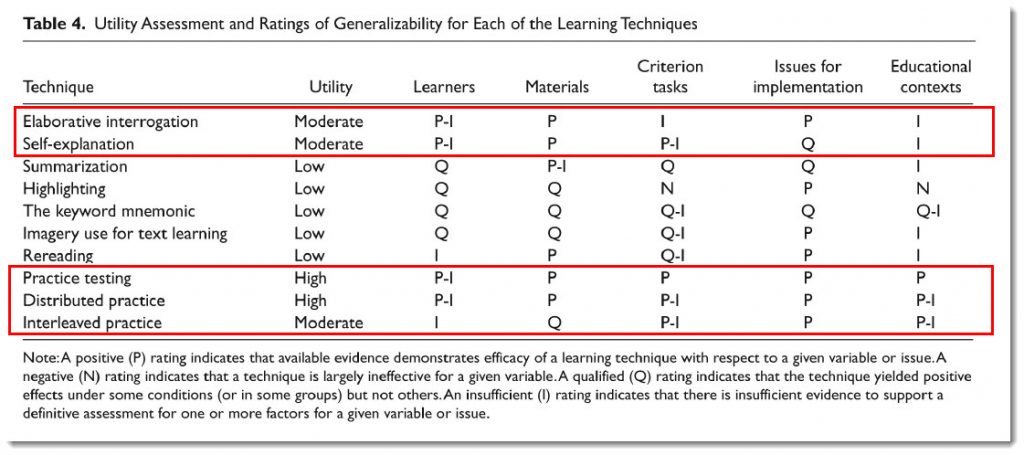
- Study smart — from apa.org by Lea Winerman; as recommended by Daniel Willingham here
Make the most of your study time with these drawn-from-the-research tips.
Per Willingham (emphasis DSC):
- Rereading is a terribly ineffective strategy. The best strategy–by far — is to self-test — which is the 9th most popular strategy out of 11 in this study. Self-testing leads to better memory even compared to concept mapping (Karpicke & Blunt, 2011).
Three Takeaways from Becoming An Effective Learner:
- Boser says that the idea that people have different learning styles, such as visual learning or verbal learning, has little scientific evidence to support it.
- According to Boser, teachers and parents should praise their kids’ ability and effort, instead of telling them they’re smart. “When we tell people they are smart, we give them… a ‘fixed mindset,’” says Boser.
- If you are learning piano – or anything, really – the best way to learn is to practice different composers’ work. “Mixing up your practices is far more effective,” says Boser.
Cumulative exams aren’t the same as spacing and interleaving. Here’s why. — from retrievalpractice.org
Excerpts (emphasis DSC):
Our recommendations to make cumulative exams more powerful with small tweaks for you and your students:
- Cumulative exams are good, but encourage even more spacing and discourage cramming with cumulative mini-quizzes throughout the semester, not just as an end-of-semester exam.
- Be sure that cumulative mini-quizzes, activities, and exams include similar concepts that require careful discrimination from students, not simply related topics.
- Make sure you are using spacing and interleaving as learning strategies and instructional strategies throughout the semester, not simply as part of assessments and cumulative exams.
Bottom line: Just because an exam is cumulative does not mean it automatically involves spacing or interleaving. Be mindful of relationships across exam content, as well as whether students are spacing their study throughout the semester or simply cramming before an exam – cumulative or otherwise.
From DSC:
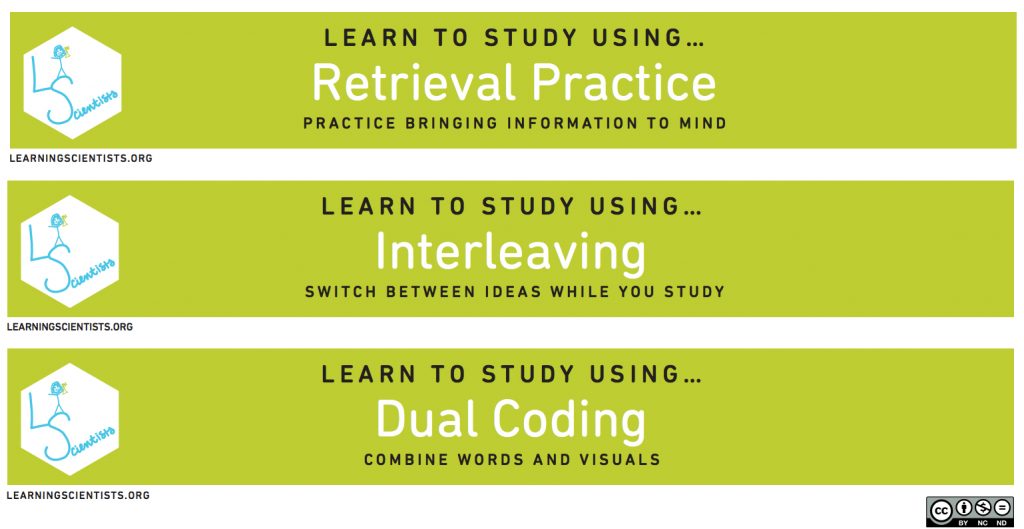
We, like The Learning Scientists encourages us to do and even provides their own posters, should have posters with these tips on them throughout every single school and library in the country. The posters each have a different practice such as:
- Spaced practice
- Retrieval practice
- Elaboration
- Interleaving
- Concrete examples
- Dual coding
That said, I could see how all of that information could/would be overwhelming to some students and/or the more technical terms could bore them or fly over their heads. So perhaps we could boil down the information to feature excerpts from the top sections only that put the concepts into easier to digest words such as:
- Practice bringing information to mind
- Switch between ideas while you study
- Combine words and visuals
- Etc.
On 01/21/2019,
in 21st century, Artificial Intelligence/Agents/LLMs/and Related, Asia, business, future, game-changing environment, robotics, society, tools, workplace,
by Daniel Christian
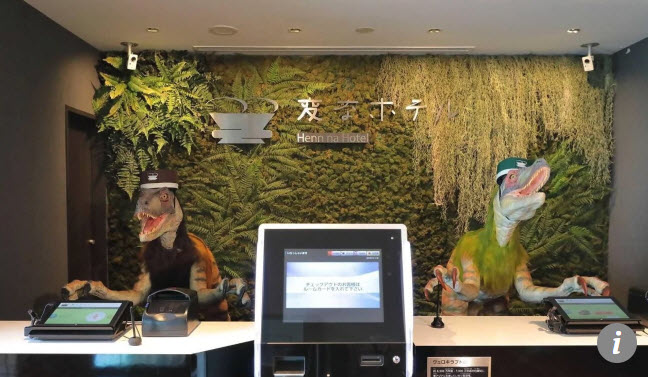
AI fail: Japan’s Henn-na Hotel dumps ‘annoying’ robot staff, hires humans — from scmp.com by Julian Ryall
Dinosaur receptionists are a thing of the past as Japan’s first robot hotel concludes there “are places where they are just not needed”
Excerpt:
The hotel decided to withdraw the dinosaur and humanoid robots that staffed front desks at its properties because they were unable to respond to queries from guests about local attractions or access to airports. Humans were also on stand-by every time a guest’s passport needed to be registered.
That said, also see:
AI predictions for 2019 from Yann LeCun, Hilary Mason, Andrew Ng, and Rumman Chowdhury — from venturebeat.com by Khair Johnson
Excerpt:
In the year ahead, Chowdhury expects to see more government scrutiny and regulation of tech around the world.
“AI and the power that is wielded by the global tech giants raises a lot of questions about how to regulate the industry and the technology,” she said. “In 2019, we will have to start coming up with the answers to these questions — how do you regulate a technology when it is a multipurpose tool with context-specific outcomes? How do you create regulation that doesn’t stifle innovation or favor large companies (who can absorb the cost of compliance) over small startups? At what level do we regulate? International? National? Local?”
She also expects to see the continued evolution of AI’s role in geopolitical matters.
“This is more than a technology, it is an economy- and society-shaper. We reflect, scale, and enforce our values in this technology, and our industry needs to be less naive about the implications of what we build and how we build it,” she said. For this to happen, she believes people need to move beyond the idea common in the AI industry that if we don’t build it, China will, as if creation alone is where power lies.
“We hold the responsibility of recreating the world in a way that is more just, more fair, and more equitable while we have the rare opportunity to do so. This moment in time is fleeting; let’s not squander it.”