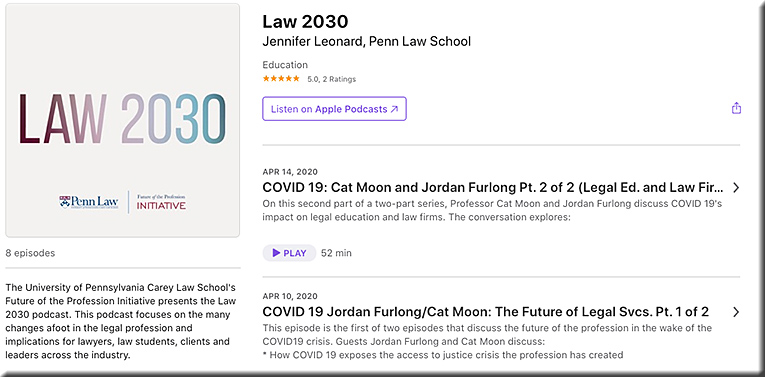
Jennifer Leonard, Jordan Long, and Cat Moon
Part I — 4/10/20

This episode is the first of two episodes that discuss the future of the profession in the wake of the COVID19 crisis. Guests Jordan Furlong and Cat Moon discuss:
- How COVID 19 exposes the access to justice crisis the profession has created
- Why the crisis offers the opportunity to leverage technology in new ways
- Why the structures and systems that have defined the profession have been so durable
- Whether lawyers view the crisis as a blip or a transformation
- How leaders can pivot toward innovation
From DSC:
At several points in the conversation, when Cat and Jordan were both referring to the importance of experimentation within the legal realm, I was reminded of this graphic that I did back in 2013:

I was reminded of it as well because Jennifer Leonard rightly (in my perspective), brought in higher education into the discussion at several points. There are some similarities — especially concerning power and privilege. Well, it’s now true in the legal realm as well (and probably has been true for a while…I’m just behind).
Experimentation. Experimentation. Experimentation. <– so key in the legal realm right now!
Other notes I took:
- Triage: Need to deal with essentials to keep afloat. Yourself, staff, clients, cash flow. Put out the fire.
- Reconstruction: In parallel, create “field hospitals.” Recession is going to have massive impacts on old systems. Need new systems. Start building institutions that work. Build as many of these as you can. Experiments. House isn’t going to be inhabitable after the fire. Need a new shelter — maybe start w/ a tent, then a cabin, then a house. Build on something small. Start building what’s going to replace the old systems.
- Power and privilege imbalance is why people haven’t been able to change things. “I can make you do something for me. You come here so I can dispense justice to you.” But not just judges…throughout the system.
- Public legal awareness and legal education. In high schools, universities, colleges, churches, mosques, synagogues, etc.
- Higher ed and legal services? Anything we can learn from each other?
- Systems created by people who rule the systems. Power imbalance exists in higher ed, but hubris is completely indefensible within the legal realm. Need much better access to legal information and legal understanding.
- OS on the Mac. Don’t have another OS for legal system to move to. We need to redesign our legal OS to serve more people.
- Law is society’s OS. Law is DOS-based…need Windows or Mac type of leap.
- Self protectionism. Hubris. Power imbalance. Power hungry.
- Yet many who enter legal profession come in wanting to make the world a better place. Why the move away from these ideals? Need more focus on developing professional identity. Structure, framework for how to be a lawyer. Students become more cynical as time goes by. Also, there’s “ladder pulling.” Pay your dues. Get hazed. I had to do it…now you have to do it. Bar Exam good example of this. Confirmation bias. It’s the way we’ve always done it.
Today, the following things ARE happening — so it CAN be done! The people in charge just didn’ want to do these things.
- lawyers working from home
- e-filing of documents to courts
- video hearings in court
- faster, cheaper, more convenient
Jennifer Leonard, Jordan Long, and Cat Moon
Part II – 4/14/20
On this second part of a two-part series, Professor Cat Moon and Jordan Furlong discuss COVID 19’s impact on legal education and law firms. The conversation explores:
- The “knock out effect” the crisis has on the various parts of the lawyer formation system
- Who might take ownership of coordinating the new landscape of lawyer accreditation
- The opportunities lifelong learning creates for law schools to be involved in the ongoing development of legal professionals
- How human-centered design and project-based learning offer ways to integrate the three sides of the Delta model of lawyer competency
- How small and solo law firms might be impacted by the crisis
Notes I took:
- The knock-out effect.
- How can we coordinate amongst the players in the system? Will be hard, because of the existing fiefdoms. Power and authority move back up the chain to those who did the delegating in the first place. If the power has been delegated to you, you are at a disadvantage. Jordan sees an assertion of authority from a central entity — legislatures most likely; possibly courts.
- This moment offers us an opportunity to experiment and to redesign our systems. Can find new ways to fulfill missions.
- Have no choice but to embrace the ambiguity of the moment.
- Triage, then try to build something better than what we had before.
- We have to build something different. “And look, the sky’s not falling!” Think big. Act boldly in these experiments. Expand what we think is possible.
- The repercussions of the Coronavirus will be with us for much longer than many think it will
- Legal principles/concepts/rules. Areas of practice. Professional formation (ethics, integrity, operational aspects, & more). Know the law, but also WHY we have the law and lawyers.
- Can learn “black letter law” asynchronously and via videoconferencing.
- Need to expand curriculum: Project/time management, customer service, financial and tech literacy
- Delta Model — a framework for developing lawyer competencies; starts in law schools; what are the skills and competencies; the foundation is the practice of law; research, issue spotting, PM, data analysis, understanding business; understanding people; wholistic approach. A lifelong journey of growth.
- Law schools — 3 years, then done. Not a productive way to do things. We need to keep people on top of their game throughout a career. Is legal education a place or a system/process that you enter and re-enter again and again throughout one’s career? Wouldn’t it be great if I could access ___ modules along the way?
- How are we going to create/design highly engaging online-based learning experiences? #1 on Cat’s priority list now. Got moved up the priority list.
- There are pros and cons for both F2F and online-based learning. Humanizing impact when your professors are teaching from their homes.
- Reframing legal education just as we are reframing courts as a service, not a place.
- Blended approach can be very effective/powerful.
- Need to collect data on what’s working and what’s not working.
- Fundamental business model of corporate side is likely at the end of its course; law firms will need a new model for generating profit. For smaller firms, prospects are more dire as their clients are going through major negative changes. Potential unsustainability of many practices.
- How can we provide different models that expand access to justice? That help develop happier and healthier lawyers?
- Per legalproblemsolving.org, human-centered design is:
- …a fluid framework for discovering problems, ideating solutions, and iterating to continuously improve solutions. HCD provides a methodology for considering both legal service delivery challenges, as well as clients’ legal problems. The HCD method also serves as a tool individual law students can use to craft a rewarding, successful legal career.