Adobe Distance Learning Resources — from edex.adobe.com
Whether your school routinely supports distance learning or is facing unexpected closures, we’ve assembled these resources and learning opportunities to help educators engage remote students through online learning.

  • Talks and Webinars
  • Khan + Create Activities
  • Learn and Create for Social Justice
  • Courses, Articles, and Blogs
  • Go Paperless with your Teaching
  • Higher Ed and K-12 projects that make distance learning engaging
  • Resources to support young learners
 

Learning experience designs of the future!!! [Christian]

From DSC:
The article below got me to thinking about designing learning experiences and what our learning experiences might be like in the future — especially after we start pouring much more of our innovative thinking, creativity, funding, entrepreneurship, and new R&D into technology-supported/enabled learning experiences.


LMS vs. LXP: How and why they are different — from blog.commlabindia.com by Payal Dixit
LXPs are a rising trend in the L&D market. But will they replace LMSs soon? What do they offer more than an LMS? Learn more about LMS vs. LXP in this blog.

Excerpt (emphasis DSC):

Building on the foundation of the LMS, the LXP curates and aggregates content, creates learning paths, and provides personalized learning resources.

Here are some of the key capabilities of LXPs. They:

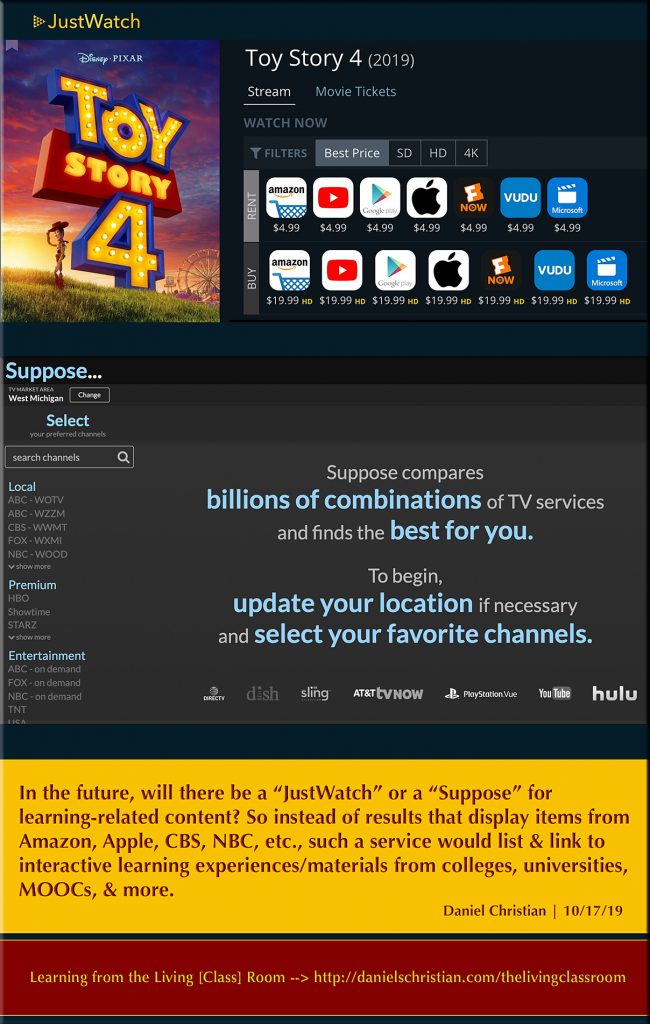
  • Offer content in a Netflix-like interface, with suggestions and AI recommendations
  • Can host any form of content – blogs, videos, eLearning courses, and audio podcasts to name a few
  • Offer automated learning paths that lead to logical outcomes
  • Support true uncensored social learning opportunities

So, this is about the LXP and what it offers; let’s now delve into the characteristics that differentiate it from the good old LMS.


From DSC:
Entities throughout the learning spectrum are going through many changes right now (i.e., people and organizations throughout K-12, higher education, vocational schools, and corporate training/L&D). If the first round of the Coronavirus continues to impact us, and then a second round comes later this year/early next year, I can easily see massive investments and interest in learning-related innovations. It will be in too many peoples’ and organizations’ interests not to.

I highlighted the bulleted points above because they are some of the components/features of the Learning from the Living [Class] Room vision that I’ve been working on.

Below are some technologies, visuals, and ideas to supplement my reflections. They might stir the imagination of someone out there who, like me, desires to make a contribution — and who wants to make learning more accessible, personalized, fun, and engaging. Hopefully, future generations will be able to have more choice, more control over their learning — throughout their lifetimes — as they pursue their passions.

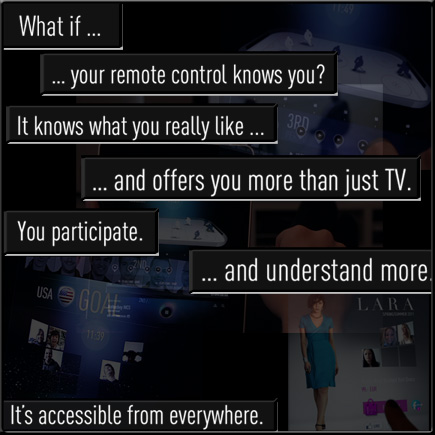
Learning from the living class room

In the future, we may be using MR to walk around data and to better visualize data


AR and VR -- the future of healthcare


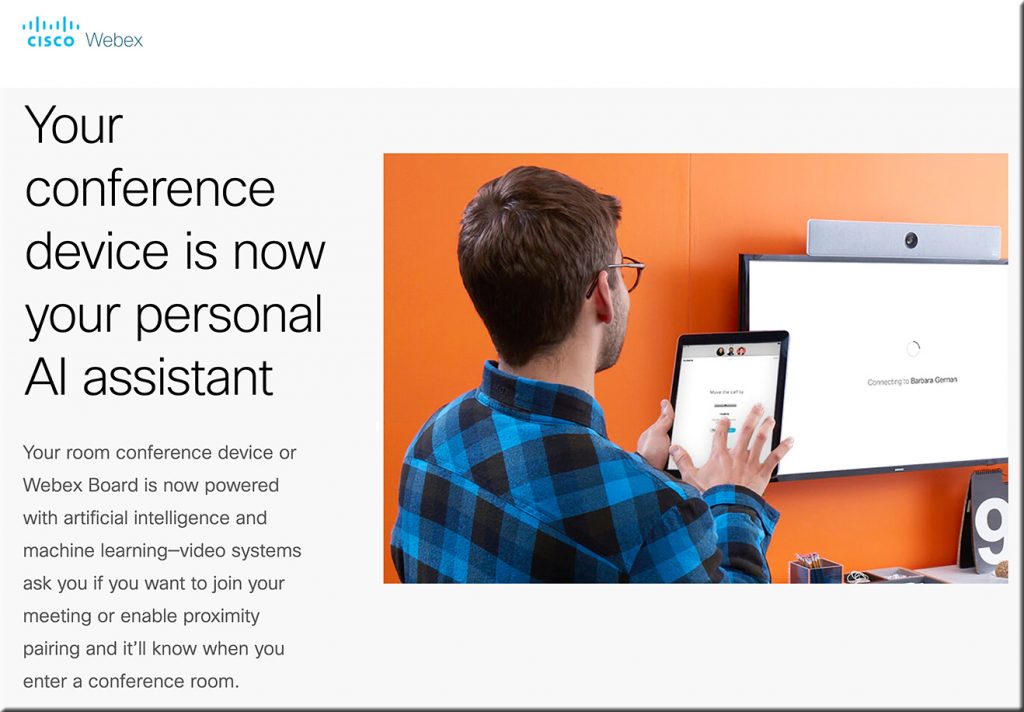
Meet the new face of Webex Assistant — from blog.webex.com by Kacy Kizer

Excerpt:

You may be familiar with Webex Assistant, the AI-powered voice assistant for work. Now known as Webex Assistant for Webex Rooms, our original digital assistant allows you to control compatible Webex Rooms devices with your voice, making it easy to join a meeting with just a few words, manage your meetings and devices from anywhere in the room, and much more.

  • A voice-activated assistant allows you to easily control the meeting through a set of voice commands.
  • Simply ask your AI-powered Webex Assistant to do things like create actions items, take notes, and even set up future meetings—with just your voice.
  • Your Webex Assistant will automatically transcribe the entire meeting in real-time.
  • With visual animation, your virtual AI assistant interacts with you and your meeting attendees during the meeting and when called upon.

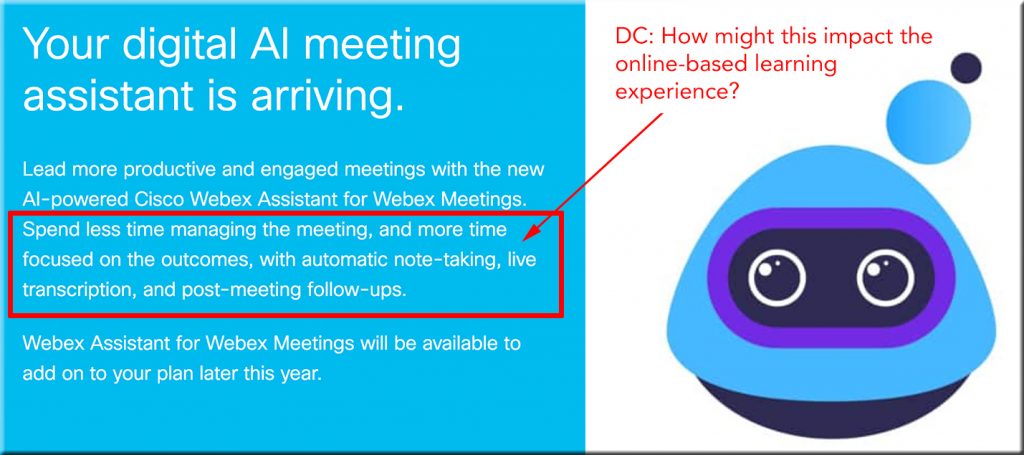
The Cisco Webex Digital Assistant -- how might AI impact the online-based learning experience?

From DSC:

  • How might these types of technologies impact online-based learning?
  • What new affordances might they bring to the learner’s experience?
  • For example, what if a listening assistant (AI) could identify some key issues/topics and then go out and grab/present some URL’s of relevant journal articles, chapters from a given textbook, blog postings, etc.? What if each student’s AI could be directed to do so independently?

#IntelligentTutoring | #IntelligentSystems |  #AI |  #EmergingTechnologies | #Collaboration | #Productivity | #PersonalizedEducation

Also see:

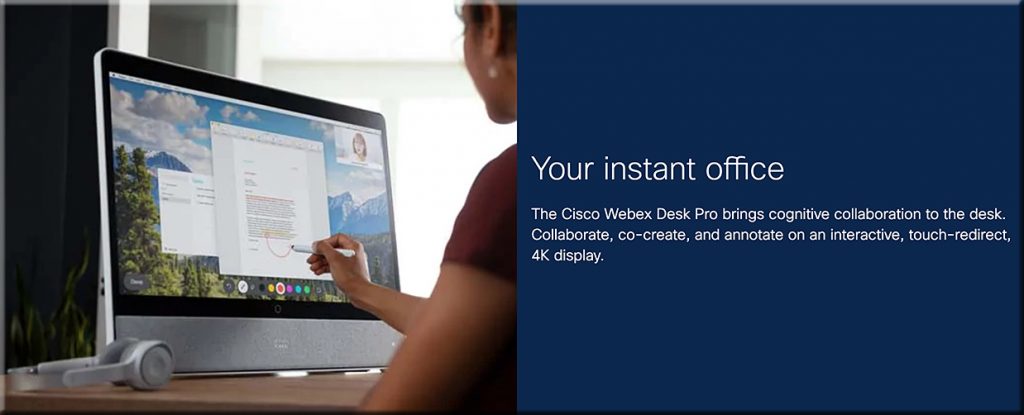
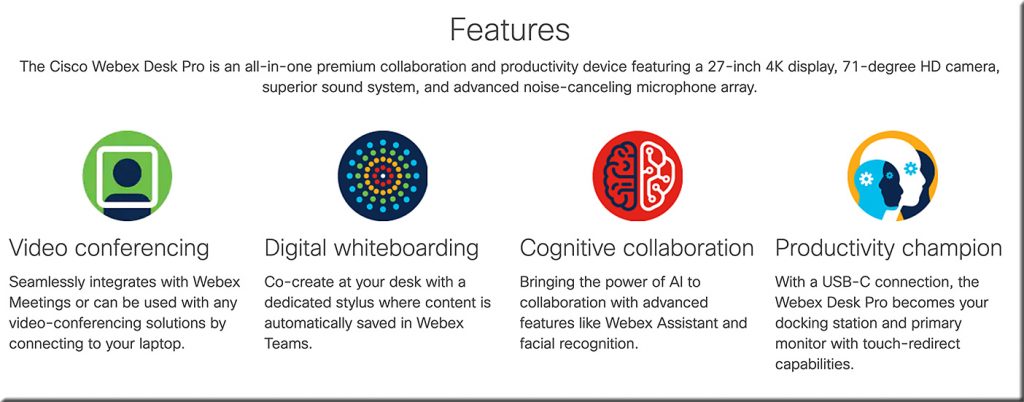
Cisco Webex Desk Pro -- AI integrated into Webex Meetings


June 29, 2007: Apple Releases the iPhone, Transforming Much of the Modern World — from by Kevin Levick

Excerpts:

Over the past 10 years, Apple’s iPhone evolved from a mobile device capable of running basic apps to a powerful computer with professional-grade cameras.
…
Today’s app economy is bigger than Hollywood, and WhatsApp, Snapchat, Uber, Tinder, and more are essential parts of modern culture, collectively used by hundreds of millions of people every day.

Now, everything from the way we work, communicate, shop, travel, manage our finances, and experience entertainment can be done through a smartphone.


Team-based content creation/delivery | We need this & other paradigm shifts to help people survive & thrive [Christian]

From DSC:
If the first wave of the Coronavirus continues — and is joined by a second wave later this year or early next year — I think a more permanent, game-changing situation is inevitable. As such, now’s the time to change the paradigms that we’ve been operating under.

It’s time to move to *a team-based approach.* To build up the set of skills an organization needs to pivot and adapt — regardless of what comes their way.

Let’s stop asking one faculty member to do it all! Consider this:

  • Would you fly in a plane that was engineered/designed/built by one person?
  • Would you drive a car that was engineered/designed/built by one person?
  • Would you go into brain surgery with only one other person in the operating room?
  • Are you, like me, amazed at the long list of people (and their specialties) who contributed to a major motion picture?!? The credits go on for several minutes — even when moving at a fast pace! Would you watch a major motion picture that was written, acted, produced, directed by — and had all of the music, special effects, and audio-related work done by — only one person? 

With the move to online learning, one person can’t do it all anymore — at least not at the level that the newer generations are coming to expect. They have grown accustomed to amazing, team-based/built content and products.

Plus, newer generations are going to know and experience much more telehealth-related services…then much more telelegal-related services. They will come to experience/expect high-quality learning-related products and services that way as well. Going forward, there are too many skillsets required by the creation and production of high-quality, online-based learning — not to mention the continued hard work of staying up-to-date on the main subject matter expertise at hand.

So if the kind of perspective continues as found in this piece — SURVEY: Students say they shouldn’t have to pay full price for online classes — then colleges and universities would do well to invest money in new Research & Development efforts, in team-based content creation, and in reimagining what online-learning could act/be like. Same for the vendors out there. And faculty members would be wise to invest the time and energy it takes to be able to teach online as well as in a face-to-face setting. Not only are they more marketable once they’ve done this, but they are then also more prepared to find their place within an uncertain future.

All of this will likely be an expensive process. Also, greater collaboration will be needed within a department (as we can’t be building a course per professor) as well as between organizations.  Perhaps the use of consortiums will increase…I’m not sure.

Perhaps a new platform will develop — similar to what’s contained in this vision. Such a platform will feature content that was designed and built by a team. Such a learning-related platform will offer streams of highly-relevant content — while providing continuous, affordable, up-to-date, convenient, and very well done means of staying marketable/employed. 

We will likely be seeing this vision come to reality in the future.

For another paradigm shift, accreditation bodies/practices are going to have to also change, adapt, pivot, and help innovative ideas come to fruition. But that’s another posting for another day.


This unique free event is designed to give our learning community a chance to explore the most popular topics discussed at Learning Technologies.

The 2020 Learning Technologies Summer Forum (#LTSF20) takes place online, looking at some of the key topics we examined at February’s conference. Once again, the Summer event is an opportunity to interact, experiment and try some new things together.


Everything you need to know about animation-based learning — from elearningindustry.com by Huong Giang Bui
When people talk about education, they often stress the formal side of learning like delivering knowledge, getting high scores on exams, etc. But animation-based education is here to up the game, with animation you can get fun, practical, and informative learning all at the same time!

Excerpt:

What Is Animation-Based Learning?
While it sounds like it, animation-based learning is not all about visual materials. Rather, resources such as videos, infographics, and GIFs are used in tandem with existing resources when employing this method. This can be applied to many different fields, from scientific visualizations to corporate training schemes; from motion-graphic narratives used in primary courses to university-level demonstrations.


Wrongfully accused by an algorithm- from the New York Times

Wrongfully accused by an algorithm — from nytimes.com by Kashmir Hill

Excerpt:

On a Thursday afternoon in January, Robert Julian-Borchak Williams was in his office at an automotive supply company when he got a call from the Detroit Police Department telling him to come to the station to be arrested. He thought at first that it was a prank.

An hour later, when he pulled into his driveway in a quiet subdivision in Farmington Hills, Mich., a police car pulled up behind, blocking him in. Two officers got out and handcuffed Mr. Williams on his front lawn, in front of his wife and two young daughters, who were distraught. The police wouldn’t say why he was being arrested, only showing him a piece of paper with his photo and the words “felony warrant” and “larceny.”

His wife, Melissa, asked where he was being taken. “Google it,” she recalls an officer replying.
…
“Is this you?” asked the detective.

The second piece of paper was a close-up. The photo was blurry, but it was clearly not Mr. Williams. He picked up the image and held it next to his face.

“No, this is not me,” Mr. Williams said. “You think all black men look alike?”


Also relevant/see:

What a machine learning tool that turns Obama white can (and can’t) tell us about AI bias


The “new normal” paradox: What COVID-19 has revealed about higher education — from bigthink.com by Dr. Michael Crow, President of ASU

Excerpt:

Third, it is abundantly apparent that universities must leverage technology to increase educational quality and access. The rapid shift to delivering an education that complies with social distancing guidelines speaks volumes about the adaptability of higher education institutions, but this transition has also posed unique difficulties for colleges and universities that had been slow to adopt digital education. The last decade has shown that online education, implemented effectively, can meet or even surpass the quality of in-person instruction.

Digital instruction, broadly defined, leverages online capabilities and integrates adaptive learning methodologies, predictive analytics, and innovations in instructional design to enable increased student engagement, personalized learning experiences, and improved learning outcomes. The ability of these technologies to transcend geographic barriers and to shrink the marginal cost of educating additional students makes them essential for delivering education at scale.

Far too many higher education outcomes are determined by a student’s family income, and in the context of COVID-19 this means that lower-income students, first-generation students and students of color will be disproportionately afflicted. And without new designs, we can expect post-secondary success for these same students to be as elusive in the new normal, as it was in the old normal.
…
This is not just because some universities fail to sufficiently recognize and engage the promise of diversity, this is because few universities have been designed from the outset to effectively serve the unique needs of lower-income students, first-generation students and students of color.


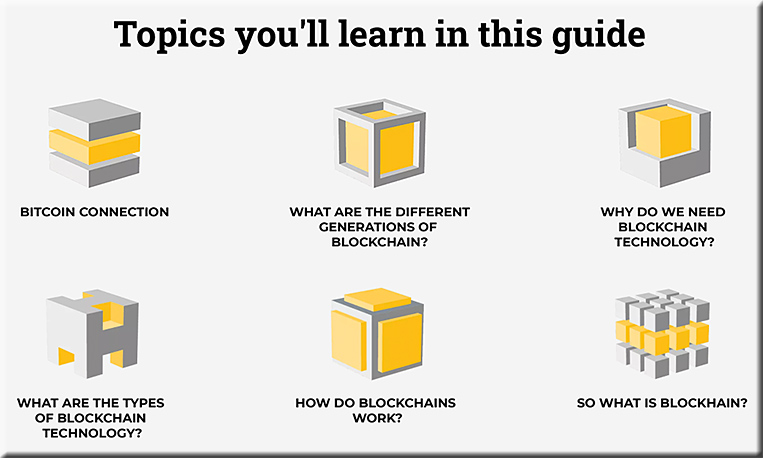
What is blockchain technology? The ultimate guide for beginners. — from cryptocoinsociety.com by Jesús Cedeño

Excerpt:

The purpose of this article is to address three central questions that should be discussed to fully understand and appreciate this revolutionary and disruptive technology called blockchain. This will include historical details about nascent technology and its evolutionary progress through the first decade of existence. We will also explore the different types of this technology and explain why the blockchain name is a misnomer and introduce a more proper name for the technology.
Why do we Need Blockchain Technology?
To answer this question we need to state what is the value proposition of Blockchain Technology. Blockchain’s value hinges on decentralization. Without decentralization blockchain technology is no different from regular databases. Decentralization removes the need to have an intermediary or a single authority that acts as gatekeepers of truth or having to trust an entity to ensure the trustworthiness of any transaction. Through blockchain, people will be able to transact with each other directly without having to worry that transactions will push through and will not be reversible.


PowerPoint Live is now generally available — from microsoft.com by Derek Jo

Excerpt:

Earlier this year, we announced that Live Presentations was coming soon, and we are excited to share that it is now generally available on PowerPoint for the web.

When we first announced PowerPoint Live, we saw excitement from both enterprise and education customers around how this feature could be utilized during in-person events—conferences, lecture halls, corporate all hands, town halls, and more. Of course, the world has changed a lot since then. 

We know that as more physical events and meetings take place, PowerPoint Live will prove to be a very useful tool for connecting with your audience and communicating more effectively, which we are excited to show you. However, we also have tips below on how to use this capability now in remote work and learning scenarios.


IBM, Amazon, and Microsoft abandon law enforcement face recognition market — from which-50.com by Andrew Birmingham

Excerpt:

Three global tech giants — IBM, Amazon, and Microsoft — have all announced that they will no longer sell their face recognition technology to police in the USA, though each announcement comes with its own nuance.

The new policy comes in the midst of ongoing national demonstrations in the US about police brutality and more generally the subject of racial inequality in the country under the umbrella of the Black Lives Matter movement.

From DSC:
While I didn’t read the fine print (so I don’t know all of the “nuances” they are referring to) I see this as good news indeed! Well done whomever at those companies paused, and thought…


…just because we can…

just because we can does not mean we should


…doesn’t mean we should.


just because we can does not mean we should

Addendum on 6/18/20:

  • Why Microsoft and Amazon are calling on Congress to regulate facial recognition tech — from finance.yahoo.com by Daniel HowleyExcerpt:
    The technology, which can be used to identify suspects in things like surveillance footage, has faced widespread criticism after studies found it can be biased against women and people of color. And according to at least one expert, there needs to be some form of regulation put in place if these technologies are going to be used by law enforcement agencies.“If these technologies were to be deployed, I think you cannot do it in the absence of legislation,” explained Siddharth Garg, assistant professor of computer science and engineering at NYU Tandon School of Engineering, told Yahoo Finance.
 

Cisco takes a lesson from the coronavirus pandemic with new solutions for remote work and learning — from cnbc.com by Jordan Novet

Key points:

  • Cisco has helped some of its customers set up remote work and education technologies. Now it wants to bring those capabilities to more organizations.
  • While Cisco remains number one in the conferencing software as a service market, Zoom is becoming a bigger force.

Also see:


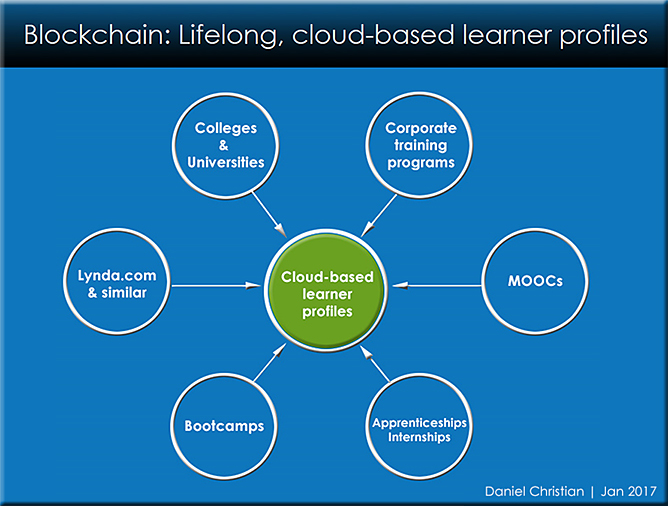
Blockchain Can Disrupt Higher Education Today, Global Labor Market Tomorrow — from cointelegraph.com by Andrew Singer
Blockchain can play its part in the education sector — record-keeping in 2–3 years and then adoption by the labor market?

Excerpt (emphasis DSC):

In the post-pandemic world, individuals will need to seize ownership and control of their educational credentials — documents like degrees and transcripts — from schools, universities and governments. That notion received key support last week from the American Council on Education in a study funded by the United States Department of Education focusing on the use of blockchain in higher education.

“Blockchain, in particular, holds promise to create more efficient, durable connections between education and work,” wrote Ted Mitchell, the president of ACE, in the foreword to the study published on June 8, adding: “In the wake of the COVID-19 crisis, learners will be more mobile, moving in and out of formal education as their job, health, and family situations change.”

A key theme of the report is personal data agency — i.e., how “distributed ledger technologies [DLT] can ‘democratize’ data and empower individuals with agency over their personal information.”


Blockchain has been described as a hammer in search of a nail. If so, academic credentialing appears to be as obvious a nail as one can find. The current international trade in fake academic degrees, after all, is “staggering,” as the BBC reported, and with a global labor market increasingly mobile, the world could badly use a decentralized, borderless, tamper-free ledger of verifiable credentials — both for education and the broader labor market.


© 2025 | Daniel Christian