On LawNext: Rocket Lawyer Founder Charley Moore — from lawsitesblog.com by Bob Ambrogi; with thanks to Gabe Teninbaum for this resource from his Lawtomatic Newsletter

Excerpt

In September, Rocket Lawyer became the first national company approved to participate in Utah’s regulatory sandbox, a pilot program for licensing new and alternative forms of legal providers and services. For Charley Moore, who founded Rocket Lawyer in 2008, it was yet another step in his quest to deliver high-value legal services at an affordable price.
…
In this episode of LawNext, Moore recounts the founding and development of Rocket Lawyer and its expansion into Europe starting in 2012. He also explains why he wanted the company to participate in the Utah sandbox and what he expects to happen there. Finally, as one of the few Black CEOs in legal tech, Moore discusses his thoughts on expanding diversity in the industry.

Also see:
Manage all of your legal needs online. Create legal documents and legal forms instantly with safe & secure storage, e-signatures and lawyer review.

Also from Gabe, see:

Justice-as-a-Service — from Henrik Zillmer

Excerpts:

There’s a new wave of customer empowerment coming. It’s called Justice-as-a-Service (JaaS), and you need to know about it because it benefits you – you just don’t know it yet.

Justice-as-a-Service is an on-demand service, powered by tech, that challenges private and public companies by representing the consumer in their fight for justice/compensation based on laws, consumers’ rights, and contract of carriage.

Why is there a need for JaaS?

  • You don’t know your consumer rights.
  • You don’t know how to claim and neither does the service provider.
  • You don’t have the time to fight for your rights.
  • Success is very unlikely.
 

Technologies that enable legal and compliance leaders to spot innovations — from helpnetsecurity.com
COVID-19 has accelerated the push toward digital business transformation for most businesses, and legal and compliance leaders are under pressure to anticipate both the potential improvements and possible risks that come with new legal technology innovations, according to Gartner.

Excerpt:

To address this challenge, Gartner lists the 31 must-watch legal technologies to allow legal and compliance leaders to identify innovations that will allow them to act faster. They can use this information for internal planning and prioritization of emerging innovations.

Also see:
(with a shoutout to Nicola Shaver for this resource)

legaltechnology hub dot com

Also see:

Envisioning the future of law — from abovethelaw.com by Ken Crutchfield
We’ve seen a transformation underway within the legal industry for some time now, and the pandemic is continuing to accelerate these changes.

Excerpt:

We’ve seen a transformation underway within the legal industry for some time now, and the pandemic is continuing to accelerate these changes. From what we have observed in recent months, many of the technologies that were reshaping the practice of law have now become necessary, and resistance to digital workflows is no longer a viable option for many legal professionals. In the midst of this transformation, we can draw some observations about how the industry can cope with what’s next. 


10 Ways You Can Use Podcasts in Your Course to Engage Students — from barbihoneycutt.com by Barbi Honeycutt, Ph.D.

Excerpts:

Have you used podcasts in your courses yet? If not, you might want to consider it! Podcasts can be an excellent tool to add to your lesson to enhance a message, present more in-depth perspectives, and offer a different medium for students to engage with the course content.
…
10 Ways You Can Use Podcasts in a Course or Lesson:

1) Compare and contrast two podcast episodes where the same topic is discussed by different guests.
2) Use an episode as a supplement or additional resource for a reading assignment.


Fostering Student Creativity with Green-Screen Videos — from teachingprofessor.com by Jason Webb and Jeff Mangram

Excerpt:

Educators have come to realize that videos are highly effective and engaging ways to create online course content. One of the most engaging forms uses a green-screen backdrop to project images or videos behind or next to the speaker. Barbara Oakley used this technique in her famous course Learning How to Learn, where she brought in images to illustrate and amplify her message during course videos. Take a look at this example and consider the fact that Oakley shot the videos in her basement using only a couple hundred dollars’ worth of supplies. Today most colleges already have green-screen studios set up for marketing or other uses.


From DSC:
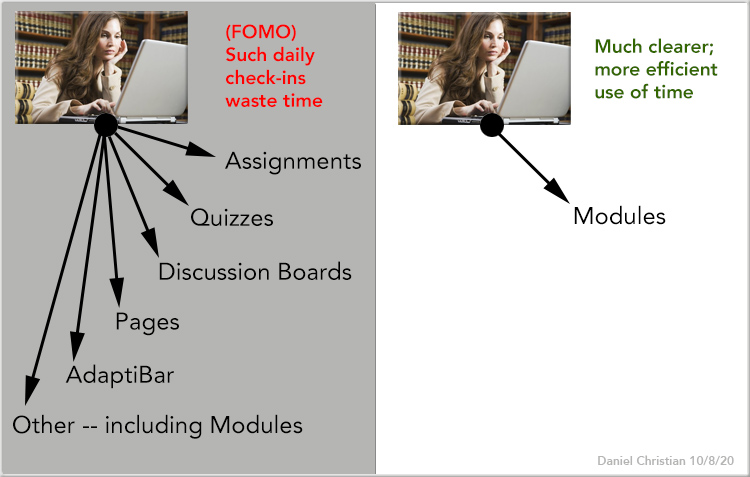
Put yourself in the place of the conscientious/thorough learner. If you come into a course on Canvas & see Quizzes, Assignments, Discussion Boards, as well as other items listed on the Course Navigation Bar — in addition to the Modules selection — you might find yourself going to check many of those selections Every. Single. Day.

Graphically speaking:

Let's stop the FOMO and make it easy to find the content and the to-do's

(DSC purchased this image from Getty Images)

From DSC:
By the way, this is why RSS feeds and feed aggregators were implemented. Have updates/content flow to the person, instead of the person wasting time trying to find what’s been updated on 100+ websites.


Per Dr. Honeycutt, also see:


Radar trends to watch: October 2020 — from oreilly.com

Excerpt:

This month, the big surprise is that there’s no significant technology news about COVID. And there is more news than ever about legislation and regulation. I suspect that the legal system will be a big driver for technology over the next year. Another trend that doesn’t quite count as technology news but that definitely bears watching is that college enrollment in the US is down. Grad schools are up, 4 year colleges are down slightly; the big hit is in 2 year colleges. COVID is probably the biggest contributing factor, but regardless of the cause, this is an inauspicious trend.


3 winners for the GSV Cup: Abwaab, Prepmedians, and Ringbeller! Congratulations!! These three exceptional companies won out of over 550 applications.

First Place Winner – Watch the pitch below from Abwaab

Second Place Winner – Watch the pitch below from Prepmedians

Third Place Winner – Watch the pitch below from Ringbeller


From DSC:
Along these lines…

Sometimes, I think we need to be very careful with Artificial Intelligence (#AI) — which elements of it and which applications of it that we use in our society and which we don’t move forward with. But in the case of cloud-based learning profiles (some might say competency profiles), AI makes sense. Algorithms could make sense. Data mining could make sense.

A cloud-based learning profile might not make sense always to us — as it could be very large indeed. But AI-based algorithms could assist with finding appropriate matches between jobs, competencies, passions, skills, and candidates.

Such services will likely be part of a next-gen learning platform.


Livestreamed Chemistry Labs Keep Learning Real — Mistakes, Spills and All — from campustechnology.com by Dian Schaffhauser

Excerpt:

To keep students engaged, the synchronous sessions include small-group breakout sessions and on-the-spot activities like having students name compounds; balance chemical equations; predict the outcomes of experiments; and calculate masses, amounts and concentrations for the chemicals used.


Civil Justice for All — from amacad.org

Excerpts:

This report calls for the legal profession, the courts, law schools, tech professionals, and partners from many other fields and disciplines to coordinate their efforts to provide necessary legal assistance to many more people in need. Past efforts to improve access to justice offer strong evidence that such an effort would have a profound effect on American society—measured in financial savings, greater trust in law and social institutions, and the safety and security of families and communities.

THE PROJECT’S SEVEN RECOMMENDATIONS ARE:

First, and above all, dedicate a consequential infusion of financial and human resources to closing the civil justice gap, and seek a significant shift in mindset—extending beyond lawyers the duty and capacity to assist those with legal need—to make genuine strides toward “justice for all”;

Second, increase the number of legal services lawyers who focus on the needs of low-income Americans;

Third, increase the number of lawyers providing pro bono and other volunteer assistance, to supplement the corps of legal services lawyers;

Fourth, bring many new advocates—service providers who are not lawyers—into the effort to solve civil justice problems;

Fifth, foster greater collaboration among legal services providers and other trusted professionals—such as doctors, nurses, and social workers;

Sixth, expand efforts to make legal systems easier to understand and use through the simplification of language, forms, and procedures and the wider use of technology; and

Seventh, create a national team, or even a new national organization, to coordinate the efforts listed above, collect much-needed data on the state of civil justice, and help identify and publicize effective innovations that improve access.


[Re: online-based learning] The Ford Model T from 1910 didn’t start out looking like a Maserati Gran Turismo from 2021! [Christian]

From DSC:
Per Wikipedia, this is a 1910 Model T that was photographed in Salt Lake City:

The Ford Model T didn't start out looking like a Maserati from 2021!


This is what online/virtual learning looks like further down the road. Our journey has just begun.

From DSC:
The Ford Model T didn’t start out looking like a Maserati Gran Turismo from 2021! Inventions take time to develop…to be improved…for new and further innovations and experiments to take place.

Thinking of this in terms of online-based learning, please don’t think we’ve reached the end of the road for online-based learning. 

The truth is, we’ve barely begun our journey.


Two last thoughts here


1 ) It took *teams* of people to get us to the point of producing a Maserati like this. It will take *teams* of people to produce the Maserati of online-based learning.

2) In terms of online-based learning, it’s hard to say how close to the Maserati that we have come because I/we don’t know how far things will go. But this I do know: We have come a looooonnnnnggggg ways from the late 1990s! If that’s what happened in the last 20 years — with many denying the value of online-based learning — what might the next 5, 10, or 20 years look like when further interest, needs, investments, etc. are added? Then add to all of that the momentum from emerging technologies like 5G, Augmented Reality, Mixed Reality, Virtual Reality, Artificial Intelligence, bots, algorithms, and more!


From DSC:
To drive the point home, here’s an addendum on late 9/29/20:

Mercedes-Benz Shares Video of Avatar Electric Car Prototype


From DSC: What if each learner/ person/ student could have a lifelong, cloud-based “tribute” site? [Christian]


From DSC: What if each learner/person/student could have a lifelong, cloud-based “tribute” site?

What if you could hire a career coach to sift through the tributes to find common themes?


From DSC:
I recently asked friends and family to help me celebrate a significant birthday for my wife by creating a tribute for her — using a service called Tribute.co. It was a fun, meaningful, relational experience — it opened the doors to some great communications.

Check out tribute.co -- what if each learner could have a lifelong, cloud-based tribute?

Here’s a video that describes what a Tribute is (from the company of that same name).

So I put out potential suggestions for what I hoped that we could relay to my wife, and people contributed their videos. Then a person at Tribute edited the videos to come up with a highlight reel. They also presented to my wife all of the videos, not just the highlight reel.

That got me to wonder, “What if each learner had a cloud-based, lifelong tribute site that parents, guardians, grandparents, teachers, coaches, musical directors, pastors, friends, and others could leave encouraging and instructive messages on? Or when they note something that might be of use later on in terms of career selection, they could “jot it down.” For example:

  • [First-grade teacher] “I noticed Anne that when we did the art projects, you were enthralled with any sort of creative endeavor or project. We almost lost you in another world!”
  • [Family member] “Tony, I’ve noticed ____. Here’s something to consider for your future pathways. Would you be interested in exploring _____ — such as if we signed you up for some lessons in that area?”
  • [Eight grade teacher] “Eloise, I saw that your engagement level skyrocket when we studied ____, especially when you did the project on ___.”
  • [Basketball coach] “Chan, I appreciated your hard work in practice today. Keep up the good work and you will be a super player! You are fast, strong, and seem to have a competitive spirit about you. Consider making a workout chart and charting out the workouts that you do each day. Monitor your progress over time. As of today, here are some apps to do just that: ___.
  • [Pastor] “So glad Amanda that you were able to join us on our youth group visit to ___. I appreciated your end-of-the-day reflections on the experiences of the day. I also appreciated your hard work helping others.”
  • [Friend] “It was great horsing around on Garageband with you today Zach. I look forward to diving into iMovie next with you. Let’s create a movie for each other. You seem to have a very creative side to you.”
  • [High school CS Teacher] “Keep up the good work programming Jeremy! I hope that you will consider going into some type of job that uses critical thinking, mathematics, problem-solving — perhaps it will be programming, perhaps it will be engineering, or something else.”
  • [College professor/advisor] “You mentioned that you hate college to me the last two times we met. You don’t seem happy studying ___. Have you considered ____?”
  • [Tennis coach] Remember to bend those knees…get low. Keep your eyes on the seams of the ball.”

The idea behind such a service would be to offer encouragement, feedback, (if carefully put) constructive criticism, a message that “I’m on your team”…and/or…”Here’s what I see in you.”


Additional functionality/options


  • Contributors:
    • Like Twitter imposes a limit on characters, there could be options to impose a time limit on the length of a video, ability to add more than one video, and/or set a limit on how many videos someone can upload
    • If submitting a written piece, the option would be there to limit the number of characters and/or the word count.
  • From learners themselves (to their own tribute)
    • No time limit, no word count or character limit
    • Would act like a multimedia-based diary/journal of learning
    • Option to select whether might be worth re-listening to for career selection purposes.
 
© 2025 | Daniel Christian