Per Robin Good:

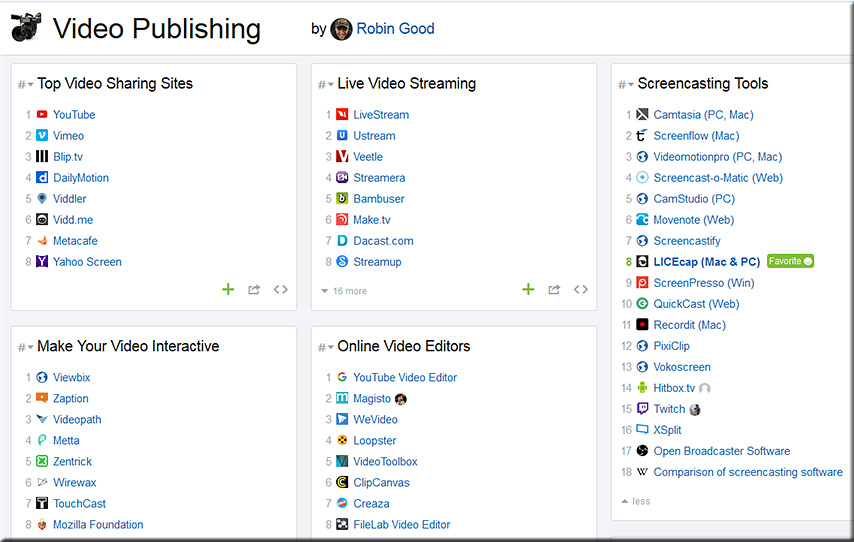
This is my own personal directory of the best tools and services to capture, edit, publish and distribute video online that I recommend.

Also, Robin lists some solid screencasting tools.


VideoPublishing-ScreencastingTools-Good-Dec2015


From DSC:
I especially appreciate the tools that help us add more interactivity to our videos.


Turning course materials into a digital magazine — from campustechnology.com by David Raths
Instructors are experimenting with the Flipboard news reader to present up-to-date course materials in a magazine-format mobile app.

Excerpt:

She started by asking students to pay money out of their pockets for the magazine subscriptions — which tended to be unpopular with students. Then she migrated to free e-zines, but students complained about the material clogging their e-mail inboxes. “They hated that, too,” she said. “I happened upon Flipboard and I haven’t had any complaints. They love Flipboard, and it is really helpful to me where textbooks lag,” she said, “especially in social entrepreneurship and social media. I use Flipboard to curate on these topics that I don’t have access to in textbooks.”


How Microsoft’s HoloLens may change everything for industrial & mechanical designers — from fastcompany.com by Daniel Terdiman
By integrating Microsoft’s “mixed reality” system and Autodesk’s Fusion 360 design software, designers can see 3-D holograms of their work.

Excerpt:

Soon, product designers will be able to get up close and personal with their creations while they’re still planning them. Rather than just look at digital models on their computer screens, they could walk around a 3-D hologram of the design.


The hot products for holiday 2015: IBM Watson launches new app that can predict trends — from by Kimberly Whitler

Excerpt:

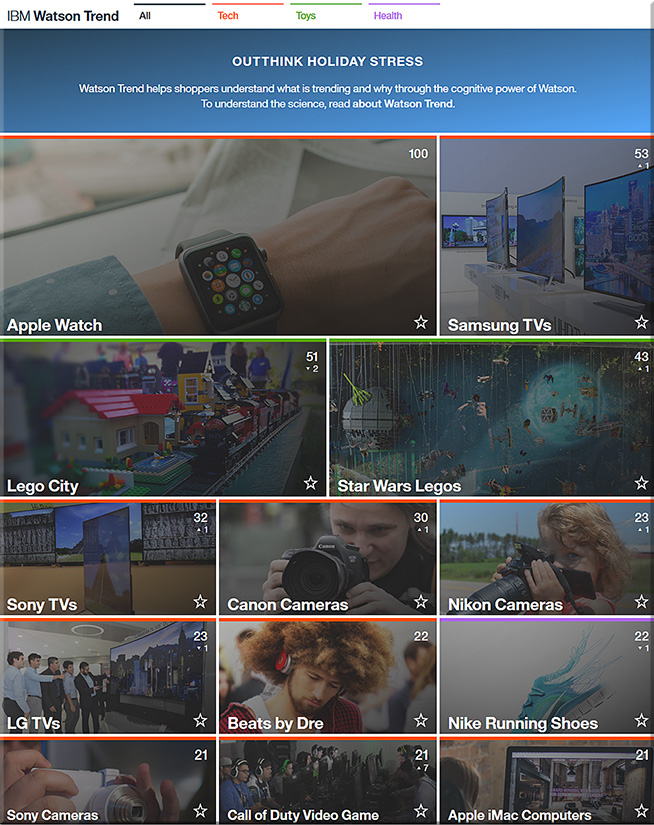
The holiday season—that favorite time of year for retailers and shoppers alike—is just around the corner.  And this year, IBM Watson is launching an app that provides shoppers with the ability to understand the top trends of the season and to predict which products are likely to sell out.

Distilling the sentiment of millions of online conversations across the internet (including social media sites, blogs, forums, ratings, reviews, etc.), the new Watson app (to download the free app, click here) goes beyond providing a static ranking of popular products to provide insight on how consumers feel about the products.


Also see:


IBMWatsonTrend-Nov2015


Addendum om 11/30/15:


UCLA computer science class integrates virtual world into reality — from dailybruin.com by Nate Nickolai

Excerpt:

Ford, a lecturer in the computer science department, aims to develop gaming as a subfield of graphics at UCLA through her courses on virtual reality and artificial intelligence. This quarter, Ford’s virtual reality class, “Advanced Game Development for Virtual Reality,” is using gesture-tracking to create its own virtual reality games, following in the footsteps of her spring class, “Virtual Reality Game Development.”

Ford’s spring class produced several pre-patterns in virtual reality programming and presented games at the Special Interest Group on Computer Graphics and Interactive Techniques, or SIGGRAPH, an annual international graphics conference held by the Association of Computing Machinery in August.

Using Oculus Rift headsets, Ford said her spring virtual reality class used Unreal Engine 4, a collection of game development tools, to produce three-dimensional worlds within which the students created original games with coding.


Here’s another practical application of IBM Watson technology in healthcare: Boston Children’s Hospital is going to tap the supercomputing platform to improve diagnosis and treatment of rare diseases.

Researchers at the Harvard-affiliated hospital’s Manton Center for Orphan Disease Research will train Watson in nephrology by reading medical literature and scanning data on mutations for a kidney disease known as steroid-resistant nephrotic syndrome. They will then give Watson retrospective genomic data from patients in an effort to teach the computer to assist physicians in interpreting genome sequences as they look for abnormalities.


Wearables will see mass adoption via educated patients and digital health stores — from medcitynews.com by Shahid Shah

Excerpt:

In a fees-for-services (volume-driven) world, selling healthcare products and services to individual institutions is certainly time-consuming but reasonably straightforward. In an outcomes-driven (fees for value) world driven by shared risks and shared rewards, selling healthcare solutions across multiple disciplines, multiple stakeholders, and multiple institutions is much harder and even more time-consuming. That’s because there’s no easy buyer to identify. Population health is all the rage but our current $3 trillion + healthcare industry was never devised nor incentivized to work together as a team for long-term patient or population benefits (it’s reimbursed mainly for episodic care).

Our country’s healthcare industry is more about sick care and episodic transactions rather than longitudinal care. But, since we are moving to population and outcomes driven care where the patient is more responsible for their own care management and payment, it would seem patient education and digital health tools are more important than ever. So, perhaps we need to get together and innovate around how we’re going to present next-generation solutions from across multiple innovators and showcase them to patients and their caregivers.


Watch users claim Apple wearable improves health — from fiercemobilehealthcare.com by Judy Mottl

Excerpt:

Nearly two-thirds of Apple Watch users are exercising more often and for longer periods of time, and 72 percent claim the wearable is improving their health and fitness levels, according to a new report.


IBM forms new health data analytics unit, extends Apple partnership— from zdnet.com by Charlie Osborne
With the help of Apple, acquisitions and new partnerships, Big Blue plans to tap into the vast amount of data offered by health-tracking devices.


After medical school, IBM’s Watson gets ready for Apple health apps — from zdnet.com by David Shamah
The Watson Health Cloud – set to become an important component of Apple’s health platform – is targeting medical care, IBM says.

Excerpt:

“Watson went to medical school, and now it’s set to graduate,” said Dr Aya Soffer, director of big data and cognitive analytics at the Israel facility. “We’ve had it study the medical literature, and now it’s ready to apply its natural language processing skills to real-life applications.”

Just in time, too. Last week, IBM announced the launch of Watson Health Cloud to “provide a secure and open platform for physicians, researchers, insurers, and companies focused on health and wellness solutions”.

The platform will be used by health companies Johnson and Johnson and Medtronic, as well as by Apple. The Mac maker has its own platform and hopes to become a top health company itself. It has established a new business unit, called Watson Health Cloud, to administer the big data apps that will use Watson’s intelligent analysis and understanding of medical data.


Addendum on 11/13/15:

  • NYU Medical Students Learning How to Analyze Big Data — from imedicalapps.com by Brian Wu
    Excerpt:
    Big data is changing the way information is shared in the medical field. Current technologies such as IBM’s Watson are working to merge data from multiple sources to make it easier to access as well as share. Even ten years ago most doctors would not have known anything about big data, and it was definitely not taught in medical school. Today big data is becoming a crucial part of the healthcare field including the diagnosis and treatment of patients. It is important that doctors not only understand the importance of data but know how to properly access and interpret the data. The NYU School of Medicine requires that its first and second-year students complete a health care by the numbers project. Students are given access to a giant database with more than 5 million anonymous records, which includes information on every hospital patient in the state for the preceding two years.
 

Going 3-D in the classroom — from kqed.org by Derek Lartaud

Excerpt:

It’s a 3-D world, so why not let students create and learn in 3-D? In so many disciplines — architecture, computer science, entertainment, engineering — it’s becoming increasingly useful to problem-solve and be creative in three dimensions. With 360 degree video, Google Earth’s 3-D maps, Oculus Rift’s virtual reality headset, and Google’s soon-to-be-released 3-D mapping phone, students, too, will be more immersed in 3-D technology than ever before. Luckily, there are some great tools out there to create 3-D projects in the classroom.


WordPress now powers 25% of the Web — from by Emil Protalinski

Excerpt:

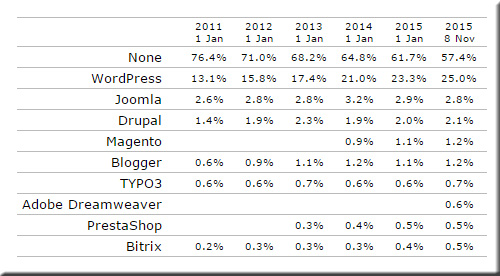
One in four websites is now powered by WordPress.

Today is a big day for the free and open-source content management system (CMS). To be perfectly clear, the milestone figure doesn’t represent a fraction of all websites that have a CMS: WordPress now powers 25 percent of the Web.


WordPress-25Percent


The Epic BYOD Toolchest (51 Tools You Can Use Now) — from edutopia.org by Vicki Davis

Excerpt:

You’ve got every device under the sun in front of you. Now what apps are you going to use? Here are the apps or app categories that I recommend you test for your school. There are lots of apps, and these are just my opinion based on what I’ve used with my students or successfully tested.
…
Screencasting and Capturing What Happens in Class
If you’re going to share and interact with your students in the electronic and physical spaces (as you should), you must learn how to screencast.

  • Screencastomatic: This is my go-to app. It’s free, but I pay a few dollars for the pro service because I love it, it gives advanced editing features, and I can download to Dropbox. You can see that my YouTube tutorials are recorded with this.
  • Camtasia: This app is high quality, and the price shows it. But I highly recommend Camtasia if you can afford it.
  • Explain Everything: This app, available from iTunes and Google Play, remains a top tablet app in the U.S. It’s perfect for math screencasting.
  • Swivl: It’s a robotic stand for your iPad, iPhone, or Droid. When you use the iOS app, Swivl will film and capture everything. It can also follow you without an app, so you could set another device on record and then just put it in the stand. Swivl lets you record speeches, or helps you evaluate your own teaching. Having a Swivl in your classroom changes everything. You just put the controller in your pocket or around your neck, and it follows and records you (mic in controller). I’ve been demoing this for two weeks and can focus on teaching rather than recording.


Helping Students with Visual Impairments: Resources, Tools and Technology to Foster School Success — from accreditedschoolsonline.org; via Angela Hanners

Excerpt:

Addressing each need of students with visual impairments and improving overall accessibility are vital to their academic success. This guide explains how colleges are creating more welcoming and inclusive learning environments, with a sharp focus on assistive technology, campus resources that provide assistive services and tools, information about scholarships for students with visual impairments, and online resources they can access to facilitate academic and career success.


Per Angela Hanners:
The guide was created in part by four experts in the field, who lent their experience and expertise to help us provide students with visual impairments the tips and resources needed to succeed in school. Key updates to our guide include:

  • An extended list of tips for choosing the right college
  • An in-depth look at the top assistive technology and tools being used today
  • Additional scholarships available for students with visual impairments


Everything You Need To Know From Microsoft’s Massive Hardware Event — from techcrunch.com by Alex Wilhelm

Excerpt:

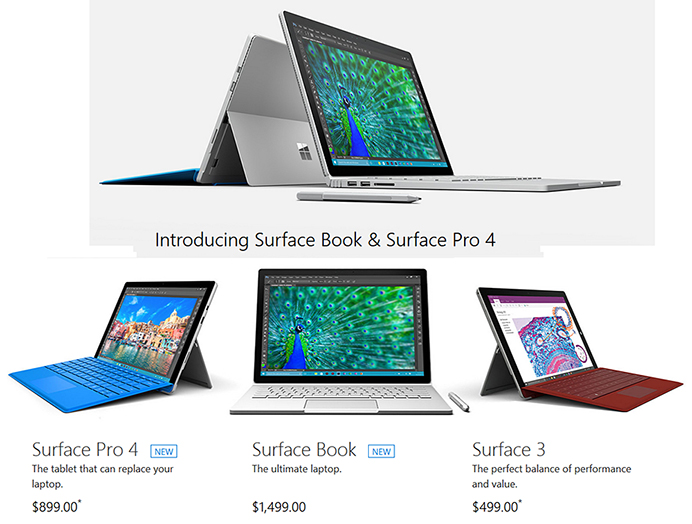
Microsoft [on 10/6/15] announced a grip of new hardware, including Surface products, high-end smartphones, a wearable, Windows 10 for the Xbox One and its first laptop.

The laptop, called the Surface Book, stunned in an event marked largely by products Microsoft watchers were expecting.


Introducing Surface Book & Surface Pro 4 — from microsoft.com


SurfacePro-MS-10-6-2015


Microsoft’s HoloLens Developer Edition Gets Date and Price — from vrfocus.com by Jamie Feltham

Excerpt:

Speaking at a Windows 10 briefing [on10/6/15] the company confirmed that applications for a HoloLens development kit are now open. Successful applicants will be able to pick up a kit for some $3,000 USD, and it will be arriving in the first quarter of 2016.

.


First HoloLens Prototypes Showcased — from vrfocus.com by Jamie Feltham

Excerpt:

Microsoft’s HoloLens mixed reality (MR) head-mounted display (HMD) is still a relatively new concept, having only been revealed to the public in January 2015. The device has remained shrouded in mystery since that time, making a handful of showings at events such as E3. The company has revealed a lot more about the kit [on 10/6/15], though, confirming that the anticipated Development Edition will be arriving in Q1 2016 for applicants in the USA and Canada at a price of $3,000 USD. Now a new video has been revealed giving a glimpse at the kit’s origins.


The new Microsoft Band offers Cortana integration, VO2 monitoring and Golf cards — from digitaltrends.com by David Curry

Excerpt:

Microsoft announced the second generation of the Microsoft Band at its event [on 10/6/15], a small update adding a new, more functional design and two sensors to track elevation and VO2 monitoring.


Addendum on 10/9/15:


Campus Technology 2015 Readers’ Choice Awards

CampusTechReadersChoiceAwardsSept2015

Excerpt:

In this first-ever higher education “gear of the year” guide, Campus Technology has turned to hundreds of education professionals to tell us which products in 29 categories are truly the best. We cover the gamut of technology from 3D printers to wireless access points. In almost every category you’ll find the Platinum, Gold and Silver picks to help you short-list your shopping, fuel your decision-making or perhaps start a friendly debate on campus.

  1. Learning Management and E-learning
  2. E-Portfolios
  3. Other Instructional Tools
  4. Student Information Systems and Data Management
  5. Enterprise Resource Planning (ERP)
  6. Constituent Relationship Management (CRM)
  7. Student Success/Retention
  8. Student Response Systems and Classroom Clickers
  9. Lecture Capture
  10. Document Cameras
  11. Projectors
  12. Interactive Whiteboards
  13. Videoconferencing and Web Conferencing
  14. Virtual Classroom and Meeting
  15. Classroom Audio Distribution/Sound Enhancement
  16. Captioning
  17. Office/Productivity Suites
  18. Classroom Presentation
  19. Multimedia Authoring Suites and Creative Software
  20. E-Learning Authoring
  21. Media Tablets
  22. Chromebook
  23. Windows Tablet
  24. Convertible and 2-in-1 Notebooks
  25. Notebooks
  26. Virtual Desktops and Thin Clients
  27. Wireless Access Points and Hotspots
  28. 3D Printers
  29. Emergency Notifications


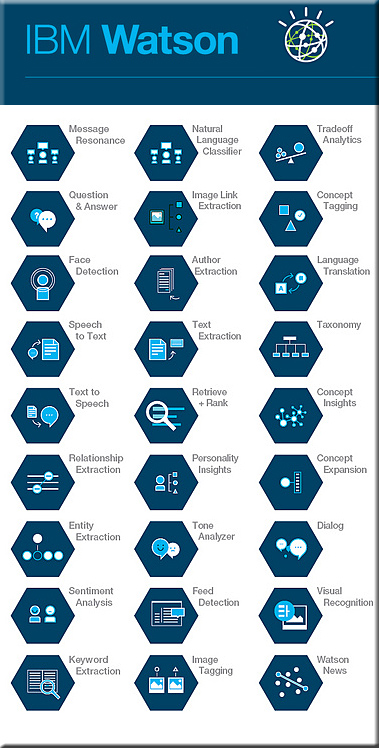
IBM Expands Watson Platform for Next Generation of Builders; Extends Industry’s Largest Portfolio of Cognitive APIs — from ibm.com

– New APIs Broaden Watson’s Language, Vision and Speech Capabilities
– Developer Tools Simplify Combining APIs and Data
– Upcoming Platform Innovations Previewed including Industry Data Sets & Robotics Integration
– New Watson Hub to Open in San Francisco

Excerpt:

SAN FRANCISCO – 24 Sep 2015: IBM (NYSE: IBM) today expanded the industry’s largest and most diverse set of cognitive APIs, technologies and tools for developers who are creating products, services and applications embedded with Watson.

The announcement was made by IBM during its forum on cognitive computing and Artificial Intelligence, where the company announced a new Watson location in San Francisco. IBM also previewed new platform innovations and research projects that will extend its industry-leading cognitive portfolio.


Excerpts from IBM Watson Ecosystem Partners in Market Building Businesses:

Student Career Counseling: Carney Labs is an education technology company that provides a platform embedded with Watson language capabilities to help schools learn about a student’s personality characteristics in order to build them a career roadmap. The Commonwealth of Virginia adopted a policy for all high schools in the state to leverage this app to use with students entering their freshman year.

Knowledge Management: Bloomfire  is a cloud-based knowledge network platform that helps employees within a company easily find the information they need to do their jobs. By scanning posts within the platform and automatically creating tags via the Watson data insights API, employees at companies including Whole Foods, Dun & Bradstreet and Etsy spend less time searching for information and more time doing meaningful work to improve company performance.

Research & Development: Inno360, an enterprise research and innovation management platform provider, is embedding a powerful combination of 7 Watson APIs for language and data insights into its SaaS platform to transform the way its clients, including Fortune 50 companies, conduct research and process big data. Inno360 is able to provide its clients advanced analysis of their R&D data to resolve product issues quickly and bring new products to market more rapidly.

Talent Sourcing and Matching: UnitesUs is a cloud based hiring & recruitment platform utilizing cognitive computing and big data analysis to match prospective employees to hiring organizations based on personality, company cultural fit, and core qualifications. By analyzing the personalities of job candidates leveraging Watson language capabilities and characterizing a company’s work environment, UnitesUs uses proprietary, automated matching algorithms to help companies, including imaging and electronics company Ricoh USA and fitness gym chain 24 Hour Fitness, make better hiring decisions.


ibmwatson-sept2015


Microsoft Office 2016 launches Tuesday — from fortune.com by  Barb Darrow
No surprises here: New Office adds real-time co-authoring for Word documents, Skype for Business, and other perks to mix.

Excerpt:

As expected, Microsoft is pushing out the latest version of its cash-cow Office application suite on Tuesday.

Office 2016, the base components of which are Word, Excel, and PowerPoint, now lets team members work together on Word documents in real time. It will add that capability to the other Office apps over time according to a blog post by Kirk Konigsburger, the corporate vice president for Office Client Applications and Services.
…
Microsoft also added Skype for Business to the mix so users can, from within their Word documents, talk or video chat with colleagues, partners or customers.
…
And Microsoft also made available a private preview of GigJam, a tool that promises to let workgroups collaborate across devices and applications, which Microsoft will add that to the Office 365 mix next year.


© 2025 | Daniel Christian